

A passing score on the California Bar Exam isn't awarded to the student who knows the most law. It's earned by the applicant who demonstrates superior architectural precision under pressure. While many candidates walk into the February or July 2026 sessions with encyclopedic knowledge, they often crumble when faced with the strict 60-minute time limit or complex crossover issues. To secure your path to the 1390 scaled score, you need more than just memorization. You need advanced california bar exam essay strategies that prioritize structure and fact-mining over generic legal summaries.
We understand the anxiety of staring at a dense fact pattern while the clock ticks away. It's exhausting to feel like you're providing shallow analysis that fails to use all the facts provided. This guide changes that by introducing the JW Bar Method's tactical framework for the 2026 exam cycle. You'll gain a repeatable structural template for any subject, learn to spot hidden issues with total confidence, and master the fact-mining techniques required to turn standard essays into high-scoring model responses. We'll break down the exact mechanics of the 2026 framework so you can walk into the exam room feeling empowered and prepared.
Key Takeaways
- Move beyond basic IRAC by adopting a persuasive structural hierarchy that commands the grader’s attention within the first 30 seconds.
- Learn the five-minute "triage" technique to effectively categorize major issues and avoid the time-wasting trap of red herrings.
- Implement advanced california bar exam essay strategies to map every prompt detail to specific legal rules through high-speed fact-mining.
- Follow a minute-by-minute breakdown of the one-hour essay block to ensure you maintain a consistent pace without missing crossover issues.
- Adopt a modern, results-driven methodology that replaces legacy study models with a framework backed by a binary performance guarantee.
Beyond Basic IRAC: Why Standard Essay Prep Fails in 2026
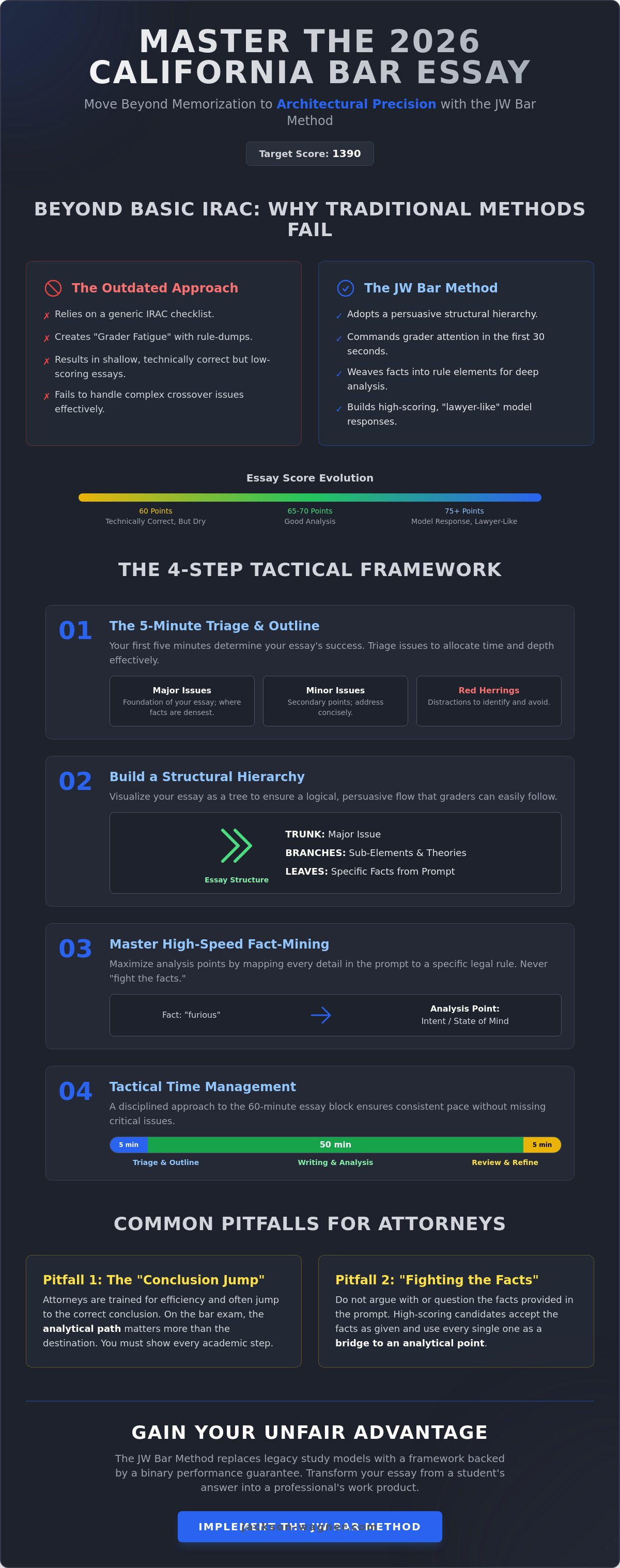
Standard bar prep usually presents IRAC as a magic bullet. It isn't. In the high-stakes environment of the 2026 exam, relying on a basic checklist is a recipe for a mediocre score. Truly advanced california bar exam essay strategies require a shift from simple rule-stating to a persuasive structural hierarchy. Graders are human. They suffer from intense "Grader Fatigue" after reading hundreds of nearly identical responses. Your first 30 seconds determine your score range. If you lead with a generic rule-dump, you've already signaled that you're a baseline candidate. Instead, you must use "Issue-Clustering" to show you understand how legal concepts interact, proving you can handle the deep nuance expected in 2026.
The Evolution of California Bar Essay Grading
The State Bar of California has moved away from rewarding rote memorization. They want to see how you think. A 60-point essay is technically correct but dry; it lacks the analytical depth needed to stand out. A 75-point "model" response shows mastery of the "lawyer-like reasoning" standard by weaving facts into rule elements seamlessly. This creates a narrative flow that makes your analysis feel inevitable rather than forced. Advanced Essay Architecture is a tool for cognitive ease for the grader.
Common Pitfalls of High-Achieving Attorneys
Licensed attorneys often struggle because they are too practical. They jump to the conclusion because they do it every day in practice. On the bar, the path matters more than the destination. You can't skip academic steps just because the answer seems obvious. Another major mistake is the urge to "fight the facts." If a prompt says a character was "furious," don't argue that they were actually calm. Use that adjective as a bridge to a point. High-scoring candidates don't question the prompt; they mine it for every possible point opportunity. Using advanced california bar exam essay strategies means accepting the facts as they are and applying the law with clinical precision.
By moving beyond the "checklist" mentality, you transform your writing from a student's answer into a professional's work product. This architectural shift is what separates those who barely pass from those who dominate the written portion of the exam. You aren't just proving you know the law. You're proving you can use it as a tool for advocacy.
Strategic Issue-Spotting: The Structural Hierarchy Method
Issue-spotting is where most candidates lose the game before they've even typed a word. You can't treat every issue with equal weight. The "Triage" approach is essential for success in 2026. You need to distinguish between Major issues, Minor issues, and Red Herrings. If you spend twenty minutes on a minor jurisdictional point while glossing over core negligence elements, you've failed the architectural test. High-scoring responses utilize advanced california bar exam essay strategies to prioritize depth where the facts are densest.
Visualize the essay as a tree. The trunk is your Major Issue; it's the foundation that holds the entire analysis together. The branches are the sub-elements or related legal theories. The leaves are the specific facts provided in the prompt. If your tree has no leaves, your analysis is shallow. If it has no trunk, it collapses. Crossover essays are the ultimate test of this hierarchy. When you see a Contracts prompt that suddenly pivots into Evidence or Professional Responsibility, your structure must remain rigid. You aren't just spotting issues. You're building a logical sequence that leads the grader to an inevitable conclusion.
The 5-Minute Master Outline
Efficiency is the byproduct of structure. Spend your first five minutes analyzing the Call of the Question. This is your anchor. Use it to build the primary headers of your response immediately. Once the anchors are set, scaffold your sub-issues. Don't write full sentences yet. Instead, look at past California Bar Exam questions to see how the highest-scoring responses allocate "Time-Value." If an issue has five supporting facts, it deserves more time than an issue with only one. This ensures you aren't wasting precious minutes on low-value points.
Clustering Related Legal Theories
A sophisticated response doesn't just list defenses. It clusters them. Grouping related theories shows the grader you understand the broader legal landscape. For complex multi-element rules like Homicide or Negligence, use "Nested IRAC." This ensures every sub-element receives its own mini-analysis without breaking the narrative flow. Implementing these advanced california bar exam essay strategies ensures your response isn't just a list of rules but a cohesive legal argument. If you want to master this level of tactical precision, exploring the JW Bar Method Prep can provide the edge you need to dominate the written portion of the exam.
Transitions are your best friend during this process. They should feel like a natural progression, not a jarring jump. Your goal is to create a narrative that makes the grader's job easy. When you provide cognitive ease, you provide a compelling reason to award a higher score. You're no longer just a student. You're a competent practitioner demonstrating total control over the material.
Fact-Mining: Maximizing Analysis Points in Every Paragraph
Every word in a California Bar exam fact pattern is there for a reason. High-scoring candidates don't just read the prompt; they mine it. The "No Fact Left Behind" rule is the cornerstone of advanced california bar exam essay strategies. If the prompt mentions a "rusty" gate or a "dimly lit" hallway, those adjectives aren't descriptive filler. They are specific point-earners designed to trigger a particular legal analysis. By using Fact-to-Rule Mapping, you mechanically pair every adjective or adverb in the prompt with a specific element of the law. This ensures you never miss a nuance that a grader is specifically looking for in the 2026 cycle.
Counter-arguments are necessary for depth, but they can be dangerous time-sinks if handled poorly. Only include them when a fact is truly ambiguous or when the prompt explicitly hints at a dispute. When you do, shut them down quickly. State the opposing view, apply the facts, and then explain why that view fails. This keeps your analysis moving forward without losing points on structure or timing. This mechanical precision is what turns a standard response into a model answer that commands the 75-point range.
The Mechanics of High-Velocity Analysis
Fact-Mining is the process of extracting legal significance from every detail. To do this efficiently, you must use mirroring language. If the rule requires "outrageous conduct" and the prompt describes a "vicious, unprovoked verbal assault," your analysis must explicitly link those two phrases. Don't paraphrase the facts into your own words; use the examiner's words against them. Neutral facts present a different opportunity. Don't ignore them. Instead, turn ambiguity into a strength by presenting an "on the one hand... on the other" discussion. Implementing these advanced california bar exam essay strategies transforms your writing from a simple summary into a high-velocity analytical engine.
Avoiding the 'Conclusory' Trap
The most common reason for a low score is a conclusory answer. This happens when there's a "Why" Gap in your writing. You've made the connection in your head, but you didn't put it on the page. You assumed the grader knows what you're thinking. To fix this, use the "Because" Test. Every analytical sentence should be able to withstand the question "Why?" by pointing back to a specific fact. Use the "This suggests that..." bridge to connect the law to the fact. For example, "The defendant's three-second pause suggests that he had sufficient time for premeditation." This bridges the gap between the evidence and the legal conclusion. Even when a conclusion seems obvious, maintain a professional, neutral tone. You aren't just giving an answer; you're proving why it's the only logical outcome based on the provided facts.
Tactical Time Management for the California Attorney’s Exam
For practicing attorneys, the challenge of the California Bar isn't a lack of legal knowledge. It's the transition from the nuanced, deliberate pace of law practice to the frantic, sixty-minute sprint of an academic essay. You don't have ten weeks to spend in a library. You have a practice to run and a career that demands your attention. Mastering advanced california bar exam essay strategies for the 2026 cycle means unlearning the habit of deep, exhaustive research and embracing a high-speed tactical framework. You must prioritize issue breadth over rule depth. A grader doesn't need a law review article; they need to see that you spotted the issue and applied the facts with clinical precision.
Success on the one-day exam requires a rigid sixty-minute countdown. Spend the first fifteen minutes on analysis and scaffolding. Use your professional intuition to identify the "trunk" of the issue tree quickly. From minutes fifteen to fifty-five, execute your drafting using the fact-mining techniques discussed earlier. The final five minutes are for the "Safety Net" check. Ensure you haven't missed a subtle crossover or a professional responsibility violation. Managing the mental reset between Essay 1 and Essay 5 is vital. Treat each prompt as a new client file. Close the previous one completely before opening the next.
The Accelerated Prep Timeline
Practicing lawyers require efficiency. You can't afford to waste time on low-probability subjects. Focus your energy on high-frequency topics like Professional Responsibility, Torts, and Contracts. If you're working with a limited window, you can utilize JW Bar Method Accelerated Prep to master the specific structural markers graders look for without the fluff of legacy programs. For unexpected subjects, employ a "Minimum Viable Answer" strategy. State a plausible rule, mine the facts, and move on. Your goal is a consistent 65, not a perfect 100 on one essay and a 40 on another because you ran out of time.
Stress Management and Professional Stamina
The "Bold Reliability" mindset is your greatest asset. Approach the exam as a professional hurdle, not an academic threat. You've already proven you can practice law; this is simply a matter of demonstrating that competence within the State Bar's specific parameters. Pacing is as much physical as it is mental. Ensure you understand the California Attorney's Exam Requirements: The 2026 Guide to Licensure so there are no logistical surprises on game day. If you want to ensure your preparation matches your professional standards, secure your spot in our Accelerated Prep program today and let us assume the risk of your performance.
Don't let the pressure of the clock force you into shallow analysis. By using a structured, minute-by-minute plan, you maintain control over the exam rather than letting the exam control you. You're a professional. Act like one on the page by delivering a structured, authoritative, and fact-heavy response every single time.
Implementing the JW Bar Method for Essay Mastery
Precision is the only metric that matters in the 2026 exam cycle. While legacy programs bury you in thousands of pages of "just in case" law, the JW Bar Method focuses on the architectural precision required to win. We don't believe in the volume-heavy approach that leaves students exhausted and unable to execute. Instead, we teach you to use advanced california bar exam essay strategies to build a response that is lean, authoritative, and impossible for a grader to ignore. Our philosophy is simple: master the structure, mine the facts, and secure the points.
We are so confident in this disruptive approach that we offer a binary performance guarantee. We assume the financial risk of your success because our methodology is built on pedagogical certainty. This isn't just about reading outlines; it's about a structured, modern path to professional empowerment. You aren't just another student in a crowded lecture hall. You're a candidate for licensure who deserves a reliable, results-driven framework that treats your time as a finite, valuable resource.
The JW Bar Method Advantage
Our programs are designed to strip away the fluff associated with traditional "big bar" prep. By focusing on tactical precision, we ensure you spend your time on the high-value activities that actually move the needle on your score. The JW Bar Method Prep - Full Exam California Bar program is specifically engineered for the 2026 standards, integrating the architectural methods you've learned today into a comprehensive study schedule. It's built for the modern professional who requires flexibility without sacrificing the rigor needed to pass the nation's toughest exam. We replace generic checklists with a sophisticated, pedagogical approach that mirrors the transition from a student's initial interest to their actual study process.
Your Path to Licensure Starts Here
The transition from "studying" to "training" is where the pass/fail line is drawn. You wouldn't prepare for a trial by just reading the rules of evidence; you'd practice your cross-examination until it's second nature. We treat bar prep the same way. Through high-stakes drills and precision feedback, we transform your legal knowledge into a weapon. You've already done the hard part by finishing law school or practicing in another state. Now, it's time to master the game. For a deeper dive into the specifics of the upcoming cycle, read our Passing the California Bar Exam in 2026: The Definitive Strategic Guide. Don't just study for the 2026 exam. Execute with a framework that guarantees results. Use advanced california bar exam essay strategies to turn your career goals into a reality. The path to your 1390 scaled score is clear; you just need to follow the blueprint.
Secure Your Future as a California Attorney
Success on the 2026 California Bar Exam requires a departure from outdated study habits. By shifting your focus from rote memorization to a structural hierarchy, you command the grader’s attention and prove your analytical competence within seconds. Mastering advanced california bar exam essay strategies means every adjective in the fact pattern becomes a point on your score report. Whether you are a first-time taker or a seasoned practitioner, your path to licensure depends on architectural precision and tactical time management.
We provide the tools to replace exam anxiety with professional certainty. Our proprietary JW Bar Method pedagogy and specialized accelerated tracks for practicing attorneys are designed to cut through the fluff of legacy prep. We are so confident in our results that we offer an industry-disrupting performance guarantee; we assume the risk so you can focus on execution. It's time to stop studying and start training for the results you deserve.
Master the California Bar with the JW Bar Method Performance Guarantee
You’ve already put in the years of hard work. Now it’s time to apply the tactical framework that ensures those efforts are rewarded. We are ready to help you cross the finish line with total confidence.
Frequently Asked Questions
How many essays are on the California Bar Exam in 2026?
The 2026 California Bar Exam includes five one-hour essay questions and one 90-minute Performance Test. These written components are administered on the first day of the general bar exam. For those taking the one-day Attorney's Exam, these six written sessions constitute the entire examination.
Is the IRAC method really enough to pass the California Bar essays?
IRAC is the baseline requirement, but it's rarely enough to secure a high-scoring model response. Graders in 2026 look for sophisticated "lawyer-like reasoning" and deep fact-mining that goes beyond a simple checklist. Implementing advanced california bar exam essay strategies helps you transition from a basic formula to a persuasive structural hierarchy that stands out during grader fatigue.
What is the passing score for the California Bar Exam essay portion?
A total scaled score of 1390 out of 2000 is required to pass the California Bar Exam. There isn't a specific "passing" cutoff for the essay portion alone because your written and MBE scores are combined to reach the final 1390 threshold. However, since the written portion accounts for 50% of your total grade, consistent performance across all essays is vital.
Can I pass the California Bar Exam while working full-time?
Yes, passing while working full-time is achievable with a high-efficiency tactical framework. Many professionals succeed by using accelerated prep programs that prioritize high-frequency subjects and structural precision over the "volume-heavy" approach of legacy providers. This method allows you to train for the exam's specific demands without sacrificing your professional responsibilities.
How should I handle an essay subject I haven't studied deeply?
Use the "Minimum Viable Answer" strategy when you encounter an unexpected subject. State a plausible rule, focus intensely on mining every fact provided in the prompt, and maintain a rigid IRAC structure. Graders often award passing points for logical analysis and thorough fact application, even if the specific rule statement isn't word-perfect.
Is the California Attorney's Exam easier than the full Bar Exam?
The Attorney's Exam is shorter, but the grading standards for the written sessions are exactly the same as the general exam. While you don't have to sit for the 200-question MBE, you must still complete five essays and a Performance Test in a single day. You need the same advanced california bar exam essay strategies to meet the 1390 scaled score requirement.
How long should each IRAC section be in a 60-minute essay?
Your analysis section should be the longest part of your IRAC, typically comprising 60% to 70% of your total text. Keep your rule statements concise and your issue headings punchy. A high-scoring hour usually follows a 15-40-5 split: fifteen minutes for outlining, forty minutes for drafting dense analysis, and five minutes for a final safety-net review.
What happens if I miss a major issue on a California Bar essay?
Missing a major issue will lower your score, but it doesn't automatically mean you will fail the essay. If your remaining analysis is deep and your structural hierarchy is sound, you can often recover enough points from minor issues and crossover elements to stay in the passing range. The "triage" approach is designed specifically to prevent these high-stakes omissions by anchoring your outline to the call of the question.


