

The February 2026 General Bar Examination pass rate plummeted to a sobering 30.8%, proving that traditional study methods are failing the modern candidate. You don't need more law. You need better execution. Most applicants fall victim to common mistakes on california bar exam essays because they prioritize encyclopedic knowledge over tactical application. We know the pressure of information overload and the paralyzing fear of the clock running out during a complex essay. It is frustrating to feel prepared yet remain uncertain if your analysis is deep enough to satisfy a discerning grader.
It's time to replace that high-stakes anxiety with a structured, reliable path to success. We'll help you identify and eliminate the specific, precision-killing errors that cause even the most prepared candidates to fail. This guide provides a clear checklist of what not to do and a reliable system for structuring answers that meet the rigorous State Bar of California standards for 2026. You'll gain the confidence to stop guessing and start writing with the authority of a licensed attorney. Let's move beyond legacy study habits and master the strategic correction your career deserves.
Key Takeaways
- Differentiate between law school writing and the rigorous precision required by the State Bar of California to ensure your analysis hits the mark.
- Stop the "Spaghetti Walling" trap by prioritizing legal discernment over exhaustive rule dumps that signal a lack of focus to graders.
- Eliminate the most common mistakes on california bar exam essays by mastering the mandatory IRAC architecture and avoiding the fatal error of fact neglect.
- Optimize your 60-minute window with a strict 15-minute planning limit, ensuring you spend your time writing high-impact analysis rather than overthinking.
- Transition from generic, legacy prep to a results-driven system that targets specific execution flaws and builds absolute writing confidence.
The High Stakes of Common Mistakes on California Bar Exam Essays
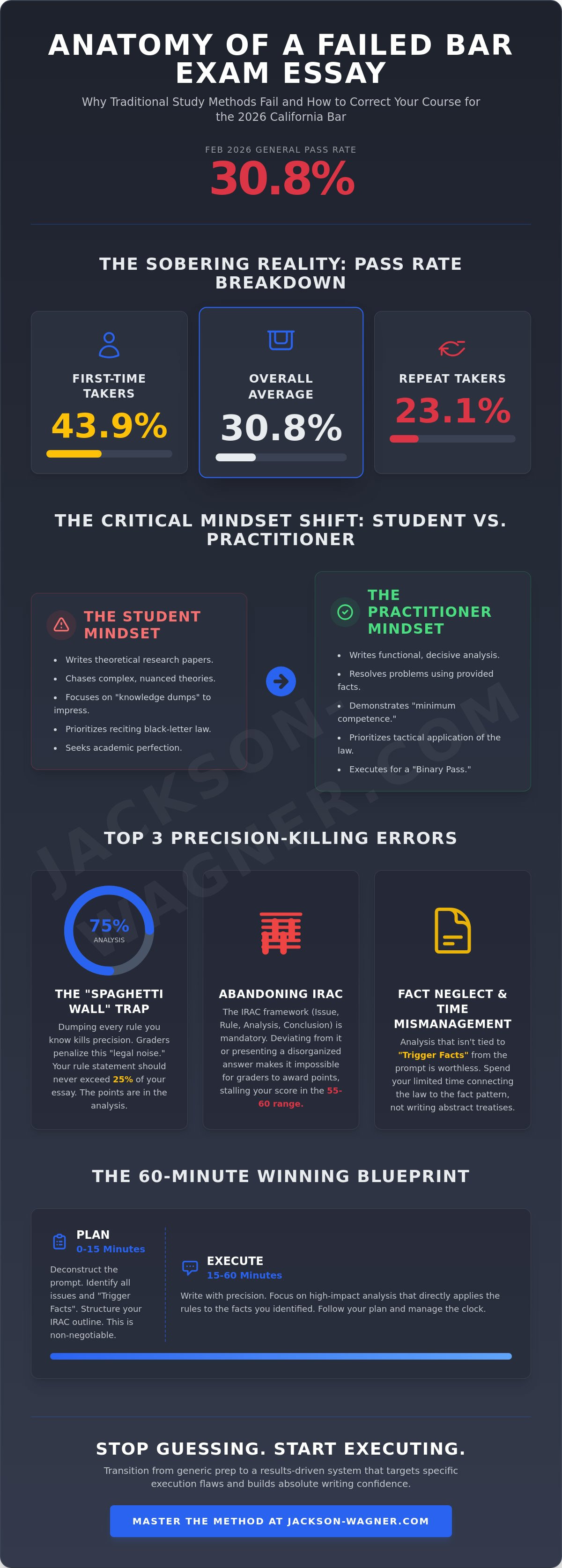
The California Bar Exam remains the ultimate professional gatekeeper. It is notoriously the most rigorous licensing test in the United States. While first-time takers in February 2026 saw a pass rate of 43.9%, repeat takers struggled at a mere 23.1%. This gap highlights a critical reality. Success requires more than just memorizing statutes. It demands a specific type of output that differs fundamentally from the academic nuance rewarded in law school. Many candidates fail because they treat their answers like theoretical research papers. In reality, the State Bar of California expects you to demonstrate immediate professional competence through clear, decisive writing. One of the most common mistakes on california bar exam essays is prioritizing "the law" over the tactical application of that law to the provided facts. If you miss a single structural requirement, your score will likely stall in the 55 to 60 range. This is a death sentence for your overall pass rate.
Graders in 2026 are increasingly focused on how a candidate handles complex, fact-heavy prompts under intense time pressure. They aren't looking for a scholar who can debate the history of the Commerce Clause; they want a practitioner who can advise a client. This shift toward practical application is why legacy study methods are no longer sufficient. You must prove you can function as a lawyer from day one.
The Anatomy of a 2026 Passing Essay
A passing essay in 2026 isn't a work of art; it's a functional tool. Graders are evaluating "minimum competence," which means you must prove you can identify legal problems and resolve them using the provided facts. High-achieving candidates often overcomplicate this. They chase complex theories and ignore the simple IRAC structure that graders rely on to award points. You must undergo a psychological shift. You are no longer a student trying to impress a professor. You are an officer of the court providing a reliable legal opinion. This transition is essential for avoiding common mistakes on california bar exam essays that stem from academic overthinking.
Why Knowledge Alone Cannot Save Your Score
A perfect outline in your head won't save you if you can't execute on the page. Knowledge is the baseline, not the finish line. The myth of the "Perfect Outline" leads many to perform "outline dumps" where they recite rules without connecting them to the prompt. The State Bar weights your analysis far more heavily than your ability to recite black-letter law. In the 2026 scoring environment, a rule statement that is slightly imperfect but applied brilliantly to the facts will always outscore a verbatim rule statement paired with weak analysis. You aren't writing for an A; you are writing for a binary outcome. This "Binary Pass" mindset forces you to execute for the win. You must focus on the specific facts that trigger the rules rather than the rules themselves.
The "Spaghetti Walling" Trap: Why Knowledge Dumps Kill Precision
"Spaghetti walling" is the desperate act of throwing every memorized rule at the prompt to see what sticks. It's one of the most common mistakes on california bar exam essays. This approach signals a catastrophic lack of "legal discernment" to the grader. When you dump an entire outline onto the page, you aren't showing how much you know. You're showing that you don't know what's relevant. In 2026, graders are increasingly aggressive about penalizing this irrelevant legal "noise." They want to see a professional who can identify the specific issues at hand, not a student reciting a textbook.
A fatal error many candidates make is allowing their rule statements to dominate the page. Your rules should never exceed 25% of your total essay. The points live in the analysis, not the rule block. Insights from the ABA Journal on Bar Exam Strategies confirm that clarity and brevity are essential in high-stakes environments. If you find yourself writing three paragraphs of law for one paragraph of application, you've already lost. Graders view excessive rule dumping as a sign that you're hiding a lack of analytical depth behind a wall of text.
Rule Precision vs. Rule Volume
Precision beats volume every time. You must learn to identify "Trigger Facts" before you type a single word of law. If a fact doesn't directly trigger a specific rule, that rule doesn't belong in your essay. Many students fall into the trap of writing "exceptions to exceptions" to appear thorough. Unless the fact pattern specifically invokes that exception, stop writing. Craft concise, high-impact rule statements. Your goal is to earn the point and move immediately to the analysis. This efficiency is what separates a 60 from a 75.
The Fact-Centric Analysis Correction
Every fact in a California Bar prompt is a "point-bearing asset." You must spend them all. If you leave a fact on the table, you've left points on the table. We teach the "Because" Test to force this connection. You should never state a conclusion without the word "because" followed by a specific fact from the prompt. This creates a logical bridge that graders love. Our JW Bar Method Prep - Full Exam California Bar program prioritizes this fact-mapping over rote memorization. It's a modern, results-driven alternative to legacy study models that focus too heavily on the "what" instead of the "how." By treating facts as your primary currency, you ensure your writing meets the 2026 standard for professional competence.
Structural Failures: Abandoning IRAC and Organizational Clarity
Structure is the difference between a grader seeing your brilliance and a grader seeing a mess. In the 2026 landscape, IRAC (Issue, Rule, Analysis, Conclusion) isn't just a suggestion; it's the only acceptable architecture for your response. Graders spend an average of two to three minutes on each essay. If they have to hunt for your points, they simply won't find them. Abandoning this rigid format is one of the most common mistakes on california bar exam essays that instantly disqualifies even the most legally sound answers. Your organizational clarity acts as a roadmap, leading the grader directly to the points you've earned.
The debate between "Conclusion First" and "Conclusion Last" often confuses candidates. For California essays, a clean IRAC with the conclusion at the end of each sub-issue is traditional and effective. However, your headings must be so descriptive that the grader already knows your conclusion before they read the paragraph. This creates an "easy-to-grade" environment. When a grader can skim your headings and see a logical progression of law, they're already biased toward giving you a passing score. Don't make them work for it. Professional competence is demonstrated through a predictable, structured delivery.
The 5-Step Structural Checklist
- Step 1: Bold, descriptive headings. Use headings that mirror the prompt’s call to action. If the prompt asks about "Duty," your heading should be "Duty of Care."
- Step 2: Narrow Issue statements. Avoid the "Whether or not" fluff. State the issue clearly and move on. "The issue is whether Smith owed a duty to Jones."
- Step 3: Rule statements. Use your issue as a pivot point. Keep these rule blocks punchy and focused only on the law triggered by the facts.
- Step 4: Analysis blocks. Always signal the start of your work with the word "Here." This tells the grader that the "law" section is over and the "points" section has begun.
- Step 5: Conclusive sentences. Provide a clear, definitive answer. Don't hedge. "Therefore, Smith owed Jones a duty of care."
Common Formatting Mistakes to Avoid
The "Wall of Text" is a psychological barrier for graders. Paragraph breaks are your best friend. Every time you move to a new sub-element or a new set of facts, start a new paragraph. While lists can be useful for elements of a rule, you must write in prose to pass. Avoid "Outline Form" at all costs. An essay that looks like a series of bullet points signals that you couldn't manage your time or lack the ability to synthesize legal arguments. Use full, declarative sentences to maintain an authoritative, professional tone throughout your response.
The Hidden Execution Errors: Time Management and Fact Neglect
Execution is where the most brilliant legal minds often stumble. You have exactly 60 minutes to deliver a professional legal opinion. This 60-minute reality means you cannot afford to "think" or hesitate for more than 15 minutes. One of the most common mistakes on california bar exam essays is losing control of the clock. When you spend too long contemplating a complex issue, you inevitably sacrifice the points available in the rest of the prompt. A candidate who writes a masterpiece on the first issue but leaves the final two issues unaddressed will fail. Graders don't reward depth at the expense of breadth.
Fact neglect is the primary reason high-scoring candidates see their grades drop to a 60. Every sentence in a California Bar prompt is there for a reason. If you aren't using every fact, you aren't earning every point. It's easy to get distracted by what you want to write rather than answering the specific "Call of the Question." Misinterpreting this call leads to irrelevant analysis that graders must ignore. You must be disciplined enough to answer exactly what was asked, even if you're eager to show off your knowledge in a different sub-topic.
The 15-45 Rule for Essay Execution
Success requires a strict tactical breakdown of your hour. Allocate the first 15 minutes to outlining and fact-mapping. This is your blueprint. If your outline is solid, the 45-minute "Execution Sprint" becomes a mechanical process of translating your plan into prose. You must maintain a steady words-per-minute pace to ensure you reach the conclusion. If you find yourself with only five minutes left and two issues remaining, don't panic. Switch to a "lean" IRAC format. State the rule and apply the facts quickly. A brief, correct answer is infinitely better than a blank page. This discipline prevents the "Deep Dive" trap that ruins so many promising scores.
Fact-Mapping: Extracting Every Available Point
Treat the fact pattern like a grocery list. You must "spend" every item provided. During the final five minutes of each essay, run a quick "Fact-Check" list. Scan the prompt to ensure no names, dates, or specific adjectives were left behind. Handling "Red Herring" facts is equally important. Acknowledge them briefly to show you've identified them, then explain why they don't change the legal outcome. This shows the grader you have the discernment of an experienced attorney. Learn how our California Bar Exam Practice drills solve fact-neglect by training you to spot every point-bearing asset in real-time.
Don't let execution errors derail years of hard work. You need a system that ensures your writing meets the highest standards every time. Our JW Bar Method Accelerated Prep - Full California Bar Exam provides the tactical tools you need to master the clock and dominate the essays.
Eliminating Essay Errors with the JW Bar Method Strategy
Legacy bar prep models rely on a flawed premise: that more information leads to better results. They bury you in thousands of pages of outlines, hoping you'll memorize enough to survive. This volume-heavy approach is exactly why many smart candidates fall victim to common mistakes on california bar exam essays. You don't need more law; you need a high-precision execution strategy. The JW Bar Method is designed to replace the stress of high-pressure certification with a structured, modern, and reliable path to success. We don't just teach you the law. We teach you how to win the points that graders are looking for in the 2026 landscape.
Our curriculum targets specific writing flaws through a student-centric approach. For those facing the full two-day challenge, the JW Bar Method Prep - Full Exam California Bar provides the comprehensive tactical training required to master both the MBE and the essays. If you're an experienced lawyer, the JW Bar Method Prep - Attorney’s Exam California Bar offers a specialized advantage. We recognize that practicing attorneys have different needs and time constraints. This is critical because while the February 2026 Attorneys' Examination pass rate was 57.0%, it remains a high-stakes hurdle that requires specific California-standard calibration. We've refined our methodology to focus on the nuances that often trip up out-of-state practitioners.
What truly distinguishes us is our bold reliability. We act as a partner so certain of our efficacy that we assume the financial risk of your performance outcome. Our binary performance guarantee is a unique anchor in an industry of cautious competitors. You shouldn't have to carry the entire burden of high-stakes licensing alone. We provide the modern alternative to legacy educational models, positioning you as a disruptive and highly competent professional from the moment you begin your prep.
The Precision Over Volume Philosophy
We believe that Precision Beats Volume. Our JW Bar Method Accelerated Prep - Full California Bar Exam focuses exclusively on the point-bearing assets that matter. Instead of generic lectures, we use custom feedback loops to fix your specific IRAC weaknesses in real-time. This ensures that every hour you spend studying translates directly into a higher score on exam day. By eliminating the common mistakes on california bar exam essays through targeted drills, we turn your writing into a precise tool for professional licensure.
Next Steps for 2026 Success
The July 2026 Bar Exam dates are set for July 28–29, 2026. The timely filing window for this cycle opens on March 1 and closes on April 1, 2026. Don't wait until you're overwhelmed by information to seek a better way. Begin by assessing your current essay baseline with a JW Method diagnostic. Whether you choose our Full Prep or JW Bar Method Accelerated Prep - Attorney’s Exam California Bar tracks, you'll gain the confidence that your writing meets the highest State Bar of California standards. Secure your spot for the 2026 cycle today and experience the strategic correction that turns candidates into attorneys.
Master Your Essay Execution for 2026
The path to the California Bar is paved with candidates who prioritized volume over precision. You now have the tactical roadmap to avoid the "spaghetti walling" trap and the structural failures that stall scores at 60. By mastering the 15-45 execution rule and treating every fact as a point-bearing asset, you've already distanced yourself from the average applicant. Success in 2026 isn't about working harder. It's about working with a methodology that mirrors the high standards of the State Bar.
Eliminating the common mistakes on california bar exam essays requires a shift from academic theory to professional competence. We are here to facilitate that transition with our proprietary JW Bar Method and specialized accelerated tracks for both law grads and practicing attorneys. We are so certain of our results-driven curriculum that we offer a bold performance-based guarantee for all 2026 candidates. You don't have to carry the risk alone.
Master the California Bar with the JW Bar Method. Your future as a California attorney starts with a strategic correction. Let's get to work.
Frequently Asked Questions
What is the most common mistake on California Bar Exam essays?
The most frequent error is fact neglect, which occurs when candidates recite rules perfectly but fail to apply every specific fact provided in the prompt. This is one of the most common mistakes on california bar exam essays because it leaves easy points on the table. Graders expect you to treat facts as point-bearing assets. If a fact is in the prompt, it must appear in your analysis to earn credit.
How long should a California Bar Exam essay answer be to pass?
There is no mandatory word count, but a passing answer typically ranges between 800 and 1,300 words. Length alone won't save a poor response; a concise 800-word essay with perfect IRAC structure will always outscore a 2,000-word "knowledge dump" that lacks focus. You should prioritize depth of analysis and ensuring every sub-issue is addressed within your 60-minute window.
Do I need to cite specific case names in my CA Bar essays?
You don't need to cite specific case names to pass the California Bar Exam. Graders are looking for the legal principle and its application, not your ability to memorize a table of authorities. Exceptions include landmark cases like Miranda or Erie, but even then, the rule earns the points. Don't waste precious mental energy trying to recall citations when you should be focusing on fact-mapping.
Can I pass the California Bar essays if I don’t finish one of them?
It's possible to pass the overall exam even if you fail to finish a single essay, provided your other scores are high enough to compensate. An incomplete essay usually results in a score of 40 or 50. To offset this, you'd need several scores in the 70 to 75 range. It's a high-risk position, which is why we emphasize strict adherence to our 15-45 execution rule.
How does the California Attorney’s Exam differ in essay grading?
The grading standard for the Attorney's Exam is identical to the General Bar Exam, focusing on "minimum competence." However, practicing lawyers often struggle with academic "over-writing" and theoretical tangents. Graders expect the same IRAC architecture but appreciate a decisive, professional tone. Experienced attorneys must resist the urge to litigate the facts and instead focus on efficient, high-precision analysis that meets the 2026 standards.
Is IRAC mandatory for every sub-issue on the California Bar?
IRAC is essentially mandatory for every sub-issue to ensure the grader can easily locate your points. While the State Bar doesn't explicitly outlaw other formats, IRAC is the universal language of the exam. Using clear headings and this rigid structure helps you avoid common mistakes on california bar exam essays related to poor organization. It forces a logical flow that signals professional competence to the grader.
What happens if I misstate a legal rule but my analysis is strong?
You can still earn a passing score of 60 or 65 even if you misstate a rule, as long as your analysis is logically sound. Analysis is the most heavily weighted component of the essay. A grader will often reward a candidate who demonstrates strong legal reasoning over one who recites a perfect rule but provides a shallow, conclusory analysis. Don't panic over a missed word in a rule.
How much time should I spend outlining versus writing the essay?
You should spend exactly 15 minutes outlining and 45 minutes writing. This 15-45 split ensures you have a comprehensive roadmap before you begin typing. Without a solid outline, you're likely to miss sub-issues or lose track of the clock. This disciplined approach is the foundation of a high-precision writing strategy. It turns the writing phase into a mechanical process of translating your plan into prose.


