

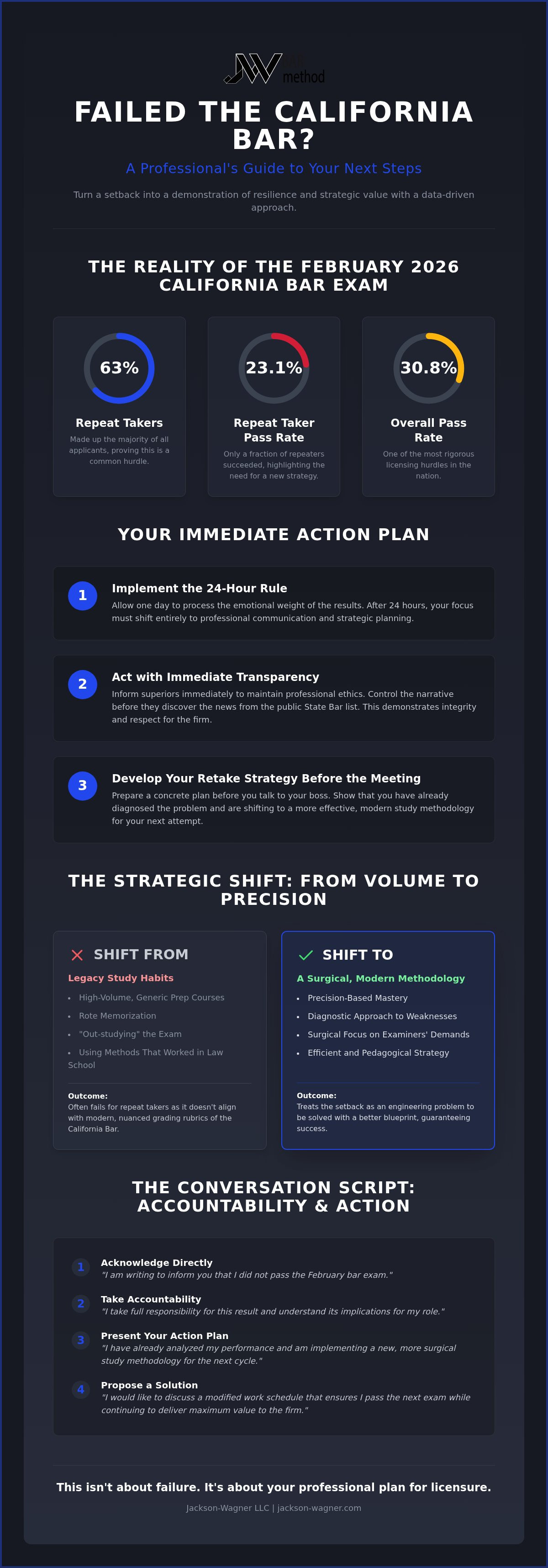
In February 2026, repeat test-takers made up nearly 63 percent of all California Bar applicants, yet only 23.1 percent of them walked away with a passing score. You aren't alone in this position. It's natural to feel professional embarrassment or fear immediate termination. Figuring out how to tell your boss you failed the bar exam is often more stressful than the exam itself. You aren't just delivering bad news; you're managing your reputation and your future at the firm.
This article provides a professional strategy to turn this setback into a clear demonstration of your resilience and value. We'll show you how to master the conversation to maintain your employment and secure the modified schedule you need for a retake. You'll learn why generic, legacy prep courses likely failed you and how a surgical, results-driven methodology can guarantee your success on the next attempt. We'll preview a plan that moves you from the stress of failure to a structured, modern path toward licensure in 2027. This isn't about your failure. It's about your professional plan for the inevitable solution.
Key Takeaways
- Inform your superiors immediately to maintain professional ethics and prevent them from discovering the news via the public State Bar of California results list.
- Master a direct-delivery script for how to tell your boss you failed the bar exam that prioritizes accountability and results over personal excuses.
- Present a concrete retake strategy before your meeting to demonstrate you are shifting from legacy study habits to a more surgical and pedagogical approach.
- Secure a modified work schedule or study leave by proving that your next attempt is backed by a structured and modern path to success.
- Shift your focus from high-volume, generic prep to the precision-based mastery required for repeat-taker success on the California Bar.
Navigating the Immediate Aftermath of California Bar Results
The moment you see the word "Fail" on the state bar portal, your professional world feels like it's narrowing. It's a profound shock, but it's vital to recognize that this is a temporary status, not a permanent professional identity. In a state where the February 2026 pass rate sat at just 30.8 percent, you're navigating one of the most rigorous licensing hurdles in the country. High-achievers often struggle with the specific pedagogical demands of the California examiners because their previous academic success was built on a different set of rules. Before you let the panic set in regarding how to tell your boss you failed the bar exam, implement the 24-hour rule. Give yourself exactly one day to process the emotional weight of the results. Once that window closes, your focus must shift entirely to professional communication and strategic planning.
The Reality of the California Bar Exam in 2026
California continues to set a uniquely high bar for entry into the legal profession. High-achieving associates often find themselves blindsided because The Bar Examination in this jurisdiction demands more than just rote memorization. Generic prep tools often fail top-tier candidates because they use legacy, volume-based models that don't align with modern grading rubrics. If you're a repeat taker, you must view your recent result as a diagnostic tool rather than a personal failure. Achieving success in the next cycle means understanding the nuances of the california bar exam, which requires a surgical focus on the specific pedagogical demands of the examiners. You don't need more hours; you need a more efficient methodology like the one pioneered by Jackson-Wagner LLC.
Identifying the 'Why' Before the 'How'
You can't effectively manage your boss's expectations if you don't understand what went wrong. Was your score a result of gaps in substantive knowledge, or did you struggle with the precision required for the performance test? Many working professionals fail because they try to "out-study" the exam using the same methods that worked in law school. This rarely works for the California Bar. When you prepare for the conversation about how to tell your boss you failed the bar exam, you need to be ready to explain the difference between your previous volume-heavy approach and the precision-based mastery you'll use for the retake. Jackson-Wagner LLC emphasizes differentiating between trying harder and changing the method. Your boss is a professional who values efficiency. They'll respect a candidate who treats a setback as an engineering problem to be solved with a better blueprint.
Timing and Transparency: Why You Must Act Immediately
In the legal profession, silence is rarely interpreted as neutral. It is almost always viewed as a lack of transparency. When you are weighing how to tell your boss you failed the bar exam, speed is your greatest asset. The State Bar of California publishes a public list of successful applicants shortly after results are released. If your name is absent from that registry, every hour you wait increases the risk of a senior partner discovering the news through a third party. This is more than just awkward; it's a breach of professional ethics that can damage your reputation far more than the failing score itself.
Allowing an information vacuum to form is dangerous. Without your direct input, rumors and assumptions will fill the space. By acting immediately, you control the narrative. You transition from being a failed applicant to a proactive professional with a clear plan for the future. This immediate disclosure signals that you respect the firm's time and its commitment to client service. It also allows you to introduce your modern retake methodology before the firm begins questioning your long-term viability.
The Ethics of Disclosure in a Law Firm
Your duty to the firm and its clients is paramount. Licensure status directly impacts your ability to sign pleadings, appear in court, or bill at specific associate rates. If you are in a bar-passage-required role, your transparency is a legal necessity. Partners value associates who own their setbacks. By being upfront, you demonstrate the level of integrity required for future leadership. It proves you prioritize the firm's operational health over your personal comfort. This builds a foundation of long-term trust that can survive a temporary licensing delay.
The Professional Meeting Request
In the 2026 law firm culture, a brief, direct email is the most effective way to request a meeting. Avoid cryptic subject lines like "Quick Question" or "Checking In," as these can trigger unnecessary alarm. Instead, use a clear subject line such as "Bar Results Update and 2027 Strategy." This signals importance while framing the conversation as forward-looking. Choose your timing carefully. Avoid peak billing windows or Friday afternoons when partners are rushing to clear their desks. A Tuesday or Wednesday morning is often ideal, providing a calm environment where you can present your plan with the focus it deserves.
Developing Your 'Retake Strategy' Before the Meeting
When you're figuring out how to tell your boss you failed the bar exam, the "how" is secondary to the "what next." Senior partners don't want to hear that you'll just "study harder" this time. That isn't a strategy; it's a hope. You must present a structured, pedagogical shift that addresses exactly why the previous attempt fell short. This means showing a timeline that respects your billable requirements while maintaining a surgical intensity for your review. Your boss needs to see that you've diagnosed the problem and have already sourced the solution.
The Power of a Performance Guarantee
Using the Jackson-Wagner LLC results-oriented approach serves as a powerful trust-builder during this difficult conversation. When you explain you're moving away from generic, high-volume legacy prep courses, you're signaling a move toward precision. The proprietary JW Bar Method assumes the financial risk of your outcome. This provides the "binary certainty" firms look for in their associates. It demonstrates that you're assuming personal accountability. You're not just retaking a test; you're executing a professional plan backed by a guarantee that legacy providers simply won't offer.
Negotiating Study Leave or Modified Schedules
Proposing a study sabbatical requires showing how you'll remain an asset to the firm during the transition. If a full leave isn't feasible, the JW Bar Method Accelerated Prep - Full California Bar Exam is designed specifically for working professionals. It allows you to master the material without fully stepping away from your desk. When you discuss how to tell your boss you failed the bar exam, come prepared with a workflow proposal that ensures client needs are met during your final review window. Consider these points for your proposal:
- Requesting a "billable cap" during the final six weeks of prep to ensure deep study time.
- Utilizing an accelerated track to minimize total time away from active files.
- Setting clear communication blackout periods that don't conflict with major firm deadlines.
- Demonstrating how the efficiency of the Jackson-Wagner LLC methodology reduces the total hours needed compared to standard courses.
Partners respect efficiency. By showing them a path that balances firm productivity with a guaranteed licensure outcome, you turn a professional setback into a manageable logistical hurdle.
The Conversation Script: Professionalism Over Excuses
When you're deciding how to tell your boss you failed the bar exam, remember that brevity is your most professional tool. Don't offer a laundry list of reasons why the exam was difficult or how your study schedule was interrupted. Instead, lead with a direct delivery of the facts. State clearly that you didn't pass, and immediately pivot to your solution. This approach demonstrates that you're managing the situation with the same level of competence you bring to your legal research and client files.
Your goal is to replace their uncertainty with your confidence. By reaffirming your commitment to the firm and explaining your methodology shift, you remind the partners that your value extends beyond a single test result. Handling the "what happens next" question with a pre-prepared plan prevents the firm from making decisions for you. You aren't asking for permission to try again; you're informing them of how you'll succeed.
Script Template: For the Big Law Associate
In a Big Law environment, the focus is often on strict compliance with the state of california state bar requirements and firm-specific promotion tracks. You need to address the licensure delay while highlighting your plan to minimize disruption. Use this concise statement: I didn't meet the passing threshold for the California Bar this cycle, so I've already enrolled in a results-guaranteed accelerated prep track to ensure my February success without compromising my current caseload.
This script works because it acknowledges the failure without lingering on it. It shows you've already researched the requirements and selected a path that assumes the financial risk of your outcome. If you need to secure a specific study leave, explore our accelerated prep options to show your boss a timeline that balances billable hours with surgical review.
Script Template: For the In-House or Boutique Counsel
For those in smaller firms or corporate legal departments, project continuity is often the primary concern. You may also need to address specific california attorney's exam requirements if you're an out-of-state hire. Your script should emphasize that your tactical setback won't derail long-term department goals. Focus on how your new study method is significantly more efficient than the legacy course you previously used. Admitting a setback while maintaining your authority as a counselor requires a focus on precision and future performance. You're demonstrating the resilience that senior partners expect from their future leaders.
Turning Failure into Licensure with the JW Bar Method
Success on the California Bar requires a psychological shift that legacy providers often ignore. When you're managing the aftermath of a failing score, your biggest hurdle isn't the law; it's the methodology. The JW Bar Method is engineered specifically for the repeat-taker's psychology, moving you away from the volume-based anxiety that leads to burnout. Instead of re-reading thousands of pages, we focus on precision-based mastery. This shift is what makes Jackson-Wagner LLC the best bar exam preparation service for career recovery. We replace the uncertainty of your first attempt with a structured, pedagogical advantage that assumes the financial risk of your outcome.
For out-of-state lawyers who may have struggled with the full exam, the path to licensure often involves navigating the specific requirements of the Attorney's Exam. In February 2026, the pass rate for this one-day examination was 57.0 percent, which is significantly higher than the general repeat-taker rate of 23.1 percent mentioned earlier. If you are an experienced lawyer, your strategy for how to tell your boss you failed the bar exam should include a discussion about whether the Attorney’s Exam track is a more surgical fit for your professional background. Our specialized prep for this track ensures you aren't wasting time on unnecessary components, focusing instead on the written mastery California demands.
Structured Success: The JW Pedagogical Advantage
Our 2026 curriculum updates at Jackson-Wagner LLC reflect the most recent grading trends from the California State Bar. Legacy courses fail top-tier candidates because they treat the exam as a memory test. We treat it as a performance. By mastering the specific rubrics used by examiners, you move from knowing the law to demonstrating the law in the exact format required for points. This level of precision is why our students walk into the testing center with binary certainty. We don't just provide materials; we provide a modern alternative to outdated educational models that no longer meet the standards of the 2026 legal market.
The Accelerated Prep Track for Working Professionals
Balancing a full-time associate role with high-stakes study is a logistical challenge that requires more than just trying harder. Our accelerated tracks are built for the working attorney who cannot afford to step away from their billing targets for months. We prioritize strategic drills over passive reading, ensuring every hour of study translates directly to score improvement. When you've mastered how to tell your boss you failed the bar exam, the next step is showing them a schedule that actually works. Secure your 2026 retake spot with the JW Bar Method and turn your tactical setback into a permanent professional win.
Secure Your Professional Future in 2027
Mastering how to tell your boss you failed the bar exam is the first step in reclaiming your career trajectory. By prioritizing immediate transparency and presenting a surgical retake strategy, you demonstrate the resilience senior partners expect from their future leaders. You aren't just reporting a setback; you're announcing a solution. The proprietary JW Bar Method is engineered for this exact moment, replacing the anxiety of legacy prep with a structured, modern path to success.
Our California-specific licensure expertise and accelerated prep tracks for working professionals allow you to maintain your billable targets while ensuring mastery. We assume the financial risk of your outcome because our pedagogical approach is built on binary certainty. Don't settle for high-volume courses that failed to deliver results. It's time to choose a disruptive alternative that prioritizes your efficiency and professional status. Enroll in the JW Bar Method and Guarantee Your 2026 Licensure. Your path to licensure is structured, reliable, and well within reach.
Frequently Asked Questions
Will I get fired immediately if I tell my boss I failed the bar exam?
Immediate termination is rare because most firms view the bar as a professional hurdle rather than a definitive finish line. You're much more likely to maintain your employment if you present a concrete retake plan alongside the news. If you're wondering how to tell your boss you failed the bar exam, remember that partners value transparency. They've already invested in your training and would usually rather see you succeed than start over with a new hire.
How long should I wait to tell my employer after receiving bar results?
You should inform your employer within 24 hours of receiving your results. Waiting longer creates an information vacuum and risks your boss finding out through the public State Bar of California list. Acting quickly demonstrates professional maturity and integrity. It allows you to control the narrative by pairing the bad news with your new, structured study plan. Prompt disclosure is a hallmark of a reliable professional who prioritizes firm ethics.
What if my firm has a 'one-and-done' policy for bar failure?
A "one-and-done" policy isn't always set in stone if you can prove your next attempt is backed by a superior methodology. Partners often make exceptions for associates who show a high level of accountability and a guaranteed path to licensure. Instead of just asking for another chance, present a surgical plan that uses a results-oriented approach. Showing them that you're assuming the financial risk of your prep can sometimes shift their perspective on your potential.
Should I ask for a study leave immediately during the conversation?
Yes, you should mention your need for a modified schedule during the initial conversation to ensure project continuity. Don't wait until the middle of the next study cycle to bring it up. Propose a specific timeline that balances your billable requirements with deep study sessions. Using an accelerated track allows you to stay involved with your cases while dedicating the necessary hours to master the pedagogical demands of the examiners.
How do I explain why I failed without making excuses?
Focus on a diagnostic analysis of your study method rather than external factors. Explain that your previous approach relied on high-volume, generic prep that didn't align with the precision required for California’s specific rubrics. This frames the failure as a technical error in strategy rather than a lack of intelligence. When discussing how to tell your boss you failed the bar exam, emphasize that you've pivoted to a surgical, results-driven curriculum for the next cycle.
Is the California Bar Exam harder to pass on the second attempt?
Statistically, repeat takers have lower pass rates, but this is often due to reusing ineffective study habits. In February 2026, the repeat pass rate was 23.1 percent compared to 43.9 percent for first-timers. The exam isn't physically harder, but the psychological pressure increases. You can beat these odds by abandoning legacy, volume-based courses and switching to a precision-based mastery model that addresses the specific reasons why repeaters often struggle.
Can I switch bar prep courses for my retake if I already used a legacy provider?
Switching to a modern, specialized provider is often the best way to ensure a different outcome. Sticking with a legacy provider that already failed you is a tactical mistake. High-achievers need a disruptive alternative that focuses on the pedagogical nuances of the California State Bar. Moving to a results-oriented method signals to your firm that you aren't just "trying again," but are actively upgrading your professional tools for a guaranteed result.
How does the JW Bar Method guarantee results for repeat takers?
The JW Bar Method assumes the financial risk of your performance by offering a binary guarantee. We move beyond passive reading and utilize strategic, surgical drills that mirror the actual grading rubrics used in California. Our accelerated tracks are designed for working professionals who need efficiency without sacrificing depth. By focusing on precision-based mastery rather than sheer volume, we provide the structured path and security that repeat takers need to secure their licensure.


