
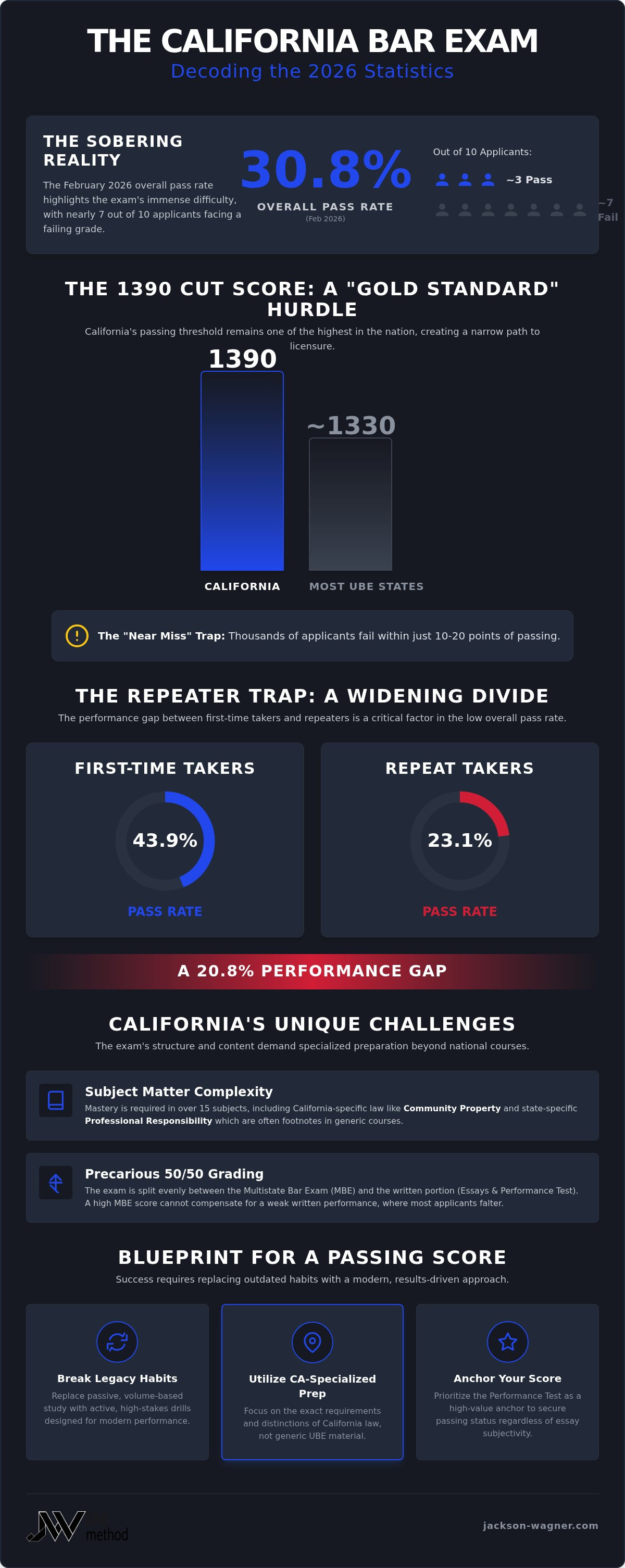
In February 2026, the overall california bar exam pass rate dropped to a sobering 30.8 percent, leaving nearly seven out of ten applicants to face the devastating reality of a failing grade. If you feel a sense of dread when looking at the 1390 cut score or feel buried under the sheer volume of generic prep material, you aren't alone. Most students follow the same legacy study patterns that lead directly to these low numbers, hoping that more hours will eventually equal a passing score. It's time to stop gambling with your career and start training with precision.
You deserve a clear path to licensure that replaces high-stakes anxiety with absolute confidence. This analysis promises to master the statistics behind the current results and reveal the strategic shifts you must make to beat the odds in 2026. We will examine the statistical landscape, identify the common failure points that trap repeaters, and provide a proven roadmap to ensure your preparation is as elite as the career you're about to start. By the end of this article, you'll have a structured understanding of how to navigate the 1390 requirement using a modern, results-driven approach that ignores the noise of traditional courses.
Key Takeaways
- Decode the latest california bar exam pass rate data to pinpoint exactly where applicants lose momentum against the 1390 cut score.
- Identify the specific California-only law subjects and grading nuances that distinguish the state's exam as the most rigorous in the nation.
- Learn how to break the "Repeater Trap" by replacing legacy study habits with active, high-stakes drills designed for modern performance.
- Prioritize the Performance Test as a high-value scoring anchor to secure your passing status regardless of essay subjectivity.
- Leverage a California-only specialized prep method to move beyond generic, volume-based material and focus on the exact requirements for 2026 success.
Analyzing the 2026 California Bar Exam Pass Rate Trends
The 2026 results are a wake-up call for every aspiring attorney. The overall california bar exam pass rate for the February administration sat at a sobering 30.8 percent. This isn't just a random fluctuation; it's a reflection of a testing environment that remains the most demanding in the United States. While other jurisdictions move toward uniformity, the State Bar of California maintains a standard that creates a massive divide between those who are merely prepared and those who are strategically trained for this specific hurdle.
July vs. February: Which Administration is "Harder"?
Many applicants fall for the dangerous myth that the February exam is "easier" because the raw numbers can fluctuate. The statistical reality of 2026 tells a different story. The 30.8 percent pass rate in February was actually a decline from previous years, such as the 33.9 percent seen in 2024. The difficulty doesn't stem from the questions themselves, but from the applicant pool composition. February is often dominated by repeat test-takers who are already fighting a statistical headwind. You aren't competing against an easier curve; you're navigating a landscape where the margin for error is razor-thin.
The 1390 Cut Score: A 2026 Reality Check
The 1390 scaled score is the ultimate gatekeeper. While most Uniform Bar Exam (UBE) jurisdictions set their passing thresholds much lower, California's 1390 remains a "gold standard" of exclusion. In 2026, the most common failure mode isn't a total lack of legal knowledge. It's the "near miss." Thousands of applicants fall within 10 or 20 points of the 1390 mark. These students often possess a solid legal foundation but fail to execute the specific formatting and timing requirements that California graders demand. If you don't have a strategy to bridge that 20-point gap, you're just another statistic.
The gap between first-time takers and repeaters is widening at an alarming rate. In the February 2026 administration, first-time takers saw a 43.9 percent pass rate, while repeaters plummeted to just 23.1 percent. This 20.8 percent gap exposes the "Repeater Trap" in its most lethal form. Doing the same thing twice won't change the outcome. If you're a repeater, you're fighting a historical trend that requires a total pedagogical shift, not just more hours spent with the same legacy prep materials.
Nationally, California remains an outlier. Even as the state prepares for the NextGen UBE transition in 2028, the current 2026 standards prioritize a depth of knowledge in state-specific subjects that most national courses simply skim over. This misalignment is exactly why the california bar exam pass rate continues to lag behind national averages. Success in this state requires more than general legal competency; it requires a specialized approach that respects the unique difficulty of the California curriculum.
Why the California Bar Remains the "Gold Standard" of Difficulty
California's reputation isn't just hearsay; it's a statistical reality reinforced by the California Bar Examination Statistics released year after year. While other states simplify their requirements, California demands mastery over a sprawling legal landscape. This complexity is the primary driver behind the consistently low california bar exam pass rate, as it forces students to juggle federal law alongside intricate state specific rules that don't exist in most other jurisdictions. You aren't just taking a test; you're surviving a professional gauntlet.
Subject Matter Complexity in 2026
Applicants must be ready to tackle over 15 potential subjects, including heavy hitters like Community Property and California-specific Professional Responsibility. These aren't just minor tweaks to general law; they represent entirely different legal frameworks. The "California Distinction" acts as a pedagogical hurdle where students must consciously override their general legal knowledge to apply state specific nuances under extreme pressure. Generic courses often treat these as footnotes. In California, these distinctions are the difference between a 1350 and a 1400.
The Grading Rubric: Beyond the MBE
The 50/50 split between the Multistate Bar Exam (MBE) and the written portion creates a precarious balance. You can't hide behind strong multiple choice scores. The written portion is where most dreams go to die, particularly during the "Second Read" process. If your initial scaled score falls between 1350 and 1389, your papers are sent to a second set of graders for review. This subjective review is often where the california bar exam pass rate is decided for the "near miss" group. Without a strategy for high-impact writing, you're leaving your career to chance.
The Performance Test (PT) remains the secret pass rate killer. It's a 90 minute sprint that tests raw lawyering skills rather than memorization. Many students spend 90 percent of their time on black letter law and ignore the PT; they find themselves paralyzed by the clock on exam day. Volume-based study methods from legacy providers encourage this shallow approach. They focus on watching hours of video instead of doing the high stakes drills necessary to survive the grading rubric. These national courses fail because they treat California as just another jurisdiction. If you want to avoid the repeater trap, you need a specialized California prep track that prioritizes active output over passive consumption. This shift in focus is essential for anyone serious about landing on the right side of the 1390 cut score.
First-Timers vs. Repeaters: Navigating the Statistical Divide
The statistical gulf between first-time takers and repeaters is one of the most significant factors affecting the california bar exam pass rate. Data from the February 2026 General Bar Examination results reveals a stark reality: first-time applicants achieved a 43.9 percent pass rate, while repeaters struggled at just 23.1 percent. This discrepancy isn't a reflection of intelligence. It's a clear indicator that the "Repeater Trap" is real. Many students who fail their first attempt simply double down on the same legacy prep methods, hoping that more volume will lead to a different result. This is the "Volume Fallacy" in action.
To move from a failing score to a passing one, you have to realize that more hours spent watching passive videos won't fix a fundamental execution error. If you missed the 1390 mark, your previous study plan has already proven it doesn't work for your learning style or the specific demands of the California graders. You don't need more material; you need a total pedagogical shift that prioritizes high-stakes application over simple memorization. Success in 2026 requires identifying the specific gaps in your analysis that the "Second Read" process likely exposed.
The California Attorney’s Exam Pass Rate
Practicing lawyers from other jurisdictions often enter the California market with a false sense of security. In February 2026, the pass rate for the Attorneys' Examination was 57.0 percent. While this is significantly higher than the general california bar exam pass rate, it still means nearly half of all experienced attorneys failed to meet the state's standards. These professionals often fall short because they underestimate the rigid, pedantic nature of the written portion. Our JW Bar Method Prep - Attorney’s Exam California Bar is designed to help busy practitioners master these nuances without wasting time on the MBE subjects they've already mastered in practice.
Breaking the Cycle of Failure
Breaking the cycle of failure requires a clinical look at your previous attempts. You aren't just "bad at the bar." You likely have a specific "missing link" in how you bridge the gap between knowing a rule and applying it to a California fact pattern. Transitioning from passive study to active, mentor-led drills is the only way to ensure your next attempt is your last. Learning how to navigate the State Bar of California administrative hurdles and grading expectations is a critical part of this strategic pivot. Don't let the statistics define you; let them inform a better, more modern approach to your licensure.
Strategic Blueprint: How to Ensure You Land on the Passing Side
To survive a 30.8 percent overall pass rate, you've got to abandon the study habits that got you through law school. The current california bar exam pass rate proves that traditional passive learning is a failed model for this specific jurisdiction. Most legacy courses bury you in 400 hours of video lectures and thousands of pages of outlines. This volume-based approach creates a false sense of security while leaving your actual performance skills underdeveloped. Success in 2026 requires a lean, high-impact blueprint that focuses on how you execute under pressure, not just what you know.
The Performance Test (PT) must become your scoring anchor. While other applicants treat the PT as an afterthought, you should treat it as a guaranteed point-generator. It's a closed-universe exercise that rewards structure and timing over rote memorization. By mastering the PT early, you create a buffer for the more subjective essay portions. Additionally, you must adopt the "California Style" of essay formatting. This means moving beyond basic IRAC to provide the specific depth and counter-analysis that State Bar graders expect. Diagnostic feedback is the final piece of the puzzle. Without a mentor to identify your structural weaknesses, you're essentially guessing why you're missing the 1390 mark.
Precision Over Volume: The New Prep Paradigm
Focused intensity is the hallmark of the modern applicant. The JW Bar Method replaces the bloat of traditional courses with targeted, high-stakes drills that simulate the actual exam environment. Active Recall in the context of California Bar essays is the deliberate cognitive process of retrieving legal rules from memory to solve complex fact patterns without relying on external outlines or notes. This method ensures that your knowledge is accessible when the clock is ticking. You don't need to study more; you need to study with more precision.
The 30-Day Accelerated Strategy
If you're a busy professional or a repeater looking for a pivot, a condensed timeline is often more effective than a long, drawn-out grind. The final 30 days should be spent entirely on output. Your milestones must include at least two full-length simulated exam days and daily PT practice. This is where you refine your timing and solidify your formatting. Choosing the Best Bar Exam Preparation Service 2026 means prioritizing these active milestones over passive consumption. You can't afford to waste the final month on generic reviews.
If you're ready to stop being a statistic and start training for a result, explore the JW Bar Method Accelerated Prep - Full California Bar Exam to lock in your 2026 success.
Beyond the Statistics: The JW Bar Method for Guaranteed Licensure
The numbers don't lie. Facing a california bar exam pass rate that hovers near 30 percent requires more than just general legal knowledge; it requires a specialist's precision. Most legacy bar prep providers are generalists, stretching their resources across dozens of states and diluting the intensity needed to survive California's 1390 cut score. Jackson-Wagner LLC rejects this model. We focus exclusively on California licensure, ensuring every resource and pedagogical strategy is tuned to the specific nuances of this jurisdiction. Specialization isn't just a preference; it's the only reliable way to beat the statistical odds in 2026.
The JW Bar Method is a disruptive, mentor-led approach that replaces the passive consumption of legacy programs with active, performance-driven training. We don't just give you the law; we train you to execute it under the exact conditions the State Bar demands. This methodology is designed for the modern learner who needs flexibility without sacrificing rigor. Whether you're a first-time applicant or a repeat test-taker fighting a historical trend, our structured environment provides the clarity and accountability necessary to secure a passing score. We win when you win.
The Financial Guarantee Explained
We are so certain of our efficacy that we assume the financial risk of your outcome. This binary performance guarantee is our signature of "bold reliability." Unlike competitors who focus on generic pass rate claims, we act as a true partner in your success. If you don't pass, we take the financial hit. This alignment of interests ensures that we remain results-oriented and student-centric throughout your entire study process. You aren't just another enrollment; you're a future attorney whose success is tied directly to our own.
Join the JW Bar Method and secure your California license today to experience the difference that specialized, risk-shared prep makes.
Your Path to the 2026 California Bar
The transition from "studying" to "passing" requires a definitive strategic pivot. For law grads, the JW Bar Method Accelerated Prep - Full California Bar Exam offers a high-intensity track that maximizes efficiency. For out-of-state practitioners, the JW Bar Method Accelerated Prep - Attorney’s Exam California Bar provides a streamlined path that respects your professional experience while preparing you for the state's pedantic grading standards. Closing the gap between your current score and the 1390 mark is a matter of choosing the right tools and the right partner.
Don't let another administration pass you by. Your next steps should focus on active output and diagnostic mastery. For a deeper dive into the mechanics of success, consult our California Bar Exam Strategy: The Definitive Guide. The california bar exam pass rate is a hurdle, but with the right method, it's one you will clear. Let's get to work.
Secure Your Future in the California Legal Market
The data from 2026 makes one thing clear: navigating the california bar exam pass rate requires a total departure from legacy study habits. Whether you're a first-time applicant facing the 1390 cut score or a repeater looking to break the cycle of near-misses, success depends on precision and active application. You've spent years in law school preparing for this moment. You shouldn't leave your licensure to a volume-based course that treats California as an afterthought.
Jackson-Wagner provides an exclusively California-focused environment with accelerated professional tracks for both the full exam and the attorney's exam. We are so confident in our disruptive, mentor-led approach that we offer a binary performance guarantee, assuming the financial risk of your outcome ourselves. This modern paradigm replaces high-stakes anxiety with a structured, reliable path to success. Don't let the statistics define your potential when you can choose a partner that is as invested in your results as you are.
Master the JW Bar Method and Pass the California Bar Exam
Your career as a California attorney is within reach. It's time to train with the authority you deserve and join the ranks of those who have mastered the gold standard of difficulty.
Frequently Asked Questions
What is the current California Bar Exam pass rate for 2026?
The overall california bar exam pass rate for the February 2026 administration was 30.8 percent. This figure represents a slight decrease from previous February sessions, such as the 33.9 percent recorded in 2024. While the number seems daunting, it's heavily influenced by the specific mix of first-time and repeat test-takers in the winter pool. Success in this environment requires a preparation strategy that moves beyond generic outlines and focuses on the specific grading criteria used by the State Bar.
Why is the California Bar Exam pass rate so much lower than other states?
California maintains a lower pass rate primarily due to its high 1390 scaled cut score and the inclusion of complex, state-specific law subjects. Unlike many states that have adopted the Uniform Bar Exam, California requires mastery over 15 distinct legal areas. The grading process is also notoriously rigorous, utilizing a "Second Read" for applicants who fall just short of the passing threshold. These factors combine to create a testing environment where only the most precise candidates succeed.
Does the California Attorney’s Exam have a higher pass rate than the full exam?
Yes, the February 2026 Attorneys' Examination pass rate was 57.0 percent, which is significantly higher than the 30.8 percent overall rate for the General Bar Exam. This specialized exam is reserved for practicing lawyers from other jurisdictions who've been in good standing for at least four years. However, nearly half of all attorney applicants still fail the exam, often because they underestimate the pedantic formatting requirements of the California written portion and the speed required for the Performance Test.
What is a passing score (cut score) for the California Bar in 2026?
The passing score for the California Bar Exam in 2026 is a scaled score of 1390. This threshold applies to both the General Bar Examination and the Attorneys' Examination. Applicants must achieve this total through a combination of their Multistate Bar Exam results and their written scores, which include five essays and one Performance Test. Falling even a few points short of 1390 results in a failing grade, making precision in every single essay section vital for success.
Are February bar exam pass rates lower than July rates?
Historically, February pass rates are lower than July rates. For example, the February 2026 california bar exam pass rate sat at 30.8 percent. This trend exists because the February administration typically includes a higher percentage of repeat test-takers, who statistically pass at lower rates than first-time applicants. July administrations usually feature a larger pool of recent law school graduates, who benefit from fresh academic training and a higher baseline pass rate of approximately 43.9 percent.
How many times can you take the California Bar Exam?
There is currently no limit on the number of times an applicant can sit for the California Bar Exam. You can continue to take the exam as long as you meet the eligibility requirements and pay the necessary registration fees. However, the repeater pass rate in February 2026 was only 23.1 percent. This suggests that simply retaking the exam without a fundamental shift in your study methodology often leads to repeated failure under the state's rigorous standards.
What percentage of first-time takers pass the California Bar?
In the February 2026 administration, 43.9 percent of first-time takers passed the California Bar Exam. This is a much higher success rate than the 23.1 percent seen among repeaters during the same period. While first-time takers have a statistical advantage, the majority still fail to meet the 1390 cut score. This highlights the need for a specialized, results-oriented prep course that addresses the specific nuances of California law from the very first day of your study schedule.
Does a higher pass rate in a specific law school guarantee my success?
A high law school pass rate is a positive indicator of institutional quality, but it doesn't guarantee individual success. Every applicant faces the same 1390 cut score and the same subjective grading pool regardless of their alma mater. In 2026, personal performance on the Performance Test and essays is the only factor that determines licensure. Relying on school statistics can lead to complacency; you must still master a structured, modern prep method to pass the exam.


