
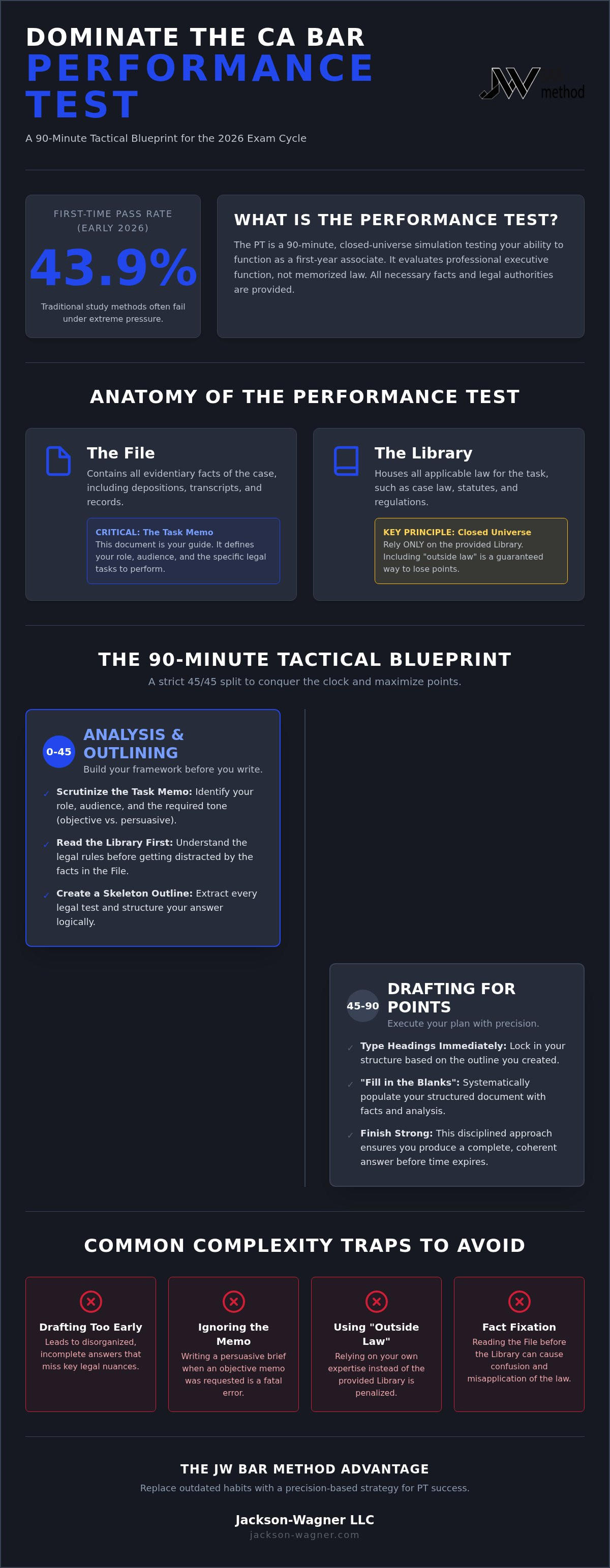
The california bar exam performance test isn't a test of how much law you've memorized; it's a high-stakes simulation of your professional executive function under extreme pressure. Most applicants approach this 90-minute hurdle as a speed-reading contest, only to find themselves staring at a half-finished draft as the clock expires. If you feel overwhelmed by a thirty-page Library or struggle to translate the Memo's instructions into a coherent structure, you're not alone. The 43.9% first-time pass rate for takers in early 2026 proves that traditional, volume-based study methods often fail when the pressure is at its peak.
We understand the anxiety of knowing your licensure depends on mastering this closed-universe challenge. You deserve a repeatable system that replaces frantic skimming with surgical precision. This guide will teach you how to dominate the PT by using a professional workflow designed for the modern learner. We'll show you how to decode the File, extract the winning rules from the Library, and produce a finished product that hits every grader's requirement before the timer hits zero. It's time to move beyond legacy prep and embrace a strategy built for the 2026 exam cycle.
Key Takeaways
- Master the "90-minute wall" by adopting a strict 45/45 split between analysis and drafting to ensure you never leave a point on the table.
- Navigate the california bar exam performance test with a closed-universe mindset, treating the provided Library and File as your exclusive sources of truth.
- Identify and avoid common complexity traps by focusing strictly on the legal tasks outlined in the partner's Memo rather than including every provided fact.
- Learn to synthesize multiple cases into high-impact rule statements that satisfy exactly what the graders are looking for in a professional work product.
- Leverage the JW Bar Method to replace outdated, volume-heavy study habits with a precision-based strategy designed for 2026 licensure standards.
What is the California Bar Exam Performance Test?
The california bar exam performance test is a 90-minute simulation designed to evaluate your ability to function as a first-year associate under realistic time constraints. Unlike the essay portion of the examination, the PT doesn't require you to bring any outside legal knowledge into the room. Everything you need to succeed is provided within the test materials. Your objective is to produce a high-quality work product, such as a memorandum, a closing argument, or a client letter, based on a specific set of facts and legal authorities. Because it carries significant weight in the total written score, mastering this section is non-negotiable for anyone seeking licensure in 2026.
The Anatomy of the Performance Test: File and Library
To dominate this section, you must understand the interplay between the two provided booklets. The File contains the evidentiary facts of the case. This includes depositions, transcripts, medical records, and the most vital document of all: the Task Memo. The Library houses the applicable law, which might consist of case law, statutes, or administrative regulations from the fictional state of Columbia. The History of the Performance Test shows that while the length of the exam has fluctuated over the decades, the core requirement remains the same. You must follow instructions to the letter. The Task Memo defines your specific role and identifies the intended audience. If the partner asks for an objective memo, don't write a persuasive brief.
PT Requirements for the California Attorney's Exam
Seasoned practitioners often make the mistake of underestimating this section. Out-of-state lawyers taking the shorter version of the test must still conquer the PT to pass. Ironically, years of practice can sometimes hinder performance. Experienced attorneys often struggle with the rigid formatting and the closed-universe nature of the test. They frequently try to rely on their own legal expertise rather than sticking strictly to the provided Library. This leads to the inclusion of "outside law," which is a guaranteed way to lose points.
The California Attorney's Exam requirements place a heavy emphasis on the PT because it serves as a direct measure of professional competence. It tests whether you can adapt to California standards of practice quickly and accurately. Success here requires unlearning legacy habits and adopting a structured, professional workflow. We focus on training attorneys to treat the PT as a technical exercise in organization and execution rather than a test of legal memory.
The 90-Minute Tactical Blueprint: Timing and Organization
Success on the california bar exam performance test is rarely a matter of legal brilliance; it's a matter of managing the 90-minute wall with clinical efficiency. Most examinees fail because they begin drafting their response too early, resulting in a disorganized mess that misses key legal nuances. The JW Bar Method advocates for a strict 45/45 split. This means you spend exactly 45 minutes on research and outlining, followed by exactly 45 minutes of drafting. By refusing to type a single word of your final answer before the halfway mark, you ensure your analysis is grounded in a complete understanding of the provided materials.
The First 45 Minutes: Research and Rule Extraction
Your first priority is the Task Memo. You must scrutinize it to identify your role, your specific audience, and the required tone. Misinterpreting a request for an objective memorandum as a persuasive brief is a fatal error. Once you've locked in the instructions, move directly to the Library. Reading the law before the facts allows you to build a legal framework before you're distracted by the "noise" of the client's story. As you read, create a skeleton outline that extracts every mandatory legal test. According to the California Bar Examination Scope, the PT evaluates your ability to handle legal authorities in a factual context. Mapping the facts from the File directly into your pre-built legal framework ensures no critical detail is left behind.
The Final 45 Minutes: Drafting for Points
When the clock hits 45 minutes, your skeleton outline should be comprehensive enough that the drafting phase becomes a simple exercise in "filling in the blanks." Start by typing your headings immediately. This provides an instant structure and ensures you don't forget to address any part of the Task Memo. You should prioritize the "Analysis" sections of your answer. This is where the bulk of the points are earned. Don't waste time on overly long introductions or flowery prose. Instead, focus on clear, logical applications of the Library's rules to the File's facts. If you find yourself struggling to stay on track, our JW Bar Method Prep provides the drills necessary to sharpen this reflex.
Finally, you must leave five minutes at the end for a sanity check. Use this time to re-read the Task Memo. Ensure you've answered every specific question asked and that your tone remains consistent with your assigned role. This final review often catches small, high-impact errors that can be the difference between a passing score and a repeat attempt. It's the final step in a professional workflow that guarantees you finish with time to spare.
Why Examinees Fail the PT: Overcoming Complexity Traps
Failing the california bar exam performance test usually isn't the result of low intelligence or poor legal writing. It's the result of falling into carefully designed complexity traps. The State Bar of California creates these 90-minute simulations to test your discernment, not just your speed. When you approach the PT without a professional workflow, you're likely to fall victim to the "Kitchen Sink" trap. This happens when an applicant tries to include every single case and fact provided in the materials. Graders aren't looking for a summary of the File; they're looking for a targeted solution to the specific problem posed in the Task Memo. Including irrelevant information doesn't just waste time. It signals a lack of professional judgment.
Another common pitfall is the "Outside Law" trap. This is particularly dangerous for repeaters or seasoned practitioners who've spent years in the courtroom. You must remember that the PT is a closed-universe environment. If a legal rule isn't in the provided Library, it doesn't exist for the purposes of your answer. Using real-world California statutes or your own knowledge of the UCC will lead to immediate point deductions. Your job is to apply the law of the fictional state of Columbia, even if it contradicts the law you use in your daily practice.
The Danger of 'Legacy' Preparation Methods
The PT is often treated as an afterthought by many legacy bar review courses that focus on memorization over execution. These programs often push the myth that "more practice" is the only way to improve. However, practicing the wrong habits only reinforces failure. The JW Bar Method replaces this volume-heavy approach with surgical precision. We don't just tell you to write more; we teach you a repeatable workflow that handles the 90-minute wall with clinical efficiency. You need a system that prioritizes executive function over brute-force typing.
Identifying 'Red Herrings' in the Library
The Library and File are intentionally bloated with red herrings to test your ability to filter noise. You'll often find cases that seem relevant but are actually distinguishable based on a single, critical fact. To succeed, you must quickly identify which rules are "controlling" and which are merely background information. We teach the "Rule of Three": if a fact in the File doesn't directly hit an element of a rule in the Library, it's likely a distraction. By filtering these out during your initial 45-minute research phase, you can focus your drafting on the complex legal twists where the real points are earned.
Strategic Execution: Mastering the Library and the File
The psychological burden of the california bar exam performance test stems from the sheer volume of data you must process in a vacuum. To succeed, you must treat the Library as your absolute and only source of truth. Any instinct to pull from your 1L Torts class or a recent news article must be suppressed. Fact-sorting under high pressure is an exercise in mental discipline. You aren't just reading; you're filtering. You must categorize every piece of information as either a "controlling rule," a "dispositive fact," or "irrelevant noise." This level of discernment is what separates passing answers from those that get lost in the weeds.
One of the most effective ways to benchmark your performance is by reviewing the State Bar's "Selected Answers." These aren't just examples of good writing; they are templates for professional tone and formatting. They demonstrate how to balance the provided facts with the legal framework without over-explaining the obvious. High-scoring examinees use a technique we call "Fact-to-Law Matching." This involves taking a specific element from a Library case and finding its exact factual counterpart in the File. If a case in the Library turned on the "intent of the parties," your analysis must immediately hunt for the specific emails or testimony in the File that prove or disprove that intent.
Advanced Synthesis Tactics
Mastering the Library requires more than just reading cases; it requires synthesizing them into a single, cohesive rule statement. Don't write three paragraphs for three different cases. Instead, extract the dispositive facts from each and merge them. Your goal is to create "ready-to-wear" rule statements that you can drop directly into your analysis. When you encounter conflicting authorities, don't ignore the tension. Graders want to see you manage that conflict by explaining why one statute or case is more applicable to your client's specific situation. This shows executive function and professional maturity.
Document Organization and Formatting
Your document's structure should be so clear that a grader could understand your entire argument just by reading your point headings. The difference between an objective memorandum and a persuasive brief is fundamental. An objective memo requires a neutral evaluation of both strengths and weaknesses; a persuasive brief demands a zealous advocacy for your client's position. Regardless of the format, your Conclusion must be definitive. Never leave a grader guessing about your final recommendation. To refine these high-level execution skills, we recommend enrolling in the JW Bar Method Prep to practice with precision-engineered simulations.
The JW Bar Method Advantage: Guaranteed PT Success
The JW Bar Method Prep treats the california bar exam performance test as the tactical anchor of your entire written score. While legacy programs focus on the sheer volume of substantive law, we recognize that the PT is a test of professional execution. Our methodology is built for the modern learner who requires a structured, reliable path to licensure without the fluff of traditional courses. By leading with a binary performance guarantee, we assume the financial risk of your outcome. This bold reliability replaces the paralyzing stress of passing the california bar exam in 2026 with a clear, empowered strategy.
Precision-Based PT Drills
Our curriculum utilizes high-stakes drills that simulate the exact intensity of the 90-minute wall. These aren't generic writing exercises; they're precision-engineered simulations designed to build the reflexes you need to handle complex Library materials under pressure. Instead of simple "right or wrong" grading, our feedback loops focus on your workflow efficiency. We track how quickly you synthesize rules and how accurately you map facts. This steady, structured progression ensures you're meeting the state of california state bar requirements through targeted repetition rather than aimless practice.
Your Path to Licensure Starts Here
Choosing the right program depends on your specific professional needs. The JW Bar Method Prep offers a comprehensive deep dive for those who want a steady, thorough pace. For busy professionals or out-of-state attorneys, the JW Bar Method Accelerated Prep provides a condensed, high-impact track that focuses on the most critical execution skills. Both programs are centered on the same disruptive pedagogy that prioritizes precision over volume.
The financial assurance of our performance guarantee means we're partners in your success. We don't just provide materials; we provide a result. Securing your spot for the 2026 California Bar cycle is the first step toward replacing exam anxiety with professional confidence. Whether you're a first-time taker or a seasoned attorney, our system is designed to navigate the complexities of the PT with clinical accuracy. It's time to move beyond legacy models and embrace the modern evolution of bar preparation.
Secure Your Future in the California Bar
The 90-minute wall is only a barrier if you lack a repeatable system. By mastering the 45/45 split and treating the Library as your exclusive source of truth, you transform the california bar exam performance test from a source of anxiety into a showcase of your professional competence. Success in 2026 requires moving beyond legacy memorization and adopting a workflow built for precision. We've shown you how to decode the File, synthesize the Library, and draft for points with surgical accuracy.
At Jackson-Wagner, we provide the proprietary JW Bar Method to ensure you execute with clinical confidence. Our accelerated prep programs are specifically designed for busy professionals and out-of-state attorneys who need results without the fluff of traditional courses. We're so certain of our pedagogical approach that we offer a binary performance guarantee. We assume the financial risk because we know our system works. Your path to licensure is no longer a gamble; it's a steady, structured progression toward success.
Master the California Bar with the JW Bar Method
You have the drive and the legal mind. Now, you have the strategy to conquer the most challenging exam in the nation. We look forward to seeing your name on the pass list.
Frequently Asked Questions
How long is the California Bar Exam Performance Test?
The california bar exam performance test is exactly 90 minutes long. It consists of a single question that requires you to produce a professional work product based on a provided File and Library. This 90-minute window is designed to simulate a real-world legal task under significant time pressure. Success requires a strict adherence to a timed workflow to ensure you process all materials and complete the drafting phase before the clock expires.
Do I need to know California law for the Performance Test?
You don't need to bring any outside legal knowledge into the room. The PT is a closed-universe examination, meaning every case, statute, and regulation required to answer the prompt is included in the provided Library. In fact, relying on real-world California law can be detrimental if it contradicts the fictional law of the state of Columbia. Your task is to apply only the authorities provided in the exam materials to the specific facts of the case.
What is the best way to practice for the PT component?
The most effective practice involves performing full-length, 90-minute simulations under actual exam conditions. We recommend using the JW Bar Method Prep to master a 45/45 timing split, where you spend exactly half your time on research and the other half on drafting. Simply reading old exams is insufficient. You must actively practice the process of synthesizing rules from the Library and mapping them to the File's facts to build the necessary muscle memory.
Can I use my own legal knowledge if the Library is missing a key rule?
You should never use your own legal knowledge during the performance test. If a rule seems to be missing from the Library, it's likely because the examiners want to see how you handle an ambiguity or a specific legal twist using the provided authorities. Graders specifically penalize the inclusion of outside law. Your score depends entirely on your ability to work within the provided universe and follow the instructions found in the Task Memo.
How much is the PT worth on the California Bar Exam?
The PT represents a significant portion of your total written score. On the current exam, the performance test is weighted equally to two essay questions. Since the written portion accounts for 50% of your total scaled score, the PT alone carries substantial weight in determining whether you reach the required passing score of 1390. Mastering this 90-minute task is often the deciding factor for applicants who fall just short of the passing threshold.
What happens if I don't finish the PT draft in 90 minutes?
Failing to finish the draft usually results in a non-passing score for that section. Graders look for a complete work product that addresses all tasks mentioned in the Memo. If you run out of time, you likely missed critical analysis sections where the bulk of the points are earned. This is why our methodology emphasizes a strict drafting schedule. Finishing a slightly shorter, complete answer is always better than leaving a complex legal argument half-written.
Is the PT different for the California Attorney's Exam?
The performance test is identical for both general applicants and those taking the California Attorney's Exam. Even seasoned practitioners must conquer the same 90-minute simulation. While the Attorney's Exam is shorter overall, the PT remains a core pillar of the assessment. Many experienced lawyers struggle with this section because they rely on their own practice habits instead of the rigid, closed-universe requirements of the california bar exam performance test materials.
How does the JW Bar Method improve PT scores compared to other courses?
Unlike legacy courses that treat the PT as an afterthought, the JW Bar Method Prep focuses on it as a technical exercise in executive function. We replace volume-heavy practice with precision-based drills that sharpen your rule synthesis and fact-mapping skills. Our approach is designed for efficiency, offering accelerated tracks for busy professionals. Most importantly, we're the only program with a binary performance guarantee, ensuring our interests are perfectly aligned with your success.


