

The most dangerous mistake you can make on your California moral character application isn't having a criminal record; it's the strategic failure of omission. Many applicants believe that a "perfect" record is the only path to licensure, yet the State Bar of California values radical transparency and demonstrated rehabilitation over an opaque history. If you're looking for moral character application tips california candidates can actually rely on, you must understand that the Bar is testing your current integrity, not just your past mistakes. We know the high-stakes anxiety of waiting six to eight months for a determination while your legal career hangs in the balance.
You've worked too hard to let a decade-old DUI or a period of financial instability derail your future. We agree that the lack of clarity regarding "full disclosure" is frustrating, especially when a single oversight can trigger an investigation. This 2026 guide promises to replace that stress with a structured, reliable path to a positive determination. We'll explore how to present your history with professional authority, the exact level of detail required for disclosures, and how to integrate this $900 filing into your JW Bar Method study timeline for maximum efficiency.
Key Takeaways
- Discover why "radical candor" is a strategic asset, prioritizing complete transparency over the pursuit of a flawless past to secure a positive determination.
- Apply advanced moral character application tips california applicants need to navigate common red flags, including financial debt and past conduct, with professional authority.
- Execute a rigorous 5-step audit of your personal records to ensure your Bar disclosures are perfectly reconciled with your previous law school applications.
- Learn how to integrate your application timeline into your JW Bar Method Prep schedule to avoid administrative delays during your final licensure push.
Understanding the California Moral Character Requirement in 2026
The Committee of Bar Examiners defines "good moral character" through the lens of honesty, fairness, and trustworthiness. This isn't a vague philosophical standard; it's a measurable metric of professional fitness. The State Bar of California conducts this investigation to ensure that every licensed attorney possesses the integrity required to handle client funds and uphold the law. For 2026 applicants, digital accuracy in the Applicant Portal is non-negotiable. A single typo in a past address or an inconsistent employment date can trigger an inquiry that extends your processing time by months.
Submitting your application is your first test of professional competence. Don't view this as a hurdle. View it as a strategic component of your licensure. These moral character application tips california candidates must follow emphasize the "8-month rule." Because the State Bar currently estimates a minimum processing window of six to eight months, filing early is the only way to ensure your determination is finalized before your bar results are released.
The Scope of the Investigation
The background check is intentionally all-encompassing. Investigators scrutinize your criminal history, academic discipline records, and financial health. They look for patterns of behavior rather than isolated incidents. For example, significant unpaid debt or tax non-compliance signals a potential risk to future clients. Third-party references and employment verification aren't just formalities. The Bar contacts these individuals to verify your reputation for candor and reliability in professional settings. This level of scrutiny ensures that the integrity of the profession remains uncompromised.
2026 Submission Timelines
Timing is everything when you're preparing for the California Bar Exam. Ideally, 3L students should submit their application at the beginning of their final year. Practicing attorneys from other jurisdictions should file as soon as they commit to California licensure. If your determination is still pending when you pass the exam, you cannot be sworn in. This administrative limbo is avoidable through proactive filing. Integrating this process into your broader preparation strategy ensures that your focus remains on the law, not on tracking down old court records during peak study weeks.
The Strategy of Radical Candor: Why Disclosure is Everything
The "Golden Rule" of your application is simple. When in doubt, disclose. The Committee of Bar Examiners doesn't expect perfection, but they do demand absolute honesty. Many applicants mistakenly believe that omitting a minor arrest or a decade-old academic warning will streamline the process. In reality, the discovery of an omission is often treated as more damaging than the incident itself. The State Bar views silence as a deliberate choice to hide information, which they interpret as a lack of current character. By following these moral character application tips california candidates can utilize, you position yourself as a professional with the integrity required for the legal profession.
Candor is the proactive alignment of all historical records. This means your Bar application must perfectly mirror your law school application and any previous professional licensing disclosures. If you find a discrepancy now, you must address it head-on rather than hoping it goes unnoticed. If you're feeling overwhelmed by the administrative burden, aligning your timeline with a structured JW Bar Method Prep program can help you stay organized during this high-stakes period.
Framing Past Mistakes Professionally
Drafting explanatory statements requires a balance of accountability and context. You must avoid making excuses. An excuse attempts to shift blame to external factors or other people, whereas a contextual explanation provides the "why" while maintaining full responsibility. Use a rehabilitation framework to show growth. If you're discussing a past DUI or arrest, focus on the specific steps you've taken since the event, such as counseling, community leadership, or professional milestones. The goal is to demonstrate that the version of yourself who made that mistake no longer exists.
The Danger of "Technical" Omissions
California law is specific about what must be revealed. Many applicants assume that expunged or sealed records are off-limits. This is a dangerous misconception. You must review the California Moral Character Application Requirements to understand that even set-aside convictions must be reported. The Committee has access to records you might think are buried. If they find a record you failed to mention, they will likely view it as a deliberate attempt to deceive. Consistency across all platforms is your best defense against a negative determination.
Navigating Common Red Flags: Financials and Conduct
Identifying red flags early is the only way to mitigate their impact on your licensure timeline. The State Bar doesn't expect you to have lived a life free of hardship or error. They do, however, expect you to demonstrate that any past issues don't compromise your current fitness to practice. While previous sections focused on the strategy of disclosure, this section analyzes the specific categories that most frequently trigger follow up inquiries. By applying these moral character application tips california applicants often overlook, you can address concerns before they become roadblocks.
Financial Integrity Requirements
The Committee evaluates your fiduciary responsibility long before you ever touch a client's trust account. They view your personal financial history as a primary indicator of how you'll handle the high stakes responsibilities of a legal career. Debt isn't an automatic disqualifier. However, a pattern of ignoring obligations or failing to communicate with creditors is a major concern. Reviewing the California Bar Moral Character Requirements reveals that the Bar is looking for a responsible approach to debt, not necessarily a zero balance. You must be in good standing with the IRS and the Franchise Tax Board (FTB). If you have significant student loan or consumer debt, you should be prepared to show a consistent payment history or a formal deferment plan. Ignoring these obligations suggests a lack of the fiduciary care required to manage client funds.
Conduct and Behavioral History
Your role in civil litigation also matters. Whether you were a plaintiff or a defendant, the Bar wants to see that your conduct during the lawsuit reflected the honesty required of an officer of the court. If a court ever found that you acted in bad faith or filed a frivolous claim, you'll need to provide a professional statement explaining the circumstances and what you've learned. This proactive approach ensures your application remains on track for a positive determination.
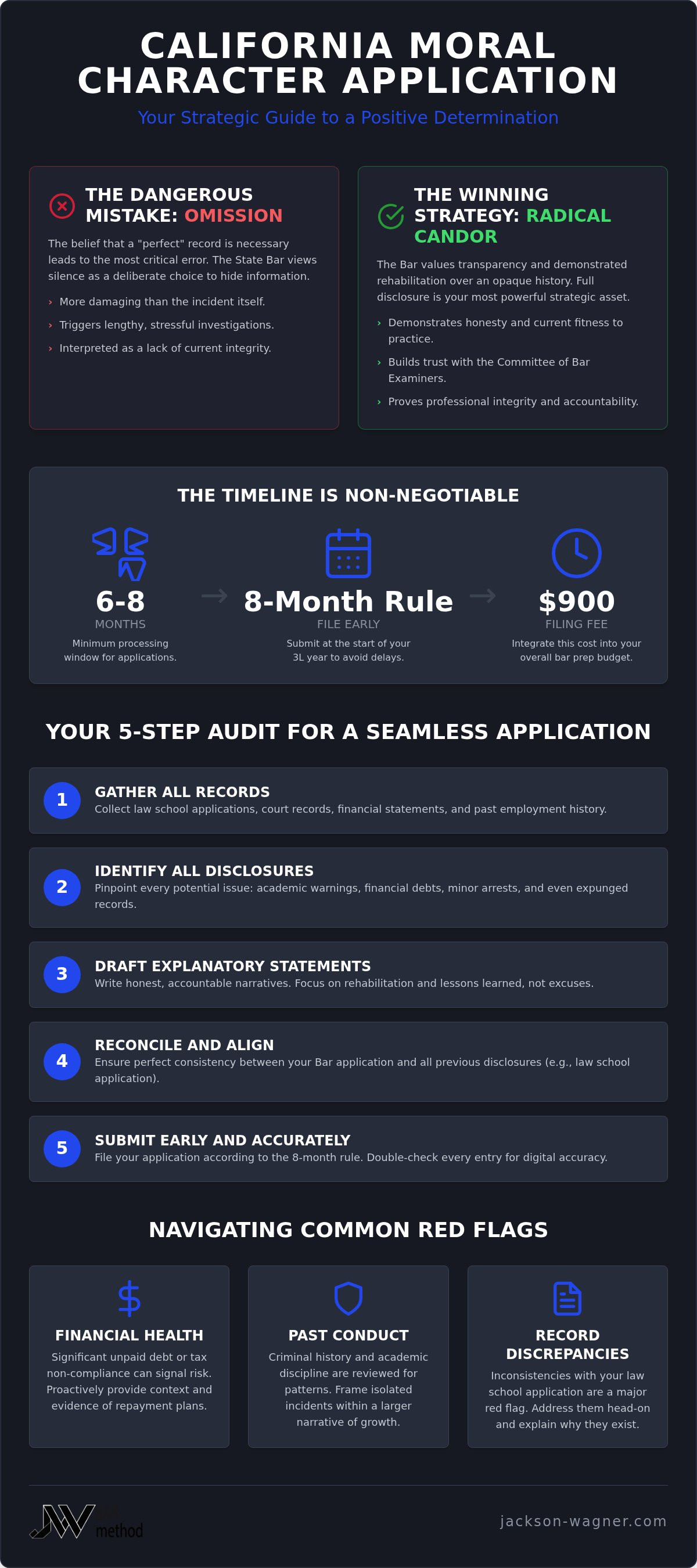
A 5-Step Audit for a Seamless Application Process
Success on the moral character application isn't just about what you disclose; it's about the precision of your preparation. Most applicants simply follow the State Bar's checklist, but a strategic audit of your own history before you open the portal is what prevents multi-month delays. These moral character application tips california candidates use to bypass common roadblocks focus on a rigorous, proactive self-screening process. By treating this audit as a professional due diligence exercise, you ensure your application is "bulletproof" before it reaches an investigator's desk.
- Step 1: Conduct a personal records audit. Request your official DMV driving record and a comprehensive credit report. Don't rely on memory for dates or specific incident details.
- Step 2: Reconcile your law school application. Request a copy of your original law school application. Any discrepancy between what you told your school and what you tell the Bar is a major red flag.
- Step 3: Secure prompt character references. Identify individuals who respond quickly to emails and possess a clear understanding of your professional growth.
- Step 4: Draft and vet your explanatory statements. Write your statements with a focus on accountability. Avoid defensive language and ensure the tone remains professional and objective.
- Step 5: Final review for consistency. Verify that every address, employer, and volunteer position over the last 10 years is accounted for without gaps.
Gathering Your Documentation
The 2026 Applicant Portal requires high-quality digital uploads for all supporting documents. You'll need certified court records for any criminal matter, even if it was dismissed or expunged. If you've lived in multiple states, you must secure driving histories from each jurisdiction. Handling missing employment history requires a proactive approach. If a former employer has gone out of business, document your efforts to locate them and provide secondary evidence, such as tax records or old pay stubs, to verify your tenure. This level of detail demonstrates your commitment to transparency and administrative competence.
Vetting Your References
Your choice of references can significantly influence the speed of your determination. While personal friends are acceptable, "legal" references, such as former supervising attorneys or law professors, often carry more weight. These individuals understand the ethical standards of the profession and can speak to your character with professional authority. Ensure your references are prepared for potential Bar inquiries. They should be aware of any disclosures you've made so their statements don't inadvertently contradict your application. Master your licensure timeline by pairing this rigorous audit with the structure of JW Bar Method Prep to ensure every aspect of your candidacy reflects excellence.
Integrating Character Prep into Your JW Bar Method Plan
Treating your moral character application as a separate administrative burden is a mistake that often leads to avoidable stress. Instead, view this process as your first exercise in "California Bar Precision." The same attention to detail required to reconcile your historical records is what you'll eventually apply to our performance test and essay frameworks. By integrating these moral character application tips california candidates rely on into your broader timeline, you ensure that your focus remains entirely on the law when it matters most. Finalizing your submission early allows you to transition into a focused JW Bar Method Prep experience without the distraction of pending background inquiries.
Securing a positive determination isn't just a hurdle; it's a strategic milestone. Jackson-Wagner’s structured approach applies to every facet of the state of california state bar requirements. We believe that professional empowerment comes from eliminating variables that cause anxiety. When you file your application months in advance, you're clearing the psychological deck for the intensive cognitive work required during the final 60 days of your study schedule.
The Mental Edge of Administrative Readiness
The "waiting game" is one of the most draining aspects of the licensure process. If you wait until you're deep in bar prep to handle your moral character disclosures, you're inviting administrative stress into your peak study window. This organized mindset is particularly vital for those tackling the California Attorney’s Exam, where the stakes are high and the timeline is compressed. Confidence in your eventual licensure starts with a complete and honest profile. When you know your background investigation is already in motion, you can commit 100% of your energy to mastering the exam’s pedagogical and strategic requirements.
Next Steps for 2026 Candidates
Before your JW Bar Method course begins, use this final checklist to ensure your application is ready for the State Bar's 2026 standards. Verify that your digital uploads are legible, your references are alerted, and your explanatory statements are polished and professional. Once your application is filed, you can move forward with the absolute certainty that your administrative affairs are in order. This allows us to focus together on the proprietary success strategies that lead to a passing score. Don't let a pending determination shadow your performance on exam day.
Ensure your exam success with the JW Bar Method by starting your professional audit today. We're ready to guide you through an accelerated study track that respects your time and demands your best performance.
Secure Your Professional Future in California
Your path to licensure is as much about administrative precision as it is about substantive law. By embracing radical candor and executing a rigorous personal audit, you remove the barriers that often delay 2026 candidates. These moral character application tips california applicants follow are designed to transform a high-stakes background check into a clear demonstration of your current professional fitness. Don't let a past mistake or an administrative oversight define your career; instead, use the application process to prove you possess the integrity required of an officer of the court.
Once your application is filed, your focus must shift entirely to the exam itself. We replace the stress of high-pressure certification with a structured, modern, and reliable path to success. Our California-specific pedagogy and results-oriented study tracks provide the confidence-building curriculum you need to dominate the exam. You've done the work to build your character. Now, it's time to master the JW Bar Method and finalize your transition into the profession. Master the California Bar with the JW Bar Method and step into your new career with the absolute trust of the State Bar. Your future as a California attorney is within reach; start your journey with the right strategy today.
Frequently Asked Questions
How long does the California moral character determination take in 2026?
The State Bar currently requires a minimum of six to eight months for processing from the date of submission. This 180 day window can extend significantly based on the complexity of your background or the responsiveness of your references. Because processing times vary, we recommend filing early in your 3L year or immediately upon starting your JW Bar Method timeline to avoid licensure delays.
Can I take the California Bar Exam if my moral character application is still pending?
You are permitted to sit for the examination while your application is still under review. However, you cannot be sworn in as an attorney until you receive a positive determination. If your results are released and your status is still pending, you'll remain in administrative limbo. Coordinating your filing with our strategic moral character application tips california guide ensures you aren't waiting for clearance after passing.
Do I need to disclose a DUI if it was expunged or happened over 10 years ago?
You must disclose all arrests and convictions, regardless of how much time has passed or whether the record was expunged. California's disclosure requirements are exceptionally broad; they specifically include set-aside or sealed records. Failing to mention a decade-old incident is often viewed as a lack of current candor. It's better to provide a professional explanatory statement than to risk a negative determination for an omission.
What happens if the State Bar requests an informal conference or hearing?
An informal conference is a request for you to clarify specific areas of concern directly with investigators. This typically occurs when your written disclosures require further context or when third-party information contradicts your application. While this sounds intimidating, it's an opportunity to demonstrate your rehabilitation and integrity. Prepare for this with the same precision you'd use for a legal oral argument to ensure a positive outcome.
Does the State Bar of California check social media accounts during the investigation?
The State Bar's investigation is comprehensive and can include a review of your public digital footprint. While they don't necessarily audit every applicant's social media, any information that contradicts your claims of honesty or fairness is fair game. Ensure your online presence reflects the professional standards expected of a lawyer. A clean, consistent digital profile supports your overall narrative of professional fitness and integrity.
How much does the moral character application fee cost in 2026?
The standard application fee for a Determination of Moral Character is $900.00 for general applicants as of August 2026. Foreign attorney applicants may face higher costs, with some reports indicating fees around $1,080.00. For these candidates, ensuring that all international legal and residency records are perfectly aligned is crucial, and professional resources like MJ Law can provide the specialized perspective needed for such disclosures. This is a non-refundable investment in your career, so ensure your application is accurate before submission to avoid the need for costly re-applications or supplemental filings later in the process.
What should I do if I realize I made a mistake on a previously submitted application?
You have a continuing duty to update your application with any new or corrected information within 30 days of the change. If you discover an error after submission, notify the State Bar immediately through the Applicant Portal. Proactive correction is viewed as a sign of integrity and candor. It's much better to self-report an oversight than to wait for an investigator to discover the discrepancy during their background check.
Can financial debt alone cause a negative moral character determination?
Financial debt isn't an automatic disqualifier, but a pattern of fiscal irresponsibility or tax non-compliance is a significant red flag. The Committee looks for evidence of fiduciary responsibility and respect for the law. If you have significant debt, you must show you're acting in good faith to resolve it. Utilizing professional moral character application tips california strategies involves presenting a clear plan for repayment to satisfy the Bar's integrity standards.


