

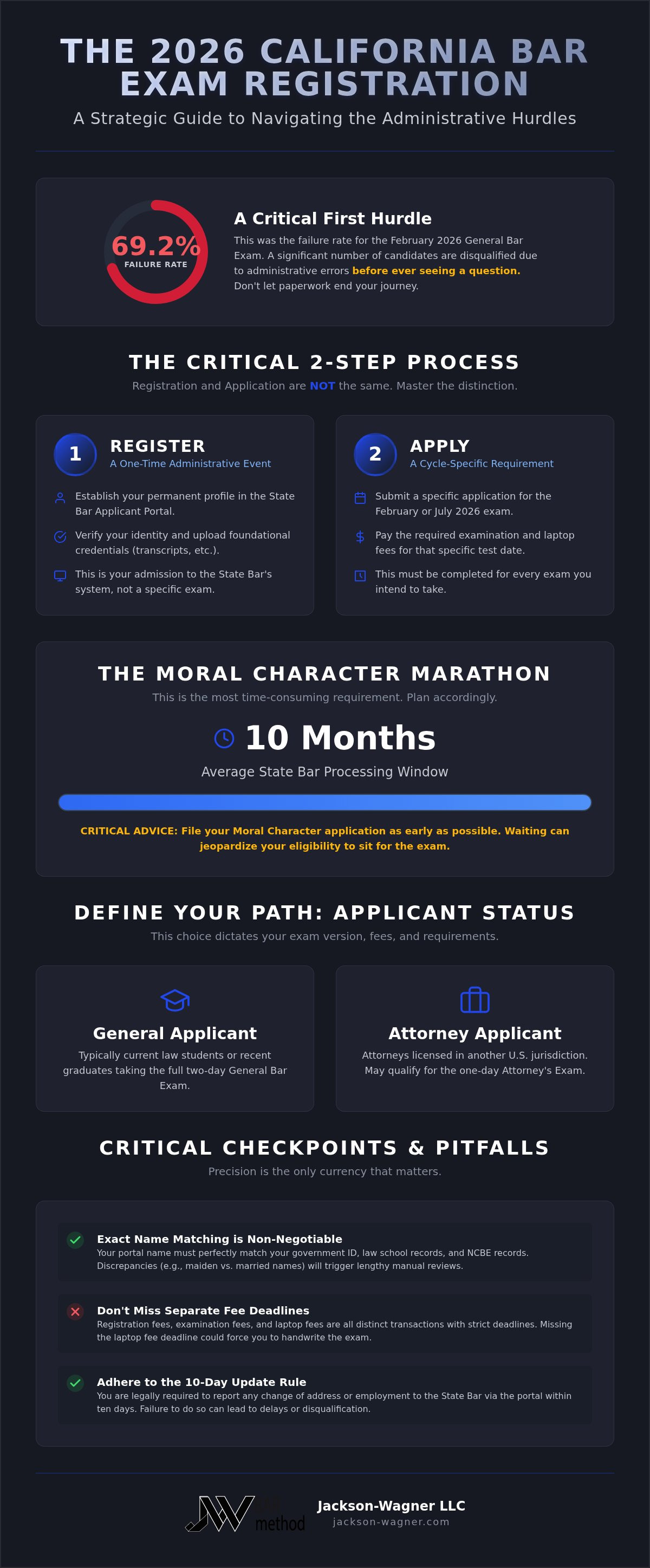
Did you know that 69.2% of applicants failed the February 2026 General Bar Exam? While that statistic is sobering, a significant number of candidates are disqualified before they even see a single essay question due to administrative errors. The california bar exam registration process is the first high-stakes hurdle of your licensure journey, and it's a system where precision is the only currency that matters. You're likely feeling the weight of the State Bar's complex multi-step portal and the daunting 10-month lead time required for Moral Character clearance. It's a heavy burden to carry when your focus should be on mastery, not paperwork.
We're here to replace that administrative anxiety with absolute certainty. Our 2026 strategic guide provides a precise roadmap to navigate the State Bar's bureaucratic requirements without a single misstep. We'll outline the critical 2026 filing windows, break down the fee structures for first-time and attorney applicants, and provide a clear timeline for your Moral Character determination. By mastering these logistics now, you'll secure the mental bandwidth necessary for a seamless transition into your JW Bar Method prep. This is how you build the foundation for a successful result.
Key Takeaways
- Master the State Bar of California Applicant Portal and learn the critical distinction between one-time registration and cycle-specific applications to prevent administrative delays.
- Secure your 2026 timeline by filing the Moral Character determination application early to account for the State Bar’s lengthy 10-month processing window.
- Navigate the 2026 fee increases and strict filing deadlines with our comprehensive roadmap for the california bar exam registration process.
- Transition seamlessly from bureaucratic hurdles to high-performance study by integrating your registration milestones with the JW Bar Method prep strategy.
Navigating the State Bar of California Applicant Portal
The Applicant Portal is your administrative command center. Every interaction with the State Bar of California occurs within this centralized digital environment. It isn't just a website; it's the definitive repository for your legal career's foundation. Accuracy here is non-negotiable. A single typo in your Social Security number or a mismatched middle initial can trigger manual review cycles that last weeks. For the 2026 cycle, the portal interface has been optimized for modern browsers. You should use the latest version of Chrome or Safari to avoid script errors during the high-stakes fee payment phase. Data security is handled via high-level encrypted protocols. This ensures your sensitive transcripts and personal history remain protected under strict professional compliance standards.
Creating Your Admissions Profile
Your first move involves establishing a permanent profile. This step is distinct from the exam application itself. You'll need to verify your identity through a multi-factor authentication process to secure your data. One of the most frequent pitfalls involves name matching. Your portal name must exactly match your records with the NCBE and your law school. If your school uses a maiden name but your government ID uses a married name, the system will flag the discrepancy. This stalls the california bar exam registration process before it even begins. Accuracy prevents these avoidable friction points. Keep your contact information current; the State Bar sends critical 2026 alerts regarding venue changes and deadline reminders exclusively through this portal.
Determining Your Applicant Status
You must correctly identify as either a General Applicant or an Attorney Applicant from the outset. General applicants are typically current law students or recent graduates. Attorney applicants are those already licensed in another jurisdiction. This choice is pivotal. It dictates which version of the exam you'll sit for and the specific fees you'll pay. Out-of-state lawyers often qualify for the one-day Attorney's Exam, which requires a specialized registration track. This distinction is a fundamental component of the california bar exam registration process. Remember the 10-day rule; you're legally required to report any status changes, such as a change in employment or residential address, within ten days. Failing to update this status through the portal can lead to administrative disqualification or significant delays in your Moral Character clearance.
The 2-Step Registration Process for the 2026 Bar Exam
The most dangerous misconception in the california bar exam registration process is the belief that registering and applying are synonymous. They are not. Think of registration as your permanent admission to the State Bar’s system, while the application is your specific reservation for a 2026 test date. Registration is a one-time administrative event. The application is a recurring, cycle-specific requirement. By completing your registration months before the filing window opens, you eliminate the risk of documentation delays. This strategic buffer allows you to focus on your study schedule rather than chasing down law school transcripts during peak prep weeks.
Managing the financial commitment requires a multi-tiered approach. You'll face an initial registration fee to establish your profile. Later, you'll pay the examination fee, and if you choose to use your own computer, a laptop fee. These are distinct transactions. Failing to pay the laptop fee by the deadline, for instance, could force you to handwrite the entire exam; a catastrophic outcome for most modern applicants. Precision in your financial planning prevents these last-minute crises. Consult the Official California Bar Examination Information to verify the exact fee structure for your applicant type, as attorney fees differ from student fees.
Step 1: General Registration as an Applicant
This phase involves uploading your credentials to the State Bar. For law students, this means verifying your degree status with your institution. For out-of-state and international lawyers, the requirements are more rigorous. You'll need to submit certificates of good standing from every jurisdiction where you hold a license. Approval isn't instantaneous. You must track your status in the portal and wait for the Approved notification. If you're a working professional, managing these logistics early is the first step toward the JW Bar Method Prep - Attorney’s Exam California Bar track, where administrative efficiency is a prerequisite for success.
Step 2: The Specific Examination Application
After registration is finalized, you must file the actual exam application. For the February 2026 cycle, the timely filing window runs from October 1st to November 1st, 2025. For the July 2026 exam, the window opens on March 1st and closes on April 1st. If you need special accommodations under the ADA, you must act even faster. The State Bar requires accommodation requests to be filed by January 1st for the February exam and June 1st for July. Your application is only complete once you see the Green Checkmark in the portal and receive a confirmation email. Any ambiguity at this stage can lead to administrative disqualification, so verify your submission immediately.
Managing the Moral Character and MPRE Requirements
The Moral Character application represents the most significant administrative hurdle within the california bar exam registration process. While the exam itself tests your legal knowledge, this investigation scrutinizes your past to ensure you meet the high ethical standards of the profession. This process is exhaustive. It requires coordination with multiple third-party entities for Live Scan fingerprints, character references, and verified records from every past employer you've had for the last ten years. We strongly recommend filing your California Bar Exam Moral Character Application as early as possible. Waiting until you've passed the bar can result in a frustrating delay where you're legally qualified to practice but administratively barred from being sworn in.
Strategic Timing for Moral Character Applications
The State Bar reports that processing these applications can take between 8 and 10 months. To stay within the "safe zone," you should ideally file during your second year of law school or at least six months before your intended exam date. If you have "Red Flag" disclosures, such as past criminal records or significant financial issues, you must prioritize absolute candor. Inconsistencies are often viewed more harshly than the original offense. You can monitor your progress by checking the "Admissions" tab in the State Bar of California registration portal regularly. This ensures all third-party disclosures have been received and no documents are missing.
MPRE Scores and Final Certification
The Multistate Professional Responsibility Examination (MPRE) is the final administrative piece of the puzzle. For the 2026 cycle, California requires a minimum scaled score of 86. You must manage the transfer of these scores from the NCBE to the State Bar yourself. An "incomplete" MPRE status is a common trap for applicants who assume the process is automatic. Even if you pass the General Bar Exam with flying colors, a missing MPRE score will halt your certification entirely. This administrative oversight can prevent you from practicing for months while you wait for the next MPRE testing window. Ensure your score is on file before the results for the 2026 exam cycle are released. This level of administrative precision is what allows you to focus on the high-stakes demands of the california bar exam registration process and your subsequent studies.
2026 Deadlines, Fees, and Administrative Logistics
Precision in the california bar exam registration process is your first competitive advantage. While many candidates focus solely on the black letter law, administrative negligence often derails high-potential applicants before they reach the testing hall. Just as technical teams utilize Jol to simplify and manage complex system operations, you must apply a high level of operational rigor to your registration paperwork. The State Bar of California operates on a rigid, non-negotiable schedule. Missing a deadline by even a few minutes can result in significant late fees or total disqualification from the 2026 cycle. You must distinguish between the various financial obligations early to avoid budget surprises.
For the 2026 cycle, the State Bar has established a clear fee hierarchy. Budgeting for these expenses ensures your focus remains on the law, not your bank account. The primary costs include:
- General Application (First-Time): $677
- General Application (Attorney): $983
- Attorney Applicant Application: $1,650
- Laptop Fee: $153
- Late Filing Fee: $50
Timelines for February vs. July 2026 Exams
The timely filing window for the February 2026 exam opens on October 1, 2025, and closes on November 1, 2025. Applications submitted between November 2 and November 30 incur a late fee, while the final filing window extends to January 2, 2026. For the July 2026 exam, the timely window begins on March 1, 2026, and closes on April 1. The final deadline for the July 2026 exam represents the absolute cutoff for all applications, including those with late penalties, after which the State Bar will not accept any further submissions for that cycle. If you need to withdraw, doing so before the final deadline is the only way to secure a partial refund of your application fees.
Testing Logistics: Laptop and Center Selection
Laptop testing is the standard, but it requires proactive certification. You'll use ExamSoft or a similar approved interface to complete your essays. You must register your device and complete a mandatory mock exam during the certification period, which usually occurs 4 to 6 weeks before the test date. Failing this step forces you to handwrite the exam; a risk no modern applicant should take. Testing centers are assigned on a first-come, first-served basis. If you want a center near your home to avoid a long commute or expensive hotel stay, you must finalize your application the moment the window opens. Your Admittance Ticket will be available in the portal 3 to 4 weeks before the exam.
Professionals who demand an efficient path to licensure often choose the JW Bar Method Accelerated Prep - Full California Bar Exam to match their administrative precision with pedagogical excellence.
Beyond Registration: Integrating Your Prep Strategy
Completing the california bar exam registration process is merely the administrative gatekeeper. Once you've secured your seat in the 2026 cycle, your primary objective shifts instantly from bureaucracy to substantive mastery. Administrative compliance isn't just a checkbox; it's the strategic foundation that allows for total mental immersion. By finalizing your profile and Moral Character standing early, you eliminate the administrative drag that plagues less-organized candidates during the high-pressure weeks before the test. This clarity is a prerequisite for the JW Bar Method, where we replace the anxiety of paperwork with the precision of performance-driven drills.
Aligning your study calendar with the official California Bar Exam timeline is essential for success. Our pedagogy is built on the premise that once the State Bar confirms your eligibility, every hour must be spent on high-yield mastery. We don't believe in the volume-heavy models of legacy providers that prioritize busywork over results. Instead, we utilize the post-registration window to maximize pedagogical impact, ensuring you're not just studying, but evolving into a licensed professional.
Why Registration Precision Matters for JW Bar Method Students
Effective prep requires a clear mind. When you choose the best bar exam preparation service, you're investing in a system that demands your full attention. We've designed our dashboard to pick up exactly where the State Bar portal leaves off. The moment your registration is finalized, you transition from the applicant portal to the JW Bar Method dashboard. This seamless integration ensures your 2026 timeline is respected, allowing you to focus on high-stakes essay drills and MBE precision without the distraction of missing transcripts or pending fees.
Transitioning to Strategic Mastery
Your confirmed exam date is the anchor for your study milestones. Understanding the state of california state bar rules regarding testing logistics gives you a tactical edge. For example, knowing the exact timing of your admittance ticket release allows you to plan your final mock exams with surgical precision. This is the moment to finalize your commitment to the JW Bar Method accelerated track. We provide a binary performance guarantee because our method is built on this level of strategic integration. We're so certain of our efficacy that we assume the financial risk of your outcome. Registration is the start; mastery is the result.
Secure Your Path to the 2026 California Bar
Mastering the california bar exam registration process is the first definitive step toward your legal career. Precision is mandatory. You've learned that accuracy in the Applicant Portal and early Moral Character filing are strategic necessities, not just suggestions. By securing your testing center and completing laptop certification ahead of schedule, you remove the administrative friction that distracts from substantive mastery. This logistical excellence creates the mental space required for the high-stakes drills ahead.
At Jackson-Wagner LLC, we specialize in turning this administrative foundation into a successful result. Our exclusive focus on California Bar pedagogy and specialized Attorney's Exam accelerated tracks ensures you aren't wasting time on generic materials. We're so confident in our proprietary system that we offer an industry-leading performance guarantee. Secure your 2026 success with the JW Bar Method; explore our California prep programs. You've handled the bureaucracy; now it's time to achieve the mastery your career deserves. Your future as a California attorney starts with this commitment.
Frequently Asked Questions
When does registration open for the February 2026 California Bar Exam?
Registration for the February 2026 exam officially opens on October 1, 2025. You have until November 1, 2025, to submit your application within the timely filing window. Missing this initial period triggers late fees, so it's vital to finalize your submission early. This ensures you can transition quickly from administrative tasks to your intensive study curriculum.
What is the difference between the California Attorney's Exam and the Full Bar Exam?
The Attorney's Exam is a specialized one-day test designed for lawyers already licensed in another jurisdiction, while the Full Bar Exam is a two-day assessment for general applicants. Attorney applicants must have practiced law for at least four years in another state to qualify. This distinction significantly impacts your california bar exam registration process, as fees and documentation requirements vary between these two tracks.
How much are the registration fees for the 2026 California Bar?
First-time general applicants will pay a base fee of $677, while attorney applicants face a fee of $983 for the general exam. If you're filing an Application to take the California Bar Examination as an Attorney Applicant, the cost is $1,650. You must also account for the $153 laptop fee and the $551 Moral Character application fee to ensure your budget is complete.
Can I register for the California Bar Exam before I graduate law school?
You can and should register as a law student with the State Bar of California well before your graduation date. This initial registration is a prerequisite for filing your actual exam application. Most students complete this step during their first year of study to initiate the long-term Moral Character investigation process. Early registration prevents last-minute technical hurdles when the exam application windows finally open.
What happens if I miss the timely filing deadline for the 2026 exam?
Missing the timely filing deadline results in a mandatory $50 late fee during the secondary filing window. For the February 2026 exam, the final hard cutoff is January 2, 2026. If you fail to submit by the final deadline, you'll be administratively disqualified from that cycle. There are no exceptions for technical issues, so you should always aim for the initial October or March windows.
How long does the Moral Character application take to process in 2026?
The State Bar of California currently requires 8 to 10 months to process a Moral Character and Fitness application. This lengthy investigation involves extensive background checks and third-party verifications. Because this timeline often extends beyond the exam date, filing early is the only way to ensure you're eligible for swearing-in immediately after passing the bar. Delaying this step can stall your career for months.
Is the MPRE required before I can register for the California Bar Exam?
You don't need to pass the MPRE before starting the california bar exam registration process, but you must pass it before you can be admitted to the bar. California requires a minimum scaled score of 86. Many applicants choose to take the MPRE during their second or third year of law school. This ensures their score is on file with the State Bar before the results of the 2026 bar exam are released.
How do I select my testing center location for the 2026 exam cycle?
You select your preferred testing center directly through the Applicant Portal when you file your specific exam application. These locations are assigned on a first-come, first-served basis, meaning popular sites in major cities fill up within hours. If you require a specific location to minimize travel stress, you must submit your application the moment the filing window opens on October 1st or March 1st.


