
Did you know that in July 2025, the repeater pass rate for the California Bar Exam plummeted to a staggering 12.4%? It's a sobering statistic that proves legacy study methods are failing the candidates who need them most. You've likely already experienced the exhaustion of balancing a career with endless hours of passive video lectures, only to be met with a score report that feels like a riddle. This guide is designed to break that cycle by introducing a high-performance california bar exam retaker strategy that replaces brute-force volume with surgical, data-driven precision.
We'll move past the confusion of your previous attempts to build a clear, diagnostic roadmap for success. You'll learn how to analyze your metrics with precision and focus your energy on the specific pedagogical shifts required to hit that 1390 passing score. We're providing a streamlined blueprint for the July 28 and 29, 2026, exam dates that prioritizes efficiency over exhaustion. This approach ensures you walk into the test center with the absolute certainty that your preparation finally matches the rigor of the exam.
Key Takeaways
- Identify why legacy bar prep courses fail repeaters by prioritizing passive volume over surgical skill development.
- Learn to decode your score report metrics to build a personalized california bar exam retaker strategy that targets your specific performance gaps.
- Transition from passive outline reading to active mastery using pedagogical techniques designed specifically for the 2026 exam format.
- Integrate an accelerated study timeline into your professional schedule to ensure you're ready for the July 2026 administration without burning out.
- Understand how a performance-based financial guarantee replaces exam anxiety with the confidence of a proven, modern methodology.
Why Traditional Bar Prep Fails California Retakers
Traditional bar prep is built on a model of mass consumption. It assumes that if you watch enough videos and read enough outlines, you'll eventually pass. For first-time takers, this brute-force approach might work through sheer saturation. For those facing a retake, it's a recipe for burnout. The 'Volume Trap' is the primary reason candidates fail a second or third time. They spend 100 hours watching lectures they've already seen, hoping for a different result. This is a strategic error. A successful california bar exam retaker strategy isn't about more hours; it's about surgical precision.
Large-scale, legacy prep courses rely on generic feedback. When you submit an essay, you often receive a canned response from a grader who hasn't analyzed your specific reasoning gaps. This failure of individualized critique is why high-achieving attorneys often struggle. Even seasoned practitioners fail to meet the specific academic rubric required for licensure. The February 2026 Attorneys' Examination pass rate was 57.0%. While higher than the general repeater rate, it proves that professional experience doesn't automatically translate to a passing score. You must stop thinking like a student and start thinking like an exam-taker who understands the mechanics of the points.
The Myth of 'Studying Harder'
Repeating the same course that failed you is the definition of a sunk cost. If a generic program didn't help you reach a 1390 in the last cycle, it won't magically work now. There's a law of diminishing returns in passive review. Watching a video for the third time won't fix a logic gap in your Torts analysis. To succeed in 2026, you need a results-oriented mindset that prioritizes active mastery over comfortable review. It's time to abandon the "study harder" mantra in favor of studying smarter.
California's Unique Grading Nuances
The State Bar of California maintains a grading rubric that demands a specific style of 'lawyer-like' analysis. Legacy courses often miss the mark on California-specific essay formatting, focusing instead on multistate generalities. This is a fatal flaw. With the July 2025 repeater pass rate at a staggering 12.4%, the evidence is clear: the status quo is failing. You must master the specific nuances of the California rubric to bridge the gap between a near-miss and a confirmed pass. Your california bar exam retaker strategy must account for these scoring trends to ensure your writing meets the exact expectations of the graders.
Diagnosing Your Score Report: Data-Driven Retake Strategy
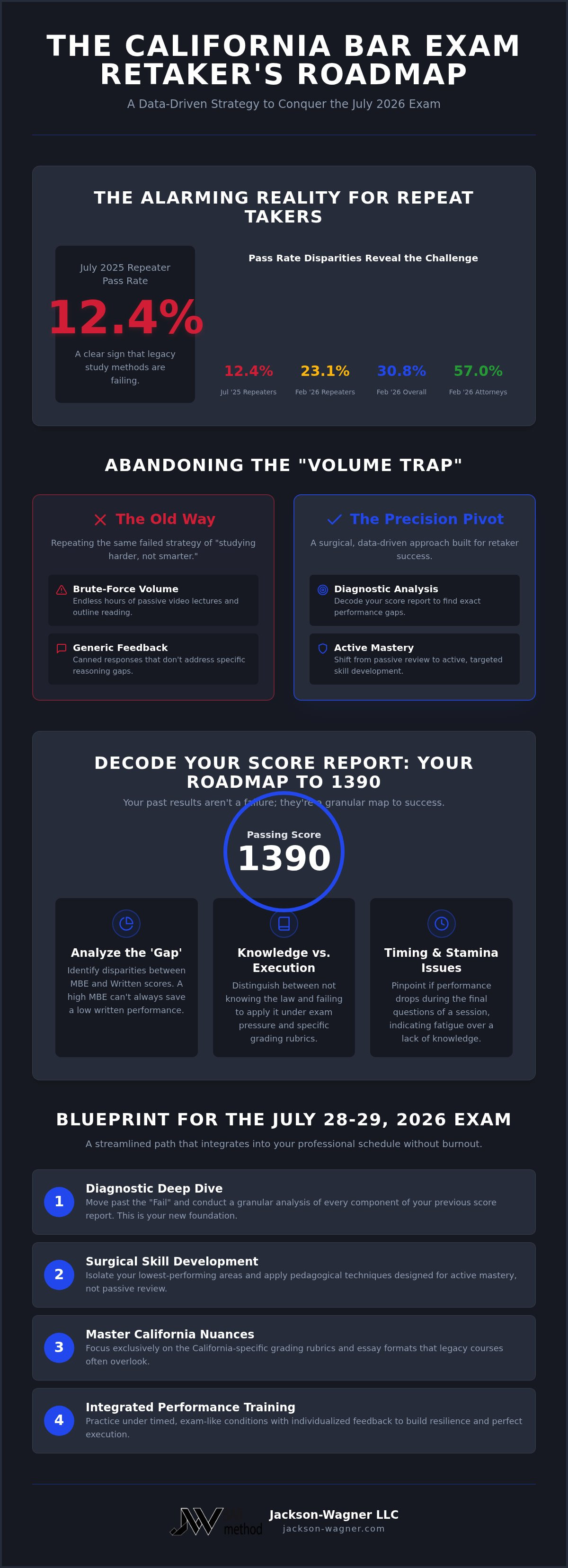
Your score report is the most valuable asset in your possession. It isn't just a record of a setback; it's a granular map of exactly where your previous preparation failed. To build an effective california bar exam retaker strategy, you must look past the "Fail" status and dive into the raw and scaled data. The State Bar of California requires a scaled score of 1390 to pass. While the February 2026 General Bar Examination saw an overall pass rate of 30.8%, the repeater pass rate was notably lower at 23.1%. Bridging this gap requires understanding the math behind the metrics.
Raw scores represent your initial performance on the five essays, the Performance Test, and the MBE. However, these are converted into scaled scores to account for varying difficulty across exam administrations. You can find the official California Bar Examination information regarding how these components are weighted on the State Bar's website. A common mistake is ignoring the 'Performance Gap.' If your MBE scaled score is a 1450 but your written score is a 1300, you don't have a knowledge problem; you have an execution problem. Identifying these disparities allows you to stop wasting time on areas where you're already proficient.
MBE Analysis: Beyond the Percentile
Your MBE percentile only tells you how you performed relative to others. It doesn't explain why you missed questions. You must distinguish between knowledge gaps and timing issues. If your performance drops in the final 20 questions of a session, your problem is stamina, not the law. With current grading trends, a 140+ MBE is no longer a safe harbor that can carry a weak written score. You need a balanced proficiency across the seven core subjects to ensure your california bar exam retaker strategy is resilient. If you're tired of guessing why your scores aren't climbing, consider a more precise diagnostic approach that targets these specific deficiencies.
The Written Diagnostic: Essays and the PT
The Performance Test (PT) is the most underutilized lever in bar prep. It's weighted heavily, yet most legacy courses treat it as an afterthought. A score of 60 on the PT is often the difference between passing and failing. When reviewing your essays, look for patterns in your scores. Consistent 55s usually signal a lack of depth in your analysis; 60s suggest you have the law but aren't hitting the specific 'lawyer-like' formatting the graders expect. You need to master the art of rule-application rather than just issue-spotting to push your written score into the passing range for 2026.
The Precision Pivot: Moving from Passive Review to Active Mastery
The transition from a "failed" status to a licensed attorney requires more than just re-reading your old law school notes. You need a fundamental pedagogical shift. While legacy courses encourage you to consume content, the JW Bar Method demands that you produce it. This is the precision pivot. It replaces the comfort of passive review with the rigor of active mastery. For 2026 candidates, your california bar exam retaker strategy must prioritize the ability to retrieve information under pressure rather than simply recognizing it on a page. If you can't recall a rule in an empty room, you don't know it well enough for the exam.
Active recall is the only way to bridge the gap between knowing the law and applying it. Reading an outline creates a false sense of security called the "fluency illusion," where you confuse familiarity with mastery. The California Bar Exam Statistics consistently show that repeaters who rely on the same passive habits often see their scores plateau. To break this cycle, you must engage in high-intensity california bar exam practice that mimics the cognitive load of the actual test day. This isn't just about doing more work; it's about doing the specific work that translates to points.
Writing for the Rubric
California examiners aren't looking for a law school essay; they're looking for a professional work product. You must master "Attorney-Style" writing, which prioritizes factual integration over abstract legal theory. The JW Bar Method teaches you to structure essays to maximize "point-grabbing" opportunities by using every fact in the prompt. This includes the heavy use of counter-arguments. Graders want to see that you can anticipate an opponent's position and dismantle it. We prioritize the quality of your analysis over word count, ensuring every sentence serves a diagnostic purpose.
MBE Precision Drills
Stop "doing questions" and start "analyzing distractors." Success on the MBE in 2026 requires you to identify why three answers are wrong, not just why one is right. You must learn to spot the "call of the question" in high-pressure scenarios to avoid falling for sophisticated traps. This is especially critical for handling the experimental and difficult items that often rattle unprepared candidates. By moving past surface-level recognition, you develop the surgical precision needed to navigate the MBE with absolute confidence, regardless of the subject matter.
The 2026 California Bar Exam Retaker Roadmap
Legacy courses demand 10 hours of daily study for 10 consecutive weeks. For a working professional, this isn't just difficult; it's impossible. Your 2026 california bar exam retaker strategy must be agile enough to fit into the cracks of a demanding career while maintaining the intensity required to pass. The July 2026 exam dates are set for July 28 and 29. Whether you're targeting the February or July administration, your roadmap must prioritize high-impact execution over mindless repetition. This is the 'Accelerated Prep' philosophy: we condense the fluff and maximize the final 30 days of preparation where the most significant gains are made.
Success as a retaker requires a cognitive shift. You aren't learning the law for the first time; you're refining your ability to deploy it. This means your schedule shouldn't look like a first-timer's calendar. We focus on maintaining emotional and cognitive stamina by avoiding the early-season burnout that plagues many repeat candidates. By the time you reach the final month, you'll have the mental reserve to engage in the surgical drills that actually move the needle on your score report.
Strategic Scheduling for Working Professionals
You don't need to quit your job to pass the bar. You do need to own your time. We recommend 'Early Bird' blocks for attorneys, utilizing the two hours before billable work begins for high-focus MBE drills. Save the 'Night Owl' sessions for lighter review or essay outlining. Weekends are your most critical asset. They should be reserved for full-length california bar exam simulations that build the physical and mental endurance required for two days of testing. Don't be afraid to communicate your study needs to your firm; most employers prefer a brief period of reduced availability over a multi-year cycle of failed attempts.
The Final Push: 14 Days to Success
The last two weeks before the exam are for execution, not learning. You must transition entirely from learning law to executing the exam format. This period is dedicated to full-length, timed mock exams that mirror the 2026 testing environment. You should finalize your 'Attack Outlines' for the most frequently tested subjects, ensuring you have a pre-set plan for every major issue. If you're ready to trade your generic 10-week calendar for a precision-engineered roadmap, explore the JW Bar Method Accelerated Prep - Full California Bar Exam to see how we streamline your path to licensure.
Securing Your License: The JW Bar Method Advantage
Legacy industry standards often offer a "free retake" of their own course if you fail. This is a hollow promise that provides no real security. A free seat in a methodology that already failed you isn't a solution; it's a waste of another six months. The JW Bar Method is the best bar exam preparation service for repeaters because we replace generic support with a binary commitment to your specific result. We've dismantled the traditional study model to focus on the surgical precision required to hit your target score. We don't just provide materials; we provide a modern evolution of the entire learning process.
The most defining signature of our approach is a performance-based financial guarantee. We assume the financial risk of your performance because we're certain of our pedagogical efficacy. This establishes a level of absolute trust that standard industry offerings can't match. Success stories from recent retakers highlight the transition from high-pressure anxiety to the "bold reliability" of a structured, results-driven roadmap. When you choose this california bar exam retaker strategy, you're choosing a partner that's as invested in your license as you are.
The Guaranteed Path to Licensure
Our binary performance guarantee isn't just a marketing claim. It's a professional empowerment tool. There's a massive difference between "academic support" and a financial commitment to your specific result. We've moved past the outdated models of the past to create a student-centric environment that prioritizes your practical needs. Our success in recent exam cycles proves that when you focus on active mastery over passive review, the results follow. We don't just help you study; we ensure you pass.
Next Steps: Reclaiming Your Career
Reclaiming your career starts with a decision to study differently. You can enroll in the JW Bar Method Accelerated Prep to begin your final, successful attempt at the 2026 exam. For those already practicing elsewhere, our tracks are specifically built to meet california attorney's exam requirements without sacrificing your billable hours. While you execute your new california bar exam retaker strategy, don't forget to finalize your california bar exam moral character application to avoid administrative delays. It's time to stop the cycle and start your life as a California attorney.
Join the JW Bar Method and Pass the California Bar
Reclaim Your Career and Secure Your License
The cycle of retaking the bar ends the moment you decide to stop repeating legacy habits. You've learned how volume-based studying fails and why data-driven diagnostics provide the only real path to a passing score. Success in 2026 requires a california bar exam retaker strategy that prioritizes surgical precision and active mastery over the passive consumption of outdated outlines. It's about working smarter, not just longer.
Jackson-Wagner offers the modern alternative you need. With our California-exclusive expertise and accelerated prep tracks designed specifically for working attorneys, we remove the friction from your path to licensure. We're so certain of our methodology that we provide a binary performance guarantee; we assume the financial risk because we know our system works. It's time to trade the exhaustion of uncertainty for the confidence of a proven pedagogical shift.
End the retake cycle; enroll in the JW Bar Method today
You already have the legal talent to succeed. Now, you finally have the right roadmap to prove it to the examiners.
Frequently Asked Questions
How many hours should a retaker study for the California Bar Exam?
You should focus on 20 to 30 hours of high-intensity, active study per week rather than the generic 60-hour schedules recommended by legacy providers. A successful california bar exam retaker strategy prioritizes surgical precision over passive volume. By focusing on your specific diagnostic gaps, you can achieve better results in less time. This is especially critical for working professionals who must maximize every minute of their accelerated prep track to avoid burnout.
What is the pass rate for California Bar Exam retakers in 2026?
The pass rate for repeat takers in the February 2026 General Bar Examination was 23.1%. This figure represents a significant challenge compared to the first-time taker rate of 43.9% from the same administration. These statistics highlight the necessity of shifting away from traditional study methods that failed to produce a passing result. Success in 2026 requires a modern, data-driven approach that addresses the specific reasons why candidates fall short of the required 1390 scaled score.
Should I use the same prep course I used the first time?
Re-enrolling in the same course that failed you is a strategic error that often leads to the same outcome. If a legacy program's volume-heavy approach didn't help you reach a passing score, it's unlikely to fix your specific reasoning gaps in a second attempt. You need a pedagogical shift that replaces passive video consumption with active mastery and personalized feedback. Switching to a disruptive, mentor-led model ensures you aren't just repeating the same mistakes under a different calendar.
Can I pass the California Bar while working full-time?
You can absolutely pass the California Bar while working full-time if you utilize an accelerated study track designed for professionals. Balancing a career requires a california bar exam retaker strategy that focuses on high-impact blocks rather than all-day library sessions. By utilizing early morning sessions and high-intensity weekend simulations, you can build the necessary stamina without sacrificing your billable hours. Our JW Bar Method Accelerated Prep is specifically engineered to accommodate the demanding schedules of working candidates.
What is the most important subject to focus on for a retake?
The Performance Test (PT) is the most critical subject to master because it's worth double the points of a single essay and tests skills rather than memorization. Many retakers ignore the PT in favor of substantive law, which is a fatal mistake. Mastering the PT allows you to pick up significant points through superior organization and factual integration. It serves as a powerful lever to lift your overall written score into the passing range, regardless of the essay topics you encounter.
How do I interpret my California Bar Exam score report?
You should interpret your score report by identifying the "Performance Gap" between your scaled MBE and written scores. If your MBE is significantly higher than your written score, your issue is execution and formatting, not a lack of legal knowledge. Conversely, low scores in specific MBE subjects indicate substantive law gaps. Analyzing these metrics with surgical precision allows you to build a roadmap that targets your actual weaknesses instead of wasting time on strengths you've already mastered.
What happens if I fail the California Bar Exam multiple times?
There's no limit to how many times you can take the California Bar Exam, but multiple failures suggest a fundamental flaw in your preparation methodology. Each attempt costs $878 in application fees and months of lost income. To break the cycle, you must move beyond the "study harder" mindset and adopt a disruptive, results-oriented strategy. Our binary performance guarantee is designed to provide the security and structure needed to finally move past the exam and reclaim your professional life.
Is the California Attorney's Exam easier than the full Bar Exam?
The Attorneys' Examination isn't necessarily easier; it simply removes the MBE portion for qualifying out-of-state lawyers. While you only face the written day, the grading rubric remains just as rigorous as the General Bar Exam. In February 2026, the Attorneys' Examination pass rate was 57.0%. Success still requires mastering the specific California "lawyer-like" analysis and formatting that examiners demand. Professional experience alone won't carry you to a passing score without a dedicated strategy for the written rubric.


