

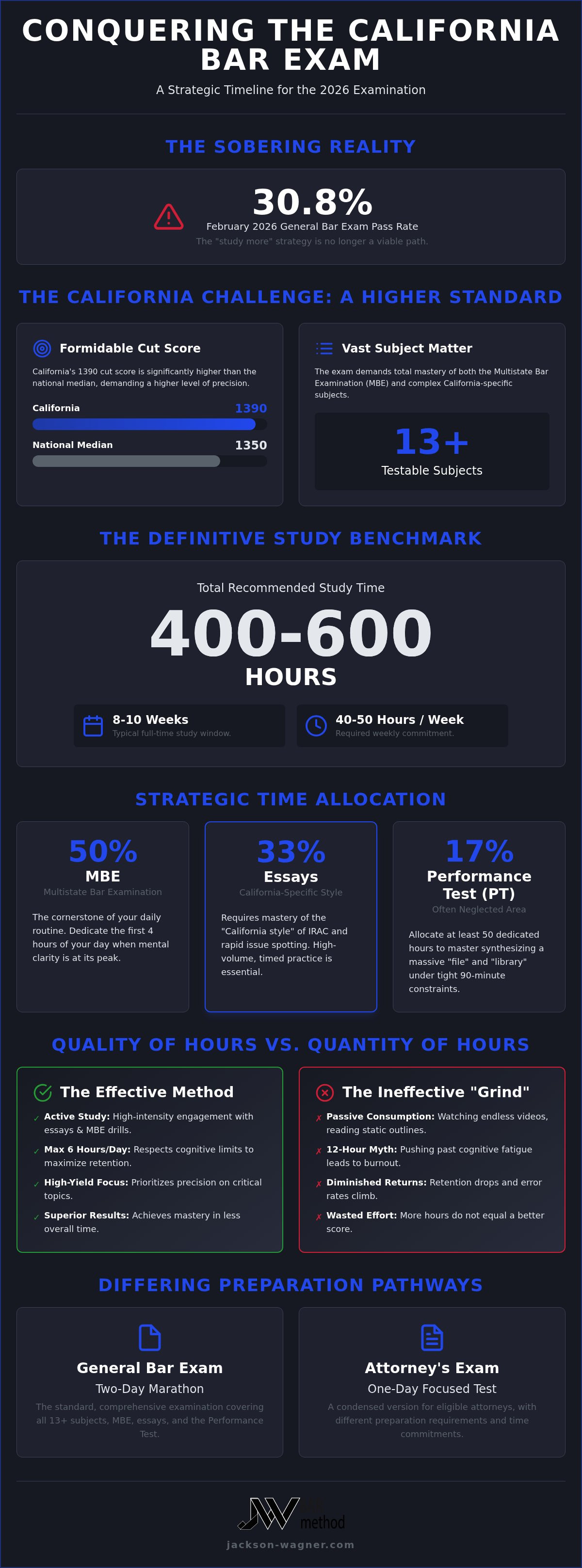
With the February 2026 General Bar Exam pass rate sitting at a sobering 30.8%, the traditional "study more, sleep less" strategy is no longer a viable path to licensure. The most critical decision you'll make isn't which high-volume outline to buy; it's exactly how long to study for california bar exam success while protecting your professional and personal life. Most applicants feel crushed by the weight of 13 testable subjects, fearing they'll become another statistic in California's notoriously low pass rates.
You deserve a clear, defensible plan that replaces exam-day anxiety with absolute confidence. This guide reveals the precise study hours and strategic timelines required to conquer California's rigorous standards without the typical burnout associated with legacy programs. We'll explore how a structured, methodology-first approach allows you to optimize every hour, ensuring your path to the 2026 bar is both efficient and successful. By moving away from outdated models, you can secure your license and focus on your future as a California attorney.
Key Takeaways
- Learn why the 400 to 600 hour benchmark remains the definitive standard for mastering the 13 plus subjects required for California licensure.
- Calculate exactly how long to study for california bar exam success by aligning your schedule with either the traditional 10 week window or an accelerated professional track.
- Identify the critical differences in preparation time between the standard two-day General Bar Exam and the one-day Attorney's Exam.
- Master a phased scheduling approach that shifts your focus from foundational knowledge to high-volume practice at the optimal moment.
- Discover how the JW Bar Method prioritizes precision over sheer volume to maximize your results in a shorter, higher-intensity study window.
The Reality of the California Bar Exam Timeline in 2026
The California Bar Exam is a two-day marathon that demands total mastery of both the Multistate Bar Examination (MBE) and complex California-specific subjects. It's an endurance event designed to filter out anyone without a rigorous, disciplined approach. To understand the full scope of what you're up against, including the 13 plus subjects tested, this California Bar Examination overview provides essential context on the exam's structure and history. You aren't just memorizing rules; you're preparing to perform under extreme pressure.
Determining exactly how long to study for california bar exam success depends on your background and current obligations. The traditional "study window" typically spans 8 to 10 weeks of full-time dedication. This path usually requires 40 to 50 hours of weekly commitment, which is often impossible for working professionals or those with family duties. Modern, accelerated tracks now offer a more efficient alternative, focusing on high-impact methodology rather than just counting weeks on a calendar. You need a plan that respects your time while meeting California's uncompromising standards.
Success in 2026 requires a fundamental shift in how you view preparation. Passive content consumption, such as watching endless lecture videos or reading static outlines, won't get you a passing score. You must transition to active methodology application early in your timeline. This means practicing timed essays and performance tests until the process becomes second nature. Every hour you spend must be an investment in your ability to apply the law, not just recall it.
Why the California 1390 Cut Score Changes Your Timeline
California's 1390 cut score is a formidable barrier, sitting significantly higher than the national median of 1350. This 40-point gap means that a performance considered "passing" in most other states would result in failure here. The grading system is often perceived as an all-or-nothing gauntlet where minor errors in analysis can lead to devastating score deductions. The 1390 cut score acts as the primary driver of study intensity, forcing applicants to achieve a level of precision that other jurisdictions simply don't require. You cannot afford to aim for the middle; you must aim for mastery.
Quality of Hours vs. Quantity of Hours
The myth of the 12-hour study day has led many talented applicants to burnout before they even reach the testing center. Cognitive fatigue is a biological reality that typically sets in after six hours of intense mental labor. When you push past this limit, your retention drops and your error rate climbs. The JW Bar Method rejects this "grind" mentality by prioritizing high-yield topics to compress the necessary timeline. We define active study as high-intensity engagement with rigorous essay prompts and MBE drills. By focusing on the quality of your focus rather than the quantity of your hours, you can achieve superior results in less time.
The 400-600 Hour Benchmark: A Realistic Breakdown
Determining how long to study for california bar exam success begins with a clear understanding of the 500-hour benchmark. For the majority of law graduates, this translates to 10 weeks of full-time effort, averaging 40 to 50 hours every week. While some legacy programs suggest a flat 400-hour goal, California's complexity often demands more. You aren't just memorizing rules; you're training for a high-stakes performance that requires specific cognitive conditioning. This total hour count is the price of entry for a license in the nation's most rigorous jurisdiction.
Allocating Time Across the Three Exam Components
The MBE accounts for 50% of your total score, making multiple-choice drills the cornerstone of your daily routine. We recommend dedicating the first four hours of your day to these questions when your mental clarity is at its peak. Essays make up 33% of the grade, requiring you to master the "California style" of IRAC and rapid issue spotting. Finally, the Performance Test (PT) represents 17% of the total. Even though it's a smaller percentage, it's often the most neglected area. You should allocate at least 50 hours of dedicated practice to the 90-minute PT to ensure you can synthesize a massive "file" and "library" under tight constraints. For the latest details on the test structure, consult the official California Bar Exam information provided by the State Bar.
Calculating Your Personal Study Requirement
Your specific timeline depends on three critical factors. First, consider how recently you graduated or practiced law. If you've been out of the classroom for years, your foundational knowledge may require a longer ramp-up period. Second, assess your familiarity with California-specific subjects like Community Property and Professional Responsibility. Third, your baseline performance on a diagnostic MBE or essay prompt will dictate your intensity. If your diagnostic scores are low, you may need to extend your window to the 600-hour mark. If you are balancing a full-time career, the JW Bar Method Accelerated Prep - Full California Bar Exam provides a more efficient framework to hit these benchmarks without sacrificing your professional obligations.
Adjusting your timeline based on your first-year law school performance is also a smart move. Those who excelled in 1L subjects like Torts and Contracts might find they can shift more hours toward California-specific essay topics. However, if those subjects were a struggle, you'll need to front-load your schedule with substantive review. Precision in your planning is what separates those who pass from those who become part of the repeat-taker statistics.
Full Bar Exam vs. Attorney’s Exam: Differing Prep Requirements
Choosing the correct path to licensure is the most significant factor in your preparation strategy. The General Bar Exam is a two-day marathon, while the Attorney’s Exam offers a streamlined, one-day format for those who qualify. Understanding these structural differences is the first step in calculating how long to study for california bar exam success. While the content overlaps, the cognitive demands and time commitments for each path vary significantly.
Timeline for the Two-Day Full Bar Exam
First-time applicants and those not yet licensed in another state face the full two-day challenge. Day one consists of five one-hour essays and one 90-minute Performance Test. Day two is dedicated entirely to the 200-question Multistate Bar Examination (MBE). Because you must balance MBE endurance with high-speed essay writing across 13 plus subjects, a 10-week window remains the recommended safety zone. This timeframe provides the necessary cushion to master substantive law while building the mental stamina required for 12 total hours of testing. Attempting to compress this into a shorter window often leads to gaps in subject mastery that the 1390 cut score will ruthlessly expose.
Accelerated Prep for the Attorney’s Exam
Practicing attorneys who have been in good standing in another U.S. jurisdiction for at least four years may qualify for the one-day exam. This version omits the MBE entirely, focusing exclusively on the written components: five essays and one Performance Test. This shift fundamentally changes your preparation timeline. Instead of a 10-week grind, many professionals successfully execute a 4 to 6 week high-intensity sprint. You can verify your eligibility and specific rules in our California Attorney's Exam requirements guide.
Experienced lawyers can leverage their professional background to significantly shorten their study window. You don't need to relearn the fundamentals of legal practice; you need to master the specific grading rubric of the California examiners. The focus shifts from broad memorization to California-specific essay methodology and the 90-minute Performance Test. Our JW Bar Method Prep - Attorney’s Exam California Bar is built specifically for this transition. It prioritizes precision over volume, ensuring you aren't wasting valuable hours on MBE subjects that aren't on your test. This targeted approach allows you to secure California licensure without taking an extended leave of absence from your current practice.
Strategic Scheduling: How to Optimize Your Study Window
When mapping out how long to study for california bar exam success, don't treat your calendar as a monolithic block of time. Effective preparation requires a phased approach that mirrors the way the brain encodes and retrieves complex information. By breaking your schedule into three distinct segments, you ensure that you aren't just reading outlines, but actually building the muscle memory needed for the 1390 cut score. This structure allows you to track your progress objectively and adjust your intensity before you reach the point of exhaustion.
- Phase 1: Substantive Review (Weeks 1-4). This initial month is dedicated to building a foundational knowledge base. You'll map out the 13 plus testable subjects, focusing on the highly tested "big ticket" items while creating condensed rule statements for later memorization.
- Phase 2: Practice and Application (Weeks 5-7). This is the most critical pivot in your timeline. You must shift from passive reading to high-volume drills and timed essays. Use our California Bar Exam practice checklist to ensure your daily drills are hitting the necessary targets for both the MBE and written components.
- Phase 3: The Final Polish (Weeks 8-10). The final three weeks are reserved for full-day exam simulations and aggressive memory reinforcement. You're training your brain to maintain focus for 12 hours of testing over two days.
The Dangers of Over-Studying and the 'Burnout Point'
Burnout is a biological reality that can derail even the most brilliant applicants. Diminishing returns typically set in when you push beyond your mental threshold without adequate recovery; if you find yourself reading the same paragraph three times without comprehension, you've hit the burnout point. To maintain cognitive sharpness, you must schedule one full day of rest every week. Cramming is mathematically impossible for an exam of this magnitude. Your brain requires downtime to consolidate the massive volume of legal rules you're absorbing into long-term memory.
Can You Study While Working Full-Time?
For many professionals, a 10-week full-time window is a luxury they don't have. A 20-week alternative is the most effective way to calculate how long to study for california bar exam mastery while maintaining your career. This track spreads the 500-hour benchmark over five months, requiring roughly 25 hours of study per week. Morning study sessions are usually superior for complex rule absorption, as your brain is most receptive before the fatigue of the workday sets in. If you are balancing a high-stakes career with bar prep, the JW Bar Method Accelerated Prep - Full California Bar Exam provides a streamlined professional framework designed to maximize your limited hours.
Why the JW Bar Method Redefines the Study Timeline
Traditional preparation models often treat the bar exam as a test of sheer endurance rather than strategic precision. When you calculate how long to study for california bar exam mastery, you must account for the efficiency of your curriculum. Legacy programs frequently bury applicants in thousands of pages of academic theory, leading to cognitive overload and the burnout we discussed in previous sections. The JW Bar Method rejects this "more is better" philosophy, replacing it with a streamlined, results-driven framework that prioritizes high-yield content. By focusing on the specific patterns the State Bar uses to test competency, we allow you to achieve superior results in a more condensed timeframe.
Our approach provides a significant psychological advantage. Instead of feeling overwhelmed by a mountain of generic outlines, you'll follow a structured path designed for professional empowerment. This clarity is why we are recognized as the best bar exam preparation service for candidates who need to balance their study window with high-stakes professional obligations. We don't just give you the law; we give you a definitive methodology for applying it.
Eliminating the 'Fluff' from Traditional Bar Prep
Many legacy providers rely on 40-hour video lecture series that treat every legal nuance with equal importance. This is an inefficient use of your limited time, especially when you are targeting a 1390 cut score. The JW Bar Method identifies high-probability subjects through a proprietary analysis of historical testing trends, ensuring your focus remains on the rules most likely to cross your desk on exam day. We prioritize the "testable" law over theoretical legal history or obscure edge cases that rarely appear. By stripping away the academic noise, our JW Bar Method Accelerated Prep - Full California Bar Exam allows you to master the 13 plus subjects with surgical precision, significantly shortening your path to licensure.
The JW Performance Guarantee: Confidence in the Clock
The high-stakes nature of the California Bar often creates a paralysis of fear. We address this head-on with a binary performance guarantee that removes the financial risk of your study investment. This "bold reliability" serves as a powerful brand anchor; we are so certain of our methodology's efficacy that we assume the risk of your outcome. This guarantee provides the peace of mind necessary to study with absolute focus and intensity. You won't waste hours second-guessing your materials. Instead, you'll move through your timeline with the confidence of a candidate who has a modern, reliable partner in their success.
Your time is your most valuable asset. Don't spend it on outdated models that value volume over victory. Secure your future and Pass the California Bar Exam with the JW Bar Method.
Master the 2026 California Bar with Strategic Precision
Success on the nation's most challenging licensing exam isn't determined by how many weeks you spend, but by the intensity and accuracy of your preparation. We've established that while the 500-hour benchmark remains the gold standard, your specific timeline depends on whether you're tackling the full two-day marathon or the streamlined attorney's track. Determining exactly how long to study for california bar exam success allows you to build a defensible plan that respects your professional boundaries while meeting the State Bar's uncompromising 1390 cut score.
You don't have to face this gauntlet using legacy programs that prioritize volume over victory. Our specialized, CA-only focus ensures you're mastering the testable law with surgical precision rather than getting lost in academic fluff. With our accelerated prep options and a binary performance guarantee, you can invest your time with absolute confidence in the outcome. It's time to replace the anxiety of high-pressure certification with a structured, reliable path to your new career.
Secure your California license with the JW Bar Method. Your future as a California attorney is within reach, and the right methodology will get you there.
Frequently Asked Questions
How many hours a day should I study for the California Bar Exam?
You should aim for six to eight hours of high-intensity, focused study if you're preparing full-time. Pushing beyond this limit often leads to diminishing returns and cognitive exhaustion. It's far more effective to complete six hours of active methodology application than twelve hours of passive reading. Quality of focus always beats raw clock time when you're targeting a score as high as 1390.
Is 8 weeks enough time to pass the California Bar if I'm working?
Eight weeks is generally insufficient for a working professional taking the Full Bar Exam. To reach the necessary 500-hour benchmark while maintaining a career, you'll likely need a 20-week track. This extended window allows you to absorb the 13 plus testable subjects without the burnout that typically causes repeat-taker statistics to climb. Success requires a plan that respects your professional bandwidth.
Can I pass the California Attorney’s Exam in just 4 weeks?
Yes, many experienced lawyers successfully pass the one-day Attorney's Exam in a focused four-week sprint. Since this format omits the MBE, you can dedicate your entire study window to mastering California essay methodology and the Performance Test. This accelerated path leverages your existing professional experience, allowing for a much higher intensity over a shorter period than the traditional two-day exam requires.
What is the minimum number of hours needed for the CA Bar?
The absolute minimum for most successful applicants is 400 hours, though 500 to 600 hours is the definitive safety zone. When calculating how long to study for california bar exam success, remember that precision matters more than volume. California's high cut score leaves very little room for error, so every hour must be spent on high-yield topics and active practice rather than passive review.
How many practice MBE questions should I do before the exam?
You should aim to complete between 1,500 and 2,000 practice MBE questions. It's not just about hitting a number; you must analyze every wrong answer to understand the specific patterns examiners use to trigger certain legal rules. Quality review of your performance is what actually moves your score. This analytical approach ensures your practice hours translate directly into points on exam day.
Is it possible to over-study for the California Bar?
Yes, over-studying is a common trap that leads to mental fatigue and decreased performance. When your brain is exhausted, your ability to spot complex issues and apply legal rules sharpens less effectively. Scheduled rest is a mandatory component of a high-performance plan. You must include one full day of recovery each week to maintain the cognitive clarity required for the actual test days.
How do I balance studying for essays versus the MBE?
You should allocate approximately 50% of your time to the MBE and the remaining 50% to written components. Since the MBE accounts for half your total score, it demands daily attention. However, don't neglect the "California style" required for essays and the Performance Test. Balancing these pillars ensures you don't excel in one area only to be dragged down by the other under California's rigorous grading.
Should I take a full 10 weeks off work to study?
Taking 10 weeks off is the traditional "safety zone" for first-time takers, but it isn't the only path to success. Many applicants use accelerated tracks or extended 20-week schedules to pass while maintaining their careers. Your decision should be based on your diagnostic scores and your personal learning speed. If you can't take time off, a structured, methodology-driven plan becomes even more critical for your success.


