
Most candidates fail the California exam because they treat it like a three-year law school retrospective rather than a high-stakes performance event. You've likely felt the crushing weight of massive prep books and the creeping fear that a generic course won't cut it for the toughest bar in the country. It's a valid concern; the California Attorney’s Exam and the full General Bar Exam demand a level of precision that legacy industry standards simply cannot provide. We know you're looking for more than just another review course. By shifting your focus toward precision-based bar exam training, you can finally escape the cycle of information overload and focus on the specific pedagogical shifts required for success in 2026.
This article will show you exactly how to master the execution strategies needed to conquer the California Bar with efficiency over generic volume. You'll learn how a structured, modern approach to the Performance Test (PT) can replace high-pressure anxiety with a reliable, results-oriented methodology. We're moving beyond the basics to provide a clear roadmap for your transition to licensure, backed by a study process that offers the financial safety net you deserve. It's time to stop reviewing the past and start training for your future as a California attorney.
Key Takeaways
- Learn why active bar exam training is the only way to move beyond the passive reading habits of law school and secure a passing score in 2026.
- Discover the three pedagogical pillars that transform your study process from an overwhelming data dump into a precision-based execution strategy.
- Understand the specific "bar-speak" required to navigate the California Attorney’s Exam without falling into the common traps of traditional practice experience.
- Identify how a disruptive, results-oriented approach replaces exam-day anxiety with a structured, reliable roadmap to licensure.
- Compare the efficiency of a boutique precision model against the exhausting volume of big-box courses to find your fastest path to success.
What is Bar Exam Training vs. Traditional Bar Review?
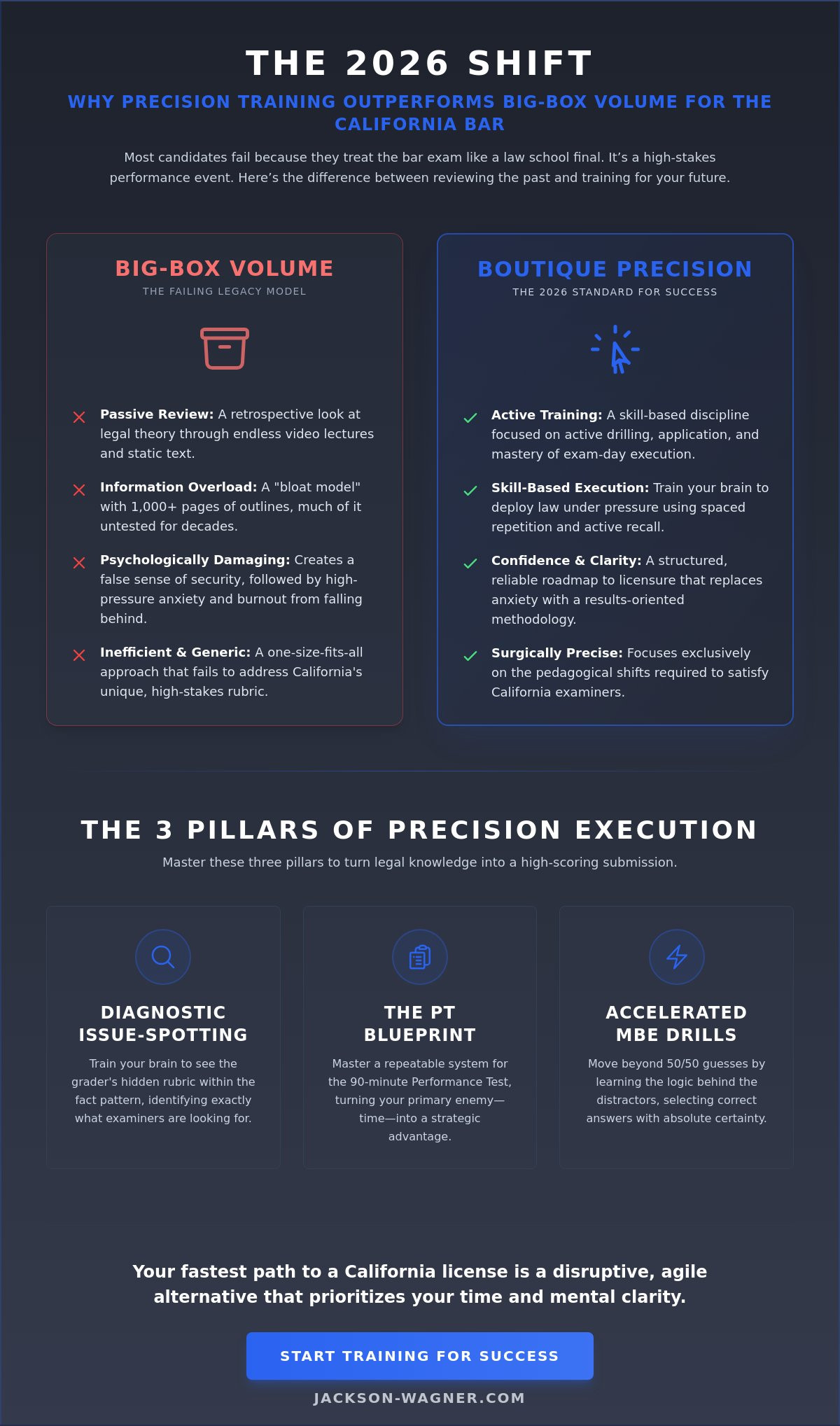
Most students approach the bar exam as if it's a final exam for law school. It isn't. Traditional bar review focuses on a retrospective look at legal theory, asking you to watch hours of video lectures and read thousands of pages of static text. In contrast, bar exam training is an active, skill-based discipline. It treats the exam as a performance event rather than an academic exercise. While review is passive, training is about active drilling, application, and the mastery of exam-day execution. You aren't just learning what the law is; you're training your brain to deploy it under extreme pressure.
California's unique grading scale and notoriously high cut score demand specialized training over generic, nationwide review. You can't simply "know" the law to pass here; you must execute it according to a very specific, local rubric. This is why "Precision Prep" has become the 2026 standard for high-stakes licensure. It moves away from the "one-size-fits-all" approach of legacy providers and focuses exclusively on the pedagogical shifts required to satisfy California examiners. If your prep feels like a history lesson, you aren't training; you're just reminiscing.
The Cognitive Science of Precision Training
Effective bar exam training relies on the science of spaced repetition and active recall. Memorizing a 50-page outline is a failing strategy for the California Essay Exam because it creates a false sense of security. You might recognize a rule when you see it, but that doesn't mean you can produce it on a blank screen. Training forces you to retrieve information from memory repeatedly, strengthening the neural pathways required for the actual test. Exam-ready proficiency is the ability to issue-spot under 15-minute time constraints.
Why Big-Box "Review" Courses Are Failing Modern Students
Traditional courses are built on a "bloat" model. They provide 1,000+ pages of outlines filled with legal nuances that haven't been tested in decades. This unmanaged volume isn't just inefficient; it's psychologically damaging. The stress of falling behind on a generic schedule leads to burnout and a lack of confidence. The market is already reacting to these failures. Major legacy providers are struggling to adapt to the California-specific market, with some even withdrawing their specialized offerings entirely. This proves that the old way of "big-box" review can't keep up with the rigorous demands of modern California licensure. You need a disruptive, agile alternative that prioritizes your time and mental clarity over sheer page count.
The 3 Pillars of Effective California Bar Exam Training
Success in 2026 isn't about working harder; it's about working with surgical precision. To pass, you must master three specific pillars that turn raw legal knowledge into a high-scoring submission. These pillars form the core of the best bar exam preparation service models, focusing on execution rather than just absorption. By prioritizing these areas, you ensure that every hour of study translates directly into points on the scoreboard.
- Diagnostic Issue-Spotting: You must train your brain to see the grader's rubric hidden within the fact pattern. It's not about what you know; it's about identifying exactly what the examiners are looking for in that specific prompt.
- The PT Blueprint: This requires mastering a 90-minute universe where the law is provided, but time is your primary enemy. You need a repeatable system for organization.
- Accelerated MBE Drills: You have to move beyond 50/50 guesses. Effective bar exam training should teach you the logic behind the distractors so you can select the correct answer with absolute certainty.
These pillars aren't independent silos. They integrate into a cohesive strategy that builds confidence through repetitive, high-stakes simulation. When you train this way, you stop fearing the exam and start viewing it as a series of solvable problems.
Mastering the California Essay Exam Format
Graders in California have a specific appetite for structure. You must use IRAC (Issue, Rule, Analysis, Conclusion) with extreme discipline to ensure your reasoning is transparent. Every essay response needs "Headed Outlines" to guide the grader's eye to your key points. This structural clarity is often the difference between a 60 and a 75. Additionally, you must prepare for the Professional Responsibility requirement in every exam cycle. It's a constant presence that requires its own dedicated sub-strategy.
The 90-Minute Performance Test (PT) Mastery
Many candidates ignore the PT until the final weeks of their prep. That's a critical mistake. The PT is the "hidden" key to passing the california bar exam. Unlike the essays, this is a non-substantive skills test. Training differs from review here because you aren't learning law; you're learning to manage a file and library under extreme time pressure. You need a system to extract relevant facts and rules within seconds. For those seeking a streamlined path to this level of mastery, the JW Bar Method Prep - Full Exam California Bar provides the exact framework needed to dominate the PT.
Boutique Precision vs. Big-Box Volume: A 2026 Comparison
Choosing a preparation path is the most critical decision you'll make before day one of the exam. Big-box providers sell you a "volume" model. They measure success by the number of hours you sit in a chair and the number of pages you turn. We call this the Standard model, and it's fundamentally flawed for the 2026 California cycle. In contrast, the JW Bar Method utilizes a Precision model. It doesn't care about how much you read; it cares about how well you perform. This methodology focuses on high-impact bar exam training that targets the specific rubrics used by California graders.
This distinction is vital for those enrolled in the JW Bar Method Prep - Attorney’s Exam California Bar. Big-box courses often over-prepare experienced lawyers on substantive law they already understand. Meanwhile, they fail to address the "bar-speak" required to pass the specialized one-day exam. Boutique training provides something an algorithm cannot: direct, expert feedback. When a mentor reviews your essay, they aren't just checking boxes. They're identifying the specific cognitive gaps in your analysis and correcting them before they cost you a passing score.
This leads to our signature "Bold Reliability." While legacy providers offer a "free repeat" if you fail, we prefer to align our interests with yours from the start. A "free repeat" just means more of the same failing method. A binary performance guarantee serves as a marker of absolute trust in our pedagogical approach. We assume the financial risk of your performance outcome, which distinguishes us from more cautious, less effective competitors.
The Myth of the 10-Hour Study Day
You don't need to study 10 hours a day. That's a relic of inefficient, bloat-filled systems. Precision training allows for high-impact study in 4-6 hours by cutting out the non-testable noise. This efficiency is essential for working professionals and out-of-state attorneys who need to know how to navigate the State Bar of California without abandoning their current practices. We focus on the "heavy lifting" of active recall so you can spend your time where it actually earns points.
Financial Risk and Performance Guarantees
Traditional courses rarely offer a true money-back guarantee because their business model relies on mass volume, not individual success. A performance guarantee aligns the interests of the student and the mentor. It replaces the stress of high-pressure certification with a sense of security. When the training provider assumes the financial risk, the student can focus entirely on execution. This "Assumed Risk" model provides a psychological safety net that is often the missing ingredient in a successful study season.
Specialized Training for the California Attorney’s Exam
The California Attorney’s Exam is a unique beast. Unlike the full two-day exam, you don't have the Multistate Bar Examination (MBE) to act as a scoring cushion. You have five essays and one Performance Test, all packed into a single day. This format demands a specialized form of bar exam training that acknowledges your status as a practitioner while correcting the habits that lead to failure. Many out-of-state attorneys assume their years in court will carry them through. In reality, that experience often becomes a hurdle.
Practicing lawyers frequently fail because they use "lawyer-speak." In practice, you write to persuade a judge or a client, often glossing over "obvious" legal principles to get to the heart of a complex dispute. On the bar, you must do the opposite. You have to prove you know the basics by writing in "bar-speak," which requires mechanical application of rules and exhaustive IRAC structure. You're training to satisfy a rubric, not to win a motion. This shift in perspective is the hardest part of the process for most veterans, yet it's the most essential for passing the one-day exam.
Unlearning Practice Habits for the Bar
Your real-world experience is a liability if it makes you skip steps. Graders don't care about your successful settlements; they care about seeing every element of a rule on the page. You're training to write for a grader who has roughly two minutes to score your paper. This is especially true for California Evidence and Civil Procedure, where the state-specific rules often contradict the Federal Rules you use daily. You must learn to set aside your practical intuition and lean into the rigid requirements of the California examiners.
The Accelerated Prep Timeline
Seasoned practitioners don't have 40 hours a week to sit in a library. You need a "Minimum Effective Dose" of study. This means condensing a traditional 12-week review into a high-intensity training program that fits around a full-time practice. Success in 2026 requires hitting specific metrics: mastering 15-minute issue-spotting and 60-minute essay execution. We provide the structure to balance these demands, ensuring your bar exam training is both efficient and exhaustive. By focusing on high-weight subjects and the specific nuances of California's 1-day format, you can achieve licensure without the bloat of a general review course.
For those ready to secure their California license without sacrificing their career, the JW Bar Method Prep - Attorney’s Exam California Bar provides the precise, accelerated framework needed for a one-day victory.
The JW Bar Method: A Disruptive Path to Success
The JW Bar Method at Jackson-Wagner LLC isn't just another study plan; it's a fundamental rejection of the legacy education models that have failed students for decades. While big-box providers sell you a generic platform filled with automated calendars and impersonal dashboards, we offer a results-oriented alternative built on high-stakes accountability. This isn't a retrospective review of your law school career. It's a disruptive, forward-looking discipline designed to replace the stress of high-pressure certification with a structured, modern, and reliable path to success.
We focus on the California licensure requirements exclusively. We don't dilute our curriculum with out-of-state law or generic multistate filler that doesn't serve the specific needs of a California candidate. The distinction between a platform and mentorship is the core of our efficacy. A platform gives you data; a mentor gives you direction. When you engage in our bar exam training, you're entering a partnership where we assume the financial risk of your performance. At Jackson-Wagner LLC, we're so confident in our pedagogical approach that we offer a binary performance guarantee. If you don't pass, our interests remain aligned until you do.
Why Precision Beats Volume Every Time
Efficiency is the hallmark of a professional. You don't need to memorize every nuance of academic law to be a competent attorney; you need to master the testable law that California graders actually use to measure proficiency. The JW Bar Method strips away the non-testable noise that clutters traditional outlines. This allows you to focus your energy on the specific pedagogical shifts required for the 2026 exam cycle. We don't want you to spend 10 hours a day reading; we want you to spend four hours executing with surgical precision. This approach isn't just about saving time; it's about building the cognitive stamina required for the toughest bar exam in the country.
Your Next Steps to California Licensure
The path to the 2026 Bar begins with an honest evaluation of your current readiness. If you're a first-time taker, you require a comprehensive foundation that covers every nuance of the General Bar. If you're a seasoned practitioner, you need an accelerated track that respects your time while unlearning the practice habits that can hinder your score. You can choose between the JW Bar Method Prep - Full Exam California Bar or the JW Bar Method Accelerated Prep - Attorney’s Exam California Bar depending on your specific needs. Replace your anxiety with a structured, guaranteed path to passing. Visit jackson-wagner.com to secure your spot and start your journey toward licensure with absolute confidence.
Secure Your Path to the California Bar
The 2026 California Bar Exam requires a departure from the volume mindset of the past. Success isn't about how many pages you turn; it's about how precisely you execute on the page. By focusing on the specific pedagogical shifts required by California examiners, you can transform your study process into a high-impact, skill-based discipline. This transition from passive review to active bar exam training is the only way to replace high-stakes anxiety with a reliable, structured path to licensure.
Whether you're a first-time candidate or an experienced practitioner, the choice between legacy bloat and modern precision is clear. Jackson-Wagner LLC provides the California-specific expertise and the binary performance guarantee you need to move forward with absolute trust. Don't let generic courses dictate your future. It's time to embrace a disruptive, results-oriented approach that aligns your effort with a measurable outcome.
Master the California Bar with the JW Bar Method—Guaranteed
You have the legal talent; now you just need the right framework to prove it. Your journey to the California Bar ends in success when you choose a partner that assumes the risk alongside you.
Frequently Asked Questions
How is bar exam training different from a standard bar review course?
Training is active and skill-based while standard review is passive and content-based. Standard courses focus on reading outlines and watching lectures; bar exam training prioritizes active recall, timed drilling, and the specific execution of California-style essays. This methodology ensures you can apply the law under pressure rather than just recognizing it in a book. It's the difference between watching a sport and playing it.
Does the California Bar Exam allow for an accelerated training schedule?
Yes, the California Bar Exam is a performance-based test that rewards efficiency and precision over sheer study hours. While traditional paths take 10 to 12 weeks, an accelerated schedule focuses on the "Minimum Effective Dose" of testable law. This approach is ideal for those who have strong legal foundations and need to master the specific mechanics of the California rubric in a shorter timeframe.
Can I pass the California Attorney’s Exam while working full-time?
Passing while working full-time is entirely achievable with a precision-based approach. The one-day Attorney's Exam requires mastery of five essays and one Performance Test rather than the two-day General Bar. By cutting out the bloat of traditional study models, you can focus on high-impact training that fits into a 4 to 6 hour daily window. This makes it compatible with a professional practice.
Why did Kaplan stop offering California-specific bar exam prep?
Kaplan exited the market following the State Bar of California's decision to move away from the National Conference of Bar Examiners (NCBE) for exam development. This shift toward a state-specific, proprietary exam format made the national "one-size-fits-all" model obsolete. Modern candidates now require specialized providers who focus exclusively on the unique pedagogical demands of the new California standards and grading rubrics.
What is the pass rate for the JW Bar Method compared to national averages?
Our pass rates consistently exceed national averages because our methodology targets the specific execution required by California graders. While general pass rates for the California Bar often hover below 50 percent, our focused training creates a significant performance advantage. We prioritize the quality of your output over the quantity of your study, ensuring you are prepared for the toughest grading rubric in the country.
What happens if I don’t pass the California Bar after completing the training?
We assume the financial risk of your performance through our binary performance guarantee. If you don't pass the exam after completing our required curriculum, we provide a clear, structured path forward that includes a financial safety net. This alignment of interests ensures we are fully committed to your success from day one, replacing high-stakes anxiety with absolute trust in our pedagogical process.
Does the JW Bar Method cover the Multistate Professional Responsibility Examination (MPRE)?
Our curriculum is laser-focused on the California Bar Exam and the California Attorney’s Exam. While we emphasize the Professional Responsibility requirements that appear in every California essay cycle, we don't provide a separate course for the MPRE. We believe in specialized excellence; our training is designed to conquer the licensure exam itself rather than adjacent certification tests that use different formats.
Is the training updated for the 2026 California Bar Exam requirements?
Yes, all our programs are meticulously updated to reflect the 2026 pedagogical shifts and grading standards. We stay ahead of regulatory changes to ensure your bar exam training materials match the current reality of the exam. This includes the specific structural requirements for the Performance Test and the nuances of state-specific law that the California Bar examiners expect to see in your responses.


