

With the February 2026 pass rate sitting at a sobering 30.8%, it's clear that simply knowing the law isn't enough to secure your license. You've likely spent countless hours obsessing over practice MBEs while feeling completely in the dark about how those numbers translate into a passing result. It's frustrating to face an exam where the scaling formulas feel like a guarded state secret, leaving you to wonder exactly how is the california bar exam graded and what your actual target should be.
We're here to replace that uncertainty with a structured, reliable path to the 1390 passing score. In this guide, you'll master the complex math behind the scaling process and learn exactly how graders evaluate your written performance. We'll break down the 50/50 weighting between the written and MBE portions, identify the specific raw targets you need for your practice exams, and explain the critical re-read process that applies if your initial score falls between 1350 and 1390. By the end of this article, you'll have the clarity and confidence to stop guessing and start hitting the marks that matter.
Key Takeaways
- Master the architecture of the 1390 scaled score and see how your performance is weighted against a 2000-point maximum.
- Demystify the scaling formula to understand exactly how is the california bar exam graded and why raw scores are adjusted for difficulty.
- Identify specific grading criteria for written answers to move your scores beyond the standard 55 to 75 range.
- Learn the "Auto-Pass" strategy to secure your results during the first read and avoid the uncertainty of a re-read.
- Optimize your study time by focusing on high-yield "Grader-Bait" issues rather than the ineffective volume-based methods of legacy providers.
The Architecture of the 1390: California Bar Exam Scoring Components
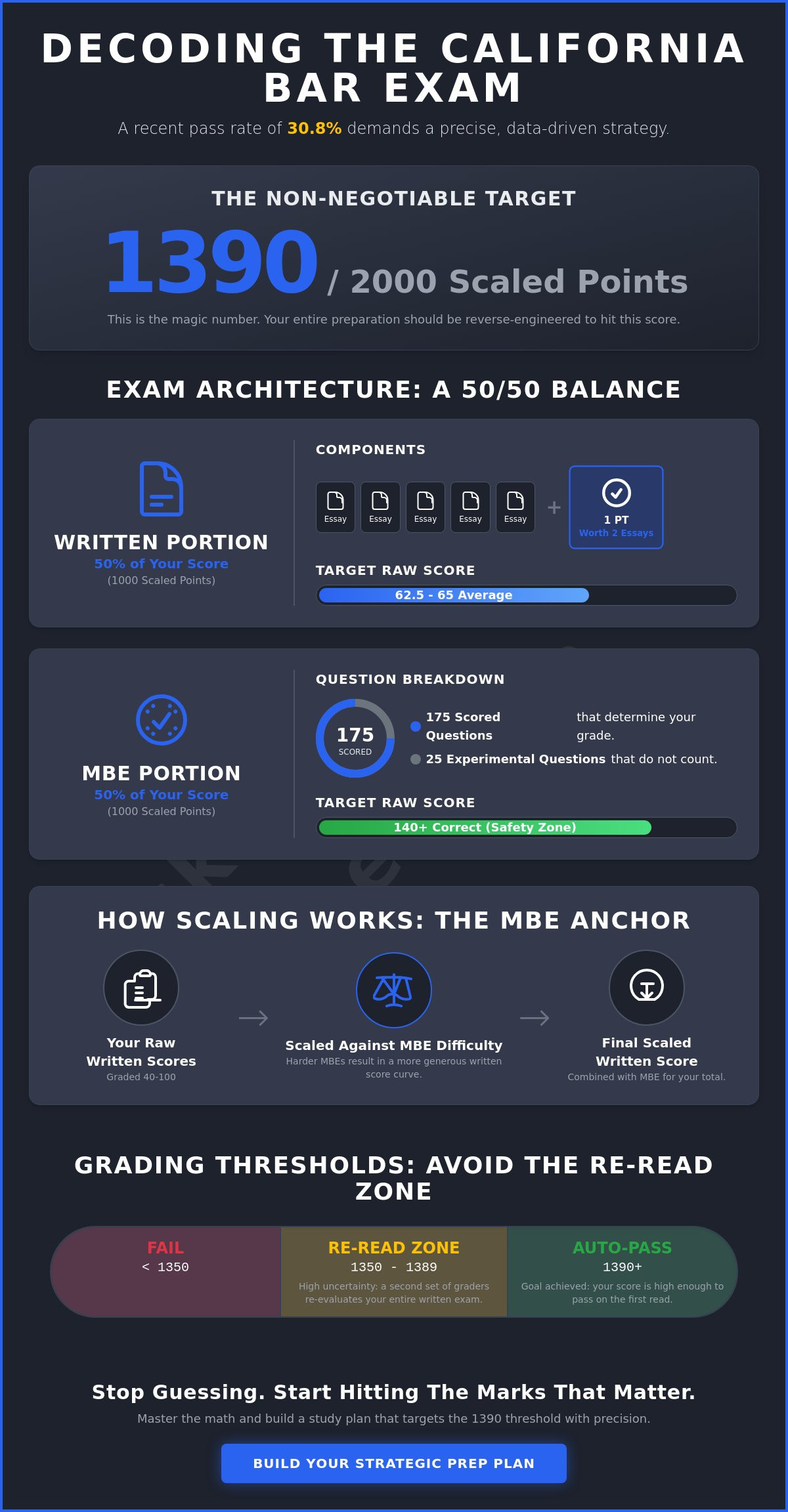
To succeed in California, you must understand the math. The magic number is 1390. This is a scaled score out of a possible 2000. Many candidates get lost in the "raw" points, but the State Bar of California uses a specific conversion process to reach this final figure. Understanding how is the california bar exam graded starts with recognizing that the test is perfectly balanced. Half of your score comes from the written portion, and the other half comes from the Multistate Bar Exam (MBE).
California is notoriously protective of its standards. Unlike many states that use the Uniform Bar Exam (UBE), California doesn't allow score transfers. You can't bring an MBE score from another state to "plug in" here. You must earn your entire score in a single California administration. For experienced practitioners, the Attorney’s Exam offers a different path. This version skips the MBE entirely. This means 100% of the 1390 target is derived from the written portion, placing immense pressure on essay performance.
The Written Portion: Essays and the Performance Test
The written half of the exam is a grueling marathon of analysis. It consists of five one-hour essays and one 90-minute Performance Test (PT). While the essays cover a massive range of over 15 legal subjects, the PT is often the deciding factor for borderline candidates. It's designed to simulate real-world lawyering tasks, like drafting a brief or a client memo. Crucially, the PT is weighted as two essays. It represents two-sevenths of your total written score. This makes it the single most critical written component you'll face on day one.
The Multistate Bar Exam (MBE) Component
The MBE is the second half of the 50/50 split. It features 200 multiple-choice questions delivered in two three-hour sessions. However, only 175 of these questions actually count toward your score. The remaining 25 are "experimental" questions used for future test development. You won't know which is which. When analyzing how is the california bar exam graded, you'll see the MBE acts as the statistical anchor. The difficulty of the MBE in a given year determines how the written scores are scaled. This ensures that a 1390 in February 2026 represents the same level of competence as a 1390 from previous years.
Raw vs. Scaled Scores: How the Math Actually Works
Understanding how is the california bar exam graded requires looking past the raw numbers written on your practice exams. Since 2020, the State Bar has held the line at a 1390 passing score. This is your non-negotiable target. To hit it, you must distinguish between raw and scaled points. Graders assign raw scores to your essays and Performance Test, usually on a scale of 40 to 100. However, these numbers are just the raw material. The final result is a scaled score that fits within a 2000-point maximum. Don't chase a perfect 2000. It's statistically impossible. Graders almost never award scores in the high 90s, making the top end of the scale a theoretical limit rather than a realistic goal.
The Scaling Formula and the MBE Anchor
The written portion is adjusted based on the difficulty of that year's MBE. This is the core of how is the california bar exam graded. If the national MBE pool performs poorly, suggesting a harder exam, the scaling formula compensates by lifting the written scores. This protects well-prepared students from being penalized by a single outlier administration. The official grading process ensures the standard of minimum competence remains consistent. A "hard" exam version can actually benefit you if you've mastered the fundamentals. The scaling curve often works in your favor when the overall applicant pool struggles with a particularly dense set of questions.
Calculating Your Target Raw Scores
What does 1390 look like in practice? You need a clear target for your mock exams. For the written portion, an average raw score between 62.5 and 65 across your five essays and PT is the sweet spot for a pass. On the MBE, you should aim for a "Safety Zone" of 140 or more raw correct answers. This provides a necessary buffer against the unpredictability of scaling. Ultimately, your scaled score is a relative measure of performance against the applicant pool. If you want to see how these targets fit into a structured study plan, consider looking into JW Bar Method Prep - Full Exam California Bar to streamline your approach. This methodology focuses on hitting these specific mathematical thresholds rather than just memorizing outlines.
How Essays and Performance Tests Are Evaluated
Graders don't read your essays like a law professor would. They typically spend fewer than ten minutes reviewing each response, looking for specific triggers that signal professional competence. Understanding how is the california bar exam graded requires you to pivot from academic writing to a high-speed, issue-spotting format. While the raw scale technically runs from 40 to 100, the reality is much narrower. Most scores cluster between 55 and 75. A score below 50 usually indicates a total failure to identify the legal problem, while scores above 80 are exceptionally rare. Graders prioritize "Lawyer-like Reasoning" over rote memorization. They want to see you apply the law to the facts, not just recite a dusty outline you've memorized.
The 90-minute Performance Test (PT) is the heavy lifter of your written score. While essays are scored once, the PT is double-weighted. This means a single PT score is counted twice in your raw total, effectively making it worth two full essays. If you perform well here, you can offset a mediocre performance on a difficult essay like Property or Community Property. Success on the written portion depends heavily on your mastery of IRAC (Issue, Rule, Analysis, Conclusion). Graders use this structure as a roadmap; if they can't find your conclusion or your analysis is buried in a wall of text, your score will suffer regardless of your legal knowledge.
Grader Calibration and Quality Control
The official grading process begins with a phase called "Calibration." More than 150 graders gather to align their standards on a single rubric. They read the first few hundred papers multiple times, discussing discrepancies until every grader is looking for the same "Grader-Bait" issues. A Lead Grader oversees this process, stepping in to resolve outliers and ensure that a paper graded in Los Angeles receives the same score as one graded in San Francisco. This herd mentality means you must write for the rubric, not for yourself.
What a "65" Essay Looks Like
A score of 65 is the baseline for passing. To hit this mark, you must identify all major issues and provide "competent" analysis that connects the rule to the provided facts. You don't need to be perfect; you just need to be professional. Common mistakes that drop a score to a 55 include missing a "big" issue or failing to provide a counter-argument where the facts clearly suggest one. If you want to reach a 70 or higher, you must demonstrate nuanced analysis. This involves distinguishing between immaterial and material facts, showing the grader that you understand why certain details were included in the prompt while others were omitted.
The Phased Grading Process and the Re-Read Rule
The process of how is the california bar exam graded involves a multi-stage safeguard designed to catch errors before final results are released. Phase 1 is the universal starting line. Every applicant's MBE is electronically scored, and every essay and Performance Test receives its first reading from the calibrated pool of graders. If your combined scaled score hits 1390 or higher during this initial pass, you've achieved an "Auto-Pass." Your journey ends here with a success notification. You've cleared the bar with enough margin to avoid further scrutiny, which is the gold standard for any serious candidate.
The real tension exists in the "Re-Read Zone." If your total scaled score falls between 1350 and 1389 after Phase 1, your written answers are automatically triggered for Phase 2. This isn't a courtesy; it's a rigorous second look by a completely different set of graders who don't know your initial scores. This 40-point window is where many dreams are deferred. While it offers a second chance for those who narrowly missed the mark, relying on a re-read is a high-stakes gamble. Understanding how is the california bar exam graded at this level reveals that most scores in this zone don't move enough to cross the 1390 threshold without a significant shift in the written average.
The Mechanics of a Re-Read
During Phase 2, the second grader assigns a new set of raw scores for every written answer. If the difference between the first and second reading is within a standard margin, the scores are simply averaged. However, if a significant discrepancy occurs, a supervisor intervenes to conduct a third review. This ensures that a single rogue grader doesn't determine your professional future. Your final score is the average of all readings, scaled against the MBE anchor. Staying out of this zone entirely is the only safe strategy for passing.
Why Scores Are Rarely Reconsidered After Release
Once the State Bar releases the final results, the door is locked. There is a strict "no appeal" policy regarding the subjective grading of written work. You can't argue that a grader missed your brilliant analysis of a hearsay exception. The phased grading process is the State Bar's way of saying they've already checked their work twice. For a deeper dive into managing the administrative side of your application, read How to Navigate the State Bar of California: A 2026 Guide to Licensure Success.
Don't leave your career to the mercy of a second grader's average. Secure your "Auto-Pass" by training with the JW Bar Method Prep - Full Exam California Bar. We focus on the precision needed to clear the 1390 mark on the first read, removing the anxiety of the re-read process entirely.
Strategic Preparation: Hitting the Threshold with Precision
Legacy bar prep providers often rely on a "volume" approach that fails the modern California applicant. They drown students in thousands of pages of outlines and hundreds of hours of video lectures, hoping that some of it sticks. This strategy is often fatal in a jurisdiction with a 30.8% pass rate. When you analyze how is the california bar exam graded, it becomes clear that success isn't about knowing every obscure legal theory. It's about hitting the specific triggers that graders are trained to find. The Jackson-Wagner approach rejects generic study models in favor of identifying high-yield "Grader-Bait" issues. By focusing on the issues that carry the most weight, you can maximize your raw points without burning out on low-probability topics.
You must use the grading math to your advantage. If you're strong on the MBE, you can afford a slightly lower written average, but you should never leave points on the table by neglecting the Performance Test. Since the PT is double-weighted and represents two-sevenths of your written score, mastering this single 90-minute task is the most efficient way to bolster your results. The JW Bar Method is precision-engineered for the 1390 threshold. We don't just teach the law; we teach you how to write the specific, "lawyer-like" answers that graders are calibrated to reward during the first read.
The Attorney’s Exam Advantage
For practicing lawyers, the Attorney's Exam removes the MBE entirely. This shifts the entire focus of how is the california bar exam graded to a 100% written assessment. In this high-stakes scenario, the PT becomes the absolute make-or-break factor. Without the MBE to act as a statistical safety net, your ability to demonstrate lawyering skills under pressure is what secures your license. To understand how to manage this specific challenge, read Passing the California Bar Exam in 2026: The Definitive Strategic Guide.
Accelerated Prep for High-Stakes Success
Working professionals don't have 400 hours to waste on generic lectures. You need a pedagogical structure that respects your schedule and focuses on results. Our accelerated programs, such as the JW Bar Method Accelerated Prep - Full California Bar Exam, teach you to simulate the grader calibration process in your own practice. By learning to see your work through the eyes of the State Bar, you can refine your analysis and ensure you hit the "Auto-Pass" marks. Ready to stop guessing and start performing? Master the California Bar with the JW Bar Method and take control of your professional future.
Secure Your License with Mathematical Certainty
You now possess the blueprint for the 1390 passing score. The California Bar isn't just a test of legal memory; it's a complex math problem that requires hitting specific raw targets on both the MBE and written portions. Understanding how is the california bar exam graded is the definitive first step toward removing the anxiety of the "Re-Read Zone" and securing a Phase 1 "Auto-Pass." By focusing on the 50/50 split and mastering the double-weighted Performance Test, you can navigate the scaling process with absolute confidence.
Stop leaving your future to the mercy of legacy study models that prioritize volume over precision. Our proprietary JW Bar Method pedagogical approach is designed to replace high-stakes stress with a reliable, modern path to success. We offer structured and accelerated programs for the Full Bar and Attorney's Exam that are focused exclusively on California licensure success. You don't need to master every obscure corner of the law; you simply need to master the high-yield triggers that graders are calibrated to reward.
Pass the California Bar Exam with the JW Bar Method Guarantee. Your path to the 1390 starts today. You've put in the work. Now it's time to execute with precision and claim your seat at the bar.
Frequently Asked Questions
What is the passing score for the California Bar Exam in 2026?
The minimum passing score for the California Bar Exam is 1390. This standard was adopted in 2020 and remains the permanent threshold for both the general and attorney's exams. This score is a scaled result, meaning it doesn't represent a simple percentage of correct answers but rather a relative measure of performance. Clearing this mark requires a balanced performance across both the written and multiple-choice portions.
How is the California Attorney’s Exam graded differently?
The California Attorney’s Exam is graded based solely on the written portion. Since there is no MBE component for these applicants, the 1390 passing score must be earned entirely through the five essays and the Performance Test. This makes written precision and the double-weighted PT even more critical for practicing attorneys. The scaling process still applies, but it's anchored differently without the MBE participation of the specific applicant.
What happens if I score a 1385 on the California Bar?
Scoring a 1385 places you in the "Re-Read Zone," which covers all applicants between 1350 and 1389. Your written answers will be automatically reviewed by a second set of graders in Phase 2 of the grading process. The final score will be the average of the two readings. If that average hits 1390, you pass; if it falls short by even a fraction, the failing result is final.
Is the California Bar Exam graded on a curve?
The exam is not graded on a traditional curve but is subject to a scaling process that ensures consistent difficulty. This scaling method accounts for variations in the difficulty of different exam administrations. While there isn't a set percentage of people who must pass or fail, the process of how is the california bar exam graded involves adjusting raw written scores against the MBE anchor to maintain a uniform standard of minimum competence.
How much is the Performance Test (PT) worth in the final score?
The 90-minute Performance Test is weighted as two essays, making it the single most valuable written component. In the raw scoring calculation, the PT score is counted twice, representing approximately 28.5% of your total written score. Because it carries such significant weight, a strong PT performance can often compensate for a lower score on one of the five one-hour essays.
Can I appeal my California Bar Exam grade if I fail by a few points?
No, you cannot appeal your grade once the final results are released. The State Bar of California maintains a strict policy of finality regarding the subjective grading of essays and Performance Tests. The multi-phase grading and re-read process for borderline scores are considered the primary safeguards for accuracy. Once the results are official, there are no administrative or legal avenues to challenge the graders' decisions.
How many essays do I need to pass to get a 1390?
There is no specific number of essays you must "pass" to reach 1390. Because the total score is an aggregate of the MBE and written portions, you could theoretically fail several essays and still pass if your MBE score is exceptionally high. However, to stay on track for a 1390, you should aim for a raw average of 62.5 to 65 across all written tasks to avoid relying on an outlier MBE result.
Does California accept MBE scores from other states?
California does not accept MBE scores transferred from other jurisdictions. Every applicant must take the full California Bar Exam, including the MBE and written portions, during the same administration. This is a unique requirement of how is the california bar exam graded compared to many other states that participate in the Uniform Bar Exam (UBE) system. You must earn your entire 1390 score within the California system.


