
The California Performance Test isn't an "open book" exam designed to test your legal knowledge; it's a high-speed simulation of law practice that rewards structural precision over exhaustive detail. With the February 2026 pass rate sitting at a challenging 30.8%, you can't afford to treat this 90-minute sprint as an afterthought. Mastering the california bar exam performance test format is the strategic difference between drowning in the Library and delivering a crisp, professional work product that secures your license.
You're likely feeling the weight of the clock and the overwhelm of a massive File. The confusion of switching between objective and persuasive tones in the fictional state of Columbia can feel paralyzing. This guide changes that. We'll provide a clear understanding of the PT anatomy and a repeatable system for outlining that works every time. You'll gain the confidence to handle any task type, from memos to briefs, turning the exam's most unpredictable section into your greatest scoring advantage.
Key Takeaways
- Identify the "blueprint" of your answer by decoding the Task Memo before diving into the complex File and Library documents.
- Execute the 45/45 rule to ensure you spend exactly half your time on high-level analysis and outlining, preventing a mid-exam time crunch.
- Master the nuances of the california bar exam performance test format by learning to pivot between objective neutral analysis and persuasive advocacy on command.
- Replace inefficient, legacy drafting habits with structural templates designed to produce a professional work product in exactly 90 minutes.
Decoding the California Bar Exam Performance Test Format: 2026 Overview
The California Bar Exam Performance Test (PT) isn't just another essay; it's a high-stakes simulation of your first day as a junior associate. Administered on Day 1 of the exam, Tuesday, July 28, 2026, this 90-minute written assignment carries immense weight in your final score. While the five one-hour essays test your ability to recall and recite rules, the PT tests your ability to function as a professional. It often acts as the decisive tie-breaker for applicants hovering near the 1390 passing score. Understanding the california bar exam performance test format is essential because it's the only section where you don't need to memorize a single statute. Everything you need to succeed is provided in the materials.
The bar exam performance test evaluates raw analytical skill rather than rote memorization. You'll receive a File containing factual documents and a Library of legal authorities. Your task is to extract relevant facts and apply the provided law under extreme pressure. With the overall pass rate for the February 2026 exam sitting at a lean 30.8%, mastering this section is a strategic necessity. It's a test of efficiency, organization, and the ability to distinguish between what's relevant and what's merely noise.
The Fictional State of Columbia
Every PT takes place in the fictional State of Columbia. The State Bar uses this imaginary jurisdiction to ensure no applicant has an unfair advantage based on their law school location. Whether you studied in San Francisco or New York, the rules of Columbia are new to everyone. This creates a level playing field where your success depends on your ability to read and apply provided material rather than your memory of California-specific statutes. A crucial, non-negotiable rule exists: never use outside legal knowledge. Bringing in real-world California law is a fast track to a failing score. You must live and breathe only the law provided in the Library for that specific 90-minute window.
The Goal: Professional Competence
Graders aren't looking for a law student's academic treatise; they're looking for professional competence. This shift from "student" writing to "practicing attorney" execution is where many fail. You aren't just summarizing cases; you're solving a client's problem. The first step to mastery in the california bar exam performance test format is identifying the Call of the Question within the Task Memo. This document serves as your blueprint. If the memo asks for an objective memorandum and you deliver a persuasive brief, your score will plummet. Precision is your only currency here, and your ability to follow instructions perfectly is what distinguishes a passing answer from a repeat attempt.
The Anatomy of a PT: Task Memo, File, and Library
Success on the PT requires more than just speed; it demands a clinical understanding of how the three core components of the exam packet function together. The State Bar provides specific Performance Test instructions that dictate how these materials should be used. The Task Memo is your commanding officer. It dictates the specific tone, the intended audience, and the precise legal issues you must address within the strict 90-minute window. If you ignore a single instruction in the Task Memo, you risk failing the entire section, regardless of how well you write. It's the blueprint that determines the california bar exam performance test format for that specific sitting.
The File represents the messy reality of legal practice. It's a collection of raw factual data, including witness transcripts, deposition summaries, medical records, or even office correspondence. Your job is to act as a filter. You must identify which facts are legally significant and which are mere distractors designed to waste your time. Conversely, the Library serves as your closed legal universe. It contains the statutes and cases from the fictional state of Columbia. You must treat these as the only valid authorities, synthesizing the rules found within them to build a framework for your analysis. Mastering this hierarchy is a core component of the JW Bar Method Prep, where we teach you to treat the packet as a puzzle rather than a reading assignment.
Navigating the File: Sifting Facts from Noise
Effective fact-tagging is the difference between a coherent argument and a disorganized mess. As you read the File, you must immediately categorize information into material facts, background facts, and "noise." Material facts are those that directly trigger a legal element found in the Library. When you encounter conflicting witness statements or ambiguous evidence, don't ignore them. A high-scoring answer acknowledges these inconsistencies and explains how they impact the client's position. This level of detail demonstrates the practitioner mindset that graders crave in the california bar exam performance test format.
Deconstructing the Library: Identifying the Rules
The Library isn't just a reading list; it's a toolbox. You must approach Columbia statutes and cases with the goal of extraction. Look for the "legal test" or the specific elements required to prove a claim. Often, the rules aren't found in a single document. You may need to synthesize a rule from a statute and two seemingly contradictory cases. This synthesis is where most applicants struggle. You must bridge the gap between the abstract law in the Library and the concrete facts in the File to form a cohesive, professional work product.
Common Performance Test Assignments: From Briefs to Demand Letters
The california bar exam performance test format isn't a static requirement; it's a versatile framework that shifts based on the specific document the Task Memo requests. You aren't merely writing to show what you know. You're drafting a functional work product for a specific audience. The most frequent assignment is the Objective Memorandum, which requires a neutral, balanced analysis of a client’s legal position. In this format, your job is to be a truth-teller for a supervising partner, identifying both the strengths and the fatal flaws in a case. Graders look for your ability to remain detached while providing a realistic prediction of how a Columbia court would rule.
In contrast, the Persuasive Brief demands a total shift in mindset. Here, you're an advocate. Your goal is to convince a judge to rule in your client's favor using aggressive, one-sided arguments. While the objective memo explores every angle, the brief prioritizes the most favorable interpretations of the law found in the Library. Other tasks, such as Demand Letters, require you to speak directly to opposing counsel with a specific "ask" or settlement offer. Occasionally, the exam introduces a Closing Oral Argument, where you must draft a transcript-style speech. Regardless of the task, you must adhere to the California Bar Exam Performance Test Instructions provided in the packet to ensure your document meets professional standards.
Objective vs. Persuasive Tones
The linguistic divide between "likely" and "should" determines your success in the california bar exam performance test format. In an objective memo, you use phrases like "The court will likely find" to signal a measured prediction. When you pivot to a persuasive brief, your language must become imperative; "The court should find" or "The court must conclude" are your primary tools. Your headings must also reflect this shift. Memo headings are often topical or neutral, while brief headings are complete, argumentative sentences. You must address counter-arguments in both, but in a brief, you raise them only to immediately dismantle them with favorable facts from the File.
Formatting Requirements
Formatting isn't a suggestion; it's a scored component of your professional competence. For an internal memo, you must include a standard header block: To, From, Date, and Re. Omitting these basics signals a lack of attention to detail that graders will penalize. Many tasks also require "Question Presented" and "Brief Answer" sections, which serve as an executive summary of your entire 90-minute effort. Following the Task Memo’s specific formatting instructions is the easiest way to secure "free" points. If the memo asks for a letter to a client, use a formal salutation and a professional closing. These small structural details prove you can function as a practicing attorney in the state of Columbia.
90-Minute Mastery: Strategic Time Management for the California PT
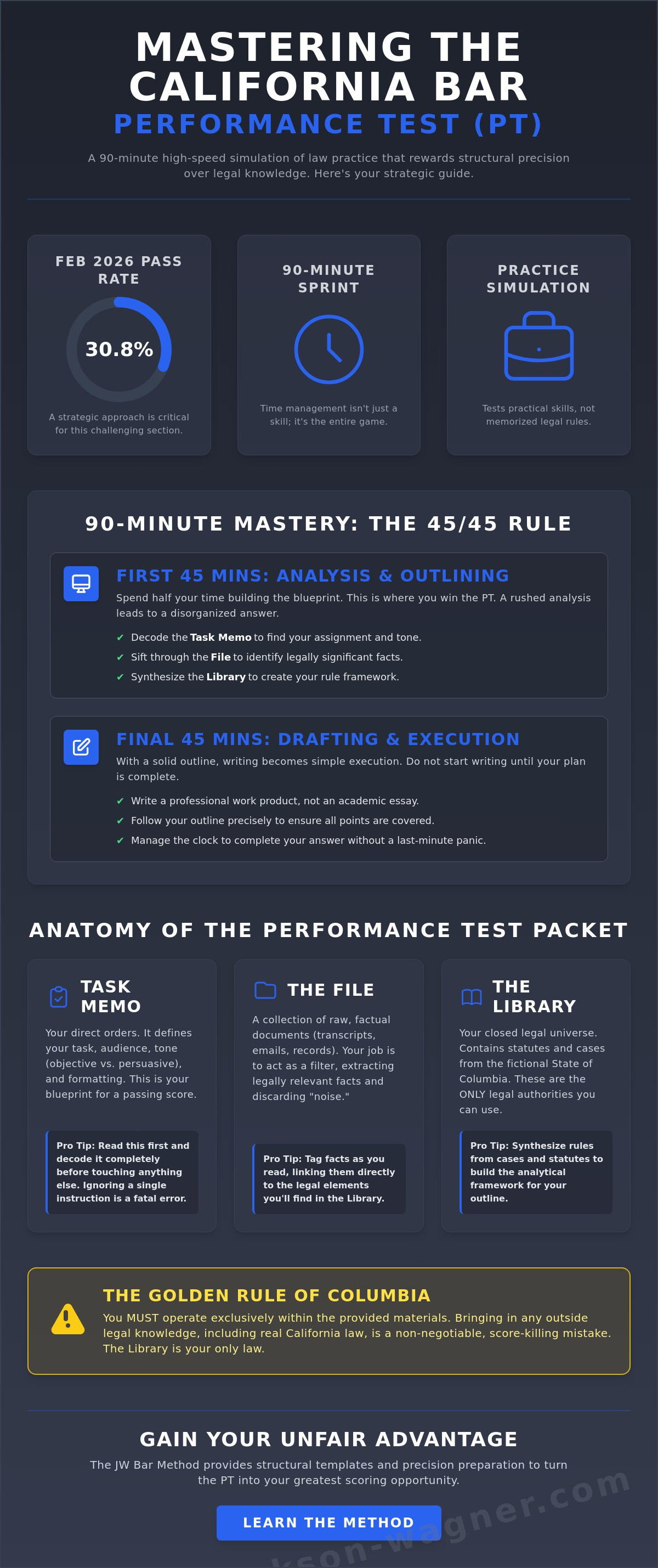
Most candidates fail the PT because they treat it like a traditional essay rather than a time-restricted simulation. In a 90-minute sprint, your greatest enemy isn't a lack of law; it's the clock. To conquer the california bar exam performance test format, you must adopt the 45/45 Rule. This system mandates that exactly half of your time is dedicated to reading, analyzing, and outlining, while the remaining 45 minutes are reserved for pure drafting. Many students panic and start typing at the 20-minute mark, only to realize halfway through that they've missed a critical legal element or misidentified the client's primary goal.
Your 90-minute execution should follow a rigid, pre-planned timeline. The first 15 minutes are for the Task Memo and Library. You must extract every rule and requirement before even looking at the facts. From minute 15 to 45, you dive into the File and build your outline. This is where you map specific facts to the legal rules you just identified. The "Sprint" happens from minute 45 to 85, where you transform your detailed outline into a professional work product. The final five minutes are for polishing, ensuring your headers are correct and you've addressed every "Call of the Question." To master this timing under professional guidance, enroll in the JW Bar Method Accelerated Prep - Full California Bar Exam.
Why Outlining is the Secret to Passing
A 15-minute outline is your insurance policy against writer's block. By the 60-minute mark, your brain will be fatigued; having a pre-built skeleton allows you to focus on writing quality rather than structural decisions. Your outline should act as a bridge, mapping Library rules directly to File facts. If a case in the Library mentions a three-part test, those three parts should immediately become subheadings in your outline. This ensures that every element of the legal test is addressed, leaving no points on the table for the graders to deduct. It transforms a chaotic pile of documents into a logical, high-scoring response.
Avoiding the "Rabbit Hole" Trap
The california bar exam performance test format often includes "distractor" documents or overly complex cases designed to slow you down. Don't let a single confusing case sink your score. If you can't synthesize a specific rule after two minutes of reading, move on to the next document. You must maintain a steady pace to avoid over-writing the first section of your assignment at the expense of the conclusion. Identify the distractor documents early. If a witness statement doesn't relate to the legal elements found in the Library, acknowledge its existence briefly and return to the material facts that actually drive the analysis.
The JW Bar Method: Precision Preparation for the Performance Test
Conventional bar prep often treats the PT as a passive, "open book" exercise, burying students under a mountain of practice questions without a clear roadmap. This volume-heavy approach is fundamentally inefficient. The JW Bar Method replaces this with a practitioner-centric strategy that focuses on the california bar exam performance test format through rigid structural templates. Instead of guessing how to format a demand letter or a brief, you use a repeatable system that mirrors the expectations of a senior partner in the fictional state of Columbia. We don't want you to just "practice"; we want you to execute with clinical precision.
The JW Bar Method Accelerated Prep - Full California Bar Exam is specifically designed for the modern learner who doesn't have months to waste on outdated pedagogy. We master the PT in a fraction of the time used by traditional courses by teaching you to see the "matrix" within the File and Library. Our results for the 2026 exams are backed by a binary performance guarantee that assumes the financial risk of your outcome. This bold reliability ensures you're moving toward licensure with a partner as committed to your success as you are. Jackson-Wagner LLC positions itself as a modern alternative to legacy models that have failed to keep pace with the evolving demands of the State Bar.
Beyond Generic Prep
Legacy standards often prioritize quantity over precision, leaving working professionals overwhelmed by busywork. They fail to address the high-stakes anxiety of the 90-minute clock with a structured, reliable path. The JW Bar Method focuses exclusively on the unique pedagogical requirements of the California Bar, ensuring every minute of study contributes to a passing score. The JW Bar Method utilizes accelerated prep to transform complex legal simulations into a structured, reliable path toward licensure success. We replace the stress of high-pressure certification with a modern system that prioritizes efficiency over exhaustive, unnecessary detail.
Your Next Steps for 2026 Success
Preparation for the July 2026 exam requires a clinical approach to your schedule. You should integrate PT practice into your california bar exam study schedule early to build the muscle memory required for the 90-minute clock. Choosing the best bar exam preparation service is a critical decision for working professionals who need efficiency over volume. If you're ready to secure your license and stop the cycle of repeat attempts, review our state of california state bar guide for a complete breakdown of licensure requirements. Don't leave your career to chance; choose a method that treats the california bar exam performance test format as a weapon rather than a hurdle.
Secure Your California Licensure with Precision
The 90-minute Performance Test is the ultimate hurdle between you and your professional license. Success in the california bar exam performance test format isn't about reading faster; it's about executing a repeatable system with clinical precision. By prioritizing the 45/45 rule and utilizing structural templates for every task type, you transform a chaotic volume of facts into a passing work product. You don't need more practice; you need a better method that treats the exam as a simulation of real-world law practice.
Traditional prep models often leave busy professionals drowning in busywork. We offer a modern alternative with accelerated study tracks focused exclusively on California licensure to ensure you're ready for the 2026 exam without the burnout. Our binary performance guarantee means we assume the financial risk of your outcome because we're that confident in our pedagogical results. It's time to replace high-stakes anxiety with a structured path to success.
Master the California Bar with the JW Bar Method and turn your professional goals into a reality. You have the drive to succeed. Now, you have the strategy to match it.
Frequently Asked Questions
How long is the California Bar Exam performance test in 2026?
The California Performance Test is exactly 90 minutes long. It is administered on the first day of the examination, Tuesday, July 28, 2026, alongside five one-hour essays. You must manage your time aggressively to finish both the analysis and drafting phases within this strict window to ensure a professional work product.
What is the fictional state of Columbia on the bar exam?
Columbia is the imaginary jurisdiction where every Performance Test scenario takes place. The State Bar uses this fictional setting to level the playing field for all applicants, regardless of where they attended law school. You must ignore real-world California or federal laws and rely exclusively on the statutes and cases provided in your Library.
What are the most common tasks on the CA Performance Test?
Objective memoranda and persuasive briefs are the most frequent assignments you'll encounter. However, the california bar exam performance test format is versatile. You may also be asked to draft demand letters, client opinion letters, or even a transcript for a closing oral argument, depending on the specific instructions in the Task Memo.
Do I need to cite cases in the California Performance Test?
Yes, citing the authorities provided in the Library is mandatory for a passing score. You don't need formal Bluebook citations, but you must clearly identify which case or statute supports your legal conclusions. Graders look for your ability to anchor your analysis firmly in the provided Columbia law rather than making generalized assertions.
Can I use outside legal knowledge for the PT?
No, you must never use outside legal knowledge or real-world statutes. The PT is a closed universe exam designed to test your analytical skills rather than your memory. Relying on actual California law instead of the provided Columbia authorities is a common mistake that leads to significant point deductions and can jeopardize your results.
How much is the Performance Test worth on the California Bar Exam?
The Performance Test is weighted as double the value of a single essay question. In the current california bar exam performance test format, the written portion accounts for 50% of your total score. Because the PT is worth two essays, it often serves as the decisive factor in reaching the 1390 passing threshold.
What is the difference between an objective and a persuasive PT?
An objective PT requires a neutral, balanced analysis of the law and facts for a supervising partner. A persuasive PT requires you to act as an advocate, using an argumentative tone to convince a judge or opposing counsel. The Task Memo will explicitly state which tone you must adopt, and failing to pivot correctly will lower your score.
Is the California Performance Test harder than the MPT?
While both the California PT and the Multistate Performance Test (MPT) are 90 minutes, California's version is often viewed as more demanding. The volume of the File and Library materials is typically denser, and the grading standards are notoriously rigorous. Success in California requires a more structured, practitioner-focused approach than the standard MPT requires.


