
With the February 2026 state bar of california results revealing a pass rate of just 30.8%, the margin for error has never been thinner. You have spent four grueling months in a state of professional limbo, waiting for a single notification to determine your career trajectory. It is completely natural to feel overwhelmed by the silence of the waiting period or the complexity of the 1390 scale. The stress of potential career stagnation is real, but it doesn't have to be your permanent reality.
We're here to replace that anxiety with a structured, reliable path to professional empowerment. You will learn exactly when to expect your 2026 results, including the scheduled November 6 release for the July administration, and how to strategically interpret your score report to ensure your licensure. Your results are more than just a grade; they are a diagnostic blueprint for your future. This guide provides a clear timeline for your next steps and a proven methodology to turn a score report into a successful passing attempt.
Key Takeaways
- Access the official timeline for the state bar of california results, including the scheduled November 6 release for the July 2026 administration.
- Master the diagnostic value of the 1390 scaled score to identify specific performance gaps in your essay and MBE responses.
- Learn why traditional study models often lead to the "Repeater Trap" and how to pivot toward a precision-based strategy that secures licensure.
- Discover the "48-Hour Rule" for processing results and the immediate administrative steps required for the Virtual Oath Packet.
- Understand how the JW Bar Method assumes the financial risk of your performance through a bold, binary outcome guarantee.
2026 California Bar Exam Results: Release Dates and Logistics
The waiting period following the California Bar Examination is a four month test of professional endurance. It is a period defined by high stakes and even higher anxiety. Understanding the mechanical details of how the State Bar of California delivers your results is the first step in reclaiming control over your career trajectory. Whether you sat for the winter or summer administration, the release of the state bar of california results follows a rigid, predictable protocol designed to handle thousands of simultaneous users.
The 2026 Release Schedule: Mark Your Calendar
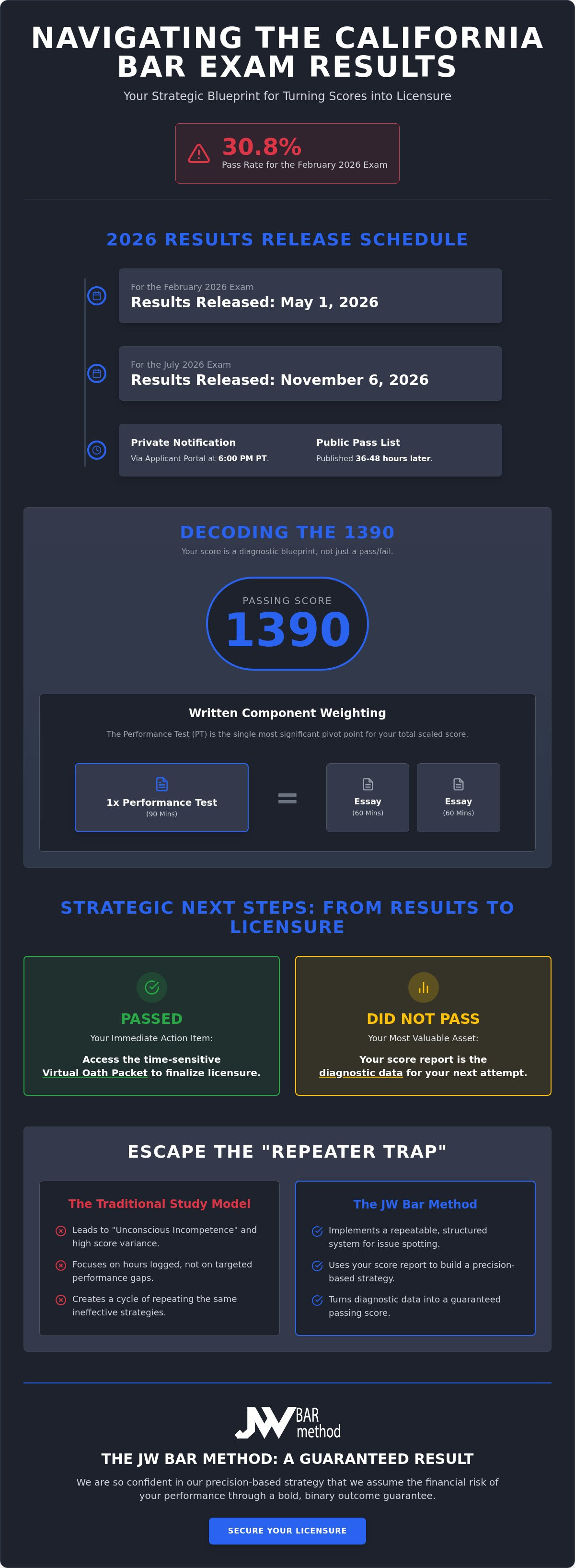
The State Bar has confirmed specific dates for the 2026 cycle. For those who completed the February 2026 exam, results will be available on May 1, 2026. If you are preparing for or have completed the July 2026 exam, your results are scheduled for release on November 6, 2026. In both instances, the official release time is 6:00 p.m. Pacific Time. It's vital to understand that "no later than 6:00 p.m." often means the portal will not update a single second early. Rapidly refreshing your browser at 5:45 p.m. only increases server strain without accelerating your notification.
There is also a significant distinction between your private notification and the public pass list. Your individual result is available immediately upon login at 6:00 p.m. on Friday. However, the public list, which displays the names of all successful applicants, typically does not go live until the following Sunday morning. This 36 to 48 hour lag allows you to process your results privately before colleagues or employers begin their searches. If you've opted for private results during the application process, your name won't appear on the public list at all, regardless of your performance.
Portal Logistics and Troubleshooting
The Applicant Portal is the only official channel for receiving your state bar of california results. Success on release day starts with administrative preparation. We recommend verifying your login credentials at least 48 hours before the release window. The State Bar's password reset system can experience delays during high traffic periods, and the last thing you want is a locked account at 5:59 p.m. on a Friday night.
- Verify your email: Ensure the email address on file is current, as the State Bar sends a courtesy notification when the portal is updated.
- Update your browser: Use the most recent version of Chrome or Firefox to ensure compatibility with the portal's security protocols.
- Manage expectations: If the site crashes due to the 6:00 p.m. rush, wait five minutes before attempting to log in again. Repeated failed attempts can trigger a temporary IP lockout.
Once you gain access, successful applicants will find a Virtual Oath Packet. This packet is time sensitive and contains the necessary documentation to finalize your licensure. For those who don't see their name, the portal will provide a link to a detailed score report. This report isn't a failure; it's the diagnostic data you need to ensure your next attempt is your last.
Decoding the 1390: How to Interpret Your Score Report
Receiving your state bar of california results and seeing a score below the passing mark is a visceral blow to your professional confidence. However, the data on that page is the most valuable diagnostic tool you possess. The State Bar of California provides this breakdown not to discourage you, but to reveal exactly where your execution deviated from the required standard. A score of 1380 isn't a "near pass"; it's a structural failure in specific performance categories that requires a complete strategy overhaul rather than just more hours of the same study routine.
The Weight of the Written Component
The written portion of the exam consists of five one-hour essays and one 90-minute Performance Test (PT). In the California scoring model, the PT carries the weight of two essays, making it the most significant pivot point for your total scaled score. A scaled score of 1390 represents the absolute threshold for California licensure. If your essay scores fluctuate wildly, you are likely suffering from "unconscious incompetence." This means you are identifying legal issues by instinct rather than through a repeatable, structured system. High variance suggests you pass when the facts are "friendly" and fail when they aren't, which is a professional gamble you can't afford to take twice.
MBE Percentiles and What They Reveal
Your score report includes a national percentile ranking provided by the NCBE. This number reflects how you performed relative to every other examinee in the country during that administration. If your percentile is low, it indicates a lack of substantive law mastery or a failure to grasp the specific "distractor" logic used in MBE drafting. Many applicants fall into the trap of volume-based prep, believing that doing 3,000 questions will naturally lead to success. It won't. Stagnant scores are usually the result of practicing your mistakes rather than refining your pedagogical approach. Identifying your "danger zone" is critical: if your MBE is strong but your written score is low, your knowledge isn't the problem; your application is.
A "near miss" often tricks students into believing they only need a few more weeks of the same routine to bridge the gap. This is a dangerous fallacy that leads to the repeater trap. To bridge a 20 or 30 point gap in your state bar of california results, you must move from passive recognition to active, precise application. If you're tired of the legacy prep models that failed to get you across the finish line, it's time to explore how a precision-driven methodology can ensure your next attempt is your last.
Why Pass Rates Remain Low: The Gap Between Prep and Performance
The February 2026 state bar of california results delivered a sobering message: a general pass rate of just 30.8%. This figure highlights a persistent, widening gap between traditional preparation and the actual demands of the modern examination. According to official pass rate statistics, first-time applicants passed at a rate of 43.9%, while repeaters struggled at a dismal 23.1%. This discrepancy defines what we call the "Repeater Trap." Many applicants believe that merely increasing the volume of their study or "trying harder" with the same materials will bridge the gap. They're wrong. Doing the same thing twice rarely yields a different result in a testing environment this rigorous.
The Failure of Legacy Bar Prep
Legacy bar prep providers rely on a "one-size-fits-all" model that prioritizes passive learning through endless video lectures and generic outlines. This approach fails because it treats the California Bar as a memory test rather than a demonstration of professional skill. Under California standards, there's a massive difference between knowing the law and applying it under high-pressure constraints. Passive consumption leads to a lack of agility. When you face a novel fact pattern on exam day, a memorized outline won't save you. You need a pedagogical system that emphasizes active, precision-based output from the very first day of your schedule. National providers focus on the mean, but California requires you to be exceptional.
The Attorney’s Exam Nuance
Seasoned practitioners often approach the Attorney’s Exam with a dangerous level of confidence. While the February 2026 pass rate for this group was higher at 57.0%, nearly half of all experienced lawyers still failed to secure licensure. The challenge is primarily psychological. You must shift from the practical, often messy reality of law practice back to the rigid academic standards of the State Bar. Practicing attorneys frequently underestimate California-specific nuances that differ significantly from their home jurisdictions. If you're an out-of-state lawyer, reviewing the California Attorney’s Exam requirements guide is an essential first step in your strategic pivot.
The 2026 state bar of california results prove that institutional performance is declining because the exam is evolving while legacy prep methods remain stagnant. Success requires a modern, agile alternative to these outdated models. You don't need more study hours; you need a more sophisticated, results-oriented methodology that addresses the specific technicalities of the California Bar.
Strategic Next Steps: From Results to Licensure
The moment you access your state bar of california results, your professional timeline shifts. Whether the screen displays a message of success or a link to a score report, your next 48 hours must be governed by strategy rather than emotion. Licensure in California is a multi-step process that does not end with a passing score, nor does it permanently stall with a failing one. You must move immediately from the anxiety of waiting to the precision of administrative or pedagogical execution.
Path A: You Passed, What Now?
Congratulations. Your name on the pass list is a significant achievement, but you are not yet a licensed attorney. Successful applicants will find a Virtual Oath Packet in their portal. This document is time sensitive and contains the specific instructions for your swearing-in ceremony. You must also ensure that your Multistate Professional Responsibility Examination (MPRE) score of 86 or higher has been officially reported to the State Bar. If you haven't already done so, you need to finalize the California bar exam moral character application. This background check is rigorous and can take several months to process. Delaying this filing is the most common reason new lawyers experience a gap between passing the exam and actually practicing law. Once these hurdles are cleared, you can join the California Bar Association and begin your career.
Path B: The Strategic Pivot After a Fail
If your state bar of california results were not what you expected, you must implement the 48-Hour Rule. Allow yourself two days to process the emotional weight of the outcome. On the third day, the emotional phase ends and the strategic audit begins. You must request your exam answers immediately. Reading your "failed" work is painful but necessary to identify the "JW Gap." This is the space between what you believed was a passing answer and what the examiners actually rewarded.
A common mistake is re-enrolling in the same high-volume course that failed to prepare you the first time. If a legacy provider's "one-size-fits-all" model did not work for the February administration, it will not work for the July administration. You need to identify whether your failure was a result of substantive law gaps or a failure in application. For those receiving May results, the late filing deadline for the July 2026 exam is April 30. This means you are already in a high-pressure window for re-registration. Don't waste another cycle on outdated methods. If you are ready to replace generic study with a results-oriented system, it is time to switch to precision-based bar prep that targets your specific performance gaps.
Your score report is a diagnostic blueprint. Use it to determine if you need to focus on MBE distractors or the structural nuances of the California Performance Test. Every point counts when you are aiming for that 1390 scaled score. The path to licensure is still open; you simply need a more sophisticated map to navigate it.
The JW Bar Method: A Guaranteed Result for 2026
The 1390 threshold is a binary wall; you are either a licensed attorney or you are an applicant in waiting. When the state bar of california results are released, they often reveal a significant gap between what legacy prep providers taught and what the examiners actually demanded. We don't believe in the "one-size-fits-all" approach that national providers push on thousands of students. Instead, our methodology focuses on precision over volume. We don't ask you to memorize thousands of pages; we teach you to master the specific technicalities that move your score from a 1350 to a passing 1390.
Precision-Based Pedagogy
Traditional bar prep is a relic of a different era. It relies on passive video consumption and generic outlines that ignore the unique "California-ness" of this exam. Our curriculum is built from the ground up to address the specific grading nuances of the California examiners. We target the high-variance subjects and the specific structural requirements of the Performance Test. The JW Bar Method acts as a disruptive mentor for high-stakes licensure, providing you with the agile strategies needed to navigate complex fact patterns. By replacing the stress of high-pressure certification with a structured, modern path, we empower you to perform at your peak on exam day.
We are so certain of our efficacy that we assume the financial risk of your performance outcome through a binary guarantee. While legacy providers offer a "free retake" of the same curriculum that failed you, we offer a literal financial assurance. This focus on a specific, measurable outcome distinguishes us from more cautious competitors. It creates a partnership where our success is entirely dependent on yours. This bold reliability allows you to focus on the pedagogy rather than the financial stress of a potential failure. We act as a partner so confident in our own methodology that we are willing to stand behind your results.
Your Path to the State Bar Starts Here
Choosing the right track is essential for your strategic pivot. The JW Bar Method Prep - Full Exam California Bar is designed for those who require a steady, structured progression through the entire curriculum. If you are a busy professional or a repeater facing a tight deadline, the JW Bar Method Accelerated Prep - Full California Bar Exam offers a faster-paced cadence without sacrificing depth. For out-of-state lawyers, the JW Bar Method Prep - Attorney’s Exam California Bar and its accelerated counterpart provide the specific "California-only" focus needed to bridge the gap between your home jurisdiction and the 1390 threshold.
The 2026 state bar of california results showed that doing the same thing twice is a recipe for stagnation. It's time to choose a path that is modern, agile, and results-driven. Secure your spot for the next administration and replace your anxiety with a guaranteed strategy for success.
Pass the California Bar with the JW Bar Method
Secure Your Professional Future in 2026
The release of the state bar of california results marks a pivotal transition in your legal career. You now have the diagnostic tools to move beyond the uncertainty of the waiting period and into a phase of decisive action. Whether you are navigating the administrative requirements of the Virtual Oath Packet or performing a strategic audit of a near-miss score, your focus must remain on precision. Legacy study models have proven insufficient for the modern California standard, making it essential to adopt a methodology that prioritizes active application over passive memorization.
Success requires a partner that assumes the risk of your performance. With our specialized California-only focus and accelerated tracks for working professionals, we provide the structured path needed to bridge the gap to licensure. Our binary performance guarantee ensures that your investment is protected as you master the technicalities of the 1390 threshold. Don't let another cycle pass using outdated methods that fail to deliver results.
Master the California Bar with a Guaranteed Prep Method
Your journey to becoming a licensed attorney in California is a marathon of professional endurance. You have the talent and the drive; now you simply need the right strategy to cross the finish line.
Frequently Asked Questions
What time are California Bar results usually released?
Results are released at 6:00 p.m. Pacific Time on the scheduled Friday release date. This applies to both the May and November windows for the 2026 administrations. You must access the Applicant Portal directly to view your status. Courtesies like email notifications often lag behind the portal update, so checking your account directly is the most efficient way to access your state bar of california results.
How do I find my California Bar Exam score if I failed?
You can find your detailed score report by logging into the Applicant Portal and selecting the "Unsuccessful Applicant Bulletin" link. This report provides your scaled MBE score along with raw scores for each essay and the Performance Test. Use this data as a diagnostic tool to identify specific performance gaps. It is the most critical document for refining your strategy and ensuring success on a subsequent attempt.
What is a passing score for the California Bar Exam in 2026?
The minimum passing score for the California Bar Exam in 2026 is a scaled score of 1390. This score is a mathematical combination of your performance on the Multistate Bar Examination (MBE) and the written portion. Both sections are weighted equally at 50% each. Achieving this threshold requires a precise balance of substantive law mastery and tactical application under the State Bar's strict time constraints.
Can I appeal my California Bar Exam results if I am close to 1390?
No, the State Bar of California does not provide a process for appealing exam results or requesting a regrade. All scores are final once they are released. Even if you are only a few points shy of the 1390 threshold, the examiners will not reconsider your work. Your only path forward is to analyze your score report and implement a more sophisticated, precision-based study method for the next administration.
What is the "Virtual Oath Packet" and when do I get it?
What happens if I fail the California Bar Exam twice?
Failing the exam twice does not prevent you from taking it again, as California currently has no limit on the number of attempts. However, you must recognize that repeat takers face a significantly lower pass rate of 23.1% compared to first-time applicants. To avoid the "Repeater Trap," you must pivot away from legacy prep models and adopt a modern, results-oriented strategy that targets your specific performance weaknesses.
How long does it take to get the official success letter in the mail?
Official success letters are typically mailed within two to four weeks following the digital release of the state bar of california results. While the portal notification is the immediate source of truth, the physical letter serves as a formal record of your achievement. Ensure your mailing address is updated in the Applicant Portal to avoid delays in receiving your official licensure documentation and your first membership card.
Can I see my essay answers if I passed the exam?
No, you cannot see your essay answers or raw scores if you pass the exam. The State Bar only provides score breakdowns and copies of written answers to unsuccessful applicants for diagnostic purposes. Successful applicants receive only a notification of their pass status. Your focus should shift immediately to the Virtual Oath Packet and the administrative steps required for your formal enrollment in the State Bar.


