

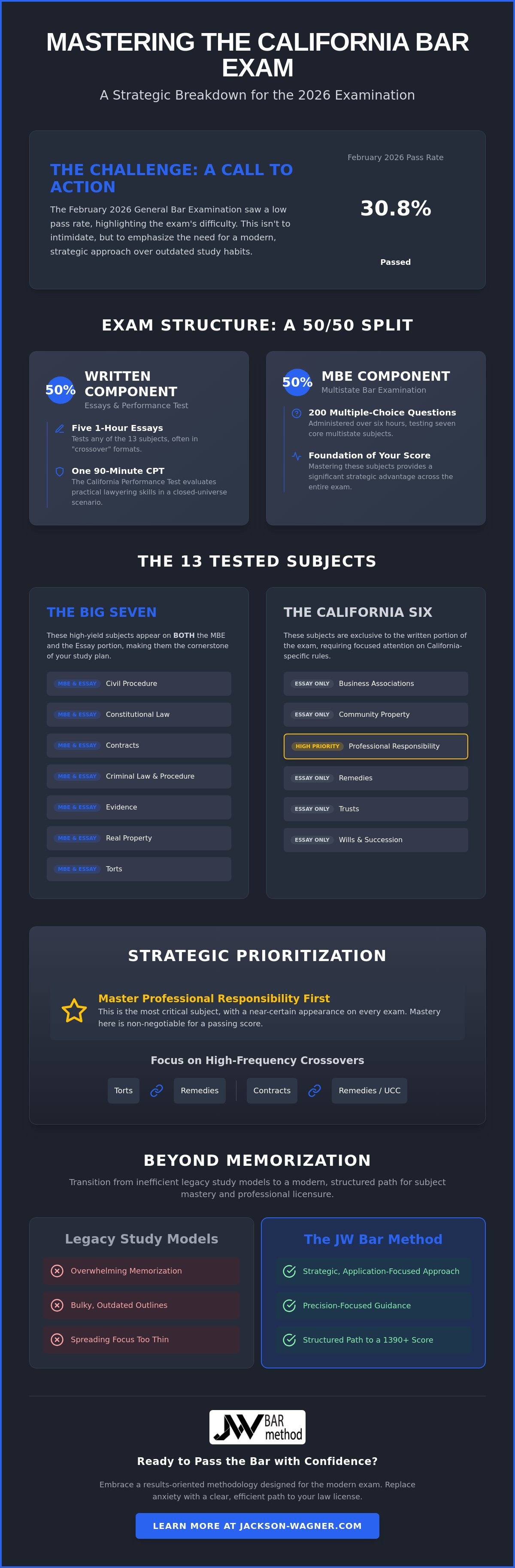
Did you know that only 30.8% of test-takers passed the February 2026 General Bar Examination? This statistic isn't meant to intimidate you; it's a call to action. You're likely feeling the crushing weight of the 13 california bar exam subjects and the constant pressure of distinguishing between California-specific rules and Federal law. The fear of a complex crossover question on the written portion is enough to keep any candidate up at night, wondering if they've spread their focus too thin.
We're here to replace that anxiety with a structured, modern methodology that turns these subjects into your greatest advantage. You'll master the nuances of the 2026 exam with precision-focused guidance that prioritizes what actually matters for your score. This breakdown provides a clear list of every tested topic, strategic prioritization for the MBE and essay portions, and the pedagogical methodology you need to hit that 1390 scaled score with absolute confidence. It's time to move past legacy study habits and embrace a results-oriented path to your law license.
Key Takeaways
- Understand the critical distinction between the Multistate Bar Examination (MBE) and the California-specific written components to balance your study time effectively.
- Identify the 13 california bar exam subjects tested on the written portion, including the foundational "Big Seven" topics that overlap with your multiple-choice prep.
- Learn why Professional Responsibility is the most important subject to master, given its near-certain appearance on every exam administration.
- Discover how to prioritize high-yield topics to avoid burnout and replace overwhelming memorization with a strategic, application-focused approach.
- Transition from legacy study models to the modern JW Bar Method for a structured, efficient path to achieving professional licensure.
Mastering the Scope: What Subjects Are on the California Bar Exam in 2026?
Success on the California Bar isn't about guessing; it's about surgical precision. The Committee of Bar Examiners defines the "Scope of the Exam" to ensure every candidate possesses the minimum competence required to practice in the nation's most rigorous jurisdiction. In 2026, this scope remains a massive hurdle, requiring you to demonstrate mastery over 13 potential topics. Relying on outdated study methods or bulky, legacy outlines won't cut it. You need to understand exactly how the california bar exam subjects are distributed across the two-day ordeal to maximize your efficiency.
The 2026 exam cycle maintains a strict divide between multistate standards and California-specific law. While the National Conference of Bar Examiners (NCBE) provides the foundational MBE content, the State Bar of California dictates the nuances of the written portion. This distinction is critical. You aren't just learning law; you're learning how to apply specific rulesets depending on which part of the exam you're currently tackling. Referencing the official California Bar Exam subject list reveals a daunting breadth of material, yet a structured approach makes this volume manageable. 2026 marks a shift toward evaluating subject mastery through deeper integration rather than surface-level memorization.
The Written Component: Essays and the CPT
The written portion of the exam accounts for exactly 50% of your total scaled score. It consists of five one-hour essay questions and one 90-minute California Performance Test (CPT). These essays don't just test your memory; they test your ability to perform under pressure. Any of the 13 california bar exam subjects can appear here, often in "crossover" formats that blend topics like Torts and Remedies or Community Property and Trusts. The CPT is different. It's a closed-universe test designed to evaluate your lawyering skills, such as drafting a memo or a brief, using only the provided library and file. It's about practical application, not just recitation.
The MBE: Seven Core Multistate Subjects
The other 50% of your score comes from the Multistate Bar Examination (MBE). This involves 200 multiple-choice questions administered over six hours. In 2026, the NCBE continues to test seven core subjects: Civil Procedure, Constitutional Law, Contracts, Criminal Law and Procedure, Evidence, Real Property, and Torts. These seven subjects form the bedrock of your preparation. Because they appear on both the MBE and the essay portion, mastering them provides a massive strategic advantage. They are the high-yield foundations that can carry your score when a more obscure California-specific topic appears on the written day. Focus here first to build a safety net for your results.
Deep Dive into the 13 Tested Essay Subjects
Success requires more than a casual glance at the california bar exam subjects; it demands a strategic dissection of how these topics interact. The Committee of Bar Examiners draws from a pool of 13 subjects to craft five essay questions that test your analytical depth. These subjects fall into two categories: the "Big Seven" that you'll also see on the MBE, and the "California Six" which are exclusive to the written portion. Business Associations encompasses Agency, Partnership, and Corporations. To master this volume, you must move beyond the surface and understand the specific rules the State Bar expects you to apply under pressure.
You'll find the Official California Bar Exam details confirm that any of these topics can appear in isolation or as part of a complex crossover. The "Big Seven" include Civil Procedure, Constitutional Law, Contracts, Criminal Law and Procedure, Evidence, Real Property, and Torts. The "California Six" round out the list with Business Associations, Community Property, Professional Responsibility, Remedies, Trusts, and Wills and Succession. Focusing your energy on the intersections of these subjects is what separates passing scores from those who fall just short of the 1390 mark.
High-Frequency Crossover Topics
Crossover essays are the ultimate test of issue spotting. They terrify unprepared candidates because they require you to pivot between different areas of law within a single 60-minute window. You'll often see Torts paired with Remedies, or Contracts intertwined with Remedies and Uniform Commercial Code (UCC) nuances. Evidence frequently appears alongside Criminal Procedure, forcing you to analyze both the legality of a search and the admissibility of the resulting fruit. Identifying these multiple subject issues early in the fact pattern is a skill that requires a structured pedagogical approach rather than just reading bulky outlines.
California-Specific Subjects: Community Property and Professional Responsibility
Professional Responsibility is the most important subject on the entire exam. It's the only one you can virtually guarantee will appear in some form, either as a standalone essay or as a sub-issue in a crossover. The State Bar prioritizes ethical competence above all else. Community Property presents a uniquely Californian challenge, especially for out-of-state attorneys or students accustomed to common law marital property systems. In the 2026 testing cycle, Wills and Trusts also remain high-frequency topics that often appear together. If you're feeling overwhelmed by this volume, exploring the JW Bar Method can help you prioritize high-yield topics without burning out.
The MBE Subjects: Foundations of Your Total Score
The Multistate Bar Examination (MBE) isn't just a component of your testing cycle; it's the bedrock of your entire performance. When you're preparing for the california bar exam, you must respect the massive 50% weight assigned to these 200 multiple-choice questions. This is the most objective portion of the test. While essay grading can feel subjective or dependent on a grader's specific preferences, the MBE is a binary game of right and wrong. Mastering the foundational california bar exam subjects tested here provides a critical safety net. A dominant MBE score can compensate for a mediocre essay performance, effectively carrying you across the 1390 finish line even if Day 1 doesn't go perfectly.
In 2026, the precision requirements for subjects like Civil Procedure and Real Property have reached a peak. These aren't topics you can "common sense" your way through. High-achieving professionals often make the mistake of underestimating "easy" subjects like Torts or Contracts because they use these concepts in daily practice. The MBE doesn't test practical experience; it tests specific, narrow, and often obscure legal nuances defined by the NCBE. Arrogance is a score-killer. You need to approach these seven subjects with the same intensity as the most complex California-specific topics.
Why MBE Mastery is Non-Negotiable
The mathematical reality of the California Bar is simple: you cannot pass without a competitive MBE score. This portion is administered on Day 2, split into two three-hour sessions of 100 questions each. It's a grueling marathon of mental endurance. However, there's a significant psychological advantage in knowing that exactly half of your total possible points are determined by objective, multiple-choice logic. This removes the "blank page" anxiety associated with the written portion and allows you to bank points through sheer repetition and rule mastery.
Analyzing Subject Overlap Between Day 1 and Day 2
Every subject on the MBE is a "double-threat" because these topics are also frequently tested as Day 1 essays. Subjects like Constitutional Law, Evidence, and Criminal Procedure are high-frequency guests on the written portion. Your strategy should reflect this overlap. When you master an MBE topic, you're simultaneously building the rule blocks for your IRAC structures. The challenge lies in the pivot. You must be able to switch from the "process of elimination" logic required on Wednesday to the "issue-spotting and analysis" construction required on Tuesday. If a subject appears on the MBE, it deserves double the attention in your study schedule.
Strategic Prioritization: Which Subjects Deserve Your Maximum Focus?
The sheer volume of 13 california bar exam subjects is designed to overwhelm the average applicant. You can't treat every topic as an equal priority if you want to avoid burnout and secure a passing score. Success requires a ruthless triage of your study hours. The best bar exam preparation service focuses on high-yield mastery over the exhausting rote memorization of 3,000-page outlines. You need to allocate your time based on the mathematical probability of a subject appearing and your own diagnostic weaknesses. It's about working smarter, not just harder.
Mastering Professional Responsibility is your non-negotiable insurance policy. We call it the "Professional Responsibility Guarantee" because the State Bar tests this on nearly every administration. If you aren't scoring in the top percentile for ethics, you're leaving the easiest points on the table. While other subjects rotate, your competence in PR must be absolute. This isn't just about passing; it's about establishing the professional standard required by the nation's most demanding jurisdiction.
Distinguishing Between General Law and California-Specific Rules
Confusion over which ruleset to apply is a common reason for failing the written portion. You must be surgically precise when switching between the Federal Rules of Evidence and the California Evidence Code. In 2026, the 'California Distinction' in Civil Procedure remains a frequent source of "nuance traps" for examinees. In California, unless otherwise specified, examinees should apply general law to Contracts and Torts but must utilize specific state statutes for Community Property and Professional Responsibility. This distinction is the difference between a 60 and a 75 on your essay score.
The 80/20 Rule of Bar Prep Subjects
The 80/20 rule dictates that 20% of the sub-topics within the california bar exam subjects generate 80% of the points. Don't get bogged down in the obscure corners of the Rule Against Perpetuities in Real Property or the fringe nuances of the Dormant Commerce Clause in Constitutional Law. Identify the core issues that the examiners return to every cycle. During your final 30 days of preparation, you must triage. Stop trying to learn new, low-probability rules and instead solidify your "A-level" mastery of high-yield topics. This strategic focus ensures you're prepared for the questions that actually appear on the exam.
Ready to stop guessing and start preparing with precision? Explore the JW Bar Method Prep - Full Exam California Bar to streamline your path to success.
Beyond Memorization: The JW Bar Method for Subject Mastery
Legacy bar prep is a relic of the past. Traditional providers bury you in 3,000-page outlines, expecting you to absorb information through sheer volume. This approach fails modern professionals who require efficiency and precision. The JW Bar Method is a disruptive alternative designed specifically for the California state bar, replacing bulky text with a structured, pedagogical framework. We don't just give you the law; we give you a binary performance guarantee. We're so confident in our results-oriented curriculum that we assume the financial risk of your outcome, allowing you to focus entirely on execution.
Mastering the california bar exam subjects shouldn't feel like a hazing ritual. Whether you're a first-time taker or a practicing lawyer navigating the California attorney's exam requirements, your time is your most valuable asset. Out-of-state attorneys often underestimate the written portion because they're exempt from the MBE. However, the 13 subjects tested on Day 1 remain just as rigorous. Our methodology ensures you aren't just memorizing rules but learning how to deploy them in a way that satisfies the most demanding graders in the country.
Precision Preparation for the Full and Attorney's Exams
The JW Method streamlines the vast california bar exam subjects into an accelerated curriculum that prioritizes high-yield mastery. We utilize structured drills that simulate the high-stakes environment of the 2026 exam, forcing you to apply rules under time constraints. For those taking the Attorney's Exam, we tailor the focus to the specific nuances of the written components. This ensures you aren't wasting hours on multiple-choice logic you'll never use. Instead, you'll develop the "muscle memory" required to identify crossover issues and draft passing responses with surgical speed.
The Path to Licensure: Your Next Steps
Finalize Your Strategy for 2026 Licensure
Mastering the 13 california bar exam subjects is not a feat of endurance; it is a test of strategic intelligence. You've identified the "Big Seven" overlap, recognized the non-negotiable weight of the MBE, and learned why Professional Responsibility remains your most critical insurance policy. Now, it's time to stop drowning in legacy outlines and start preparing with a methodology that respects your professional time. Success on this exam requires more than just knowing the law. It requires a structured, modern approach that prioritizes high-yield results over mindless memorization.
The JW Bar Method replaces bulky, outdated study habits with an accelerated, precision-focused curriculum. Whether you're navigating the full exam or utilizing specialized tracks for attorney's exam candidates, our proprietary system provides the security you need to perform. We offer a binary performance guarantee because we're certain of our results. We assume the financial risk so you can focus on the performance that will define your career. Pass the California Bar Exam with the JW Bar Method and secure your future in the nation's most prestigious legal market. Your path to licensure starts with a single, confident decision.
Frequently Asked Questions
What subjects are tested on the California Bar Exam in 2026?
The exam tests 13 potential subjects on the written portion and seven core subjects on the Multistate Bar Examination (MBE). Essay topics include Business Associations, Civil Procedure, Community Property, Constitutional Law, Contracts, Criminal Law and Procedure, Evidence, Professional Responsibility, Real Property, Remedies, Torts, Trusts, and Wills and Succession. The MBE specifically focuses on the "Big Seven" foundational topics, including Real Property, Torts, and Evidence.
Is California law tested on the MBE portion of the exam?
No, the MBE tests general principles of law rather than California-specific rules. It is a standardized, 200-question multiple-choice exam administered by the National Conference of Bar Examiners (NCBE). You should only apply California-specific law on the written portion of the exam when the fact pattern prompts you to do so or involves state-specific topics like Community Property or the California Evidence Code.
How many essay questions are on the California Bar Exam?
You must answer five one-hour essay questions during the first day of the examination. These questions test your analytical depth across the 13 potential california bar exam subjects. In addition to these five essays, you will complete one 90-minute California Performance Test (CPT). This written component accounts for exactly 50% of your total scaled score, making it equal in weight to the multiple-choice MBE.
Which subjects are tested on the California Attorney’s Exam?
The Attorney's Exam tests all 13 subjects available on the General Bar Exam but focuses exclusively on the written components. This means you'll answer the same five essay questions and the one California Performance Test as other candidates over a single day. You're exempt from the 200-question MBE. Because your entire score depends on the written day, mastering the nuances of the california bar exam subjects is your only path to licensure.
What is a 'crossover' question on the California Bar?
A crossover question is an essay that integrates two or more legal subjects within a single fact pattern. Common pairings include Torts with Remedies or Evidence with Criminal Procedure. These questions require you to pivot quickly between different rulesets and identify issues from multiple subjects simultaneously. Preparing for crossovers is essential because they frequently appear on the exam to test your ability to handle complex, multi-dimensional legal problems.
How often is Professional Responsibility tested on the CA Bar?
Professional Responsibility is tested on nearly every administration of the California Bar Exam. It's the most high-frequency subject, appearing either as a standalone essay or as a significant sub-issue within a crossover question. Because the State Bar prioritizes ethical competence, you can't afford to treat this as a minor topic. Mastering it's a strategic requirement to reach the 1390 scaled passing score.
Do I need to know California-specific Evidence and Civil Procedure?
Yes, you must be able to distinguish between California-specific rules and Federal law for both Evidence and Civil Procedure. While the MBE portion uses Federal rules, the essay portion often requires you to apply the California Evidence Code or state-specific procedural statutes. Precision in identifying these "California Distinctions" is what separates high-scoring candidates from those who struggle with the written portion's complexity.
What is the passing score for the California Bar Exam in 2026?
The total scaled passing score for the California Bar Exam remains 1390 out of a possible 2000 points. This score is calculated by combining your performance on the MBE and the written portion, which are weighted equally at 50% each. Achieving this mark is a significant challenge, as evidenced by the 30.8% pass rate for the February 2026 General Bar Examination. Precision and strategic prioritization are your best tools for success.


