

Your MPRE score can meet California’s requirement and still be missing from your Applicant Portal. An MPRE score transfer to california involves two separate systems: you request an official report through the NCBE, then the State Bar of California must match it to your applicant record.
If you’re unsure whether you selected California or can’t see your score in the portal, it helps to know which organization handles each step. California requires a scaled score of at least 86, and the State Bar doesn’t set an expiration date for a passing MPRE score.
This guide explains how to request a score report, compare the details in your NCBE and Applicant Portal accounts, and follow up if the score doesn’t appear. It also covers what to do if your score was sent before you registered with the State Bar and how to confirm the report reached your file. Once the reporting steps are clear, you can focus on the separate California Bar Exam requirement and plan your next stage of preparation.
Key Takeaways
- The MPRE score transfer to california depends on an official report sent by the NCBE and matched to your State Bar applicant record.
- Check your NCBE account and California Applicant Portal before requesting another report, then compare your identifying details across both accounts.
- Your next step depends on whether you selected California during MPRE registration. This guide explains both reporting paths.
- If your score was sent before you registered with the State Bar, follow the steps that can help connect it to your file.
- Keep MPRE reporting separate from California Bar Exam preparation, and plan for that remaining requirement on its own.
MPRE score transfer to California: what the score report actually does
The phrase MPRE score transfer to california describes sending an official MPRE result from the National Conference of Bar Examiners (NCBE) to a jurisdiction you select. It doesn’t mean your score automatically appears in every state’s admissions system. The NCBE sends the report; the State Bar of California receives it and matches it to the correct applicant record.
These steps can happen at different times: you take the exam, the NCBE issues your score, and California records the report in your applicant file. Seeing a score in your NCBE account confirms that your result is available there. It doesn’t confirm that California has received the official report or matched it to your file.
What the MPRE score requirement means for California applicants
California requires applicants to meet a minimum MPRE scaled score. The reported minimum is 86. Verify the current threshold and applicable applicant rules on the official State Bar of California website before relying on it. The State Bar receives the report for California admissions, while the NCBE sends the official score report.
A passing score and a completed reporting step are related, but they aren’t the same thing. If your score meets California’s threshold, it may satisfy the score requirement once the State Bar has received the official report and recorded it in your file. Keep your score information available while you check the State Bar’s instructions.
Why an MPRE result is not the same as a California bar exam result
The MPRE is a separate, 60-question professional-responsibility exam administered by the NCBE, not a section of the California Bar Exam. For a broad overview of the exam’s purpose and role in bar admissions, see the Multistate Professional Responsibility Examination (MPRE) on Wikipedia. This guide focuses on reporting an earned score to California, not MPRE study strategies.
Keep the two exams’ roles clear as you plan. MPRE reporting addresses the professional-responsibility score requirement. It doesn’t report a California Bar Exam result or replace preparation for that exam. For broader planning around the separate California exam, use this California Bar Exam strategic guide.
In short: completing the MPRE earns a score, requesting a report sends it to California, and accurate account matching helps the State Bar attach it to your applicant file. Treat these as separate checkpoints. A passing result may appear in your NCBE account before it shows in your California records, so check both systems rather than assuming one confirms the other.
How NCBE and the State Bar of California handle MPRE score reporting
Think of score reporting as a handoff between two systems, not a transfer completed inside the California Applicant Portal. Your NCBE Account is where you review your MPRE result and manage score-report requests. The State Bar of California receives reports for its jurisdiction and maintains the applicant record where the score must be matched.
| Organization | Role in reporting |
|---|---|
| NCBE | Administers the MPRE, posts candidate scores in the NCBE Account, and sends official reports to selected jurisdictions. |
| State Bar of California | Receives California-designated reports and matches them to an applicant’s State Bar record. |
The NCBE handles score delivery; the State Bar of California holds the applicant record and matches the report to it. The NCBE’s NCBE Official MPRE Score Reporting Information explains score access and reporting options. Candidates can view their result in the NCBE Account, while the official report is sent directly to the jurisdiction rather than delivered to the candidate to forward.
When to designate California as your MPRE score recipient
During MPRE registration, candidates can designate a jurisdiction to receive the score report. If you selected California, review the summary of your test-authorization request in your NCBE Account and confirm the jurisdiction listed. This helps you determine whether California was selected before you request another report.
Designating California starts the reporting process, but it doesn’t guarantee an immediate update in the Applicant Portal. The score must be released and sent, then associated with your State Bar record. Check the NCBE designation and your California account as separate checkpoints.
When an additional NCBE score report may be needed
If you didn’t select California during registration, use the score-services area of your NCBE Account to request a report for an additional jurisdiction. Review the current instructions before submitting the request. If you’re unsure whether a previous request went through, check your account first to avoid submitting a duplicate.
NCBE also advises candidates to check the jurisdiction’s score-age rules before ordering a report. California’s reported policy is that a passing MPRE score has no expiration date, but verify current requirements with the State Bar. For related licensure context, the California Attorney’s Exam requirements guide discusses that exam pathway, not MPRE reporting instructions.
Once you’ve clarified the reporting route, keep your exam plans moving. Jackson-Wagner provides structured preparation for the separate California Bar Exam through online California Bar Exam preparation. This preparation is separate from the score-reporting process.
MPRE score missing from your California account? Check these record-matching issues
A score in your NCBE Account confirms that your result is available there. It doesn’t confirm that the State Bar of California has received the official report or matched it to your Applicant Portal record. Before requesting another report, check where it was sent and whether your identifying details match across the two systems.
Work through these checks in order:
- Confirm California was selected. Review your NCBE Account and the summary of your test-authorization request. If California wasn’t designated, check whether you need to request an additional report through NCBE.
- Confirm you have a State Bar applicant record. Sign in to the California Applicant Portal and make sure your applicant registration is complete. A report sent before you registered may require a different follow-up step.
- Compare identifying details. Check that your name and other identifying information match across the NCBE and State Bar records. Differences, including an inconsistent Social Security number, can interfere with matching.
- Check the NCBE number. Confirm it’s entered in the Applicant Portal wherever the State Bar’s instructions request it. Don’t post your Social Security number, NCBE login, or other sensitive account details in a public forum or message.
The State Bar’s published guidance estimates two to three business days for processing after NCBE sends a score report. Treat this as an estimate, not a guarantee, and verify the current timeline and instructions on the official State Bar page. If that period has passed, use the State Bar’s official Applicant Portal request route when its instructions direct you to do so.
Check the identifying information in both accounts
Compare the information in each account directly instead of relying on memory or a saved form. Look for differences in your name and other identifying details, and check that the NCBE number is present in the California Applicant Portal if requested. Don’t send sensitive identifiers through an unapproved channel. If you need to submit information, follow the portal’s current secure instructions.
If you passed the MPRE before registering with the State Bar
If you earned your score before creating a State Bar applicant record, California’s guidance directs already-scored applicants to submit a General Request through the Applicant Portal so the score can be located and added to the file. Follow the current portal wording and instructions exactly. Requirements can change, so use the portal’s instructions rather than relying on a paraphrased list of fields or attachments.
This is different from asking NCBE to send a score report. If California wasn’t selected or the report needs to go to an additional jurisdiction, make the request through your NCBE Account. If NCBE already sent the report before you registered with the State Bar, use the General Request route described by California. The MPRE score transfer to california depends on both parts being handled correctly: NCBE delivery and State Bar record matching.
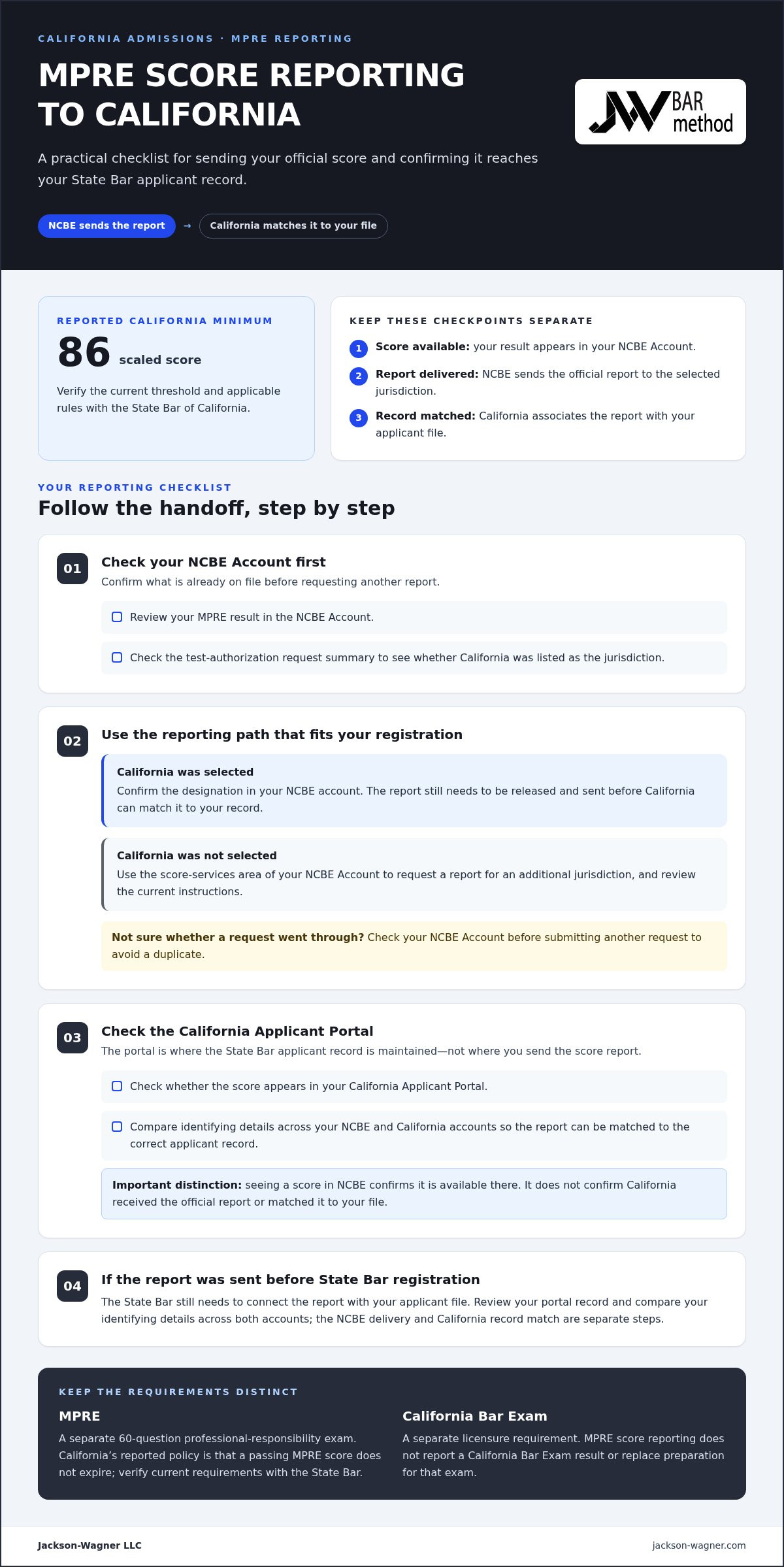
Reporting Your MPRE Score to California: A Checklist
Before requesting another report, check both systems. Your NCBE Account shows your score and reporting activity; the California Applicant Portal shows your State Bar applicant record. The right next step depends on whether you selected California during MPRE registration and whether you received your score before registering with the State Bar.
- Review your NCBE Account first. Find your MPRE score and the test-authorization request summary. Check whether California is listed as the jurisdiction selected to receive the report. If you can’t tell whether the report was requested or sent, review the current NCBE Score Services instructions before submitting a duplicate request.
- Check your California Applicant Portal record. Confirm that you’re registered with the State Bar and can access your applicant account. Review the account details California uses to match reports, including your NCBE number wherever the portal instructions request it. Make sure identifying information is consistent across the two accounts.
- Follow the path that matches your situation:
- If you selected California during MPRE registration: Keep the NCBE test-authorization summary as evidence of your designation. After NCBE sends the report, check the Applicant Portal. The State Bar has reported an estimated processing time of two to three business days after sending. Verify the current estimate and instructions on the official State Bar page before relying on that timing.
- If you didn’t select California: Use your NCBE Account’s Score Services process to request a score report for an additional jurisdiction, following the current prompts. Then check your California Applicant Portal record after the stated processing interval.
- If you received your score before registering with the State Bar: Check California’s current instructions for already-scored applicants. The State Bar directs qualifying applicants to submit a General Request through the Applicant Portal so the score can be located and added to their file. Use the portal’s exact current labels and submission directions.
- If the score still isn’t visible, use the official request route. Follow the State Bar’s current portal guidance for a missing or unmatched score. Don’t assume that a score displayed in your NCBE Account has been matched to California, and don’t send sensitive identifying information through an unapproved channel.
- Keep a record of what you submit. Retain NCBE request confirmations and any State Bar portal confirmation. Check the California account again after the applicable processing interval, and note when you checked and which official instructions you followed.
Once the reporting task is moving, plan separately for the California Bar Exam with Jackson-Wagner’s online California Bar Exam preparation. MPRE reporting and bar-exam preparation are distinct steps in your licensing path.
After MPRE score reporting: prepare for the remaining California licensure steps
Once your MPRE report is sent and your California account reflects it, turn to the other parts of the licensure process. Score reporting and bar-exam preparation are separate tasks. A recorded MPRE result doesn’t prepare you for the California Bar Exam or replace the other requirements for admission, so plan for each step on its own timeline.
Jackson-Wagner provides structured preparation for the California Bar Exam and California Attorneys’ Exam. Its courses focus on those California exams, not MPRE reporting or MPRE study. Choose a course that aligns with the exam route you’re pursuing, then build a study plan around that exam’s components.
Choose California Bar preparation that matches your exam route
Full California Bar Exam preparation and California Attorneys’ Exam preparation are different routes. Choose based on the exam you’re taking. The 3-Week Attorneys’ Exam program covers essays and the Performance Test only; it does not include the MBE. For broader planning, the California Bar Exam guide offers a wider view of preparation for the exam.
Know what Jackson-Wagner’s online study format includes
Jackson-Wagner’s California exam courses are fully online. Registration and payment provide immediate digital access, and no physical books are required. Courses include quizzes, assignments, automated feedback, and a mastery certificate for completing each module. Work through the course material, test your understanding, and use feedback to identify areas that need more attention.
The stated result promise is “Pass the California Bar or your money back.” Review the applicable course information for the terms of the money-back guarantee. Preparing for the exam is separate from completing the MPRE score-reporting process.
With the reporting task handled, you can focus on exam preparation and the requirements still ahead. If you’re ready to build a structured plan for the California Bar Exam or Attorneys’ Exam, explore Jackson-Wagner’s California exam preparation and choose the route that fits your exam.
Turn your next licensing step into a focused plan
With your MPRE reporting task underway, focus on the next part of the licensing path you can prepare for. Keep your MPRE score transfer to california records organized, then make a clear plan for the California Bar Exam or California Attorneys’ Exam you intend to take.
Jackson-Wagner’s California exam courses are fully online, with immediate digital access after registration and payment. No physical books are required. Quizzes, assignments, automated feedback, and module mastery certificates support a structured study routine. The stated promise is “Pass the California Bar or your money back.”
Choose preparation that fits your exam route and move forward with a focused plan. Explore Jackson-Wagner’s California Bar preparation programs to choose your next step for the California exam. You’ve made progress on the administrative side; now you can build momentum toward the exam itself.
Frequently Asked Questions
Is California the only jurisdiction that receives an MPRE score automatically?
No. California isn’t the only jurisdiction that can receive an MPRE score report. During registration, you can designate a jurisdiction to receive your score, and NCBE sends the report to the jurisdiction you selected. Don’t assume California is selected because you plan to apply there or took the exam in California. Review the jurisdiction shown in your NCBE Account to confirm where the report was directed.
Can I transfer an MPRE score to California after taking the exam in another state?
Yes. The state where you sat for the MPRE doesn’t prevent you from reporting your score to California. To complete an MPRE score transfer to California, use your NCBE Account to request a report if California wasn’t selected during registration. Then check your California Applicant Portal record. NCBE handles the score-report request; the State Bar receives the report for your California file.
How long does it take for an MPRE score to appear in a California applicant account?
The State Bar has reported an estimate of two to three business days for processing and adding a score to an applicant account after NCBE sends the report. This isn’t the time from your exam date or necessarily from when your NCBE score first appears. Check the State Bar’s current guidance for the applicable timeline, and allow for the full processing interval before following up through the official portal route.
What MPRE score do I need to pass for California?
California’s reported minimum passing MPRE scaled score is 86. Confirm the current threshold and applicant requirements on the State Bar of California’s official website before relying on that figure. Compare your NCBE score with the state’s requirement, and remember that the State Bar’s record must also reflect the official report. Keep your score information for your records.
What should I do if my MPRE score is not showing in the California Applicant Portal?
Start by checking that California was designated in your NCBE request and that your applicant record is active. Compare your identifying details across the NCBE Account and State Bar portal, including your NCBE number wherever requested. If you received your score before registering with the State Bar, California directs qualifying applicants to submit a General Request in the Applicant Portal. Follow the current portal instructions and avoid sending sensitive information through unofficial channels.
Does NCBE send an MPRE score report directly to the candidate?
No. NCBE posts your score in the Score Services area of your NCBE Account, but it sends official score reports directly to the jurisdiction you designate. You can review your result and manage report requests there, but you shouldn’t expect to forward a candidate copy as a substitute for the official report. Save or print your score details for your own records while they’re available in your account.


