

Your next California Bar Exam attempt shouldn’t be a replay of your last study plan. Effective bar exam preparation for repeat takers starts by identifying what needs to change, not simply reviewing everything again. After an unsuccessful attempt, it’s natural to wonder whether you need a full review, targeted practice, or a more structured plan, especially when work and other responsibilities limit your study time.
Use your previous attempt as a diagnostic. Review the information available from your result, consider how you used your study time, and look for patterns in your practice work. Then match your preparation to your exam path: the full California Bar Exam includes the MBE, essays, and Performance Test, while the California Attorneys’ Exam covers essays and the Performance Test, without the MBE.
This guide will help you turn those observations into specific preparation changes, compare general review with structured study using practical criteria, and weigh California-focused options by scope and format. You’ll leave with a clearer way to build a realistic plan around the time you have and the work your next attempt requires.
Key Takeaways
- Use your previous attempt as evidence, not a verdict. Look for patterns in results and practice work before deciding what to change.
- Make bar exam preparation for repeat takers diagnosis-led: prioritize the skills and subjects your review shows need focused work.
- Compare preparation options by structure, feedback, practice activities, exam scope, and study commitment, not just course volume.
- Build a repeatable study cycle of focused review, timed practice, careful analysis, and adjustment around your available time.
- Match your plan to your California exam path: the 4-Week Accelerated Program covers the MBE, California essays, and Performance Test.
Bar Exam Preparation for Repeat Takers: Turn the Previous Attempt into a Starting Point
An unsuccessful result can be discouraging, especially when preparing again means making room for study alongside work, family, or other responsibilities. But one exam result isn’t a measure of your ability, and it doesn’t automatically explain what happened. Treat the attempt as information to examine, not a verdict to accept. The goal of bar exam preparation for repeat takers is to turn that information into a practical change in how you prepare.
The bar exam tests knowledge and your ability to demonstrate it under exam conditions. A Bar examination overview offers general background on the exam’s purpose and administration, but your next plan should be based on your own available results and work. Avoid deciding that one subject, study method, or exam-day event caused the outcome unless the evidence supports that conclusion.
What a previous attempt can tell you
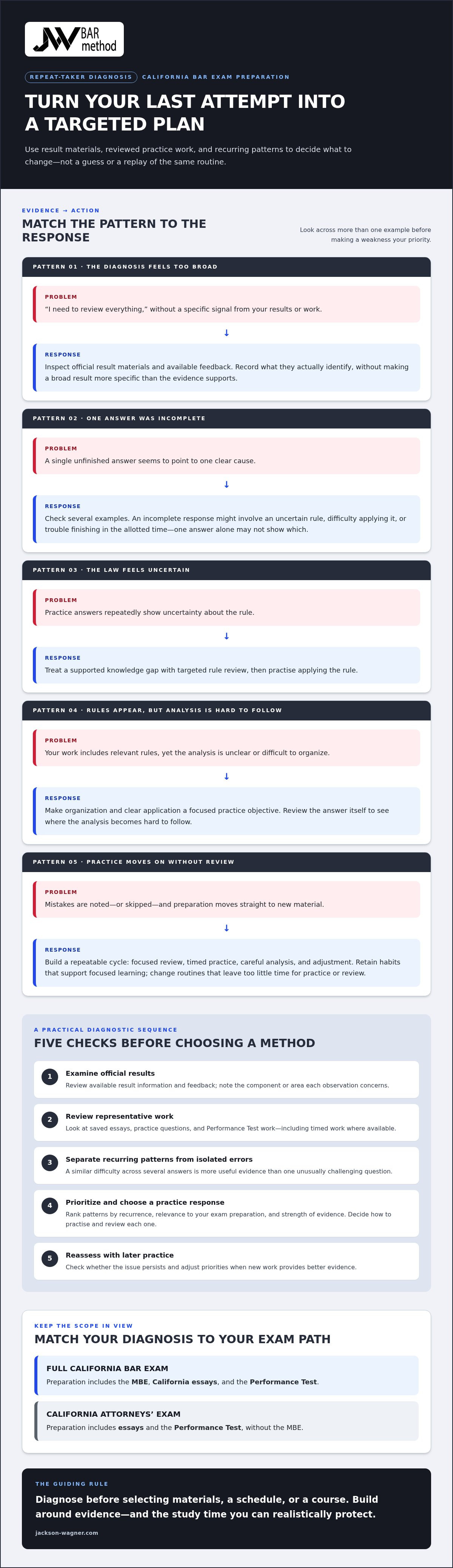
Start with what you can inspect. Review official result materials and any feedback available to you, then compare those observations with practice work you completed before the exam. You don’t need to reconstruct every moment from exam day. Look for patterns you can act on.
- Look for performance signals. Note any subjects, components, or skill areas that your result materials identify as needing attention. Keep your observation close to what the materials actually show.
- Review your completed work. Look at timed essays, practice questions, or other work you saved. Ask whether your answers showed uncertainty about the law, difficulty organizing an analysis, or trouble finishing within the allotted time.
- Check your preparation habits. Record which tasks you completed consistently, which you skipped, and whether you reviewed mistakes or mainly moved on to new material.
Separate knowledge gaps from execution concerns. An incomplete answer, for example, might reflect a timing problem, an uncertain rule, or difficulty applying a rule to the facts. One answer alone may not reveal which. Look for the same issue across multiple examples before making it a priority.
How to avoid simply repeating the same routine
Make a short retain, change, and stop list before choosing materials or a course. Retain the preparation habits that supported focused learning. Change routines that left too little time for timed practice or review. Stop activities that took study hours without helping you identify or correct a weakness.
Then test your assumptions against evidence. “I need to review everything” is broad; “my practice answers repeatedly lacked a clear application of the rule” points toward a specific objective. Likewise, don’t assume an anxious exam-day moment explains your result if your reviewed work shows a different pattern.
Finally, account for your actual study capacity. A plan built around hours you can’t reliably protect is unlikely to guide your preparation well. Before comparing study options, write one clear objective tied to your evidence and available time, such as improving timed essay analysis or building a consistent practice-and-review routine.
Takeaway: Diagnose before selecting materials, a schedule, or a course. Use available results, reviewed work, and realistic study capacity to define what your next preparation plan needs to address.
Diagnose Your California Bar Exam Preparation Needs Before Choosing a Method
Choose your next study method only after identifying what it needs to address. A useful diagnosis separates what your results show from what you suspect, then turns recurring patterns into practice priorities. For bar exam preparation for repeat takers, this helps prevent a single difficult question or stressful exam-day moment from dictating the entire plan.
Review results and available work
Work through this sequence before selecting materials:
- Examine official results. Review the result information and any feedback available for your attempt. Record the specific component or area each observation concerns. Don’t turn a broad result into a more precise diagnosis than the information supports.
- Review representative practice work. Select essays, practice questions, and Performance Test work from your preparation, including timed work where available. Look at the answer itself: Was the rule uncertain, the analysis hard to follow, or the response unfinished?
- Identify recurring patterns. Separate repeated difficulties from isolated errors and uncertain memories. A similar weakness across several answers is more useful evidence than one question you found unusually challenging.
- Prioritize and choose a practice response. Rank the patterns by recurrence, relevance to your exam preparation, and strength of evidence. For each priority, decide how you’ll practise it and how you’ll review the result.
- Reassess as you work. Use later practice to check whether the same issue persists. Adjust priorities when new work provides better evidence, rather than treating your first diagnosis as permanent.
Keep the categories distinct. A knowledge gap may call for targeted rule review followed by application. An organization issue may show up when an answer includes relevant rules but has unclear analysis. Timing concerns call for timed practice and an honest check of where the minutes are going. Inconsistent practice is a different planning problem: your routine may need to be more realistic and repeatable.
Separate California exam paths carefully
Before ranking components, confirm your exam path and current requirements through the State Bar of California. Exam formats and requirements can change, so use current official information rather than an old outline, a remembered rule, or another candidate’s plan. The full California Bar Exam and the California Attorneys’ Exam don’t involve the same components: the Attorneys’ Exam covers essays and the Performance Test, while full-exam preparation also involves the MBE. Confirm the components that apply to your attempt before building priorities.
A practical diagnosis can fit on one page: evidence, recurring need, practice response, and review method. For example, if several timed answers show sound rule recall but weak application, focus on applying rules to facts, then review that skill in new timed work. Keep the conclusion narrow enough to guide action.
With priorities in hand, you can compare study formats against specific needs instead of choosing by course volume alone. Jackson-Wagner’s California bar preparation program provides a structured option to assess against your exam path, practice priorities, and available study time.
Compare Repeat-Taker Preparation Options by Structure, Feedback, and Exam Scope
A long course isn’t automatically a better fit, and a flexible routine isn’t automatically efficient. Compare how each approach turns study time into practice, feedback, and useful next steps. For bar exam preparation for repeat takers, the key question is whether the learning process responds to your needs and matches the California exam path you’ll take.
Compare the learning process, not just the volume
Use the same criteria for every option. The table distinguishes general approaches from Jackson-Wagner program details. Confirm current exam requirements through the State Bar of California, and assess a program against your confirmed component set.
| What to compare | Self-directed review | Jackson-Wagner structured options |
|---|---|---|
| Structure | You choose the sequence and set your own milestones. This offers flexibility but requires you to maintain the plan. | Fully online programs organize preparation into modules. Completing each module awards a mastery certificate. |
| Feedback | Feedback depends on the materials and review methods you choose; don’t assume a particular feedback feature. | Courses include quizzes, assignments, and automated feedback. |
| Practice activities | Select practice that targets your diagnosed needs, then build in time to review your work. | Quizzes and assignments are included. Consider how they fit the skills you want to practise. |
| Exam scope | You assemble materials for the components that apply to your exam path. | The 4-Week Accelerated Program covers the MBE, California essays, and Performance Test. The 3-Week Accelerated Program for the California Attorneys’ Exam covers essays and Performance Test only, with no MBE. |
| Study commitment | You set a schedule around your responsibilities and need to keep it realistic. | Compare the stated program commitment with the study time you can protect alongside work or caregiving. |
The comparison makes trade-offs visible. Self-directed study lets you change pace or sequence, but you’re responsible for choosing practice, setting milestones, and reviewing your work. A structured path supplies a defined sequence and interactive activities, but its scope and workload still need to fit your needs and schedule. Reusing familiar materials may make sense if they address a specific gap; repeating them unchanged may not address a recurring timing or organization problem.
Assess claims and terms carefully
Treat pass-rate comparisons as claims that need context, not as predictions of your individual result. Consider what population, exam administration, and preparation conditions a statistic describes before using it to compare options. No single study method guarantees an outcome.
Jackson-Wagner’s programs include a money-back guarantee. Read the applicable terms to understand how the guarantee works rather than treating it as a promise of a particular exam result. Compare the stated program scope and features, then weigh those details against your priorities and available study time.
A suitable plan matches both your diagnosed needs and the correct California exam path. That standard keeps the decision focused on fit, not simply the number of materials or hours offered.
Build a Repeat-Taker Study Plan Around Your Time and Practice Needs
A study plan works when it fits the calendar you actually have, not an ideal week with no competing demands. Start by verifying your exam date and schedule through current official California information. Then plan backward: reserve time near the exam for timed practice and review, and use earlier study blocks to build the knowledge and skills those sessions require.
Set a realistic weekly study structure
Map work, caregiving, appointments, and other fixed responsibilities before assigning study tasks. The remaining blocks are your real capacity. Divide them across focused review, practice, and analysis, and protect review time rather than treating it as optional. Completing a practice task without examining what it revealed can leave the same weakness untouched.
A flexible framework might move through a repeating sequence:
- Focused study: Work on one subject or skill tied to a current priority.
- Timed practice: Apply that learning under a time limit appropriate to the task.
- Review: Examine the answer’s reasoning, organization, and completion, then record one adjustment for next time.
Fit the sequence to your available blocks. If a planned session gets displaced, move the task to another realistic opening instead of packing several missed tasks into the next day.
Use practice to test whether the plan is working
Track what you completed and what your work shows. A simple log can note the task, whether you finished it, the type of difficulty you encountered, and the next practice step. A single practice score is one data point, not a final prediction. Look instead for changes across repeated attempts: Are answers becoming more organized? Are you finishing more consistently? Are the same reasoning errors still appearing?
Review the path to the answer, not just whether the material felt familiar. If you recognized a rule but struggled to apply it, schedule practice that makes application the focus. If timing continues to disrupt completion, use timed work and examine where you spent your effort. Let recurring evidence guide the next adjustment.
Maintain momentum without overloading the schedule
Set milestones you can evaluate consistently, such as completing a planned set of practice tasks and reviewing each one before adding more. At regular check-ins, compare the plan with what you actually completed. If you repeatedly miss the same type of block, reduce or rearrange the workload; copying another candidate’s routine may not solve the problem. Sustainable consistency gives you more useful information than an ambitious schedule you can’t follow.
A structured option can help if you want an organized learning path alongside your own practice cycle. Explore Jackson-Wagner’s California bar preparation program and compare its stated workload with the study time you can realistically protect.
Choose California Bar Exam Preparation for Repeat Takers by Exam Path
The right preparation plan starts with the exam you’re taking. Confirm your current California exam path and applicable components through official State Bar information, then compare programs against that scope. A repeat candidate preparing for the full California Bar Exam needs a different component plan from a candidate taking the California Attorneys’ Exam. Matching the two prevents you from spending study time on a component that isn’t part of your exam path or overlooking one that is.
Full California Bar Exam preparation
The 4-Week Accelerated Program: July 2026 California Bar Exam covers the MBE, California essays, and Performance Test. Its scope brings all three components into one program, making it relevant to a candidate whose confirmed path includes each of them. The course is fully online, with digital materials, quizzes, assignments, and automated feedback.
Programs have stated study commitments of 4-6 hours per day or 50+ hours per week, depending on the program. Use the commitment that applies when deciding whether the pace fits your responsibilities. Don’t assume a shorter calendar duration means less work per day; account for the study time as well as the program’s component coverage.
California Attorneys’ Exam preparation
The 3-Week Accelerated Program: July 2026 California Attorneys’ Exam covers essays and Performance Test only. It does not include the MBE. Candidates preparing for the Attorneys’ Exam should compare programs by their written-component coverage, while full-exam candidates should ensure their plan also addresses MBE preparation.
The 6-Week Program: July 2026 California Bar Attorneys’ Exam is enrollment closed; its scope is essays and Performance Test only, with no MBE. The 8-Week Program: July 2026 California Bar Full Exam is also enrollment closed. These closed programs aren’t current signup options. Compare exam path and component coverage first, then consider duration and study commitment.
Understand the online course experience and next step
Programs are completely online, with immediate digital access after registration and payment. Physical books aren’t required. Courses include quizzes, assignments, and automated feedback, and completing each module awards a mastery certificate. These features describe the course format; they don’t replace your own review of practice work or guarantee an exam outcome.
The Free California Professional Responsibility Essay Course: July 2026 California Bar Exam offers focused Professional Responsibility essay training. Consider whether that narrow scope addresses a specific need, rather than treating it as a substitute for full-exam preparation when your exam path requires broader coverage.
Pass the California Bar or your money back. The money-back guarantee is subject to its terms, so read them before relying on it. For bar exam preparation for repeat takers, match confirmed exam components, program scope, and study commitment, then choose the option that fits your preparation needs.
Make Your Next Preparation Step Count
Your next attempt can start with a clear choice: what will you do differently, and what support will help you follow through? Let that answer guide your bar exam preparation for repeat takers. A practical plan isn’t about adding more material; it’s about turning focused effort into consistent practice and learning you can carry into exam day.
If a structured format fits your needs, Jackson-Wagner programs are fully online, with immediate digital access after registration and payment. Quizzes, assignments, automated feedback, and module mastery certificates support an active study process. The money-back guarantee is subject to its published terms, so review them carefully. Pass the California Bar or your money back.
Explore California bar preparation programs and choose your next step. You’ve already gained valuable information from your previous attempt. Use it to move forward with purpose, a realistic plan, and confidence in the work ahead.
Frequently Asked Questions
Can I pass the California Bar Exam after failing on a previous attempt?
Yes, passing remains possible after an earlier unsuccessful attempt, though no preparation plan can promise an individual result. A previous attempt gives you exam experience and work to review, not a fixed forecast of your ability. Focus on what you can control now: confirm your next exam path, choose a sustainable routine, and use practice to see whether your approach is addressing the needs you’ve identified.
How should repeat takers change their bar exam study strategy?
Change your approach in response to evidence, not frustration alone. If you understood rules but struggled to finish answers, practise under timed conditions and note where your time went. If recall was a problem, work on retrieving rules before applying them in written responses. Keep a brief log of the task, the difficulty, and your next practice step, then use it to guide your next study session.
Is a California Bar Exam retake plan different from a first-time study plan?
It can be, because a retake plan can draw on your prior results, saved practice work, and experience with the exam process. That doesn’t mean you need to discard every resource or replace your entire approach. Keep methods that served you well and reconsider those that didn’t. Also verify current California exam requirements for your next sitting, since your plan should reflect the rules that apply then.
Can I prepare for the California Bar Exam while working full time?
It may be possible, but the fit depends on your schedule and the program’s stated workload. Jackson-Wagner programs have commitments of 4-6 hours per day or 50+ hours per week, depending on the program. Before choosing one, map your predictable study windows around work and personal responsibilities. If the required time doesn’t fit your actual week, an unrealistic plan may be difficult to sustain.
How do I sign up for a Jackson-Wagner California Bar preparation program?
Choose a course on the Jackson-Wagner Courses page and click “Sign Up.” Before selecting, make sure you’re looking at the program for your California exam path and review its stated scope and study commitment. The 8-Week full-exam and 6-Week Attorneys’ Exam programs are marked enrollment closed, so they aren’t current signup options. Registration and payment provide immediate digital access.
What payment methods does Jackson-Wagner accept?
Jackson-Wagner accepts major credit cards, PayPal, Apple Pay, Google Pay, and some debit cards. Review the available payment options during signup, after choosing the course that matches your California exam path.
How does Jackson-Wagner’s money-back guarantee work?
Jackson-Wagner’s stated promise is “Pass the California Bar or your money back.” The published Money Back Guarantee terms explain how the guarantee works, so read them before relying on it. Don’t assume eligibility requirements, deadlines, or claim steps that aren’t stated in those terms. Understanding the conditions helps you consider the guarantee alongside your preparation choice.


