

What if a failed bar exam attempt could show you where your next study cycle needs to change? That’s the practical value of success stories from retaking the bar exam: not a promise that someone else’s result will be yours, but a chance to see how candidates describe turning disappointment into more focused preparation.
If you’re wondering whether passing is still possible or how to study while managing work and other responsibilities, those questions make sense. Start a retake plan with evidence from your own exam experience, then turn that evidence into clear priorities rather than simply repeating the same routine.
This article looks at lessons from published candidate accounts and how to apply them thoughtfully. Identify areas to review, build consistent timed practice, and choose a structured path that fits your available study time. California-focused preparation can also help organize the work through quizzes, assignments, and automated feedback. Stories can offer direction and encouragement, not guarantees. The next step is to make your preparation more deliberate and specific to the California exam.
Key Takeaways
- Read success stories from retaking the bar exam for practical lessons, not as predictions of your own result.
- Use available exam feedback to identify specific areas to work on instead of assuming another candidate’s challenges match yours.
- Build a realistic study plan around your work, family, and study obligations. Preparation commitments can vary from 4-6 hours per day to 50+ hours per week.
- Learn how the 4-Week Accelerated Program: July 2026 California Bar Exam covers the MBE, California essays, and the Performance Test.
- See how milestones, quizzes, assignments, and automated feedback can help make a retake plan more focused.
What Success Stories From Retaking the Bar Exam Can, and Cannot, Tell You
An unsuccessful result can bring disappointment, embarrassment, or doubt about what comes next. Those feelings are real, but they don’t measure your future ability. A bar exam result reflects performance on a particular attempt. It doesn’t tell the whole story of what you can learn, change, or do in a later preparation cycle.
A retaker success story is one candidate’s account of what happened: the attempt, the difficulties they describe, the changes they made, and the result they report. It’s an individual experience, not a forecast. Bar examinations differ in purpose and format, as the general overview of the Bar examination explains. Candidates also differ in their preparation, circumstances, and exam-day experience. Read accounts with curiosity, not as a standard you must match.
Why retaker stories can offer useful perspective
A first-person account can make a difficult moment feel less isolating. Its value lies in the details, not in a sweeping claim that anyone can repeat the same path. Notice how many attempts the writer describes, what challenge they identify, and what they say they changed. Did they discuss timing, written analysis, practice habits, or another concern? Keep your takeaways tied to what the candidate actually reported.
What a story cannot establish about your next attempt
Another candidate’s result can’t predict yours. Their reported study strategy may have helped them, but an anecdote alone doesn’t show that the same method will work for every reader. An account may leave out context, including how much time someone had, what feedback they received, or what else changed between attempts. Don’t treat a success story as a universal recipe or proof of a likely outcome.
Use each account as a prompt for reflection, not a reason to copy someone else’s plan. Separate what the writer directly says from what you might be tempted to infer. For example, “I practiced under timed conditions” is a reported choice. It doesn’t establish that timing was the writer’s only challenge or that the same practice would address yours.
- Attempt: What does the candidate say about their exam history?
- Challenge: Which difficulty do they identify, and is it based on their own description?
- Change: What preparation adjustment do they report making?
- Outcome: What result do they describe, without assuming the change alone caused it?
These questions help you learn from success stories from retaking the bar exam without turning someone else’s experience into a yardstick. If a published account doesn’t explain a detail, leave it unknown rather than filling the gap with assumptions. A story can offer perspective, but not promise an outcome.
What Published California Retaker Stories Reveal About Changing Course
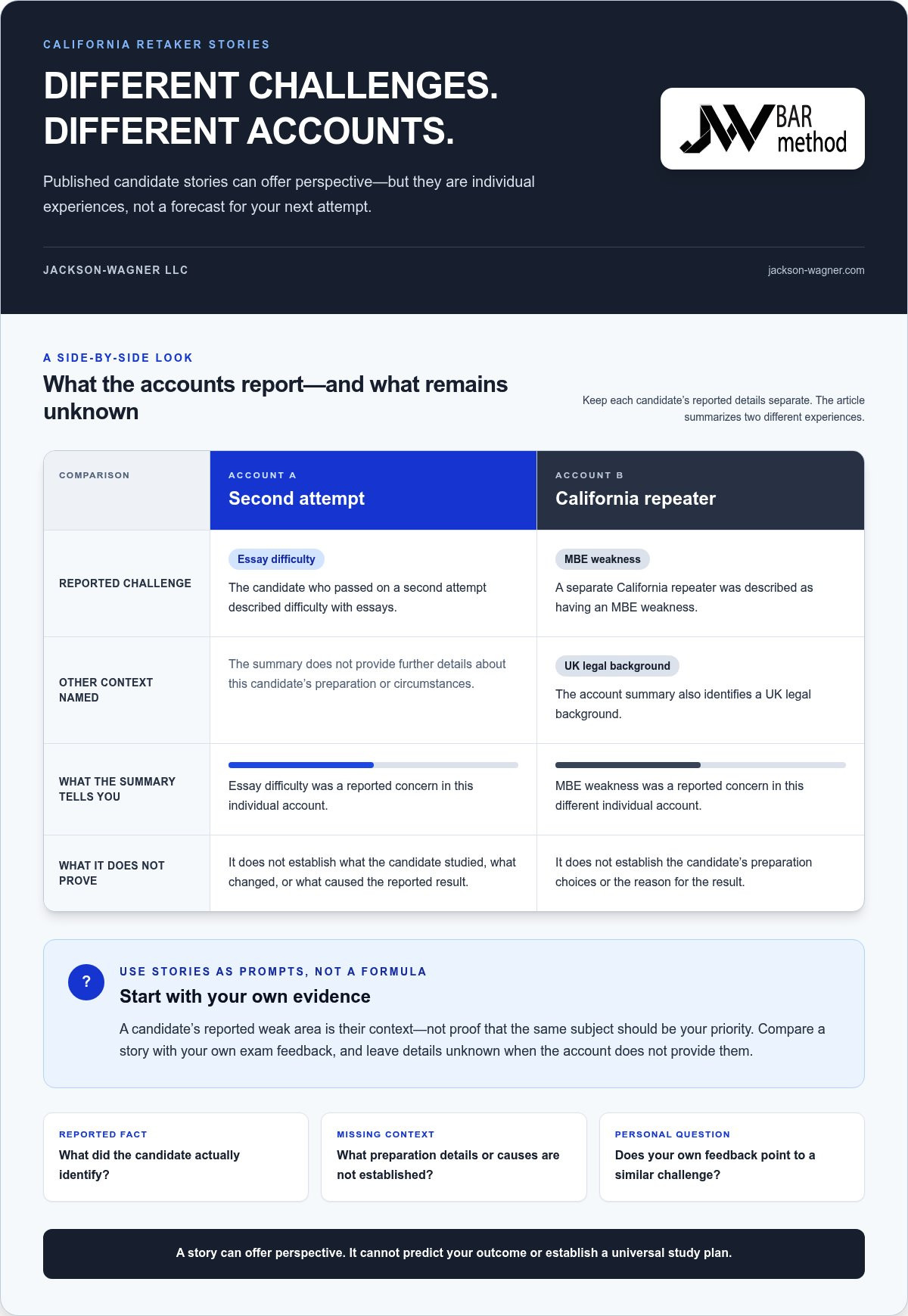
Published accounts are more useful when they describe the challenge a candidate faced instead of presenting a pass as a simple formula. Summaries in the Make This Your Last Time story library identify California retakers with different reported concerns. One candidate who passed on a second attempt described essay difficulty, while another California repeater was described as having MBE weakness and a UK legal background. These are separate accounts, not two versions of the same path.
Those details can help you ask better questions about your own preparation. They can’t tell you what either candidate studied, how they changed their approach, or what caused their result unless the original account says so. Before quoting or relying on further details, read the candidate’s original story and attribute it clearly. A summary isn’t a reason to fill in the gaps.
Look for the challenge behind the eventual pass
The essay-focused account points to a reported concern with written work. The MBE-focused account names a different area of difficulty. Keep those distinctions intact. Don’t assume the essay-focused candidate also struggled with timing, or that the MBE-focused candidate used a particular practice method. The careful takeaway is narrower: retakers may describe different challenges, so your own review should start with your own evidence.
Compare circumstances without ranking candidates
The library organizes stories around details such as attempt number, work, preparation time, and reported weaknesses. Use those categories to find context that resembles your own, not to compare ability or worth. A working candidate’s experience or a foreign-trained candidate’s account can’t stand in for every reader’s circumstances. Similarities may suggest useful questions, but they don’t establish identical needs.
As you read, separate three things: what the account says, what it leaves unanswered, and what you might cautiously consider for yourself. An identified weak area is part of the candidate’s reported context. It doesn’t prove that the same subject is your priority, and the reported outcome doesn’t establish that one factor alone produced it.
- Reported fact: The candidate identified essay difficulty or MBE weakness.
- Missing context: The account may not establish every preparation choice or the reason for the result.
- Personal question: Does your own feedback point to a similar challenge?
This approach makes success stories from retaking the bar exam more than encouragement. It turns them into prompts for thoughtful comparison without treating a stranger’s experience as a template. A retake account is most useful when its context is visible. Once you’ve considered the limits of a story, compare its reported challenge with your own priorities and explore structured California bar preparation as one way to organize your next study cycle.
How to Turn a Previous Bar Exam Attempt Into Better Study Priorities
A previous result is most useful when it helps you decide what to work on next. Start with information from your own attempt, not a weakness described in someone else’s success story. The goal isn’t to diagnose yourself from one number or one difficult exam day. It’s to make a reasoned plan from the feedback and work you actually have.
A useful study priority is a specific skill to practice and review, not a broad goal like “get better at essays.” Use this sequence to turn your past attempt into a more focused next step:
- Gather available evidence. Collect your score report, any exam feedback, practice answers, and notes you kept about the exam. If some information isn’t available, work with what you have rather than guessing.
- Identify concerns by component. Consider essays, MBE work, and Performance Test practice separately. Note what your materials suggest, and distinguish documented feedback from your impressions.
- Select priorities. Choose the specific skills that matter most based on your attempt and the preparation time you can realistically set aside.
Separate reported weak areas from your own evidence
Review your results and work before deciding what needs attention. If an available score report points to a concern, note it. If a practice answer reveals a recurring issue, describe it specifically. You might examine whether an essay response addressed the prompt or whether a Performance Test practice task raised a concern. These are review questions, not diagnoses. Avoid assuming that another candidate’s challenge applies to your exam.
Include your experience of the exam, too. Anxiety, uncertainty, or low confidence can be important to acknowledge as part of your preparation experience, but they aren’t, by themselves, explanations for a score or proof of a subject weakness. Keep feelings in view without mistaking them for performance evidence.
Choose a focused priority for the next study cycle
Turn each concern into an action you can complete and review. Instead of writing “improve MBE,” for example, define a practice objective around reviewing your reasoning on questions you missed. If you have an essay concern, specify the part of your answer you want to practice and assess. Choose objectives that fit your results and available time. No single priority list fits every candidate.
Track what you complete and what your practice or feedback shows. A simple record can include the date, component, task, and one observation about what to revisit. Look for patterns across your own work, then adjust priorities as you learn more. You don’t need to invent a required number of practice questions or a score target to make this review useful.
Use success stories from retaking the bar exam as prompts for questions, not substitutes for your own review. The next cycle becomes more deliberate when each study block has a clear purpose and a way to assess what you practiced.
How Retakers Can Build a Realistic Plan Around Work and Study Time
A study plan has to fit the life you actually have, not an ideal calendar with every evening free. Before choosing a pace, map your work hours, family responsibilities, existing commitments, and the study periods you can protect consistently. Jackson-Wagner programs vary in commitment, with options of 4-6 hours per day or 50+ hours per week. Treat these as distinct time commitments, not a universal schedule or a guarantee of an exam result.
Start with a simple calendar for a typical week. Mark fixed obligations first, then identify realistic study windows and time for rest. A short, dependable session may fit more consistently than a longer block that regularly conflicts with work or caregiving. If your schedule changes from week to week, account for that variation rather than assuming every week will unfold perfectly.
Match the study plan to the time you can consistently protect
Consider your energy as well as your available hours. After a demanding workday, concentration may be different from what you can manage on a free morning. Fatigue and competing responsibilities are planning factors, not evidence that you can’t succeed. Build a pace around sustainable study periods, then reassess if the plan repeatedly conflicts with your obligations. The right schedule is personal, and no timetable can promise a passing result.
Before settling on a preparation pace, ask yourself:
- Which periods are genuinely available most weeks?
- What work or family commitments could interrupt them?
- When do you have the focus for demanding practice, and when is lighter review more realistic?
- What adjustment would help you return to the plan after a disrupted day?
Your answers make the calendar more practical. They also help you distinguish a temporary interruption from a plan that needs redesign. For a broader grounding in the exam and preparation, refer to the California Bar Exam definitive strategic guide as you map your study cycle.
Use structure to make progress visible
Milestones can break preparation into manageable stages and show what you’ve completed. Jackson-Wagner courses include quizzes, assignments, and automated feedback, giving each study period a defined task and response to review. Completing each module awards a mastery certificate. These features help organize learning and document module completion. They aren’t a prediction of exam performance.
Keep a simple weekly record of planned sessions, completed work, and feedback worth revisiting. If you miss a planned block, reschedule it realistically instead of automatically doubling the next day’s workload. Review the calendar at the end of the week to see whether the pace fits your life and whether your study time is going toward the priorities you identified from your previous attempt.
If a structured California-focused format would help you turn available study time into clear milestones, explore Jackson-Wagner bar preparation.
A Structured California Retake Path: How Jackson-Wagner Fits the Next Step
After reviewing your exam feedback and considering how much time you can realistically study, choose preparation that matches the exam you’re retaking. The JW Bar Method provides structured, fully online preparation for California. Its accelerated programs distinguish the full California Bar Exam from the California Attorneys’ Exam, so begin by matching the program components to your exam.
Choose the program that matches the California exam you are retaking
The 4-Week Accelerated Program: July 2026 California Bar Exam covers the MBE, California essays, and the Performance Test. It is the full-exam option described here, with all three components included.
The 3-Week Accelerated Program: July 2026 California Attorneys’ Exam covers essays and the Performance Test only. It does not include the MBE. Keep that distinction clear when comparing your exam requirements with the components you need to prepare for. The two programs are not interchangeable.
Know what the online study experience includes
Both programs are fully online, with immediate digital access after registration and payment. All course materials are digital, so physical books aren’t required. You can work through the materials without printed books, and course activities provide structure for study and review.
Course features include:
- Quizzes to engage with course material.
- Assignments to work through designated tasks.
- Automated feedback to provide responses as you progress.
- A mastery certificate for each completed module.
These features can help make progress visible and give your study cycle clear milestones. They don’t establish or guarantee an exam result. Use them to organize your preparation, connect tasks to the priorities you identified, and track which modules you’ve completed.
Jackson-Wagner states, “Pass the California Bar or your money back.” The company offers a money-back guarantee. Review the guarantee terms for applicable conditions rather than assuming details from the slogan alone.
Success stories from retaking the bar exam can encourage a more focused approach, but the next step is to match that focus to your own exam and preparation needs. Choose the correct exam components, then use a structured digital course to organize the work ahead.
Make Your Next Attempt More Deliberate
Your previous result is part of your preparation history, not a verdict on what you can do next. Let it guide a more intentional decision: identify what you want to practice, choose a study structure that fits your real schedule, and check whether your preparation is addressing those priorities.
Success stories from retaking the bar exam can offer perspective, but your next step belongs to you. Jackson-Wagner’s California programs are fully online, with immediate digital access after registration and payment. The stated promise is “Pass the California Bar or your money back.” Review the guarantee terms to understand the applicable conditions. The guarantee does not mean every candidate is certain to pass.
Choose a focused path forward and put your next study cycle in motion. Explore California Bar Exam preparation with the JW Bar Method, then build a plan around the work you need to do and the time you can protect. A disappointing attempt can be the starting point for a more purposeful one.
Frequently Asked Questions
Can you pass the bar exam after failing once?
Yes. A previous unsuccessful attempt doesn’t determine the outcome of a later one. Published retaker accounts describe individual experiences, not proof that another candidate will have the same result. To plan your next move, review what you remember from exam day alongside any available score report or prior work. Identify concerns you can address, then build your preparation around those priorities rather than treating someone else’s story as a forecast.
How do I find bar exam success stories from repeat takers?
Look for accounts that name the jurisdiction, attempt number, and challenge the candidate describes. Those details help you judge whether the story offers relevant context. The California story library organizes accounts by factors such as attempts and weaknesses, which can help narrow your reading. Before quoting or relying on a detail, check the original account. Success stories from retaking the bar exam can offer perspective, but they can’t predict your result.
What should I change when I retake the bar exam?
Start with your own available feedback and prior work, then turn a specific concern into a practice objective. For instance, if your essay practice raises a concern about applying rules to facts, make that skill a focus for practice and review. Someone else’s account of essay or MBE difficulty may prompt a question, but it can’t diagnose your needs. Choose priorities that fit your evidence and available study time, not a universal volume or promised method.
Can I retake the bar exam while working full time?
Preparing while working full time can be challenging, particularly when study time is limited and fatigue competes with focus. Map fixed work and personal obligations, then identify study periods you can realistically protect across an ordinary week. A working-retaker guide notes these pressures, but one candidate’s schedule isn’t a template for everyone. Adjust your plan when responsibilities shift, and don’t treat any schedule as a guarantee of passing.
Does the 3-Week Accelerated Program for the California Attorneys’ Exam include the MBE?
No. The 3-Week Accelerated Program: July 2026 California Attorneys’ Exam covers essays and the Performance Test only. It doesn’t include the MBE. By contrast, the 4-Week Accelerated Program: July 2026 California Bar Exam covers the MBE, California essays, and the Performance Test. Keep the component lists separate so the program matches the exam you’re taking.
How does the Jackson-Wagner money-back guarantee work?
Jackson-Wagner’s stated promise is: “Pass the California Bar or your money back.” Review the Money Back Guarantee page for the governing terms before relying on the guarantee. The wording alone doesn’t establish eligibility, deadlines, refund procedures, or exceptions, so don’t assume details that aren’t stated there. The guarantee is a company promise, not certainty that any individual candidate will pass the exam.
Are Jackson-Wagner bar prep programs online?
Yes. Jackson-Wagner programs are fully online, with immediate digital access after registration and payment, and no physical books are required. Courses include quizzes, assignments, and automated feedback. Completing each module awards a mastery certificate. Use assignments and feedback to engage with material and review your progress through the modules. These are course features, not claims about instructor access or device compatibility.


