

What if the prediction you’re counting on is the reason you leave a tested subject underprepared? If you’re asking, “are bar exam predictions reliable,” the honest answer is that they can point to patterns, but they can’t tell you what will appear on your exam. With limited study time and predictions that may conflict, it’s understandable to want a clear signal about what to prioritize.
Use predictions as review prompts, not permission to skip material. They’re based on past exams, while future topics aren’t released in advance, so even a confident forecast remains a guess. That doesn’t make predictions useless. It means they work best alongside your own performance data and official exam materials.
This article explains what predictions can and can’t tell you, how to weigh them against your strengths and gaps, and how to build a California bar study plan that balances focused review with broad preparation. You’ll have a practical way to prioritize without betting your exam on anyone’s forecast.
Key Takeaways
- Learn why “are bar exam predictions reliable” depends on how forecasts are defined and measured, not how confidently they’re presented.
- Spot when prediction claims may be selective or too vague to guide your study decisions.
- Use practice results to identify gaps in recall, analysis, timing, or written execution.
- Follow a step-by-step approach to prioritize California bar review while preserving coverage of required subjects.
- See how the 4-Week Accelerated Program provides structured preparation for the MBE, California essays, and Performance Test.
Are bar exam predictions reliable, or are they educated guesses?
A bar exam prediction is a forecast about which subjects or issues might appear on a future exam. It is not confirmation, advance access, or a promise about what examiners will test. Predictions can guide attention, but they cannot verify exam content. A forecast may help you decide what to review more closely, but it cannot establish that other material is safe to ignore.
So, are bar exam predictions reliable? They may offer a reasoned basis for prioritizing review, but their usefulness depends on how they’re made and how narrowly you use them. A predictor might consider prior exams, perceived patterns, and professional judgment. Those are inputs to an estimate, not proof of what comes next. A confident tone, polished chart, or large following doesn’t make a forecast more accurate.
For general context, the Bar examination overview describes the purpose and varied structures of bar exams. But knowing how an exam is generally structured is different from knowing which topics will appear on a particular administration.
What does a bar exam prediction actually tell you?
A prediction tells you what its author considers plausible, based on selected information and assumptions. One person may give greater weight to subjects that haven’t appeared recently; another may look for recurring combinations or rely more heavily on personal experience. Since there’s no single required method, different predictors can examine the same exam history and reach different conclusions.
That difference doesn’t necessarily mean one person is careless and another has the answer. It shows that a forecast involves judgment. Treat it as a suggestion to investigate a topic, then test whether you can explain its rules and apply them to a new fact pattern. If you can’t, the subject still needs attention, regardless of whether it appears on a prediction list.
Why can a prediction feel more reliable than it is?
Strong wording can sound like strong evidence. Phrases such as “certain to appear” or “highly likely” may create a sense of precision, even if the predictor hasn’t explained what supports the claim. Popularity can have a similar effect: repeated sharing may make a forecast feel validated, but repetition isn’t independent confirmation.
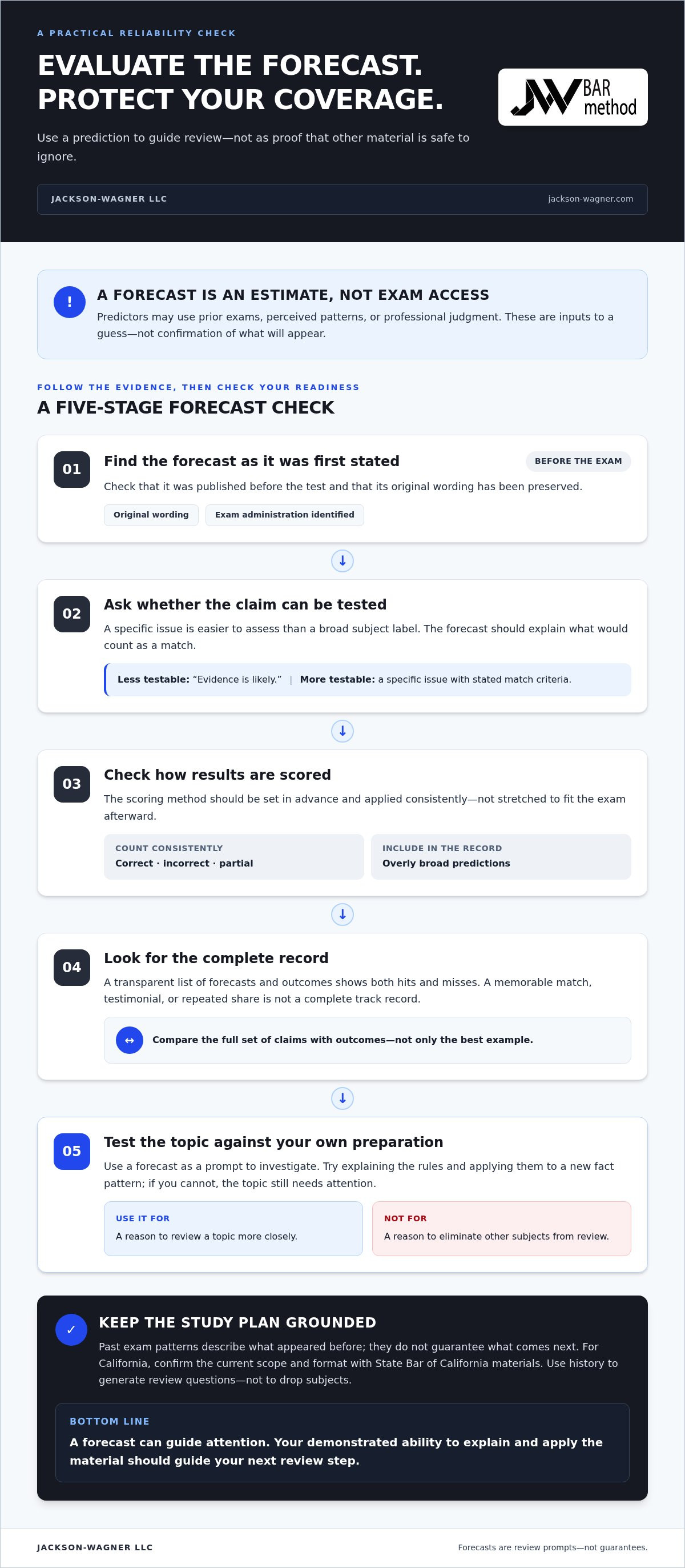
A prediction that matches one exam is a single successful forecast, not proof of a dependable method. To evaluate reliability, you’d need to know what the predictor said before the exam, how specifically each prediction was stated, what counted as a match, and how misses were recorded. A broad forecast that “contracts may appear” is difficult to assess if it doesn’t identify a testable issue. Selectively highlighting hits while overlooking misses can distort the apparent record. Without a consistent method and complete results, accuracy claims are hard to compare. Use forecasts as one perspective, not as evidence that the rest of the subject can be set aside.
What makes bar exam predictions difficult to verify?
To judge whether a forecast is reliable, you need more than a list of topics that seem familiar after an exam. You need a prediction recorded before the test, a clear definition of what would count as a match, and a consistent way to score the result. Without those pieces, “accurate” can mean different things to different people.
This matters when asking, are bar exam predictions reliable enough to influence your study plan? Historical exam patterns can help describe what has appeared before, but they don’t establish what will appear next. California exam formats and tested components can change, too. Confirm the scope and format for your administration using current State Bar of California materials rather than relying on an old prediction chart or a post about a past exam.
What evidence would support a prediction’s reliability?
Start with the record. A meaningful evaluation should show that the forecast was published before the exam, so it can’t be revised after the questions are known. It should preserve the original wording, identify the administration it covers, and explain how the results were assessed. A claim such as “Evidence is likely” is less testable than a specific, dated forecast naming an issue and explaining what would count as a match.
Scoring needs consistency, too. A fair record should account for correct, incorrect, partial, and overly broad predictions, using the same criteria each time. For example, if a forecast names an entire subject and one question tests a narrow issue within it, does that count as a hit? The method should answer that before the result is known. Otherwise, a scorer can stretch a vague prediction to fit the exam.
Testimonials and memorable anecdotes may describe someone’s experience, but they don’t show a complete record. A transparent list of forecasts and outcomes is more useful because it lets you see both the hits and the misses. Look for the full picture, not just the best example.
Why past exam patterns cannot guarantee the next subject
Exam history is useful context. Reviewing past questions can help you understand how subjects have been tested and what kinds of issues may arise. But frequency describes previous administrations, not a schedule for future ones. A subject appearing often doesn’t prove it will appear again, and a subject’s recent absence doesn’t establish that it’s due next.
Be wary of rotation rules or precise probabilities that aren’t supported by a clear method and complete data. Even a carefully constructed pattern can’t account for every choice made in creating a future exam. Use historical analysis to generate questions for your review, not to eliminate subjects from it.
Then ground your preparation in what you can measure: your practice work, the official scope, and the skills each component requires. A structured California bar preparation program can help turn identified study needs into a plan, rather than asking a forecast to do the planning for you.
Predictions versus your own performance: what should guide study priorities?
When time is limited, let evidence from your own practice lead. A prediction reflects someone else’s estimate about a future exam; your completed work shows how you’re handling tested skills now. Asking “are bar exam predictions reliable” can help you judge a forecast, but it won’t tell you whether you’re recalling rules accurately, analyzing facts clearly, or finishing within the time available.
Use each kind of input for a different purpose. Practice results can diagnose what needs work. Predictions can suggest an additional topic to review. Neither should be treated as a guarantee of what the exam will test or how you’ll perform.
| Input | What it can show | What it cannot prove |
|---|---|---|
| Completed practice questions | Whether you can recall rules and apply them to the facts presented | Exactly what will appear on the exam or your final result |
| Timed written practice | Whether your analysis, organization, and pacing are working together | That one response represents your performance across every subject |
| A topic prediction | One predictor’s view of what may deserve extra attention | That the topic will appear, or that unlisted topics can be skipped |
How can practice work reveal your actual study needs?
Review the work, not just the tally. After a set of practice questions or a written response, identify whether the trouble came from rule recall, applying a rule to specific facts, managing time, or presenting the analysis clearly. Then choose a focused next step, such as reviewing a rule you missed or practicing a more organized answer. Study hours show effort, but completed work reveals which skill needs attention more directly.
When can a prediction help without taking over your plan?
Use a prediction as a prompt to check your readiness, not a reason to drop another subject. If it names a topic, compare that suggestion with your practice record: do you understand the relevant rules, and can you apply them? A demonstrated gap deserves attention whether or not it appears in a forecast. A prediction may add a useful review question, but it isn’t evidence you can bank on.
For a broader framework for organizing California-specific preparation, consult the California Bar Exam strategic guide. Keep your priorities grounded in the official exam scope and your own work, then use predictions to refine review without narrowing your preparation blindly.
How to use predictions without leaving gaps in California bar preparation
A prediction can catch your attention, but it shouldn’t set the boundaries of your study plan. Use this sequence to keep preparation anchored in exam requirements and your demonstrated needs, while allowing forecasts to suggest a topic for closer review.
- Establish the exam scope. Start with current State Bar of California materials for your exam administration. Confirm the applicable format, components, and tested subjects there, since requirements can change. An old chart or online forecast is not a substitute for the official scope.
- Assess your performance. Complete practice questions and timed written work across the required areas. Review errors and feedback to pinpoint whether you need to strengthen rule recall, factual analysis, time management, or written organization.
- Prioritize demonstrated gaps. Give focused attention to weaknesses revealed in your work while maintaining regular review across the full exam scope. After additional practice, reassess your performance and adjust your emphasis as new evidence emerges.
- Review predictions cautiously. Treat a forecast as a brief prompt to check your coverage and understanding of a topic. Compare it with your practice record, but don’t remove a subject from your plan because it’s absent from a prediction.
Build a study plan from exam requirements and your own results
Keep a simple record of practice by subject and task. Note what you attempted, the kind of mistake you made, and what you’ll do next. For example, if a written answer shows that you recognized the issue but struggled to apply the rule to the facts, target that analysis skill rather than merely rereading the outline. Return to timed practice after reviewing, then use your work and feedback to decide whether the adjustment helped.
Make the plan responsive, not reactive. New practice results may show that a difficult area is improving or that another skill needs more attention. Update your priorities based on that evidence without narrowing required subject coverage. For planning purposes, a forecast may inform review, but it can’t replace the official scope or your own performance record.
Set boundaries for prediction content
Decide before browsing predictions that no forecast will determine which subjects you skip. Set a short time limit for reviewing prediction content, and use it only to check whether a suggested topic is part of your planned review. If a claim sounds certain, ask what evidence supports it and whether it changes anything in your practice record. Online consensus is still not a substitute for demonstrated readiness.
Keep your preparation structured and guided by verified requirements, practice, and feedback. Explore structured California bar preparation to support a plan built around the exam, not a guess about its next questions.
Prepare for the California Bar with structure, not guesses
Predictions can’t replace a study system built around the exam you’re taking and the skills you need to strengthen. A structured plan gives you a consistent way to work through material, complete practice, and use feedback to guide your next steps. The question “are bar exam predictions reliable” matters less when a forecast is one small input, not the foundation of your preparation.
What structured online preparation can add to your plan
Jackson-Wagner LLC’s California Bar preparation courses are fully online, with immediate digital access upon registration and payment. No physical books are required. Courses include quizzes, assignments, automated feedback, and a mastery certificate for each completed module. These features provide a structured way to study and check your understanding, so you can make decisions based on your work instead of relying on a guess about future exam topics.
Use course materials alongside current exam requirements and your practice results. If a quiz or assignment highlights a rule or skill that needs more attention, direct your review there, then continue working across the exam components that apply to you. A prediction may suggest an extra topic to revisit, but your preparation should still cover the full scope of your exam.
Choose the California exam program that matches your exam
Match the program to the exam you’ll sit. The 4-Week Accelerated Program: July 2026 California Bar Exam covers the MBE, California essays, and Performance Test. It brings preparation for all three components into one structured course.
The 3-Week Accelerated Program: July 2026 California Attorneys’ Exam covers essays and Performance Test only, with no MBE. Keeping these program components distinct helps you choose preparation aligned with your exam rather than following a prediction that may not reflect its scope.
Jackson-Wagner LLC’s stated promise is “Pass the California Bar or your money back,” backed by a money-back guarantee. It does not make predictions certain or guarantee what topics will appear.
Build your preparation around the right California exam, then use practice and feedback to shape your study priorities. Explore California bar preparation.
Take the next step with a plan you can trust
Before you change your study schedule for another forecast, pause and ask what would justify that change. A useful plan should respond to evidence you can act on: the exam requirements, the work you’ve completed, and the skills you’re still building. Predictions can create urgency, but you can decide whether that urgency is supported. Keep your attention on preparation choices that strengthen readiness across the exam, not guesses about one future question.
If you’re still wondering, “are bar exam predictions reliable,” use that question as a reminder to stay curious without handing over control of your plan. Set a clear direction, revisit it as your practice develops, and make your next study choice deliberately. You don’t need to predict the exam to prepare with purpose.
Jackson-Wagner offers California-specific preparation designed to give your study a structured path. Explore California bar preparation and choose a next step that fits your exam and your goals. You can move forward with focus, one informed decision at a time.
Frequently Asked Questions
Are bar exam predictions reliable enough to determine what I study?
No. Are bar exam predictions reliable enough to decide what to study? Not on their own. Use the official scope for your exam and evidence from your own practice to set priorities. For example, if you’re consistently missing questions because you can’t recall a rule, schedule targeted review even if a forecast doesn’t mention that subject. A prediction can prompt a closer look, but it shouldn’t decide what you leave out.
How accurate have California Bar Exam essay predictions been?
There isn’t a single dependable accuracy figure you can apply to California essay predictions generally. To assess a specific predictor, you’d need a complete, dated record of forecasts made before each exam and a consistent method for scoring precise matches, partial matches, and misses. Without that record, a few successful examples can’t establish overall accuracy. Treat broad claims about past performance cautiously unless their evidence and scoring rules are clear.
Can I skip a subject if multiple bar exam predictions leave it out?
No. Several predictions omitting a subject don’t establish that it won’t appear or that it falls outside your exam’s requirements. Check the current State Bar of California materials for the scope of your administration, then preserve coverage of the applicable subjects. If time is tight, adjust the depth or timing of review based on your practice results, but don’t turn a shared omission in forecasts into a decision to abandon a required area.
What should I use instead of bar exam predictions to prioritize studying?
Use a combination of official exam materials, completed practice, and feedback. After a practice set, record whether each missed question involved rule recall, applying a rule to facts, or misunderstanding the prompt. For a written answer, note whether the issue was analysis, organization, or finishing on time. These observations help you choose a concrete next task, such as reviewing a rule or writing another timed response, rather than relying on a topic guess.
Do bar exam predictions become more accurate closer to exam day?
Not necessarily. A forecast made closer to exam day may feel more timely, but its timing alone doesn’t show that its method is more accurate or that its information is better. Ask whether the predictor provides new, verifiable evidence or simply repeats a popular theory with greater confidence. As exam day approaches, use forecasts only as a prompt to check your coverage. Keep following your plan and the current official exam scope.
How can I evaluate whether a bar exam prediction is based on evidence?
Look for a forecast saved or published before the exam, with specific claims you can compare against the actual questions. Check whether the author explains what counts as a match and reports the full record, including misses and partial matches. A testimonial or one memorable hit doesn’t provide the same evidence. If the prediction is vague, such as naming a broad subject without a testable issue, it’s difficult to evaluate objectively.
Can predictions still be useful if I already have a study plan?
Yes, if you use one as a brief coverage check rather than a reason to rebuild your schedule. Suppose a forecast names a topic you’ve already studied: use it to test whether you can recall and apply the relevant rules, then decide based on your performance whether more review is warranted. If you’re consistently struggling elsewhere, don’t divert substantial study time just because a prediction sounds certain.


