

Effective California performance test library organization starts by separating the assignment into its two components: the file and the library. In a 90-minute session, reserve about 40-45 minutes for reading and organizing your analysis, review the file again for 5 to 10 minutes after outlining, then use the final 45-50 minutes to draft and refine your answer.
The challenge isn’t just finding a rule or fact. It’s applying the library authorities to the client’s problem while keeping the file’s details and task instructions in view. A clear structure helps connect those pieces instead of letting the materials lead to a scattered answer.
This guide explains how to organize the file and library, identify the materials that matter, and divide your time among reading, outlining, review, and drafting. You’ll also see how the task instructions shape your response, so your organization supports a focused answer under exam conditions.
Key Takeaways
- Keep the assignment’s file, library, and task instructions distinct so each material has a clear role in your analysis.
- Use a planned sequence for reading, outlining, reviewing the file, and drafting to protect time for a complete answer.
- Focus on how legal authorities apply to the facts, and separate material details from background information that does not affect the task.
- Let the requested work product guide your structure, whether the task calls for advocacy, advice, analysis, or another practical response.
- Build your approach around responsiveness, organization, and thoroughness rather than trying to include every detail in the packet.
Performance test file and library structure
A California performance test packet has two components: a file and a library. Organizing them separately helps you connect the client’s facts to the supplied legal authorities.
CPT Library Components
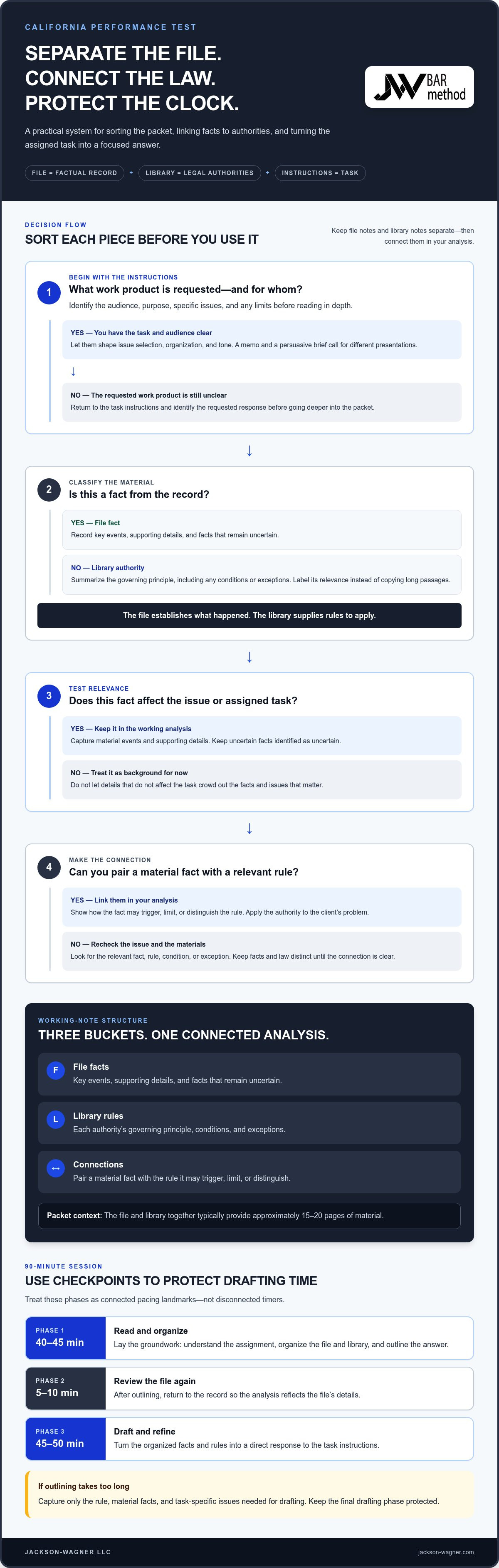
The file contains the factual record, while the library contains legal authorities for analyzing the assigned problem. Together, they typically provide approximately 15-20 pages of material. This division matters because facts and law play different roles: the file establishes what happened, and the library supplies rules to apply. Keep notes in separate file and library sections, then bring them together in your analysis.
Start with the task instructions before reading in depth. Identify the requested work product, client or audience, and any specific issues or limits. Then scan the file for the parties, events, disputed details, and questions that may affect the outcome. As you read the library, label each authority by its rule and relevance instead of copying long passages.
A practical set of working notes can use three categories:
- File facts: Record key events, supporting details, and facts that remain uncertain.
- Library rules: Summarize each authority’s governing principle and any conditions or exceptions.
- Connections: Pair a material fact with the rule it may trigger, limit, or distinguish.
For example, if a file describes a disputed agreement and the library provides a rule about contract formation, place the relevant facts beside that rule. This makes the connection clear without treating every document as equally important.
CPT Format and Tasks
A California Performance Test combines a file, a library, and instructions specifying the task. The instructions determine how you use the other two components: a memo, for example, requires a different presentation from a persuasive brief. Identify the audience and purpose early, because they shape your issue selection, organization, and tone. The State Bar provides online access to California bar performance tests and selected answers from past examinations.
Time planning needs checkpoints, not just a final drafting deadline. The recommended initial phase for laying groundwork and organizing an answer is 40-45 minutes. Another common planning point places the final file review about 30 to 35 minutes into the 90-minute session. After outlining the file and library, reserve 5 to 10 minutes to review the file again, then protect the final 45-50 minutes for drafting and refinement.
Use these landmarks to guide your pace, not as disconnected timers. If outlining takes too long, capture only the rule, material facts, and task-specific issues needed for drafting. Returning to the file helps ensure your analysis reflects the record, while the final drafting phase turns your organized work into a direct response to the instructions.
What is the California Performance Test (CPT) on the California Bar Exam?
The California Performance Test (CPT) is a practical legal analysis exercise within the California Bar Exam. It asks examinees to work through a client problem using supplied facts and legal authorities, then produce a response suited to the assigned task. Instead of testing only recall, the CPT evaluates how you apply rules, assess a record, and communicate a reasoned plan or position.
The performance test component accounts for 14-20% of an applicant’s total bar exam score, and 20% in UBE jurisdictions. Those figures describe the component across the stated exam settings; the California figure is not separately identified here. That scoring context makes the task more than a writing exercise. A sound answer must show legal reasoning and address the practical problem presented.
California CPT materials may describe unfamiliar legal issues. The library provides selected authorities, while the file supplies the client’s factual circumstances. A case in the library may be real, modified, or written solely for the test. Your task is to extract its usable rule and explain how it applies to the facts. For example, if an authority sets out factors for evaluating a dispute, connect each relevant factor to a specific fact instead of repeating the case summary.
The skills being assessed go beyond identifying a rule. Examinees must formulate legal theories from facts that may be only partly known, diagnose problems, generate alternatives, and develop a plan of action. A strong response may need to identify what the record supports, what remains uncertain, and what additional information could clarify the issue. Distinguishing established facts from assumptions is central to the analysis.
Communication also depends on the task’s purpose. The CPT may call for advocacy, client advice, information gathering, or assistance with a legal transaction. Each purpose changes what the reader needs. An advocate emphasizes support for a position; an adviser explains risks and practical choices. In either case, connect recommendations to the supplied record and legal principles.
California performance test examinees are also assessed on whether they can evaluate the consistency and reliability of facts and recognize ethical issues in practical situations. A conflicting account, for instance, may affect how confidently you can state a conclusion. An ethical concern may change the appropriate next step. Addressing these issues as part of the legal analysis helps produce a useful response, not merely a list of rules.
How should you identify relevant facts and legal authorities in the CPT library?
Start with the assigned problem, then read the file and library for connections. The CPT assesses whether you can understand and apply selected legal authorities to a client’s factual problem. Your goal is not to summarize every page. Identify which facts affect the legal analysis, which rules govern those facts, and what information remains necessary.
Read each library authority for its working parts: the rule, its conditions, and any limits or distinctions. Summarize the rule briefly in your own words. Then mark facts that could satisfy or undermine each condition. If an authority lists factors, keep them visible in your notes and match each one to evidence in the record. This approach turns a dense case into a tool for analyzing the client’s problem.
For example, imagine a file describing a workplace incident and a library authority addressing notice of a dangerous condition. Note the authority’s notice requirement, then find facts bearing on who knew what and when. Evidence of prior awareness may support one inference; a conflicting account may weaken it. Keep both in view rather than selecting only the detail that favors one conclusion.
Separate material facts from background by asking what each detail changes. Does it affect a rule’s condition, the reliability of an account, or the available response? A character detail with no link to the legal issue may not belong in the final analysis. A date, communication, or observation may matter if it changes the sequence of events or supports a competing interpretation.
- Tag the authority: Record its rule, conditions, and limits in concise language.
- Sort the file: Group facts by issue, source, and whether they support or challenge an inference.
- Match law and facts: Link each material fact to a rule condition or factor.
- Flag uncertainty: Distinguish established details from disputed or incomplete information.
The CPT also evaluates whether you can determine if additional facts are needed and where to find them. Name the missing detail precisely. For a notice issue, that might mean identifying who received a report, what it said, and when it arrived. Then locate a likely source in the file, such as a communication or witness account, if provided. Don’t present an assumption as a fact.
Finally, let the task instructions control what you include. A useful note may not belong in the answer unless it helps resolve the client’s problem. Strong california performance test library organization makes the rule-to-fact relationship easy to follow while preserving uncertainty and relevant alternative interpretations.
What format and tasks appear on the California Performance Test?
A California Performance Test packet combines a file, a library, and instructions describing the assigned task. The file supplies facts; the library supplies legal authorities; the instructions define the work product. California examinees have 90 minutes to read all performance test materials and write an answer. That limit makes task identification essential: the requested response determines what to prioritize in both sections of the packet.
Most bar exams require applicants to complete one or two 90-minute performance tests. The task may call for advocacy, client advice, eliciting information, or facilitating a legal transaction. These are different communication goals, not interchangeable formats. A response advocating a position must develop support for it, while advice should help a client understand the problem and a practical course of action.
Read the instruction page first and identify its core requirements. Note the assigned role, intended audience, purpose, and any specific questions or limits. Then use those requirements to shape your reading:
- Role: Determine whether you represent an advocate, adviser, or another assigned professional.
- Audience: Identify who will read the work and what that reader needs to know.
- Purpose: Mark whether the task seeks analysis, persuasion, information gathering, or transaction support.
- Scope: Track each instruction so the answer addresses the requested issues without drifting.
For example, an instruction asking for advice requires more than a rule summary. Explain how the supplied facts affect the client’s options, then connect each recommendation to an authority or record detail. If the task calls for advocacy instead, organize the analysis around the position and address facts that may weaken it. The same library can support different work products, depending on the instructions.
The CPT also evaluates whether examinees assess the consistency and reliability of facts. In a file containing conflicting accounts, identify the conflict and explain its significance rather than silently choosing one version. The task may also require recognizing ethical issues in practical situations. If an ethical concern affects the proposed action, address it in a way that fits the response’s purpose.
Use the 90-minute limit to keep the assignment moving from instructions to reading, analysis, and a complete written response. Reserve enough time to turn the file and library into organized reasoning, rather than spending the session transcribing authorities. Before finishing, compare the answer with each instruction. A response that misses a requested issue or adopts the wrong purpose can fail to do the work the packet assigned.
What common mistakes should California Bar Exam takers avoid when using the CPT library
A common mistake is treating every library authority as equally important. The task instructions identify the work product and issues, so use them to decide which rules deserve close analysis. For example, if the assignment asks for a client memo on one dispute, a library rule unrelated to that dispute should not dominate your answer. Tie each authority to a specific question the task requires you to address.
Another mistake is copying case language without explaining its effect. Quoting a rule does not show how the client’s facts satisfy or fail its conditions. Instead, state the principle briefly, connect it to a material fact, and explain the consequence. If a rule depends on notice, identify the file detail that supports notice and any conflicting detail that could weaken that conclusion.
Watch for these organizational traps as you work through the packet:
- Mixing facts with assumptions: Label disputed accounts and incomplete details instead of presenting them as established.
- Ignoring counterfacts: Address facts that challenge your theory, then explain their effect on the analysis.
- Overloading the answer: Leave out background that does not change a rule’s application or resolve the assigned issue.
- Using a generic structure: Match headings and tone to the requested work product and its audience.
Skipping the final file review can leave a sound legal discussion disconnected from the record. Revisit the file after outlining and check names, chronology, conflicting accounts, and facts that affect each rule. For instance, a witness’s later clarification may change how a key event fits the legal analysis. Correct the outline before drafting rather than carrying an avoidable factual gap into your response.
Time mismanagement creates another preventable problem. Spending too long summarizing authorities can leave too little room to write a complete answer within the 90-minute session. Set a clear stopping point for reading, then move from notes to an outline and draft. If one issue consumes disproportionate attention, check the task instructions again and prioritize the requested work.
Finally, don’t treat organization as decoration. California performance test answers are graded for responsiveness to the instructions, content, thoroughness, and organization. A polished heading cannot compensate for an unanswered instruction, and a concise rule summary cannot replace analysis. Before submitting, compare each part of your response with the assigned task and confirm that your reasoning supports your conclusions.
Build these habits through focused practice with realistic CPT tasks. Explore structured bar exam preparation with Jackson-Wagner LLC to strengthen your approach to reading, analysis, and timed writing.
Jackson-Wagner LLC: JW Bar Method Prep - Full Exam California Bar
JW Bar Method Prep - Full Exam California Bar gives candidates a structured preparation option alongside individual CPT practice. Use it to build broader exam preparation while practicing how to read, outline, and draft performance test answers.
Your preparation path depends on the exam you’re taking and your timeline. Jackson-Wagner LLC also offers JW Bar Method Prep - Attorney’s Exam California Bar, JW Bar Method Accelerated Prep - Full California Bar Exam, and JW Bar Method Accelerated Prep - Attorney’s Exam California Bar. Choose the full exam or Attorney’s Exam option that matches your exam, and consider an accelerated track if it fits your study schedule.
If you’re ready to explore California bar exam preparation, visit Jackson-Wagner LLC’s website.
Turn Your Study Plan Into Consistent Practice
Make each practice session purposeful. Choose a performance test, complete it under exam conditions, then review how your organization shaped the answer. Notice where your reasoning was clear and where you need more deliberate practice. Over time, that reflection can make California performance test library organization part of a repeatable study habit, not a last-minute task.
For broader California Bar preparation, Jackson-Wagner LLC offers JW Bar Method Prep - Full Exam California Bar and JW Bar Method Prep - Attorney’s Exam California Bar. An accelerated option is also available through JW Bar Method Accelerated Prep - Full California Bar Exam. The right course depends on which exam you’re preparing for and the study structure you want to follow.
Explore your preparation options or contact Jackson-Wagner LLC for guidance. Keep building your skills one focused practice session at a time.
Frequently Asked Questions
How are California Performance Test library materials organized?
The library groups legal authorities relevant to the problem, while the task instructions determine how to use them. Read each authority for its rule, conditions, and limits, then make a brief note of the issue it addresses. For example, label a case by the legal principle it explains instead of copying its full narrative. This makes the governing analysis easier to find when drafting.
What types of documents are included in the CPT library?
The CPT library contains legal authorities, which may include cases, statutes, and other supplied legal materials. The documents depend on the assigned problem. A case may be real, modified, or written specifically for the test. Treat each item as a source of law for the exercise, not as a fact from the client’s file. Note the authority’s rule and how it relates to the assigned issue.
What is the difference between the CPT library and the file?
The library supplies the legal authorities; the file supplies the problem’s factual record. Keep them distinct in your notes so you don’t mistake a rule in a case for a fact about the client. For example, a library decision may describe a notice requirement, while the file shows whether anyone gave notice. Connect those sources in your analysis and explain what the record supports.
How much time should you spend reading and organizing the CPT library?
Use the 90-minute session as a framework: the recommended initial phase for groundwork and organization is 40-45 minutes, followed by a 5 to 10-minute file review after outlining. The final phase is described as 45-50 minutes, with the final file review around 30 to 35 minutes into the session. Treat these as pacing landmarks, and move to drafting once you have a usable issue-and-rule outline.
What strategies help organize CPT cases, statutes, and other authorities quickly?
Give each authority a compact label: source type, legal issue, governing rule, and any limit or exception. Then group authorities by issue instead of keeping lengthy summaries. For a statute, capture the relevant elements; for a case, note its rule and the facts that shaped its result. Link each item to file facts, and flag conflicts or missing details so they remain part of your analysis.


