

Professional Responsibility is not a one-essay bet on the California Bar Exam. It appeared on the essay portion of 14 of the previous 15 bar exams, and it can also be tested on a performance test. The most useful professional responsibility essay tips California candidates can apply are to identify the governing rules, analyze each event in order, and distinguish California rules from ABA rules.
Careful preparation matters because one fact pattern can test several duties at once, and a California essay may ask you to discuss both California and ABA rules. A reliable approach is to identify the lawyer’s conduct, state the relevant duty, and explain how the facts support or weaken a possible violation.
This guide explains how to analyze competence and diligence, conflicts and informed consent, the scope of representation, and other recurring issues. It also covers how Professional Responsibility can appear alongside other subjects, so you can practice applying rules across essay and performance-test formats.
Key Takeaways
- Analyze each lawyer’s action or inaction in sequence, connecting the facts to the duty and possible breach.
- For a conflict, separate whether it exists from whether the representation can proceed, then address informed written consent.
- Identify whether California or ABA rules govern before applying a duty, and explain any difference that affects the result.
- Look closely at who controls key representation decisions and whether the lawyer has kept the client informed enough to decide.
- Prepare for Professional Responsibility to appear in an essay or performance test, including alongside other subjects.
1. Competence and diligence duties
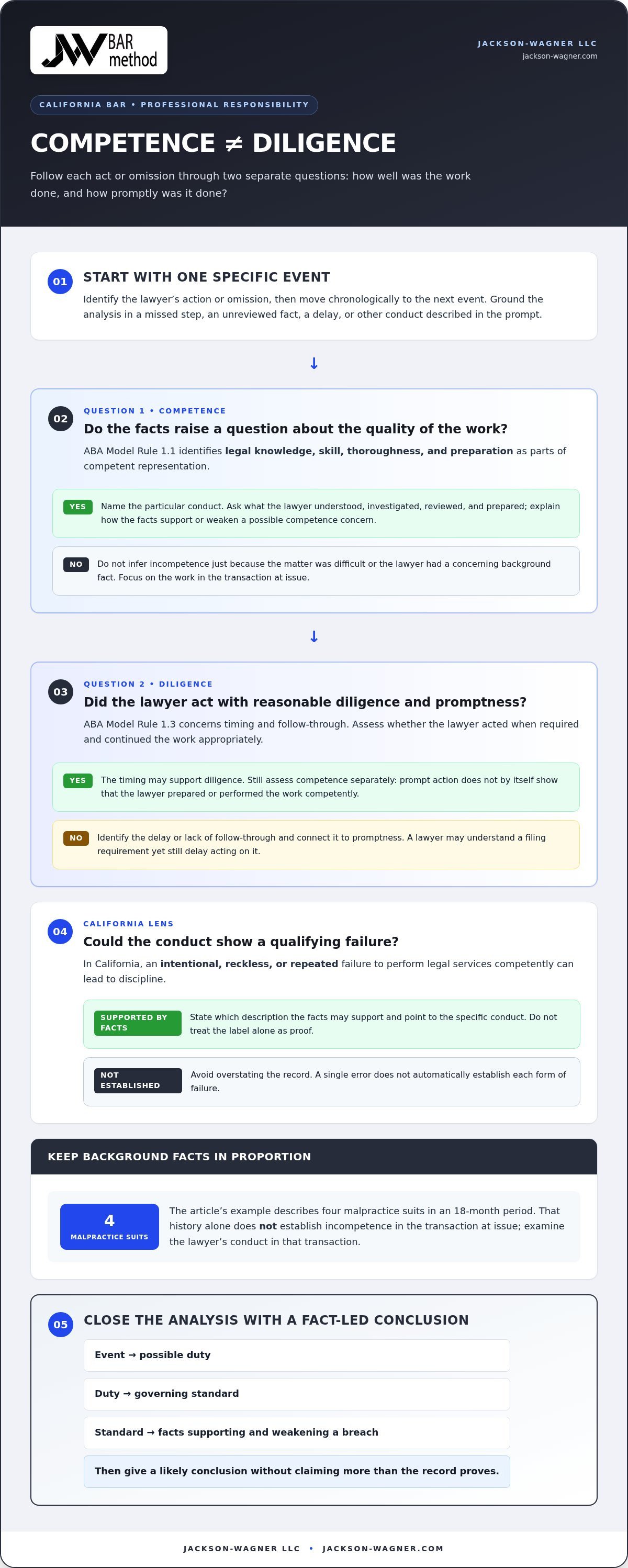
Start with the governing framework: ABA Model Rule 1.1 requires competent representation. It identifies legal knowledge, skill, thoroughness, and preparation as parts of competence. On an essay, connect each part to the lawyer’s specific conduct. For example, ask whether the lawyer understood the issue, investigated the relevant facts, and prepared before acting. Don’t assume a lawyer lacks competence just because the scenario involves a difficult matter. Explain what the facts show about the lawyer’s work on that matter.
For California lawyers, intentional, reckless, or repeated failure to perform legal services competently can lead to discipline. Identify the conduct precisely, then explain which description the facts may support. A single error does not automatically establish each form of failure. If a lawyer overlooks a key document, explain what it contained, when it became available, and how the lawyer handled it. This shows whether the facts suggest an isolated mistake or a broader problem with competent performance.
Competence and diligence are related, but they ask different questions. ABA Model Rule 1.3 requires reasonable diligence and promptness. For competence, analyze the lawyer’s knowledge, skill, thoroughness, and preparation. For diligence, examine the timing and follow-through. A lawyer might understand a filing requirement yet delay acting on it. Conversely, prompt action may still raise a competence issue if the lawyer failed to prepare. Name both duties when the facts support separate analyses, rather than treating them as interchangeable.
Use every relevant detail without turning it into proof by itself. In the example, the attorney had been sued for malpractice four times in an 18-month period. That history alone does not establish incompetence in the transaction at issue. Focus instead on the lawyer’s conduct in that transaction: what the lawyer knew, what preparation occurred, and whether the lawyer performed the work carefully. The example is a reminder to distinguish background facts from evidence tied directly to the alleged lapse.
For professional responsibility essay tips California candidates can use, apply the same sequence to each action or omission: identify the event, name the possible duty, state its standard, and connect the key facts to both sides of the analysis. Then give a likely conclusion without overstating what the record proves. Consider competence in almost any Professional Responsibility essay, even if the facts do not describe the lawyer as inexperienced. Focus on how the lawyer performed, not simply how long they have practiced.
Keep your analysis specific. Instead of saying a lawyer “handled the matter poorly,” identify a missed step, an unreviewed fact, or a delay described in the prompt. Explain why that example matters to competence, diligence, or both, then move chronologically to the next event. This keeps the answer grounded in the record and helps you address preparation or promptness alongside more obvious ethical issues.
2. Concurrent client conflicts and informed consent
On a California bar essay, analyze a conflict in two parts: explain why it exists, then decide whether representation may proceed. California revised its professional conduct rules in 2018, including its concurrent client conflict rules. Under the California rules described here, a lawyer generally needs informed written consent to proceed despite a conflict. The disclosure and consent must both be in writing.
Start with the clients and their interests. Ask whether the lawyer represents clients with opposing positions or has a personal interest that could interfere with loyalty to a client. Rely on the facts, not labels. If one client asks the lawyer to negotiate against another current client, identify the competing interests and explain how they may limit the lawyer’s work for each person. Analyze a possible conflict even if the prompt does not say either client has suffered harm.
Separate the conflict analysis from the consent analysis. First explain which interests collide and how the lawyer’s duties may be affected. Then address whether the representation can proceed under the California rules and whether the required informed written consent exists. Look for facts showing what the lawyer disclosed and whether each affected client agreed in writing. A general conversation does not establish written disclosure or consent.
Connect the disclosure to the actual conflict. If the lawyer tells a client only that “a conflict may exist,” assess whether the facts show that the competing interest and its likely effect on the representation were disclosed. Then evaluate the client’s written consent in light of that disclosure. This keeps the focus on informed decision-making instead of assuming a signature resolves every issue. State what the prompt establishes without adding assumptions about what the client understood.
For concurrent clients, assess loyalty from each client’s perspective. Consider whether confidential information, divided attention, or pressure to favor one client could affect the lawyer’s advice, and tie each concern to a fact in the scenario. A client’s criminal matter, for example, may create a separate conflict issue if another current client’s interests affect the lawyer’s work. Explain the connection rather than treating the word “criminal” as sufficient on its own.
Analyze California client funds and trust accounts separately, using the facts. Trace who owns the funds, how the lawyer handled and recorded them, whether any amount is disputed, and what happened before a transfer or disbursement. Explain which facts raise concerns about custody, accounting, or use without assuming that possession alone establishes misconduct.
Practice writing these two-part analyses under timed conditions; structured California bar exam preparation can help you build that essay routine.
3. ABA Model Rules and California rules
First identify which rules the essay asks you to apply. A prompt may call for both ABA Model Rules and California rules, so do not assume they are identical. Flag facts that trigger a duty, then state each jurisdiction’s standard separately. This prevents you from applying an ABA exception to California without analysis.
Communication with a represented person illustrates the comparison. Under the ABA and California rules described here, a lawyer generally may not discuss a case with someone the lawyer knows has counsel unless that person’s lawyer consents or a court order permits it. The ABA rules also prohibit directing another person to communicate in a way the lawyer could not communicate directly. Identify who initiated contact, whether the lawyer knew the person had counsel, and whether consent or a court order existed.
Client communication and confidentiality require their own rule checks. California Rule 1.4 requires lawyers to keep clients reasonably informed about significant developments. ABA Model Rule 1.4 also addresses responding to client requests and explaining matters so clients can make informed decisions. ABA Model Rule 1.6 covers information relating to representation, regardless of source. California generally permits disclosure to prevent a criminal act likely to cause death or substantial bodily harm, and requires an effort to dissuade the client. Compare the specific exception raised by the facts.
Fees offer another clear contrast. The ABA rules prohibit unreasonable fees, while California rules prohibit unconscionably high fees. California generally requires a written fee agreement when the fee is likely to exceed $1,000. California also prohibits contingent fees in domestic relations and criminal cases. For a fee-splitting fact pattern, identify the lawyers sharing the fee, the terms, and the client-related facts, then analyze the applicable California requirements rather than importing an ABA standard.
California duties also address conduct involving other lawyers. Consider whether information about another lawyer’s conduct raises a reporting issue, and analyze the applicable jurisdiction’s standard. California’s reporting requirement is narrower: the conduct must be criminal, involve intentional misrepresentation, be fraudulent or reckless, and substantially bear on the lawyer’s ability and fitness to practice. Match each condition to a fact before concluding that reporting is required.
When rules differ, use the same comparison method: name the issue, state the ABA rule, state the California rule, and apply each to the same facts. If a lawyer learns of planned serious harm, for example, distinguish California’s stated disclosure conditions from ABA confidentiality exceptions involving fraud or financial injury. If the essay asks which association’s rules govern, follow its instructions and explain your choice. This disciplined comparison is central to professional responsibility essay tips for California candidates, especially when one fact pattern raises several duties.
4. Attorney-client relationship and scope of representation
Begin with the scope of the relationship: identify the client, the work accepted, and the decisions the attorney handles. A lawyer’s role in negotiating a settlement, for example, does not transfer the settlement decision from the client. Under both ABA and California rules, the client decides whether to make or accept a settlement offer. Explain whether the attorney presented the offer and let the client choose, or acted without that authority.
California Rule 1.4 requires lawyers to keep clients reasonably informed about significant developments. ABA Model Rule 1.4 also requires a lawyer to respond to reasonable requests and explain matters so clients can make informed decisions. Apply those duties to concrete events: a settlement proposal arrives, a deadline changes, or the client asks about case strategy. State what the lawyer communicated, what the client needed to decide, and whether the explanation supported that decision.
For the mandatory confidentiality and privilege analysis, keep the concepts distinct. ABA Model Rule 1.6 covers information related to a client’s representation, regardless of its source, from consultation and beyond the client’s death. California generally permits disclosure to prevent a criminal act substantially certain to cause death or great bodily harm; the lawyer must attempt to dissuade the client. If the prompt raises privilege, analyze that issue separately from the lawyer’s professional confidentiality duty. Connect the communication, its purpose, and the requested disclosure to the facts.
Scope also matters when a client asks the lawyer to take a step outside the agreed work. Identify the accepted task, the client’s request, and any explanation of what the representation covers. If a lawyer agreed to handle a negotiation but not a separate proceeding, for example, analyze whether later conduct or communications changed the apparent scope. Do not assume the client’s request alone establishes the lawyer’s agreement.
For withdrawal, identify why the attorney seeks to end the representation, then assess the circumstances described in the question. Discuss the effect on the client’s interests, the timing of the proposed exit, and any facts about notice or transition. If a hearing or filing is near, explain how that timing could affect the client. Do not conclude that withdrawal is proper solely because the relationship has become difficult.
On an essay, organize these issues around decisions and communication. First identify the client and the scope of the representation. Next analyze the client’s authority over decisions, the lawyer’s communication, and any confidentiality or privilege issue. Finally, evaluate withdrawal based on the stated reason and its effect on the client. This sequence connects each conclusion to an event instead of turning the answer into a list of abstract duties.
5. How professional responsibility appears on the California Bar Exam
Professional Responsibility can appear on a California essay or performance test, and it may appear more than once. It appeared on the essay portion of 14 of the previous 15 bar exams. In the year it wasn’t tested as an essay, it appeared in one of the three-hour Multistate Performance Tests. Prepare to spot the subject in either format, not just in a question labeled “Professional Responsibility.”
The written portion consists of six subject essays and two Multistate Performance Tests, and it is worth 65 percent of the overall score. An essay may combine Professional Responsibility with Corporations, Evidence, Contracts, Torts, Civil Procedure, Community Property, or Remedies. Students should identify every subject the facts raise, then organize the analysis so ethical duties don’t disappear inside the other subject’s rules. For example, a lawyer’s conduct in a contract dispute may raise both contract issues and professional duties.
Use a clear IRAC structure for each ethical issue: state the issue, give the governing rule, apply the facts, and reach a concise conclusion. With an hour for each essay question, use the opening moments to identify the parties, events, and possible duties. Then write in chronological order, addressing each action or omission before moving to the next event. Leave enough time to apply the facts to each rule rather than listing rules without analysis.
Common mistakes include treating ABA and California rules as identical, skipping a rule because the prompt does not name it, and reaching conclusions without factual support. Avoid them by identifying the governing rules, stating relevant distinctions, and explaining how each fact affects the result. A fact pattern may require discussion of two or even three subjects, so do not let one issue crowd out another. Address each plausible ethical issue with a brief, fact-specific analysis.
Practice materials can reveal how those combinations work. The October 2020 and February 2020 Professional Responsibility essays address both ABA and California rules. The July 2017 essay combines Professional Responsibility with Evidence. Use these examples to practice identifying the governing rules and separating overlapping issues, rather than memorizing one essay’s fact pattern. Remedies has also appeared alongside other subjects in past essays, reinforcing the value of reading the entire prompt before outlining.
For a timed practice essay, read for parties and events, outline the issues, then draft rule-by-rule analysis tied to the facts. Reserve a final review for missed issues, unsupported conclusions, and California-versus-ABA distinctions. That practical sequence turns professional responsibility essay tips for California candidates into an exam routine: spot, organize, apply, and conclude. Build this routine through California Bar Exam preparation that includes focused essay practice.
Jackson-Wagner: JW Bar Method Prep - Full Exam California Bar
JW Bar Method Prep - Full Exam California Bar prepares candidates for the full California Bar Exam. It connects the rule analysis in this guide with broader exam preparation, including subjects and performance tasks beyond Professional Responsibility. Choose this offering if you are preparing for the full exam. Candidates preparing for the Attorney’s Exam can choose JW Bar Method Prep - Attorney’s Exam California Bar. Accelerated programs are available for both exam paths.
Use focused practice to build a repeatable method for spotting issues, distinguishing California and ABA rules, and applying facts under timed conditions. Jackson-Wagner LLC’s JW Bar Method programs provide California Bar Exam preparation through its proprietary method. Contact Jackson-Wagner LLC to discuss your preparation path.
Turn Your Rule Knowledge Into an Exam Routine
Make ethical analysis a repeatable part of your study plan. After each practice response, identify one missed issue, one rule distinction to sharpen, and one place where closer fact analysis would strengthen your reasoning. Use those observations to shape your next timed practice instead of simply rereading the same rules.
For a structured California Bar preparation path, Jackson-Wagner offers JW Bar Method Prep - Full Exam California Bar, JW Bar Method Prep - Attorney’s Exam California Bar, and JW Bar Method Accelerated Prep - Full California Bar Exam. Choose the program that fits your exam path and preparation timeline. These professional responsibility essay tips for California candidates can guide your practice, while a broader preparation program can help you build consistency across the exam.
Contact Jackson-Wagner today to explore your California Bar preparation options. Keep practicing with focus and purpose. Each thoughtful essay makes your approach more deliberate.
Frequently Asked Questions
What are the California Bar Exam essay rules for professional responsibility?
Analyze each issue with a clear rule, fact application, and conclusion. The written portion includes six subject essays and two Multistate Performance Tests, and examinees have an hour for each essay question. A Professional Responsibility issue may also appear alongside another subject. For practice, take a past fact pattern and mark each event that could trigger an ethical issue before drafting. This helps keep your answer tied to the prompt.
What California Rules of Professional Conduct are most commonly tested on essays?
Prepare to analyze competence, diligence, conflicts, client communication, confidentiality, and fees. California Rule 1.4 concerns keeping clients reasonably informed about significant developments. For example, a prompt about a lawyer delaying news of a settlement offer may raise communication and client-decision issues. Also review the California-specific approach to informed written consent for conflicts. Treat these as high-value subjects to practice, not a fixed prediction of what a particular essay will test.
How does California professional responsibility law differ from the ABA Model Rules?
California and ABA rules may set different standards or exceptions, so compare them issue by issue rather than assuming they match. For example, ABA rules prohibit unreasonable fees, while California rules prohibit fees that are unconscionably high. For a question about a lawyer’s fee, state each standard separately and apply the facts to both if requested. The same method helps prevent importing an ABA confidentiality exception into a California analysis.
How should California essay answers analyze attorney-client relationships and duties to prospective clients?
Start by identifying what the facts establish about the interaction: did someone seek legal advice, did the attorney agree to represent them, and what work did they discuss? Then analyze the duties raised by the prompt, such as confidentiality, conflicts, or client communication. A brief consultation followed by a request to represent someone with opposing interests, for example, calls for careful attention to what information the attorney received and when.
What professional responsibility essay issues commonly appear on the California Bar Exam?
Practice spotting conflicts, confidentiality, competence, diligence, client communication, fees, and settlement authority. Essays may combine Professional Responsibility with subjects such as Evidence, Contracts, or Civil Procedure, so look for lawyer conduct even within another subject’s fact pattern. A lawyer negotiating a dispute may raise substantive legal issues as well as ethical duties. Organize your answer around events and explain how each fact supports or weakens a possible violation.
What are the California duties concerning client funds and trust accounts?
Analyze who owns the funds, how the lawyer handled and recorded them, whether any amount is disputed, and what happened before a transfer or disbursement. These facts may raise concerns about custody, accounting, or use. Possession alone does not establish misconduct.


