

The California Attorneys’ Exam can be a more focused route, but eligibility is limited: you need an active law license in good standing, without discipline, in another U.S. jurisdiction for at least four years immediately before the exam. The california attorney exam vs general bar exam comparison comes down largely to format: the Attorneys’ Exam is a one-day written exam with essays and a performance test, while the general exam also includes the MBE. Both have the same passing standard.
Pass rates matter, but the right fit also depends on whether you qualify and how your strengths align with each format. This guide explains the eligibility rule, compares the exams, and puts pass-rate differences in context rather than treating them as a prediction of your result. You’ll find a practical way to weigh the written portion against the MBE and choose preparation for the exam you can take.
Key Takeaways
- Use the active-license and good-standing criteria to determine whether the Attorneys’ Exam is an option for you.
- Compare your essay and performance-test skills with your multiple-choice strengths before choosing an exam format.
- Look beyond a single administration’s pass rate; results vary over time and don’t predict an individual candidate’s outcome.
- Review the subjects and question formats in each exam to focus your preparation on the work you’ll actually face.
- Once you know which exam you’re eligible to take, choose a preparation track aligned with that exam and your study timeline.
Can you take the California Attorneys’ Exam?
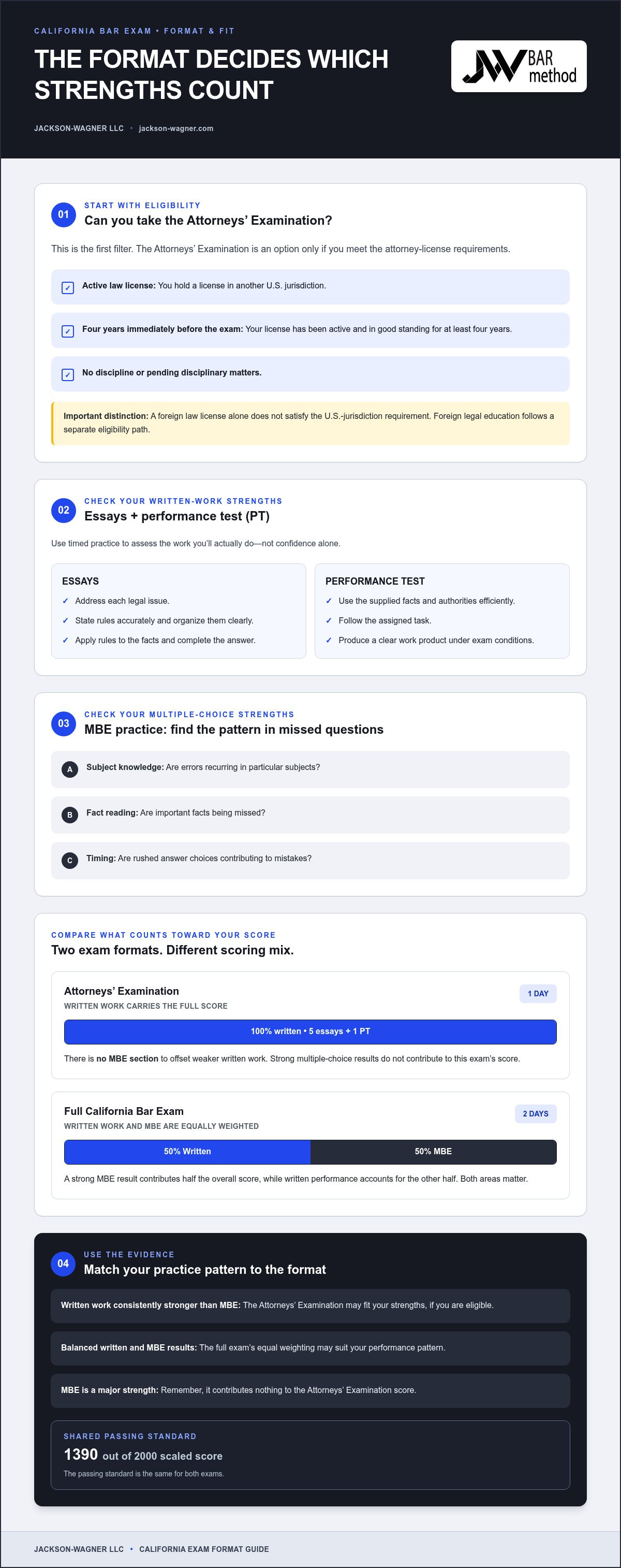
You may take California’s Attorneys’ Examination if you hold an active law license in good standing, without discipline, in another U.S. jurisdiction for at least four years immediately before the exam’s first day. You must also have no pending disciplinary matters. A foreign law license alone does not meet this U.S.-jurisdiction requirement; foreign legal education follows a separate eligibility path.
The California Attorneys’ Examination lasts one day. The full California Bar Exam lasts two days. Both use a passing standard of 1390 out of 2000 scaled score.
California offers several routes to bar-exam eligibility. One is a law degree from an ABA-approved or California-accredited school. You may also qualify through four years of study in California’s Law Office Study Program under a judge or attorney. For foreign-educated lawyers with a first law degree, eligibility requires one year of law study at an ABA-approved or California-accredited law school.
California recognizes distance-education law schools as a qualifying basis for bar-exam eligibility, unlike the usual approach elsewhere. Most states require graduation from an ABA-approved school or a law school approved or accredited by that state’s supreme court or examining committee. California law students must register with the State Bar and complete the registration form accurately under penalty of perjury.
Taft Law School students seeking the California Bar Examination must pass the First Year Law Students’ Examination after their first year of study. Graduates of Taft’s Juris Doctor-Attorney Track Program become eligible to sit after the school complies with rules established by the Committee of Bar Examiners and the California Supreme Court.
| Applicant pathway | Key eligibility criterion | Exam route |
|---|---|---|
| Licensed attorney | Active U.S. jurisdiction license in good standing for four years, without discipline | Attorneys’ Examination |
| Law school graduate | Qualifying legal education, including California’s distance-education route | Full Bar Exam |
| Foreign-educated lawyer | First law degree plus one year at a qualifying U.S. law school | Full Bar Exam |
| Law Office Study applicant | Four years of study under a judge or attorney | Full Bar Exam |
For the February 2027 exam, the final filing deadline is January 4, 2027. The listed application fee is $850 for a general applicant and $1,650 for an attorney applicant. The attorneys’ route is therefore distinct in both eligibility and application category; other states generally use their own admission rules and often require an approved law-school degree.
The MPRE score of 86 is required for California admission, but not to qualify for the Attorneys’ Examination. Applicants for admission must also complete the Moral Character Application and pass the MPRE. If you fail the examination, you have not met the passing standard; you’ll need to pursue a later sitting through the applicable application process.
Choose the Attorneys’ Examination only if you meet its attorney-license criteria. If you don’t, assess which qualifying route applies to the full exam.
How to choose based on essay, PT, and MBE strengths
Assess your performance across the California exam’s three task types: essays, the performance test (PT), and the multiple-choice Multistate Bar Examination (MBE). Eligibility determines which exam you may take, while your demonstrated strengths can help you decide which scoring structure better fits your skills.
The Attorneys’ Examination score is based entirely on five essays and one performance test. There’s no MBE section to offset weaker written work. If you can identify legal issues, organize rules clearly, apply them to facts, and manage a PT file efficiently, those skills carry the full scoring burden. Strong multiple-choice results won’t contribute to this exam’s score.
The general California Bar Exam gives equal weight to written work and the MBE: 50% for each portion. That balance can suit candidates who are capable writers and also perform consistently on timed multiple-choice questions. A strong MBE result contributes half the overall score, while written performance accounts for the other half. Neither area can be ignored.
Use practice results, not confidence alone. Review timed essays for issue coverage, rule accuracy, organization, and completion. For PT work, assess how well you extract relevant facts and authorities, follow the assigned task, and produce a clear work product under exam conditions. For MBE practice, track whether errors stem from misunderstood subjects, missed facts, or rushed answer selection.
- Essays: Check whether your answers address each issue and connect rules to the given facts.
- PT: Evaluate how efficiently you use the supplied materials and satisfy the requested task.
- MBE: Identify recurring weak subjects and distinguish knowledge gaps from timing mistakes.
Compare the patterns. If your written work is consistently stronger than your multiple-choice performance, you may prefer the Attorneys’ Exam, if eligible. With balanced results, the full exam’s split weighting may suit you better. If MBE practice is a major strength, remember that it contributes nothing to the Attorneys’ Exam score. The exam format determines which strengths count.
Build your study plan around the exam you can take and the skills its scoring rewards. If the full exam is your route, prepare for both written tasks and MBE subjects; if you qualify for the Attorneys’ Examination, prioritize essays and PT practice. A focused California bar exam preparation plan can align study work with the format you’re preparing to face.
California Attorneys' Exam
California’s Attorneys’ Examination is a one-day written exam for eligible attorneys seeking admission to the state. It uses the written portion given on the first day of the full California Bar Exam, but omits the MBE. The exam focuses on demonstrating legal analysis in written responses.
The examination consists of five essays and one performance test (PT). Because the score is based entirely on these written tasks, prepare for the skills the exam measures. Essay practice develops issue spotting, rule statements, and application to facts. PT practice trains you to work from provided materials and complete a defined assignment.
Both the Attorneys’ Examination and the full California Bar Exam have a passing standard of 1390 out of 2000 scaled score. The shared threshold does not make the exams interchangeable. The general exam also includes the MBE, while the Attorneys’ Examination score comes only from its essays and PT. A candidate’s preparation should reflect that difference.
Use timed exercises to pinpoint where written responses lose focus. After each essay, check whether you addressed the issues, explained the applicable rules, and tied them to the facts. For each PT, review whether your work product follows the assigned task and uses relevant information from the materials. These steps turn general practice into a focused improvement plan.
- Essay review: Track missed issues, unclear rule explanations, and incomplete factual analysis.
- PT review: Check task compliance, organization, and use of the supplied materials.
- Exam planning: Allocate practice across all five essays and the PT, rather than relying on MBE preparation.
California administers its Bar Exam in February and July. However, the state may not offer an Attorneys’ Examination in July 2028 or February 2029, so timing can affect an eligible attorney’s planning. California is also scheduled to switch to the NextGen Bar Exam in July 2028. These scheduled changes make it useful to consider both the exam format and the administration you intend to take.
Before choosing this route, confirm that your attorney-license history meets the eligibility requirements and plan for the written format. A useful sequence is to assess your essay and PT performance, target weaker written skills, then complete timed sets that reflect the exam’s five-essay-and-one-PT structure. The key distinction is simple: the Attorneys’ Examination concentrates assessment in written work, without an MBE section.
California bar exam pass-rate comparisons
California’s reported pass rates change across administrations, and the Attorneys’ Examination does not lead every comparison. In February 2026, 57.00% of Attorneys’ Examination candidates passed, compared with 30.80% of general Bar Exam candidates. In July 2025, the pattern reversed: the respective rates were 43.40% and 54.80%.
The recent results show why a single administration cannot settle the choice. Attorneys’ Examination candidates had higher reported rates in February 2026, February 2025, and February 2024. General Bar Exam candidates had higher reported rates in July 2025, July 2024, and July 2023. The results describe those exam groups in those sittings, not an individual applicant’s likelihood of passing.
| Administration | Attorneys’ Examination pass rate | General Bar Exam pass rate |
|---|---|---|
| February 2026 | 57.00% | 30.80% |
| July 2025 | 43.40% | 54.80% |
| February 2025 | 84.10% | 63.60% |
| July 2024 | 48.90% | 53.80% |
| February 2024 | 52.70% | 33.90% |
| July 2023 | 47.80% | 51.50% |
Interpret pass-rate comparisons alongside exam format. The Attorneys’ Examination consists of written work, while the full exam also includes the MBE. The eligibility rules also mean the candidate groups differ: Attorneys’ Examination applicants must meet California’s attorney-practice criteria. Pass-rate gaps don’t establish that one format is inherently easier; they reflect different applicants, exam content, and administrations.
Use pass rates as context, then decide based on evidence you can assess yourself. Compare timed essay and performance-test results with MBE practice performance. Identify which tasks consistently need more work and whether you qualify for the Attorneys’ Examination. A strong rate in one administration cannot replace a review of your own skills.
- Compare several sittings: Check whether a pattern holds across February and July results.
- Match outcomes to format: The Attorneys’ Examination tests essays and a performance test; the full exam adds the MBE.
- Use your practice record: Review timed work and missed questions, not pass-rate headlines alone.
For example, the February 2025 rates were 84.10% for Attorneys’ Examination candidates and 63.60% for general candidates. In July 2025, the general rate was higher. That contrast makes the practical takeaway clear: pass-rate comparisons can inform your choice, but format fit, eligibility, and demonstrated performance should guide it.
What subjects and question formats are on each California exam?
The full California Bar Exam currently combines five essay questions, one Performance Test, and NCBE multiple-choice questions. Its two-day format tests written analysis and multiple-choice application. The Attorneys’ Examination uses the written portion given on the first day, without the MBE. Knowing which tasks appear helps you focus practice on the exam you’ll take.
Essays ask candidates to analyze legal issues and apply relevant rules to facts. California’s current format includes five essays, each requiring a written response. Focus practice on identifying issues, organizing analysis, explaining rules, and applying them to the prompt. Listing rules without connecting them to the facts does not demonstrate the same analysis as reasoned application.
The Performance Test is a written task based on materials provided for the exercise. Candidates must understand the assignment, locate useful information in those materials, and produce the requested work product. The full exam includes one 90-minute Performance Test on its first day. The Attorneys’ Examination includes this same task in its written format.
The MBE is the key format difference. The full California Bar Exam includes 200 multiple-choice questions on core federal law subjects. Candidates read each question, assess the facts and applicable principles, then select an answer. The Attorneys’ Examination omits this section, so MBE practice does not directly contribute to its score.
| Exam format | Written components | Multiple-choice component |
|---|---|---|
| Full California Bar Exam | Five essays and one Performance Test | 200 MBE questions |
| California Attorneys’ Examination | Five essays and one Performance Test | No MBE |
On the full exam, the written portion and MBE each carry 50% of the score. This split rewards balanced preparation: essays and the PT matter, but multiple-choice performance carries equal weight. The Attorneys’ Examination score comes entirely from five essays and one PT, so candidates must prepare for every written task.
Use timed practice for each format. Write essays under exam conditions, complete a PT using its assigned materials, and review MBE questions by subject and error type. For example, distinguish missed questions caused by rule confusion from mistakes caused by rushed reading. That distinction helps you choose what to practice next.
Focus on the components included in your exam, not simply the total number of question types. To align study with California’s written and multiple-choice formats, build a California bar exam preparation plan around the tasks you’ll face.
Jackson-Wagner: JW Bar Method Prep - Full Exam California Bar
JW Bar Method Prep - Full Exam California Bar supports candidates preparing for the full California Bar Exam. If you qualify for the Attorneys’ Examination, JW Bar Method Prep - Attorney’s Exam California Bar from Jackson-Wagner LLC is designed for that exam. Choose the path that matches the format you plan to take.
Choose a standard or accelerated track based on your study timeline: JW Bar Method Accelerated Prep - Full California Bar Exam or JW Bar Method Accelerated Prep - Attorney’s Exam California Bar. First identify the exam you’re eligible to take, then select the matching preparation option. This gives you a clear starting point for organizing your study with Jackson-Wagner LLC.
For information about preparation, visit jackson-wagner.com.
Choose Your Exam Path and Plan Your Next Step
Make your decision based on eligibility and your own performance, not pass-rate headlines alone. Confirm which exam route you qualify for, then match your preparation to the skills it tests. Identify your target exam, study timeline, and areas needing focused work to turn the California attorney exam versus general bar exam decision into a practical plan.
Jackson-Wagner offers JW Bar Method Prep - Full Exam California Bar and JW Bar Method Prep - Attorney’s Exam California Bar, with an accelerated option for the full exam. Choose the preparation path that matches the exam you plan to take and the pace that suits your study schedule.
If you’re ready to discuss your California bar exam preparation, contact Jackson-Wagner for guidance. Take the next step with a plan built around your exam path, and move forward with purpose.
Frequently Asked Questions
Is it easier to study for the two-day General Bar Exam?
Not necessarily. The two-day schedule alone doesn’t make the General Bar Exam easier to prepare for. It includes written work and MBE questions, so your study plan must cover both task types. Strong essay performance won’t replace MBE preparation because the MBE contributes half the score. Compare your timed results across essays, the performance test, and multiple-choice practice before deciding which format better suits you.
What is the California Attorney's Examination?
The California Attorneys’ Examination is a written exam option for eligible attorneys seeking admission in California. It assesses candidates through essays and a performance test, without the MBE. If you’re stronger at written legal analysis, practice timed essays and performance-test tasks. The exam still requires meeting California’s passing standard; its shorter format does not remove the need to demonstrate exam-level legal analysis.
Who is eligible to take the California Attorney's Examination?
Eligibility generally requires an active law license in good standing, without discipline, in another U.S. jurisdiction for four years immediately before the exam’s first day. An attorney with a pending disciplinary matter does not meet the stated good-standing requirement. The MPRE score of 86 is required for admission, but not to qualify for this examination. Treat exam eligibility and final admission requirements as separate steps in your planning.
How does the California Attorney's Examination differ from the full California Bar Exam?
The Attorneys’ Examination tests written work only, while the full exam also includes the MBE. In the full exam, the written portion and MBE each account for 50% of the score; the Attorneys’ Examination score relies entirely on five essays and one performance test. The California attorney exam versus general bar exam decision therefore hinges partly on whether your preparation should include MBE practice.
What are the pass rates for the California Attorney's Examination versus the full Bar Exam?
Rates vary by administration. In February 2026, 57.00% of Attorneys’ Examination candidates passed, compared with 30.80% of general Bar Exam candidates. In July 2025, the rates were 43.40% and 54.80%, respectively. These figures describe results for those sittings, not an individual candidate’s prospects. Use them as context, then weigh eligibility, exam format, and your own practice performance.
Can attorneys licensed in another state take the California Attorney's Examination, and what practice requirements apply?
Attorneys licensed in another U.S. state can qualify if they meet California’s practice and license conditions. The license must be active and in good standing, without discipline, for four years immediately before the exam’s first day, and there must be no pending disciplinary matters. California does not grant admission by motion or reciprocity, so an out-of-state license alone does not replace the required examination and admission process.


