

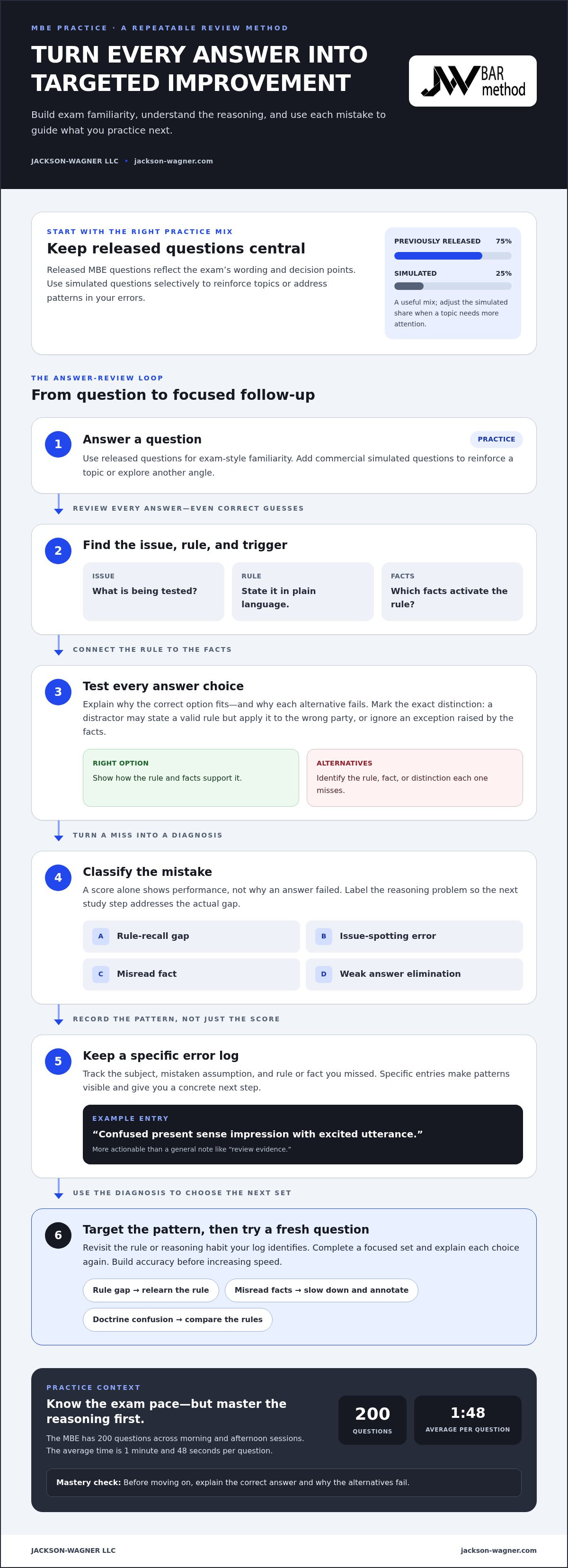
The best supplements for MBE practice prioritize previously released bar exam questions, which help you recognize question phrasing, spot issues, and eliminate weak answer choices. A useful practice mix is roughly 75% previously released questions and 25% simulated questions. Focus on learning from each answer, not just increasing your question count.
It makes sense to want realistic practice and clear explanations without paying for tools that don’t fit how you study. The right choice depends on what you need most: detailed answer rationales, feedback that helps you identify patterns in your mistakes, a flexible question bank, or a structured course. This guide explains how to compare those options by learning needs and budget, including how official materials fit into your plan. You’ll also see how California Bar Exam preparation courses can support a broader study approach when question practice alone isn’t enough.
Key Takeaways
- Compare practice resources by the quality of their explanations, not just the size of their question bank.
- Use feedback to spot whether missed answers stem from a rule gap, issue recognition, or answer-choice reasoning.
- Match supplemental practice to your current study needs, and avoid paying for overlapping tools that don’t address a clear gap.
- Use official materials to get familiar with the style and reasoning of released MBE questions.
- Consider whether structured California Bar preparation would help you connect multiple-choice practice with your broader study plan.
1. What Are The Best MBE Practice Questions?
Start with previously tested MBE questions released by the National Conference of Bar Examiners (NCBE). Add simulated questions selectively, and choose resources with clear explanations and useful feedback. Retrieval practice, careful review, and targeted repetition are practical study strategies, not supplements.
Released questions reflect the wording and decision points of actual MBE items. Commercial course questions are written for instruction or additional practice. They may test the same doctrines, but their wording and difficulty can differ. That distinction matters: recognizing an issue in a dense fact pattern requires more than recalling a rule. Use real MBE questions to learn the exam’s phrasing, then use commercial questions to reinforce a topic or explore another angle. Questions unlike those on previous exams may provide less exam-style familiarity.
Review every answer, including correct guesses. First, identify the tested rule and the facts that trigger it. Next, explain why the right option fits and why each alternative fails. For example, if a contracts question turns on acceptance, note which fact shows agreement and which distractor raises an unrelated defense. Keep a short error log by subject and mistake type. That record shows whether you need to relearn a rule, slow down, or eliminate choices more carefully. Aim to understand every option, not simply record a percentage.
Before choosing a bar prep course, find out whether its question bank includes previously released MBE questions, simulated questions, or both. Compare the explanations, feedback, and ability to focus practice on a weak subject. A large bank won’t help if you can’t tell why your answer missed the rule. The best supplements for MBE practice fit a specific need: authentic exam phrasing, topic reinforcement, or structured review. Avoid paying for a resource that duplicates your main course.
Use simulated questions to address patterns in your error log. If evidence questions repeatedly expose confusion about relevance, review that rule, then complete a focused set and explain each choice. A practice mix of roughly 75% past MBE questions and 25% simulated questions offers one way to combine exam familiarity with targeted reinforcement. Adjust the simulated share when a topic needs more attention, while keeping released questions central to exam-style practice.
Build accuracy before increasing speed. The MBE contains 200 questions across morning and afternoon sessions, with an average of 1 minute and 48 seconds per question. Practice eliminating choices by crossing out answers that contradict a tested rule, then compare the remaining options against the facts. One study guide reports improvement after about 800–1,000 practice questions, while the useful total depends on what review reveals. Set mastery as the goal: explain the correct answer and the rejected alternatives before moving on. That process develops recognition and judgment needed for passing the bar.
2. Detailed answer explanations and feedback
A useful explanation does more than identify the correct letter. It connects a tested rule to specific facts, then shows why competing answers fail. During preparation, that reasoning helps distinguish a genuine rule gap from rushed reading or a tempting distractor. For example, an explanation should identify the fact that triggers a hearsay issue, not simply label the question “evidence.”
Use a consistent review sequence after each question. First, restate the issue without looking at the answer. Then write the governing rule in plain language and match each element to a fact. Finally, compare every answer choice against that rule. This process shows whether you missed an exception, overlooked a key fact, or selected an answer that addressed a different doctrine.
Strong explanations also clarify why wrong options look plausible. In a contracts question, one choice might describe a valid defense but apply it to the wrong party. Another might state a general rule while ignoring an exception raised by the facts. Mark the exact distinction. Later, it can help you recognize the same reasoning pattern without memorizing an isolated answer.
Feedback is more useful when it tracks the kind of mistake, not only your score. After reviewing a set, label each miss as a rule-recall problem, issue-spotting error, misread fact, or weak elimination. For example, repeated misreads of timeline facts call for slower annotation. Repeated confusion between two doctrines calls for a focused rule comparison. Revisit that note before answering a fresh question on the same subject.
Check what a bar prep course means by “feedback.” A score report alone shows performance, but not why an answer failed. Look for explanations that address the tested rule, relevant facts, and each distractor. If a course includes questions released by the National Conference of Bar Examiners, review how its explanations distinguish official question wording from instructor-created analysis. For Uniform Bar Examination preparation, prioritize feedback tied to the subjects and reasoning tested by the MBE.
Use explanations to build a compact error log. Record the subject, the mistaken assumption, and the rule or fact you missed. Keep entries specific: “confused present sense impression with excited utterance” is more useful than “review evidence.” At your next study session, answer a fresh question on that distinction, then explain aloud why each alternative is weaker.
For a broader California Bar study structure, explore California Bar exam preparation alongside question review. Keep the focus on actionable feedback: each missed question should produce a rule to revisit, a reasoning habit to change, or a fact pattern to recognize. That turns explanations from post-test commentary into a practical guide for your next study block.
3. Choosing MBE supplements based on learning needs and budget
Choose a study supplement by matching its format to a specific learning gap. If you miss questions because rules blur together, prioritize concise rule review. If timing and focus are the issue, look for timed practice with useful performance feedback. Caffeine, L-theanine, creatine, and blended products have ingredient-specific side-effect considerations. Caffeine may affect sleep or alertness, while combinations can make unwanted reactions harder to attribute. Compare the label and safety information before adding any product to your routine.
Start by listing the bar prep resources you already use and what each provides: released questions, simulated questions, subject explanations, progress reports, or instructor feedback. For example, a multistate question bank may duplicate practice included in a course. A second tool earns its place when it addresses a clear gap, such as weak performance in civil procedure or difficulty reviewing errors.
Then compare the learning format with your study habits. A mobile question set can fit short breaks, while a written workbook may support slower annotation. A timed quiz can reveal pacing problems; an untimed set can help isolate rule recall. Students who learn by explaining concepts aloud can pair a question with a brief spoken rationale. Bar examiners test application, so choose formats that make you apply rules to facts, not just reread summaries.
Use the National Conference of Bar Examiners as a reference point when assessing question sources. Ask whether a resource uses previously released questions, simulated questions, or both, and whether its explanations identify the tested rule. Compare each course feature with what you actually use. A large bank has little practical value if you repeatedly study one subject and ignore feedback on another.
Make the budget decision functional rather than emotional. List each resource’s purpose, then remove overlapping tools that don’t add distinct practice or feedback. Before paying for an upgrade, use a sample set to see whether the explanations make your next study step clearer. If an added feature can’t help diagnose a specific error, spend that time reviewing missed questions or revisiting a rule outline.
For supplements marketed for focus or memory, separate health considerations from study-resource decisions. Read ingredient labels, serving directions, and warnings; avoid stacking products with overlapping ingredients. Record any new product and changes in sleep or concentration, so you can identify patterns during preparation. A supplement doesn’t replace learning, practice, and feedback. A useful study plan gives every resource a defined role and every session a concrete next step.
Aim to answer 100% of practice questions correctly as a learning goal, and use each missed answer to direct review toward the rule or reasoning gap.
4. Official MBE practice materials
For authentic MBE practice, prioritize previously administered questions later released by the National Conference of Bar Examiners (NCBE). These questions show how tested rules appear in exam fact patterns. The NCBE’s released materials can help you study wording, issue selection, and answer-choice structure. They also provide a reference point when comparing official questions with commercial practice sets.
Use released questions to study the exam’s reasoning, not just its subject labels. For each item, identify the legal issue, the decisive facts, and the rule that connects them. Then explain why the correct option fits better than each alternative. This matters because an answer may sound legally plausible yet fail to address the fact pattern’s central dispute.
Released questions can also help you calibrate commercial practice. A commercial course may write simulated questions to reinforce a doctrine or provide extra practice. Compare a simulated question with an official released item on the same subject. Note differences in phrasing, distractors, and how facts signal the issue. Commercial questions can support learning, but released items offer direct exposure to questions previously used on the bar exam.
Some older material remains useful for studying question construction. Questions released in 1992 have been described as very similar to questions written in 2017. That comparison illustrates why an older question can still provide practice in legal reasoning. Still, check the tested subject and rule against your current study materials. Use the item to sharpen analysis, not to assume every detail reflects the current exam.
Make each official question part of a repeatable review routine. First, answer it without notes. Next, write a brief explanation of your reasoning before reading the answer. Finally, compare your analysis with the provided explanation and record the rule or distinction you missed. For example, if two answer choices state valid rules, identify which one responds to the facts actually given. This method turns an official item into both a test and a targeted lesson.
Official MBE materials have a specific role in bar preparation. The MBE contains 200 questions, but practice with multiple-choice items does not replace written essays or a performance test. Those components call for different skills, such as organizing a written analysis or completing a practical task. Law school graduates seeking to become licensed should build practice around the components their exam requires. Use official MBE questions to strengthen multiple-choice reasoning, then plan separate preparation for written work and other exam tasks. Passing requires preparation suited to each format, not just a larger question count.
5. Is there scientific evidence that supplements improve performance on the MBE or other exams?
A claim that a supplement improves MBE performance needs evidence tied to exam-relevant outcomes. Research on alertness, memory, or a laboratory task doesn’t automatically show better legal analysis or bar exam scores. Look for studies that identify the supplement, participants, comparison group, measured outcome, and study conditions. Those details help distinguish a narrow finding from a broad marketing claim.
Ask what “improves performance” means in each claim. Does a study measure attention during a task, recall after a lesson, or exam results? These are different outcomes. For example, a finding about short-term alertness wouldn’t establish that students spot legal issues more accurately or eliminate MBE answer choices more effectively. A direct exam-performance claim needs evidence that measures exam performance.
Ingredient names alone don’t settle the question. Caffeine, L-theanine, and creatine are different substances, and products may combine ingredients. For each product, compare the exact formula with the evidence cited for that formula. A study of one ingredient doesn’t necessarily support a blend containing several ingredients. Don’t treat a testimonial about passing the bar as equivalent to a controlled comparison.
Use a simple evidence screen before relying on a supplement claim. Identify the measured outcome, check whether the study examined the same ingredient combination, and consider whether its participants and task resemble your study situation. Then separate the result from the product’s advertising language. A claim about “focus” is too broad to guide an MBE plan unless it explains what was measured and how that connects to question practice.
Your study process offers a direct way to monitor learning without assuming a supplement caused a change. Keep the question source and study conditions consistent, then record accuracy, timing, and recurring error types. For example, compare your ability to explain each answer choice across similar practice sets. If you change several factors at once, such as your sleep schedule, study format, and supplements, you can’t easily identify what affected your performance.
Study methods should remain the foundation. Use released MBE questions, review explanations, and revisit rules tied to repeated errors. Those actions connect directly to the exam skills you’re building. A supplement should not displace question review or become a substitute for preparation. For California Bar candidates seeking a structured plan that supports broader exam preparation, explore California Bar study options and compare how guided study fits your learning needs.
ured approach, the guide recommends that full-time students study 40-50 hours per week for 8-10 weeks for the MBE. For part-time MBE students, it recommends beginning 4-6 months ahead and studying 16-25 hours per week. These are preparation recommendations, not evidence that supplements improve scores; they emphasize sustained, exam-focused work.
Practicing with MBE questions from sources other than previous bar exams may help less than practicing with previously released questions. The author contrasts that experience with people who sometimes complete 3000+ practice questions. The page states that three high-priority areas account for 21% of the MBE. As with a runner preparing on courses that match an upcoming race’s terrain, length, and time constraints, closely matched practice may provide preparation and confidence that less similar practice may not.
Jackson-Wagner: JW Bar Method Prep - Full Exam California Bar
JW Bar Method Prep - Full Exam California Bar is a structured next step when MBE questions alone aren’t enough to organize your California Bar Exam preparation. The course provides preparation for the full exam, extending beyond standalone supplements.
Choose the full exam course if you’re preparing for the complete California Bar Exam. Candidates with a shorter study timeline can consider JW Bar Method Accelerated Prep - Full California Bar Exam. Attorneys preparing for the Attorney’s Exam can choose the corresponding standard or accelerated Attorney’s Exam preparation course.
Use your practice results to identify where structured preparation could help, then explore the JW Bar Method course that fits your exam. Contact Jackson-Wagner to discuss your next step.
Turn your study plan into a clear next step
Your next move is to decide whether independent question practice meets your needs or whether you’d benefit from a structured plan for the full California Bar Exam. The best supplements for MBE practice can support targeted study, but a broader preparation course may make more sense when you want help organizing your overall exam preparation.
Jackson-Wagner offers JW Bar Method Prep - Full Exam California Bar and JW Bar Method Accelerated Prep - Full California Bar Exam. Attorneys preparing for the Attorney’s Exam can explore JW Bar Method Prep - Attorney’s Exam California Bar. Choose based on the exam you’re preparing for and the study structure that fits your situation.
Contact Jackson-Wagner about bar prep to explore the available California Bar preparation options. Keep building your plan one deliberate step at a time, and move forward with focus.
Frequently Asked Questions
What Are The Best MBE Practice Questions?
Previously released MBE questions are the strongest starting point for exam-style practice. To make a set more useful, record its source and subject before you begin, then save unfamiliar questions for a later review session. For example, if you’ve already memorized an item, switch to a fresh question testing the same subject. That helps distinguish genuine rule application from remembering an answer.
What are the typical prices of popular supplements marketed for studying?
Prices vary by product, ingredients, serving size, and package format, so there isn’t one typical cost for study supplements. Compare the full label and the amount of product in each package rather than judging by the upfront price alone. Also consider whether a product duplicates ingredients in something you already use. Treat price as a purchasing detail, not evidence that a supplement improves exam performance.


