

Motivation isn’t the fuel for bar prep; a repeatable training plan is. Bar preparation can stretch across 10+ weeks, so don’t expect to feel driven every day. To learn how to stay motivated during bar study, set meaningful goals, practice under exam-like conditions, and schedule restorative breaks.
A demanding study routine can feel difficult, especially when the exam still seems far away. Waiting for motivation to return can make it harder to start. Choosing a clear next task gives you a practical way forward.
This article explains how to connect daily study to your goal of becoming an attorney, break a large workload into manageable benchmarks, and make room for rest and support. You’ll also learn how to build an exam-focused routine that helps you keep going, even on low-energy days.
Key Takeaways
- Reconnect routine study tasks to the professional goal that matters to you, especially when motivation dips.
- Plan energizing breaks and a small end-of-day reward so rest becomes part of your routine, not a reason to feel behind.
- Use friends, family, or a study partner for encouragement and accountability when studying alone feels isolating.
- Turn broad intentions into clear daily and weekly benchmarks, then track progress to make the workload easier to manage.
- Prepare like an athlete: practice under exam-like conditions and protect time for sleep and physical activity.
1. Focusing on the long-term payoff of becoming an attorney
Bar preparation can feel like a long stretch of work without an immediate reward. If you’re wondering how to stay motivated during bar study, connect one task to the career you’re pursuing: becoming an attorney. That goal won’t erase stress, but it can give today’s effort a purpose beyond finishing another outline. Write down what earning a license would make possible for you, such as practicing in a field you care about or using skills you developed in law school.
Think about the trade-off before abandoning your study plan. Giving in to temporary discomfort can mean trading present comfort for 9 more months of anxiety and studying. That isn’t a reason to push through exhaustion at any cost. It’s a reminder to distinguish a hard afternoon from a decision to stop preparing. When motivation dips, choose one specific next step, such as reviewing a missed Evidence question, then reassess.
Make the long-term goal practical by connecting it to a weekly study plan. Use your practice results to identify weaker subjects, then schedule focused review for them. Keep stronger areas in rotation, but don’t let familiar topics take over just because they feel easier. If Property essays reveal a recurring issue, for example, schedule a targeted review and another essay attempt. This turns “I need to pass” into work you can start today.
Use exercise as another deliberate part of that plan. A walk, run, strength session, or yoga break can help reduce stress, improve mood, and increase energy during bar preparation. Exercise can also help you concentrate better and retain more information. Choose an activity that fits your day, then return to a defined task, such as reviewing a rule or explaining it aloud. The point is to support your mental focus, not add another performance test.
The question of how to stay motivated during bar study has a practical answer: connect your effort to a reason that matters to you. A note on your desk might say, “I’m studying Evidence because I want to serve clients with care.” Make it personal and specific. Pair it with a small action, such as opening your practice log and choosing today’s weakest subject. A reminder works best when it leads directly to your next study decision.
Bar prep may last 10+ weeks, so motivation needs more than a single burst of enthusiasm. Treat each session as one contribution to a larger professional goal. At the end of the day, record what you completed and what needs attention next. That record can show progress when the finish line still feels far away. Keep the goal in view, but measure your commitment through the concrete work you can do now.
2. Scheduling energizing breaks and end-of-day rewards
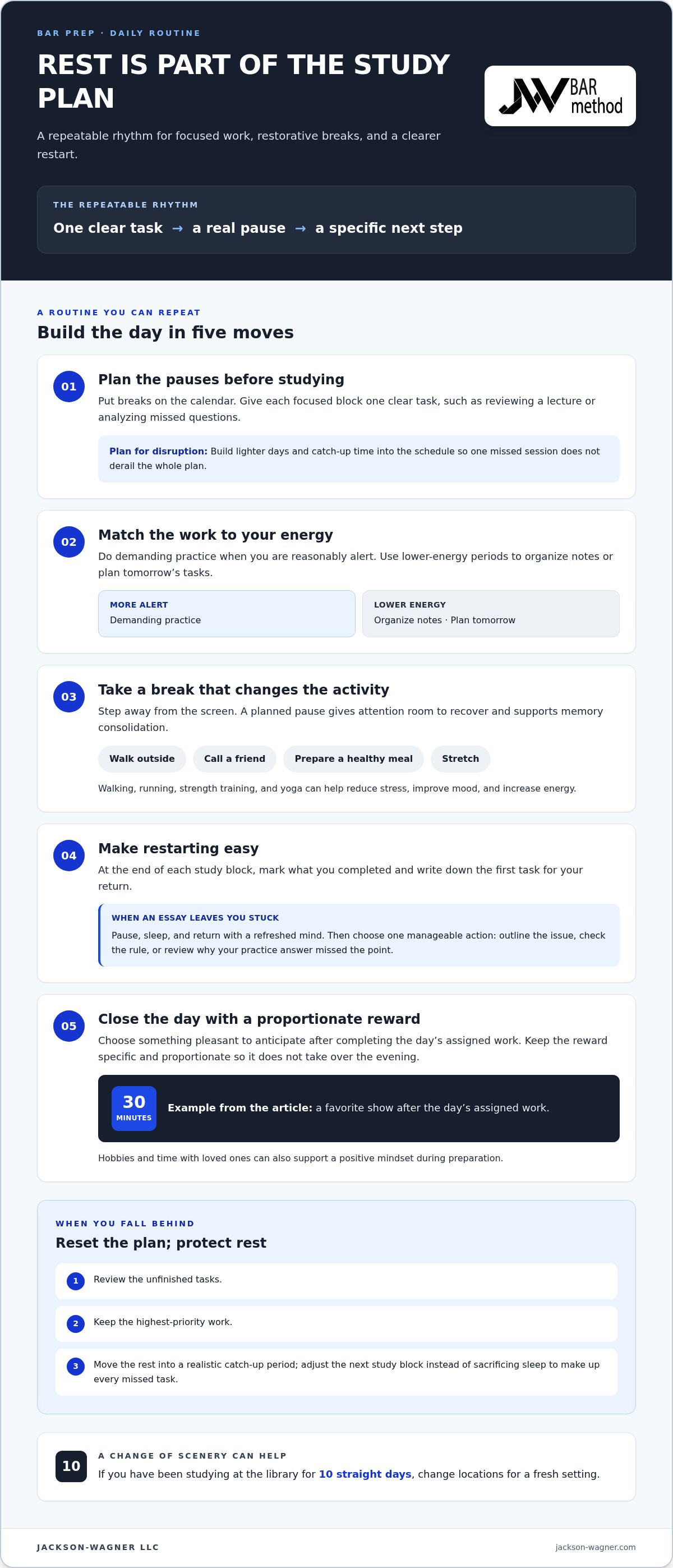
What should you do when you fall behind in your bar exam study plan? Review the unfinished tasks, keep the highest-priority work, and move the rest into a realistic catch-up period. Build lighter days and catch-up time into your schedule so one disrupted session doesn’t derail the whole plan.
Put breaks on the calendar before bar prep begins for the day. A planned pause gives your attention room to recover and supports memory consolidation, rather than treating rest as a reward you must earn through exhaustion. Break study time into focused blocks, each with one clear task, such as reviewing a lecture or analyzing missed questions. When that task ends, step away before starting the next one.
Choose a break that changes your activity, not just your screen. Walk outside, call a friend, prepare a healthy meal, or do a short stretch. Physical activity, including walking, running, strength training, and yoga, can help reduce stress, improve mood, and increase energy during preparation. If you’ve been studying at the library for 10 straight days, change locations for a fresh setting.
Use breaks to recharge, not to create another obligation. If a difficult essay leaves you stuck, pause, sleep, and return with a refreshed mind. Continuing when depleted can make it harder to focus. When you return, choose the next manageable action: outline the issue, check the rule, or review why your practice answer missed the point.
Build an end-of-day reward into your routine. For example, plan 30 minutes of a favorite show after completing the day’s assigned work. Keep the reward specific and proportionate to the task, so it gives you something pleasant to anticipate without taking over the evening. Hobbies and time with loved ones can also support a positive mindset during preparation.
A useful schedule accounts for different kinds of effort. Do demanding practice when you’re reasonably alert, then use lower-energy periods to organize notes or plan tomorrow’s tasks. If your course or daily plan changes, adjust the next study block instead of sacrificing sleep to make up every missed task. Breaks can help you resume with a clearer mind.
Keep the system easy to repeat. At the end of each study block, mark what you completed and write down the first task for your return. That small handoff makes restarting simpler after a walk or meal. If you’re considering a more structured route for California bar prep, review the California bar prep options that fit your exam path.
3. Seeking support from friends, family, or study groups
To avoid burnout during bar preparation, watch for persistent exhaustion, rising irritability, lost motivation, or difficulty concentrating. If you can no longer make sense of the same page after rereading it, reduce the day’s workload and make room for rest or support.
Bar prep can feel isolating when work or family responsibilities compete for study time. Tell the people closest to you what your study blocks require, then agree on specific help, such as a quiet hour or a prepared meal. A clear request gives family and friends a practical way to support your goal.
To study while working or caring for family, anchor preparation to time you can reliably protect, such as an early-morning block or a child’s activity. Include lighter days and catch-up periods so a changed shift or family need doesn’t make the entire schedule unusable.
For free study groups or accountability partners, start with law school classmates, alumni networks, faculty connections, and bar-preparation communities. Ask a specific question in an appropriate student group, such as who wants to review essay issue spotting together. Agree on a shared task and meeting format before the first session.
A study buddy is most useful when both students arrive with an agenda. One person can explain a rule while the other identifies gaps, then you can switch roles. Set a clear start and finish, and reserve the session for active work rather than general conversation. If your schedules don’t align, exchange brief progress updates and next steps.
Ask a tutor or law school faculty member for focused guidance when a recurring issue undermines your confidence. Bring a marked essay, a pattern of missed questions, or a short list of unclear rules. A concrete example makes it easier to discuss the problem and choose the next skill to practice.
Support also means protecting your mental health, not just adding study accountability. Exercise, meditation, or consulting a therapist can help you make space for stress relief. The Centers for Disease Control and Prevention identifies hobbies, meditation, spirituality, and time with family and friends as personal coping strategies workers have reported using.
Identify the kind of help you need before reaching out. If confusion about a subject is frustrating you, ask for academic guidance. If you feel lonely, plan a meal or walk with someone you trust. If stress keeps interfering with daily life, include a mental-health professional in your support system.
Make the arrangement specific and easy to repeat. Send a friend your planned study window, ask them to check in afterward, and share one completed task. This simple routine can make progress visible without turning support into pressure or judgment.
4. Setting smaller study goals and benchmarks
“Study more” is a thought, not a task. Replace it with a clear action you can finish and review. A daily plan might include an Evidence lecture, outline review, practice questions, missed-question analysis, and essay self-grading. Give each task a subject and a stopping point so you know when it’s complete.
How many hours per day should you study for the bar exam? There’s no single useful daily total for every candidate. Your schedule depends on available time, weaker subjects, and how effectively you can focus. Plan around completed learning and practice tasks, then adjust the workload to your obligations and progress.
Set benchmarks that connect daily work to a larger target. For example, set a weekly practice-question target that supports a larger monthly goal. Depending on how many days a week you study, that weekly target could require 35 to 50 questions a day daily. Use the benchmark to guide your plan, not as a reason to rush through questions without reviewing your reasoning.
Make each day’s target specific enough to start immediately. You might complete a 50-question multiple-choice set, review every missed answer, or outline or answer two essays. If your schedule changes, keep the most important task and reschedule the rest. A plan with a realistic catch-up period is more useful than a perfect calendar that collapses after one difficult day.
Track both completion and learning. A simple log can record the subject, task, and what you learned from your errors. Apps can help track daily goals, while a friend can provide accountability through a brief check-in. Keep the record specific: “reviewed hearsay exceptions and corrected three rule statements” gives you more direction than “studied Evidence.”
Choose a reward before you begin. Pick something enjoyable that fits your evening, then enjoy it after completing the planned work. This links effort to a clear stopping point instead of rewarding time at a desk regardless of focus. If you miss the goal, identify the obstacle and revise tomorrow’s task rather than abandoning the plan.
Include self-care in your benchmarks. Sleep and physical activity are part of preparation, not prizes reserved for perfect study days. Keep them in your routine while staying focused on your goal: each completed task builds knowledge and exam readiness. If motivation slips, check your log, choose one unfinished item, and begin.
Use a weekly review to align your goals with your results. Compare completed practice with the subjects that need more work, then adjust the next week’s focus. Stronger areas still need review, but weaker ones may deserve more scheduled attention. This makes progress visible while keeping your plan responsive to what your answers reveal.
5. Treating bar preparation as training for an exam
Training changes the question from “Do I feel motivated?” to “What’s today’s practice?” A marathon covers 26.2 miles, but runners prepare through repeated sessions, not one heroic effort. Bar exam prep works the same way: steady learning, practice, and review build readiness over time. The article’s 21-minute plank example makes the point clearly. Difficult work becomes manageable when you focus on the next step, not the whole challenge.
Use a learn-practice-review cycle to make each study session purposeful. First, learn a rule through a lecture or focused reading. Next, apply it to a practice question or essay. Then review your answer, identify the missed issue, and explain the correct reasoning in your own words. After missing a hearsay question, for example, revisit the rule and try a related question. This cycle turns mistakes into direction for your next session.
As your knowledge grows, practice under exam-like conditions. Set a timer, work without checking an outline, and continue until the exercise ends. This lets you rehearse applying rules while managing time and uncertainty. Afterward, review the reasoning, not just the number of correct answers. If you guessed correctly, identify why the answer works. If you missed one, name the rule or issue to address.
Build toward a measurable training target, then use the results to adjust. Completing 1,000 practice MBE questions in a month is one possible goal, but the learning comes from careful review. Track recurring errors by subject, rule, or question type. For example, a pattern of missing relevance questions points to a specific review task. Progress means improving your ability to recognize and apply rules, not merely increasing the number completed.
As the exam approaches, make practice more representative of the work ahead. With 10 days remaining, don’t spend too much time rereading outlines. Use concise review to refresh rules, then apply them through practice questions or essays. If an answer exposes a gap, return to that specific material. This keeps preparation active and focused instead of turning the final stretch into passive page turning.
Recovery belongs in your training plan, too. Treat sleep and physical activity as essential parts of bar preparation, not luxuries to postpone until every task is complete. A walk after a timed set or a consistent bedtime can help you return with greater focus. If exhaustion makes your practice careless, shorten the next block and protect recovery rather than treating tired work as productive training.
Keep the takeaway simple: prepare for the exam by practicing the work it requires. If a structured California bar prep course would help organize that learning cycle, explore California bar exam preparation.
Jackson-Wagner: JW Bar Method Prep - Full Exam California Bar
Jackson-Wagner LLC offers JW Bar Method Prep - Full Exam California Bar for candidates preparing for the full California Bar Examination. Candidates taking the Attorney’s Exam can choose JW Bar Method Prep - Attorney’s Exam California Bar. Accelerated options include JW Bar Method Accelerated Prep - Full California Bar Exam and JW Bar Method Accelerated Prep - Attorney’s Exam California Bar.
Consider a course if you want a defined preparation track to support your study routine. Choose an offering that matches your exam and preparation timeline, then apply the study goals, practice, and recovery strategies in this guide.
Contact Jackson-Wagner LLC to discuss your California bar preparation options.
Make your next study decision count
Motivation doesn’t have to come before you begin. Build it through a clear next step, then let consistent preparation carry you forward when your energy shifts. If you’re deciding how to stay motivated during bar study, choose a study structure that fits your exam and the pace of preparation you need.
Jackson-Wagner LLC offers JW Bar Method Prep - Full Exam California Bar, JW Bar Method Prep - Attorney’s Exam California Bar, and JW Bar Method Accelerated Prep - Full California Bar Exam. Choose the path that aligns with your exam and study timeline, then make a plan you can follow.
Contact Jackson-Wagner LLC today to explore your California bar preparation options. Take the next step with purpose, and keep moving toward the career you’ve worked for.
Frequently Asked Questions
How to create a realistic bar exam study schedule and daily goals?
Start with your exam date, fixed commitments, and the subjects or skills you need to practice. Map study blocks onto the days you can actually study. Set a few specific daily goals, such as reviewing one topic, answering a timed essay, and analyzing its model answer. Leave open time for unexpected tasks and weekly review. If a goal repeatedly runs over, reduce its scope or move it instead of sacrificing sleep.
How to stay motivated while studying for the bar exam?
To learn how to stay motivated during bar study, make progress visible and connect each session to a concrete exam skill. Choose a small starting task, such as outlining one essay, and begin without waiting to feel motivated. Rotate between review and practice to keep studying active. On difficult days, choose a shorter, realistic session and return to your normal routine the next day instead of treating one missed block as failure.
What are effective breaks and rewards during bar exam study?
Take breaks that genuinely separate you from studying: stretch, walk outside, eat, or step away from screens. Decide when the break ends before you start, then return to a defined next task. Match rewards to completed work, such as watching a favorite show after a practice set or meeting a friend after a planned study day. Keep basic needs, including meals and sleep, in your routine rather than treating them as rewards you must earn.
How to track progress and stay accountable during bar prep?
Use a simple weekly tracker to record completed study blocks, practice tasks, and specific errors to correct. For example, note whether an essay missed an issue, lacked rule detail, or ran out of time. That makes your next practice session more targeted. Review the tracker weekly and set priorities for the week ahead. A structured online prep course can add quizzes, assignments, automated feedback, and a mastery certificate for each completed module.
How to manage bar exam study anxiety and stress?
Reduce study-related anxiety by turning an overwhelming concern into one action you can complete now. If you’re worried about essays, choose one prompt and practice outlining it before reviewing the answer. Use a brief breathing exercise or short walk to reset, then return to your planned task. Protect regular sleep, meals, and time away from study. If anxiety interferes with daily functioning, consider speaking with a qualified mental-health professional.


