

Class rank can reveal a pattern in bar-exam outcomes, but it isn’t the whole story. Institutional data often shows that graduates in the top half of a graduating class achieve significantly higher bar exam passage rates than those in the bottom half. So, does law school rank affect bar passage? Yes, it’s associated with outcomes, while grades and GPA offer a closer measure of academic performance.
If your grades have you worried about the bar, that concern is understandable. A 2021 study identified law school GPA as the strongest predictor of bar exam success, but a class ranking alone can’t show how prepared you are for a particular exam.
This article explains how class rank, first-year grades, and cumulative GPA relate to bar passage, what school-level rates can and can’t tell you, and why exam preparation still matters. You’ll learn how to interpret the numbers and focus on factors that can shape your next steps.
Key Takeaways
- Use class rank and GPA as indicators of academic performance, not as a verdict on your bar-exam prospects.
- Separate a law school’s overall ranking from its bar-passage results; they measure different aspects of the school and its graduates.
- Compare passage rates by class tier carefully, paying attention to the exam period and the group being measured.
- Read first-time bar disclosures with the denominator in mind: the rate reflects passers relative to exam takers.
- Put school-level results in context by comparing them with relevant state averages, then focus your preparation on exam-specific skills.
Class rank and bar passage rates
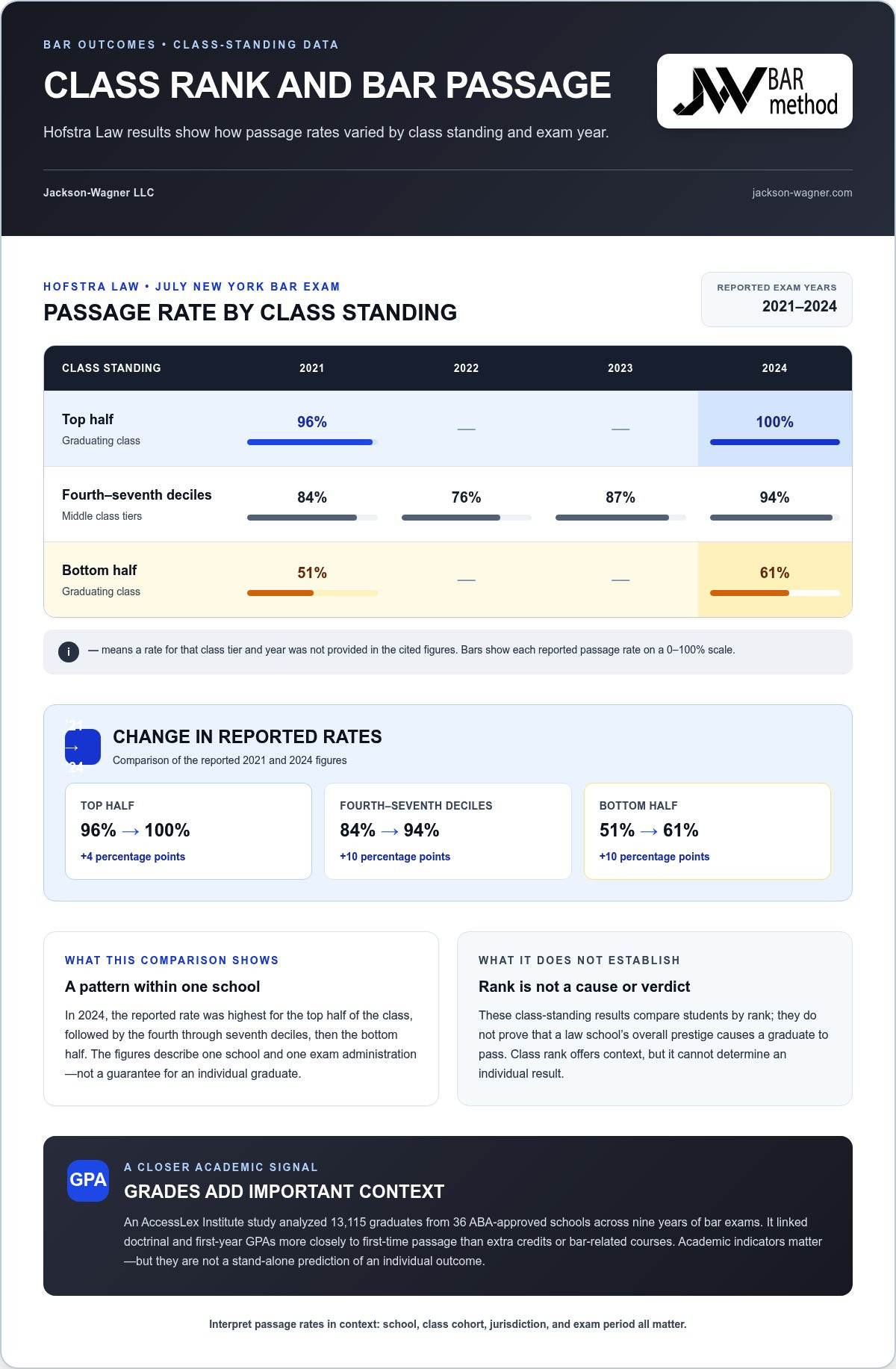
Class rank is associated with bar outcomes, but it doesn’t determine an individual result. At Hofstra Law, among graduates taking the July New York Bar Exam, the 2024 passage rate was 100% for the top half of the class and 61% for the bottom half. The fourth through seventh deciles posted a 94% rate. These figures show a pattern within one school and one exam administration, not a guarantee for every graduate.
Do graduates of highly ranked law schools pass the bar on their first attempt more often? Stronger school-level performance can accompany higher passage rates, but these Hofstra figures compare class rank, not law-school prestige. They show why rank may offer context, but they don’t prove that a school’s overall ranking causes graduates to pass.
How do repeat bar exam takers affect published law school passage rates? A first-time passage rate measures graduates taking the exam for the first time, so repeat attempts aren’t included in that denominator. An all-taker rate may include repeat attempts and can therefore differ. Compare like with like: the jurisdiction, testing period, and group of first-time or all takers must match.
What are the latest bar passage rates for law schools in each state? Rates vary by jurisdiction, school, cohort, and exam period, so there isn’t one comparable rate for every state in these figures. The 2026-27 U.S. News indicator used a two-year, nonweighted average for the 2023 and 2024 graduating classes. Its school profiles display jurisdiction-level data only where a school has at least 10 test-takers.
Does law school rank predict bar passage after controlling for student credentials? The AccessLex Institute study analyzed 13,115 graduates from 36 ABA-approved schools across nine years of bar exams. Its findings linked doctrinal and first-year GPAs more closely to first-time passage than extra credits or bar-related courses. That supports treating grades as a meaningful academic signal, while not treating class rank as a stand-alone prediction after credentials are controlled.
For prospective students, bar data is most useful as one part of a school comparison. Check the jurisdiction, cohort, and first-time testing group before interpreting a rate; then compare class-rank patterns and academic support. Hofstra’s bottom-half rate rose from 51% in 2021 to 61% in 2024, while its top-half rate was 96% in 2021 and 100% in 2024. Those results illustrate why a single year or tier can miss important context.
Does law school ranking correlate with bar exam passage rates?
School ranking and bar passage are related measures, but they aren’t interchangeable. In the 2026-27 U.S. News methodology, first-time bar passage counted for 18% of a law school’s overall ranking. That weight gives passage results a meaningful role, while leaving most of the ranking tied to other measures. A school’s overall position therefore can’t serve as a direct substitute for its bar results.
Projected 2027-28 U.S. News results illustrate why readers should inspect what a ranking reports. Stanford ranked first in the projected first-time bar-passage ranking, with a score of 112.90%. Cooley ranked last, at 194, with a score of 28.77%. These are reported ranking scores, not a simple school-by-school guarantee of an individual graduate’s outcome. Compare the label and method before interpreting any percentage as a passage rate.
Rankings can also reflect who remains in the group being measured. In an example discussed by researchers, a school with 100 entering students could move its passage rate from 85% to 94% after academically dismissing 10 students considered most likely to fail. The rate rises, but the change doesn’t mean the remaining graduates received better instruction. The example shows why the denominator and student progression matter alongside a school’s rank.
The American Bar Association describes bar passage as the single best outcome measure for assessing whether a law school maintains a rigorous legal education program. Passage data is valuable, but it doesn’t make every ranking a complete measure of educational quality. A school’s results reflect its students, exam jurisdictions, testing cohorts, and the way each ranking calculates its score.
Researchers have also assessed bar-passage performance across 186 law schools using median LSAT scores and median undergraduate GPAs. Those measures help frame a key distinction: entering-student credentials, school rank, and graduates’ exam outcomes are connected dimensions, not identical ones. A rank may summarize multiple school characteristics, while credentials describe the entering class. Neither alone reveals how a particular graduate will perform.
Use rankings as a starting point, then compare the underlying information. Look for the exam period, first-time takers, jurisdiction, and calculation method. Check whether the published result is a raw passage rate or a ranking score. Then consider what the figures leave out, such as academic attrition and differences between student cohorts. To answer whether law school rank affects bar passage, look beyond rankings: they can signal patterns, but the underlying data gives more context.
What are bar passage rates by law school ranking tier?
There isn’t one national passage rate for each law-school ranking tier in the available figures. A useful example comes from Hofstra Law, where outcomes are reported by class standing. Among graduates taking the July New York Bar Exam, students in the fourth through seventh deciles had an 84% passage rate in 2021, 76% in 2022, and 87% in 2023. In 2024, that group’s rate was 94%.
The four-year pattern shows why a single result can mislead. The middle-tier group’s rate varied across exam years before reaching 94% in 2024. That movement describes Hofstra graduates taking a particular exam, not the expected rate for every school in a similar ranking tier. Ranking bands and class deciles also describe different groups, so don’t treat them as interchangeable categories.
Class standing can offer a more specific view of outcomes within one school. For example, Hofstra’s 2024 data separated graduates in the top half, the bottom half, and the fourth through seventh deciles. That breakdown helps readers see variation within the same graduating class. It still doesn’t isolate the effects of rank from other factors, such as academic performance or exam preparation.
Read tier comparisons in context. A school’s rank is a broad summary, while a bar-passage percentage describes a defined group and period. Before comparing figures, identify:
- The cohort: Check which graduating class or exam year the result covers.
- The test-takers: Determine whether the figure concerns first-time takers or another group.
- The jurisdiction: Compare results from the same bar exam jurisdiction where possible.
- The measure: Distinguish class deciles from school-ranking tiers.
These checks matter because a percentage without its group and period can suggest a comparison that the data doesn’t support. Hofstra’s fourth-through-seventh-decile rate ranged from 76% in 2022 to 94% in 2024. The difference points to changing outcomes across exam years, not a fixed passage rate for that class tier.
Use ranking tiers as an initial filter, then look for school-level and cohort-level results. If a published comparison doesn’t define its exam period, jurisdiction, or test-taker group, it can’t answer the same question as a clearly defined rate. Hofstra’s annual figures offer a practical lesson: compare like with like, and treat class rank as context, not a stand-alone forecast of an individual result.
How do ABA disclosures report first-time bar passage rates?
A bar passage rate is calculated by dividing the number of passers by the number of takers. For a first-time rate, focus on graduates sitting for the exam for the first time. The percentage summarizes that group’s result; it doesn’t describe every graduate or later attempt. Check how the group is defined before comparing two law schools.
The 2026-27 U.S. News bar-passage indicator included all graduates who took the bar for the first time. It didn’t limit the count to graduates testing in the jurisdiction with the most test-takers. That approach can combine outcomes across jurisdictions, so a school’s displayed indicator may represent a broader set of exam locations than one state’s rate.
Jurisdiction-level visibility also depends on the number of test-takers. U.S. News school profiles display bar-passage data only for jurisdictions where a school has at least 10 test-takers. If a jurisdiction falls below that threshold, its separate profile figure won’t appear there. A missing state-level display therefore isn’t the same as a zero passage rate.
Use these checks to interpret a reported figure:
- Identify the attempt group. Separate first-time takers from repeat takers; they answer different questions.
- Confirm the exam period. The 2026-27 indicator used a two-year, nonweighted average for the 2023 and 2024 graduating classes.
- Check the jurisdiction scope. A combined indicator and a state-specific rate don’t measure the same group.
- Read the denominator. The rate compares passers with takers, so group definitions affect the result.
Alternative admission pathways can affect reported averages, too. For U.S. News bar-passage averages, graduates admitted through routes such as diploma privilege count as having passed the bar. This affects how the average is calculated. Compare the stated method as well as the resulting percentage, especially when reviewing schools with different graduate pathways.
A practical comparison begins with the reporting period, then checks who counts as a taker and which jurisdictions are included. For example, the 2026-27 indicator’s two-year cohort differs from a single-exam administration. Keep those periods separate rather than treating their percentages as direct equivalents. A clear denominator makes the result easier to interpret and prevents a school-level average from being mistaken for an individual prediction.
Rankings can use different measures or periods, so read each position alongside its label. Arizona State University’s Sandra Day O’Connor College of Law ranked No. 8 nationally for first-time bar passage differential in the 2026 ABA bar pass reports, and ranked No. 40 nationally for first-time bar passage rate. The projected 2027-28 U.S. News first-time bar-passage ranking uses average results for calendar years 2024 and 2025; it lists Belmont second with a score of 112.58.
Individual outcomes can differ from schoolwide figures. Of Hofstra Law students on probation who took the New York Bar Exam during 2018-2024, the first-time pass rate was 17%. The study found that doctrinal and first-year grade-point averages were more closely linked to first-time bar passage than taking additional credits or specific bar-related courses. Such findings provide context for interpreting aggregate results, rather than a prediction for any one graduate.
How do law school bar passage rates compare with state averages
A school’s passage rate is more informative when compared with results in the jurisdiction where its graduates take the exam. This helps distinguish a school’s results from those shaped by the jurisdiction’s overall performance. The rate still measures graduates as a group, not any one student’s likely outcome.
The projected 2027-28 U.S. News first-time bar-passage ranking compared schools’ average results with jurisdiction-weighted averages among ABA-accredited schools. For 2023 and 2024, the indicator adjusted school results by the average percentage-point difference between their weighted pass rates and weighted state averages in corresponding jurisdictions. This approach accounts for where graduates tested instead of treating every state’s results as identical.
Arizona State University’s Sandra Day O’Connor College of Law provides a concrete example. In the 2026 ABA bar pass reports, its first-time passage rate was 91.94%, and its first-time passage differential was 13.71% above statewide averages. The rate gives the share of first-time takers who passed; the differential describes performance relative to state averages. They answer related but distinct questions.
ASU Law’s reported first-time passage rate was 87.54% in the prior year and 86.55% two years before the 91.94% result. Those annual figures show the school’s results across different periods. To interpret the change, compare the jurisdiction, testing cohort, and measure used. A raw passage rate and a state-adjusted differential shouldn’t be treated as interchangeable.
Use this sequence when reviewing a school’s comparison with state results:
- Match the jurisdiction. State averages provide context for graduates taking that jurisdiction’s exam.
- Match the test-taker group. Compare first-time takers with first-time takers.
- Identify the statistic. Separate a passage rate from a percentage-point differential.
- Check the period. ASU Law’s 2026 figure and its prior-year rates cover different periods.
A state-adjusted result can reveal whether graduates performed above or below their jurisdiction’s baseline. It can’t explain why the difference occurred by itself. For example, ASU Law’s 13.71% differential gives comparative context, while its 91.94% rate shows the school’s first-time outcome. Read both alongside the exam period and jurisdiction for a more complete view.
For California candidates, use jurisdiction-specific results to shape focused exam preparation. Explore California bar exam preparation as a practical next step.
Another reported result illustrates why cohort details matter: Hofstra Law’s 2024 graduates who completed the MBE midterm had a 92% bar passage rate. That figure applies to graduates who completed the midterm, so it describes a specified group rather than serving as a substitute for an overall school rate or a first-time rate. The cohort and measure define what the percentage represents.
When reviewing this result alongside other figures, check that they cover the same group and measure before comparing them. A percentage provides useful context, but its meaning depends on who is included and what outcome is counted. Keeping these details visible helps distinguish results for a defined group from broader school-level or jurisdiction-adjusted measures, without treating unlike statistics as directly comparable.
Jackson-Wagner: JW Bar Method Prep - Full Exam California Bar
JW Bar Method Prep - Full Exam California Bar gives California candidates a focused next step after reviewing how grades and class rank relate to bar outcomes. Law school performance offers context, but preparing for the exam means focusing on the specific exam you plan to take. This full-exam course prepares candidates for the California Bar Examination.
If your schedule calls for an accelerated track, Jackson-Wagner LLC also offers JW Bar Method Accelerated Prep - Full California Bar Exam. Attorneys preparing for the California Attorney’s Exam can choose the corresponding attorney’s exam preparation option. Select the course that matches your exam and preparation timeline.
To discuss your California bar preparation, contact Jackson-Wagner LLC.
Turn your academic insight into a focused study plan
If you’re asking whether law school rank affects bar passage, use the answer to guide your preparation, not define your potential. Start by identifying the exam format you’ll take, assessing the skills that need the most attention, and building a consistent study plan. A clear structure can turn broad concerns about grades into specific, manageable work.
For California candidates, Jackson-Wagner LLC’s JW Bar Method Prep - Full Exam California Bar is one option for preparing for the full exam. Candidates seeking a different format can discuss the available California bar preparation options with Jackson-Wagner LLC and choose a course aligned with their exam path.
Contact Jackson-Wagner LLC to discuss your options, then take your next preparation step with purpose and confidence.


