

Time management for the attorney’s exam works best when you plan study blocks on a calendar, rank tasks by priority, and build in regular breaks. A practical starting point is the Pomodoro Technique: focus for 25 minutes, then take a 5-minute break. Use an ABC priority list to decide what deserves your attention first.
It’s easy to fill a study day with good intentions and still make little progress on the topics or practice that matter most. A clear plan turns a demanding exam schedule into specific, manageable sessions, while leaving room to adjust when a task takes longer than expected.
This guide shows how to map study time on a calendar, prioritize tasks with the ABC Method, and use timed breaks to protect your focus. You’ll also learn how to adapt those tools to your workload, creating a plan that is structured enough to keep you moving and flexible enough to follow.
Key Takeaways
- Map study sessions and practice work onto a calendar, then review your plan regularly so you can adjust as your workload changes.
- Use the Eisenhower Matrix to separate urgent tasks from important ones and choose what deserves attention first.
- Break focused study into timed intervals with short pauses to make sustained work easier to manage.
- Apply the ABC Method to rank tasks by priority and start with the work that matters most to your exam preparation.
1. Using calendars and legal practice management software
A calendar turns exam preparation into scheduled work rather than a vague goal. Block out study sessions, practice essays, review, and personal commitments in one place. Use separate colors for each type of task, then take a moment at the end of the day to review tomorrow’s plan. A calendar-based system makes time management for the attorney’s exam easier to adjust when work interrupts your study.
Legal practice management software can help organize case deadlines and documents, but keep exam tasks visible too. Create monthly milestones for subjects and practice work, then break each milestone into weekly sessions. A 30-minute block can focus on one defined task, such as reviewing a rule outline. Lawyers can also use a regular priority hour for work requiring concentration. A weekly review lasting 20 to 30 minutes helps reset upcoming commitments.
Time pressure is real in the legal profession: 49% of legal professionals spend seven or more hours weekly on administrative or non-specialized legal work. Templates and macros can streamline routine letters, discovery demands, and court filings. Delegate scheduling, filing, and routine document creation to trained support staff when appropriate. Junior team members can assist with research or drafting, with oversight. These strategies reduce repetitive work and limit distractions.
How much time is allotted for each section of the attorney’s exam? The schedule depends on the jurisdiction and the exam sections. Use the current instructions from the relevant state exam authority to plan timed practice. How do attorney’s exam timing rules vary by state? Each state sets its own format and timing, so there is no single schedule that applies nationwide.
What is the format and timing of the attorney’s exam? Follow the format and time limits published for your jurisdiction. To build a study schedule, place recurring sessions on your calendar, then assign a subject and task to each session.
How much time should I spend on each multiple-choice question? Divide the section’s allotted time by its number of questions, then practice maintaining that pace. If you fall behind, move on from a difficult question and return to it if time allows.
2. Prioritizing tasks with the Eisenhower Matrix
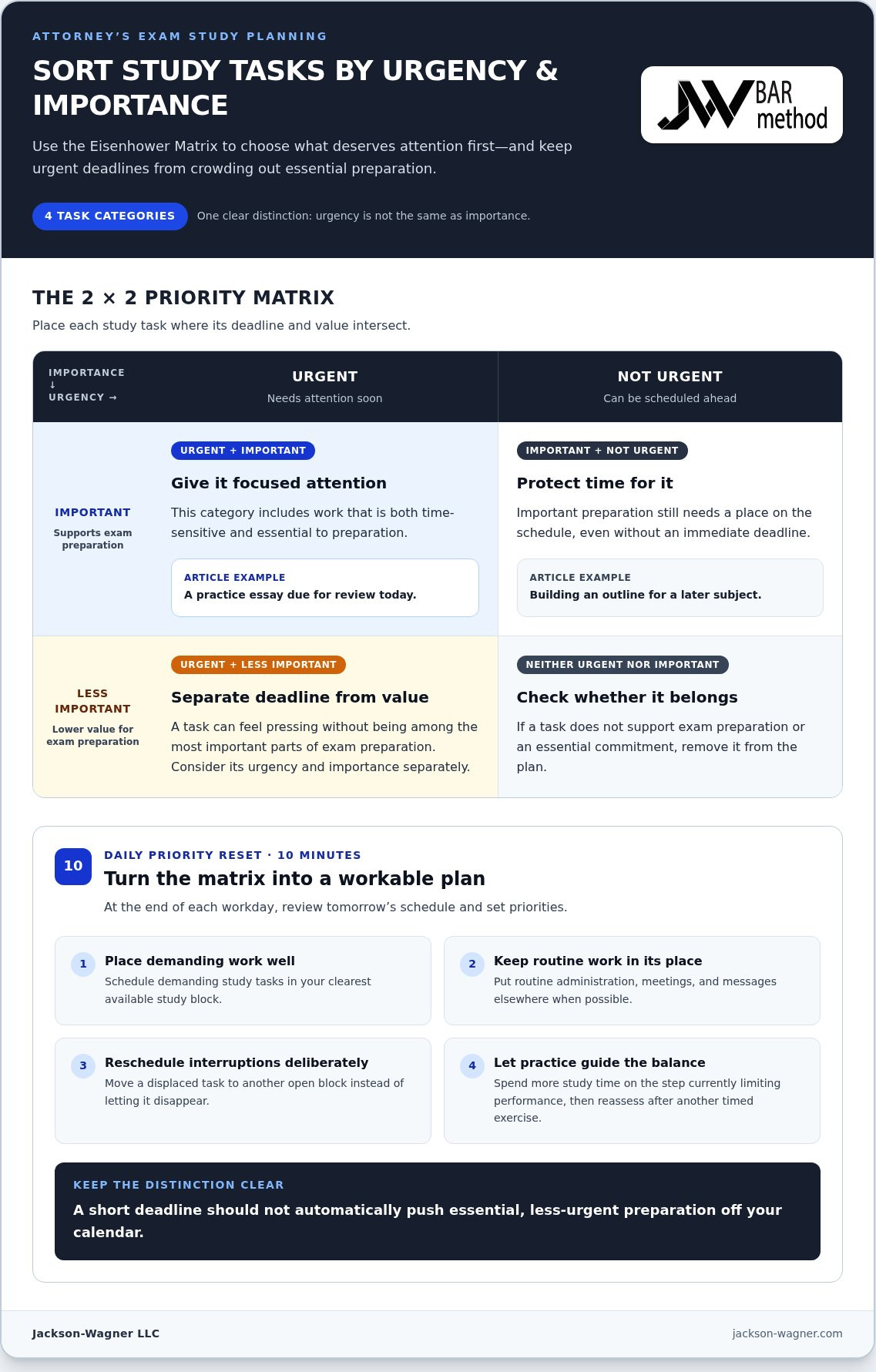
Sort study tasks by urgency and importance, then choose what to do next. The Eisenhower Matrix groups tasks into four categories: urgent and important, important but not urgent, urgent but less important, and neither. For example, a practice essay due for review today is urgent and important. Building an outline for a later subject is important, but less urgent. This distinction keeps a short deadline from crowding out essential preparation.
At the end of each workday, spend 10 minutes reviewing the next day’s schedule and setting priorities. Put demanding study tasks in your clearest available study block. Place routine administration, meetings, and messages elsewhere when possible. If interruptions push a planned task aside, move it deliberately to another open block instead of letting it disappear. Remove unnecessary tasks that don’t support exam preparation or essential commitments.
AI tools may help organize administrative work, such as turning your notes into a task checklist or drafting a study-day agenda. Treat the output as a starting point: check each task against your actual deadlines and learning goals. Don’t let an automated summary determine which legal rules matter or replace your review of course materials. This approach is useful when it reduces planning friction, not when it adds another tool to manage.
How should you divide time between reading, outlining, and writing essay answers? Let practice results guide the balance: spend more study time on the step that currently limits your performance, then reassess after another timed exercise. For instance, if you can identify issues but struggle to organize your analysis, prioritize outlining before drafting while keeping regular essay practice in your plan. Treat reading as active preparation by noting rules you can apply, rather than measuring progress by pages alone.
3. Taking regular breaks with the Pomodoro Technique
The Pomodoro Technique gives each study task a clear start and finish. Work for 25 minutes, then take a 5-minute break. After four cycles, take a break to check emails and other matters. For attorney’s exam preparation, assign each cycle one outcome, such as recalling a rule, reviewing a practice answer, or outlining an essay. A specific goal makes it easier to see whether the session stayed focused.
Focus on one task at a time. During a study cycle, close unrelated tabs, silence notifications, and keep only the materials you need open. If a distracting thought comes up, jot it down and return to the question or rule you were studying. Avoid switching from essay analysis to messages midway through a cycle. Interruptions can break concentration and make it harder to resume the original task.
Use the technique as a repeatable routine, not a rigid test of endurance. Start a timer, work on one defined task, and stop when it rings. During each 5-minute break, step away from the screen or stretch; don’t turn every pause into more study. After four cycles, use the break to handle messages or other small demands. If an essay outline needs more attention, make that the next cycle’s priority rather than extending the current session indefinitely.
To answer exam questions efficiently, practice under timed conditions, read each prompt carefully, identify what it asks, and organize your response before drafting. Use the time allowed for your jurisdiction’s exam to set a personal pace, then review your practice work to spot where you spent too long. Scheduling breaks between focused practice blocks also helps you return to the next question with a clear task in mind.
IRPC 1.3 requires lawyers to act with reasonable diligence and promptness in representing clients. Set intermediate deadlines and break long-term legal projects into smaller milestones. A regular priority hour can protect legal work requiring high concentration. In complex cases, attorneys can delegate research or drafting to junior team members, with oversight. For an appellate brief with an eight-week deadline, plan its outline and case-law research for the first week.
4. Assigning priorities with the ABC Method
The ABC Method ranks tasks by consequence, not by how quickly they appear in your inbox. Mark high-impact work A, important but less urgent work B, and lower-impact tasks C. For exam preparation, completing a timed essay or reviewing a weak subject may be A work. Organizing notes could be B, while optional reading may be C. Start with A tasks before routine emails take up your best concentration.
Make each label specific. Instead of writing “study evidence,” record “review hearsay exceptions and test them in a practice essay.” That task is easier to start and assess. An A task should support a key exam goal or a near deadline. B tasks maintain progress, while C tasks can wait, be shortened, or be removed if the day changes.
Apply the method to legal work, too. At the start of the day, mark court deadlines and time-sensitive client work A. Put drafting that can wait in B, and routine filing in C when appropriate. Schedule focused A work during an uninterrupted block, then batch emails and other brief tasks. These labels help distinguish genuine priorities from interruptions that merely feel urgent.
Keep a daily record of completed tasks and revise tomorrow’s list. Spend 10 minutes at the end of each workday reviewing the schedule and setting priorities for the next day. During a weekly review lasting 20 to 30 minutes, notice whether A tasks repeatedly displace study sessions. Adjust the coming week’s plan, and make one specific study task A before adding optional work.
For members of the legal profession balancing work and exam preparation, the ABC Method makes trade-offs visible. It doesn’t mean every legal obligation can be postponed; it helps you protect study priorities alongside essential duties. If you want structured support for California Attorney’s Exam preparation, explore Attorney’s Exam prep options from Jackson-Wagner LLC as you build your plan.
Jackson-Wagner: JW Bar Method Prep - Full Exam California Bar
JW Bar Method Prep - Full Exam California Bar is designed for candidates preparing for the full California Bar Exam. If you’re taking the Attorney’s Exam, choose a program for that exam: JW Bar Method Prep - Attorney’s Exam California Bar or JW Bar Method Accelerated Prep - Attorney’s Exam California Bar.
A structured preparation course can give your calendar and priority system a clear study framework. The standard and accelerated options let candidates select a preparation track suited to their timeline and background. Use your study plan to set regular sessions, track practice work, and identify topics that need more attention. If you’re preparing for the full exam, the accelerated full-exam option is JW Bar Method Accelerated Prep - Full California Bar Exam.
Visit Jackson-Wagner’s California Bar prep programs to explore the option that fits your exam.
Turn Your Study Plan Into Your Next Step
Your next move is to turn your priorities into a plan you can follow and refine. Choose preparation for the exam you’re taking and the time you have available. A useful schedule makes your next study task clear, so you know where to begin. Keep adjusting it as practice shows which subjects need more attention. That’s how time management for the attorney’s exam becomes part of a consistent preparation routine.
For California candidates, Jackson-Wagner offers JW Bar Method Prep - Full Exam California Bar, JW Bar Method Prep - Attorney’s Exam California Bar, and JW Bar Method Accelerated Prep - Full California Bar Exam. Choose the course that aligns with your exam and preparation timeline.
Contact Jackson-Wagner to discuss your exam preparation. Take the next step with a clear plan and steady focus.
Frequently Asked Questions
Are breaks included in the attorney's exam schedule?
Breaks depend on the jurisdiction’s exam-day schedule, so don’t assume they are built in or stop the clock. Read the instructions for your exam and note any scheduled breaks, permitted activities, and return times. During practice, follow the same break structure. This helps you rehearse the conditions you’ll actually face instead of relying on a study-session routine.
What time-management mistakes commonly lower attorney's exam scores?
Common avoidable mistakes include misreading a prompt, spending too long polishing one answer, and leaving no time to check that you addressed every part. Use a brief final review to compare your response with the task instructions, headings, and requested analysis. Practice with the exam’s published format, too. Using the wrong timing or section structure can distort your preparation and lead to poor pacing.


