

The biggest subject change is a shift in how legal knowledge is organized, not a simple cut to a shorter list. The current Uniform Bar Exam tests 14 separate subjects; the NextGen UBE tests eight foundational subjects and weaves legal skills into its questions and performance tasks. For candidates adapting to new bar exam formats, that means preparing to apply the law, not just recall it.
It’s reasonable to ask which topics will change and whether your study plan needs an overhaul. The answer depends on the exam and jurisdiction: some material is reorganized, while Family Law and Trusts and Estates appear in performance tasks during the transition period.
This article explains subject changes, compares the NextGen exam’s nine-hour schedule and digital testing-center administration with the legacy format, and outlines how the adoption schedule affects candidates. It also explains why a modern study plan should include integrated questions, performance tasks, and practice with exam software.
Key Takeaways
- See how the NextGen exam reshapes tested subjects, including the transition-period treatment of Family Law and Trusts and Estates.
- Understand how digital delivery and the three-session structure change the exam-day experience and what technology practice can help you prepare.
- Use the jurisdictional rollout schedule to identify when the new format may apply to your planned exam date.
- Build practice around integrated questions and performance tasks so you can apply legal knowledge to fact patterns, not rely on recall alone.
Exam duration and administration
The NextGen Uniform Bar Exam takes nine hours across a day and a half, compared with the legacy UBE’s 12 hours over two days. The NextGen exam has three sessions, each lasting three hours. Candidates therefore need to sustain focus through concentrated testing blocks while managing breaks, reading, and writing. The shorter overall schedule changes the rhythm of exam day, not the need to demonstrate legal knowledge and skills.
The legacy uniform bar exam divides its 12 hours among three components. Candidates complete 200 Multistate Bar Exam questions over six hours, split into two sets of 100 questions with three hours per set. The Multistate Essay Exam includes six questions over three hours, allowing 30 minutes for each response. The Multistate Performance Test has two tasks, with three hours allotted for that session and 90 minutes per task. These fixed blocks make pacing practice essential: spending too long on one essay can leave less time for later questions.
NextGen pacing works differently. Candidates should practice managing their time across standalone multiple-choice questions and integrated question sets. Each section also allocates 48 minutes to integrated question sets. Instead of treating multiple-choice, analysis, and writing as entirely separate activities, candidates encounter varied question types across the exam. Practice should therefore include switching between concise answers and deeper analysis within timed sessions.
The NextGen UBE continues twice per year. Its administration scheduled for February 23-24, 2027, takes place on those two dates. Plan preparation around the exam date and its day-and-a-half structure: complete timed three-hour practice blocks, then review where reading or writing exceeded the allotted time. California candidates should distinguish this national schedule from California’s current exam format, which uses one-hour essay responses. The exam and admission requirements depend on the jurisdiction and the administration date.
Exam software and technology preparation
The NextGen Bar Exam is digital, replacing the legacy pencil-and-paper Scantron format. It is administered in testing centers, not remotely. Practice reading prompts and entering responses on a screen, since paper-based work alone won’t recreate the testing experience. Use official materials to understand the question layout and permitted functions, and don’t assume the exam software includes features found in everyday word-processing programs.
Technology practice should support legal analysis, not distract from it. Work through timed questions on a computer, organize answers clearly, and review whether screen reading affects your pace. For example, mark the issue in a fact pattern before drafting an answer, then check that each conclusion connects law to facts. The NextGen UBE reports one score on a 500-750-point scale. That differs from the legacy UBE’s 400-point scale, so compare scores only within the relevant exam format.
Begin early enough to combine subject review with practical digital exercises. The National Conference of Bar Examiners designed the new exam to assess foundational legal concepts and skills, not recall alone. A balanced study plan should include timed multiple-choice practice, integrated analysis, and writing. Early practice can reveal weak spots, such as overlooking a key fact or spending too long polishing a response. Adjust your sessions to address those gaps instead of repeating familiar questions.
Common mistakes include relying only on legacy-format practice, postponing screen-based work, and treating the exam change as merely a new set of subjects. These choices can leave candidates less prepared to compose digital responses, apply concepts across question types, and manage their time. On test day, follow the jurisdiction’s official instructions, bring required materials, and use only permitted software functions. Read the on-screen directions carefully, track time by section, and leave room to review unanswered items.
Jurisdictional adoption and transition schedules
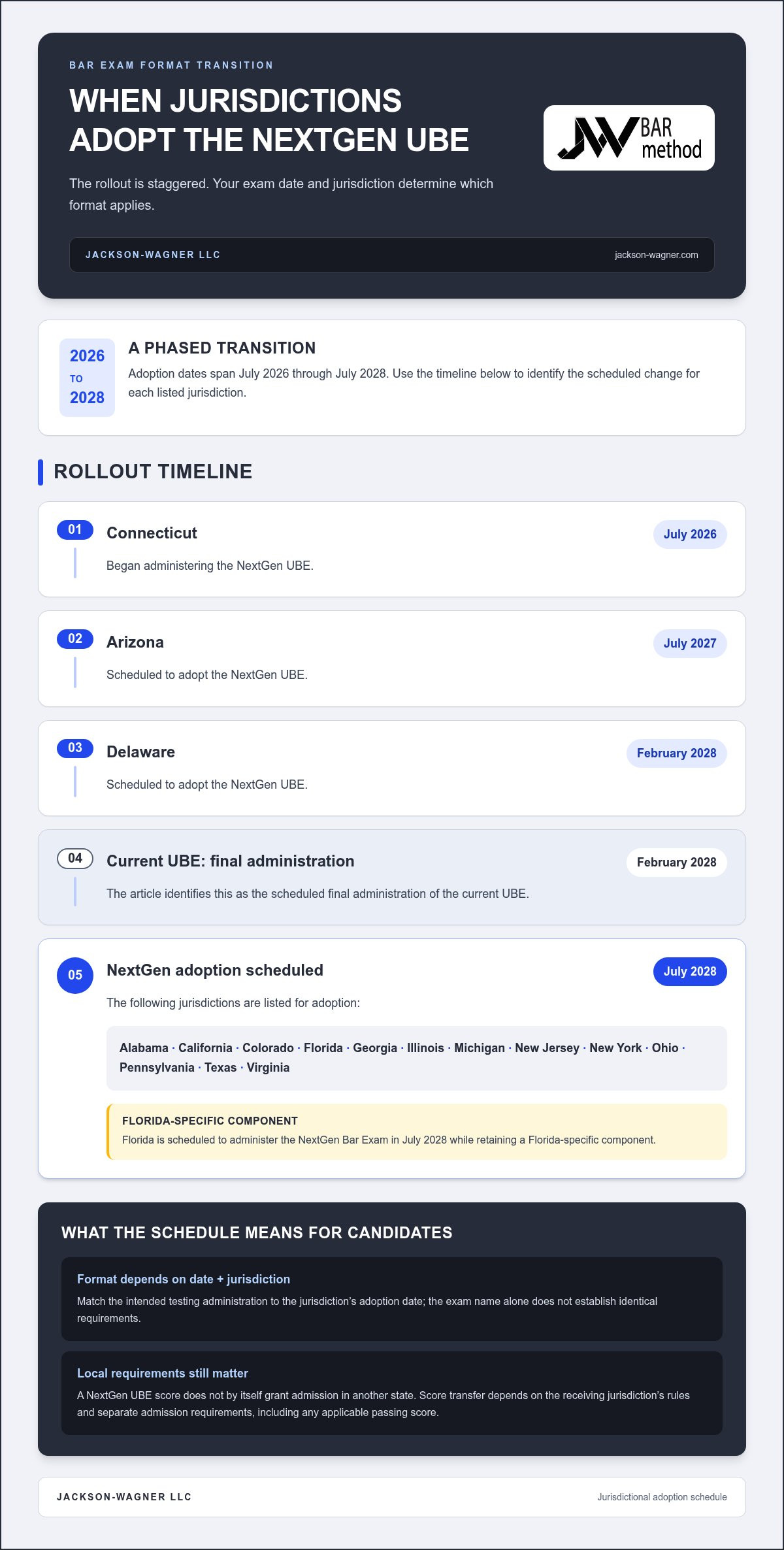
NextGen adoption is happening on different schedules across U.S. jurisdictions, so your exam date and location determine which format applies. Connecticut began administering the NextGen UBE in July 2026. Arizona is scheduled to adopt it in July 2027, while Delaware is scheduled for February 2028. The current UBE’s final administration is also scheduled for February 2028, making the transition especially relevant to candidates planning around that period.
Several jurisdictions have scheduled adoption for July 2028. They include California, Florida, New York, Texas, Alabama, Colorado, Georgia, Illinois, Michigan, New Jersey, Ohio, Pennsylvania, and Virginia. Florida is set to administer the NextGen Bar Exam in July 2028 while retaining a Florida-specific component. This staggered schedule means law school classmates may prepare for different exams, even when they graduate around the same time.
A NextGen UBE score does not by itself grant admission in another state. Score transfer depends on the receiving jurisdiction’s rules and its separate admission requirements, including any applicable passing score.
For planning, match the jurisdiction’s adoption date to your intended testing administration, then identify the exam format and local requirements that apply. A candidate sitting in California before its scheduled 2028 transition faces a different format from someone testing in Connecticut after its July 2026 adoption. Candidates should also account for local principles and any jurisdiction-specific component in their study plan. The exam name alone does not establish that two jurisdictions use identical requirements.
The NextGen UBE is scheduled to continue twice per year, and its transition dates span July 2026 through July 2028. If your admission plans involve more than one state, consider portability alongside exam preparation. Compare the receiving jurisdiction’s score-transfer policy, passing threshold, and other admission criteria before relying on a transferred result. A shared exam framework can support score portability, but it does not replace each jurisdiction’s admission process.
How should bar exam candidates adapt their study plans to performance tasks and integrated questions?
Shift your practice from isolated memorization to applying legal rules to facts. The NextGen UBE includes two integrated question sets in each session, combining question types around shared material. A set may ask you to read a fact pattern, identify relevant law, and select or explain an answer. Practice those steps together instead of treating every subject as a separate flashcard deck.
Integrated question sets account for roughly one-third of the exam. First identify the legally significant facts, then connect each to a rule or principle. For example, mark the facts that affect liability before selecting an answer or drafting analysis. After each practice set, review missed issues and determine whether the cause was weak recall, incomplete reasoning, or rushing.
Performance tasks account for 30% of the NextGen UBE score. Each session includes a performance task, and the exam emphasizes using information to solve legal problems. Rehearse reading a file, locating controlling details, organizing an answer, and writing for the task’s purpose. A concise outline before drafting can help keep the analysis tied to the supplied facts and instructions.
Writing also takes deliberate practice. The format includes three extended writing assignments, so set aside time for clear organization and objective or persuasive analysis. Check whether each paragraph states a point, supports it with facts, and explains its legal significance. Rotate practice across subjects and skills, then work on recurring weaknesses rather than sticking to comfortable topics.
Use a weekly plan that combines rule review, integrated questions, and timed writing. Track errors by skill, such as issue spotting, applying rules, or organizing analysis. That record makes study adjustments specific: if answers miss key facts, practice fact-to-rule connections; if writing lacks structure, outline before drafting. Strengthen your bar exam preparation with a study approach aligned to the exam you plan to take through Jackson-Wagner LLC.
Jackson-Wagner: JW Bar Method Prep - Full Exam California Bar
JW Bar Method Prep - Full Exam California Bar is a focused preparation option for the California Bar Examination. If you’re preparing for California’s current exam, a dedicated course can help structure subject review, essay practice, and performance work around that jurisdiction’s requirements.
Your preparation path depends on the exam you’re taking and your timeline. Candidates taking the full California Bar Exam can choose a standard or accelerated prep track. Attorneys taking the Attorney’s Exam can choose a corresponding preparation option. Identify which exam applies to you and how much structure your study plan needs before selecting a course.
As the scheduled transition approaches, keep your planned exam administration in view when building your study plan. Jackson-Wagner’s California-focused offerings are designed for candidates preparing for the California Bar Examination. Choose a full-exam or Attorney’s Exam course and a study track suited to your preparation timeline.
Make your next study decision count
Turn your exam plan into a preparation path that fits the jurisdiction and exam you intend to take. As you continue adapting to new bar exam formats, keep your target administration in view and build your schedule around the skills it tests. A clear plan makes each study session more purposeful.
For California candidates, Jackson-Wagner offers JW Bar Method Prep - Full Exam California Bar, JW Bar Method Prep - Attorney’s Exam California Bar, and JW Bar Method Accelerated Prep - Full California Bar Exam. These courses support different exam paths and preparation timelines, so you can choose one aligned with your California bar plans.
Take the next step by discussing which preparation option fits your exam path. Contact Jackson-Wagner for support and move forward with a focused plan for your bar preparation.
Frequently Asked Questions
Level of Difficulty: Is the New Bar Exam Easier or Harder?
The NextGen exam isn’t simply easier or harder; it changes what candidates must demonstrate. It tests eight foundational subjects and emphasizes applying legal concepts and skills to problems. Candidates who mainly memorize rules may need to strengthen their analysis and writing, while those comfortable applying law to facts should build speed across question types. Assess your readiness through timed practice and review of recurring errors.
There is so much to do, what is the best way to prepare?
Match your study plan to the jurisdiction and exam format you’ll take. Divide your preparation among subject knowledge, timed questions, and review of mistakes. After a missed question, for example, note whether the issue was rule recall, fact analysis, or time management, then target that weakness in your next session. Revisit your notes regularly so familiar topics don’t crowd out work you need to do.
When Is Your State Adopting the NextGen Bar Exam?
Your state’s adoption date depends on its announced transition schedule. Connecticut began administering the NextGen UBE in July 2026; Arizona is scheduled for July 2027, and Delaware for February 2028. California is scheduled to introduce it in 2028, with its first administration in July. Match your planned exam date to your jurisdiction’s schedule, since the transition can affect which format you need to prepare for.
When is the Transition to the NextGen Uniform Bar Exam?
The transition is phased, not nationwide on a single date. The NextGen UBE began in July 2026, and jurisdictions are scheduled to adopt it through July 2028. The final administration of the current Uniform Bar Exam is scheduled for February 2028. If your testing plans fall near that transition, identify the format assigned to your jurisdiction and administration before setting your study materials and practice schedule.
What changes are being made to the U.S. bar exam format, and when do they take effect?
The NextGen exam shifts the focus toward applying legal principles and demonstrating lawyering skills. It tests eight foundational subjects, uses digital delivery in testing centers, and reports a single score on a 500-750-point scale. Adoption began in July 2026 and continues by jurisdiction through July 2028. For preparation, practice using facts and provided resources to analyze problems, not only recalling rules in isolation.
Which states are adopting the NextGen bar exam, and what are their transition dates?
Connecticut began in July 2026; Arizona is scheduled for July 2027, and Delaware for February 2028. The following jurisdictions are scheduled for July 2028: Alabama, Alaska, Colorado, Florida, Georgia, Illinois, Indiana, Kansas, Massachusetts, Michigan, New Hampshire, New Jersey, New York, Ohio, Pennsylvania, Rhode Island, Texas, Utah, and Virginia. California is also scheduled to introduce the exam in 2028, with its first administration in July. Mississippi’s date remains to be determined.


