

Constitutional Law essays reward a clear argument, not a memory dump. To learn how to tackle constitutional law essays, decode the prompt, state a thesis, organize the relevant rules and facts around each issue, and make your conclusion follow from your analysis. Constitutional Law has historically appeared on the MEE, on average, once every year or year-and-a-half.
If you’re unsure what an essay prompt is asking or how to turn legal knowledge into a persuasive answer, a repeatable structure can help. Strong responses do more than recite doctrine: they use precise legal terms, connect authority to the facts, and address competing arguments.
This guide shows you how to interpret prompts such as “discuss,” build a focused argument, and bring your reasoning together in a clear conclusion. It also highlights Constitutional Law testing patterns to help you identify issues and essay skills to practice.
Key Takeaways
- Use legal keywords to connect rules and authorities to your argument, rather than simply reciting doctrine.
- Build each section around your thesis, then use the conclusion to bring your reasoning together without adding a new argument.
- Treat “discuss” as an invitation to evaluate and take a position, not just describe the issue.
- Review recurring Constitutional Law themes to guide your practice, while preparing to analyze how issues may be combined.
1. Using key words and phrases in legal analysis
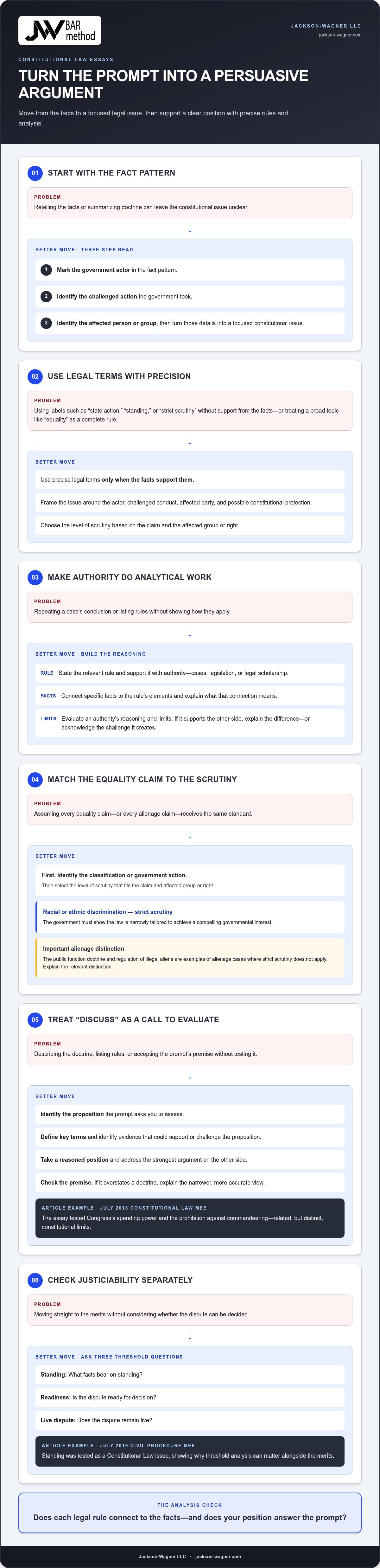
A practical method for learning how to tackle constitutional law essays starts with a three-step read of the fact pattern: mark the government actor, the challenged action, and the affected person or group. Turn those details into a constitutional issue, then use precise terms such as “state action,” “standing,” or “strict scrutiny” only when the facts support them. This keeps your writing focused on legal analysis rather than general summary.
Support each argument with relevant authority, including cases, legislation, and legal scholarship. State the rule, connect specific facts to its elements, and explain what that connection means. Critical engagement means evaluating an authority’s reasoning and limits, not simply repeating its conclusion. If a case supports the other side, explain how its facts or reasoning differ, or acknowledge how it challenges your position.
For equality claims, identify the classification or government action before choosing a level of scrutiny. Racial or ethnic discrimination triggers strict scrutiny, among other categories; the government must show that the law is narrowly tailored to achieve a compelling governmental interest. Don’t assume every alienage claim receives that standard: the public function doctrine and regulation of illegal aliens are examples of alienage cases where strict scrutiny does not apply. Explain the relevant distinction rather than treating “equality” as a complete rule.
Knowing how to tackle constitutional law essays also means selecting the level of scrutiny based on the claim and the affected group or right. For strict scrutiny, assess narrow tailoring and a compelling governmental interest against the facts.
To frame constitutional issues, identify the actor, challenged conduct, affected party, and possible constitutional protection, then state the issue as a focused question. Analyze justiciability separately: ask what facts bear on standing, whether the dispute is ready for decision, and whether it remains live. The July 2019 Civil Procedure MEE tested standing as a Constitutional Law issue, showing why threshold analysis can matter alongside the merits.
2. Drawing the argument together in the conclusion
A strong conclusion completes the reasoning developed in the body. In a constitutional essay about a federal policy, for example, return briefly to the precise constitutional challenge and state which argument your analysis supports. Don’t use the final paragraph to repeat every doctrine or case discussed. Select the controlling points and show how they connect. A useful test is whether a reader can identify your answer and its main reason from the conclusion alone.
Before writing the final lines, review the introduction and each body section. Check that the conclusion answers the same question, follows the thesis, and reflects the strongest evidence you analyzed. If your reading of a case or constitutional provision changed your initial view, revise the thesis and conclusion to match your completed analysis. This keeps the essay consistent instead of leaving an opening claim that the body no longer supports.
For IRAC, organize each issue around Issue, Rule, Application, and Conclusion; for CREAC, use Conclusion, Rule, Explanation, Application, and Conclusion. In either structure, the final conclusion should answer the specific issue after applying the relevant rule to the facts. For example, if the essay asks whether a government action is constitutional, state your position and decisive reasoning, not a new rule or an undeveloped claim. Use separate IRAC or CREAC sequences for distinct issues, then synthesize their outcomes in the essay’s closing paragraph.
Keep the ending focused. If one argument is stronger but a counterargument remains, acknowledge that limit with a brief, reasoned qualification. Don’t introduce a new case, constitutional theory, or factual assumption in the final lines; the reader needs a synthesis, not another branch of analysis. Finish by stating the result your essay has established and why the key reasoning leads there. This link between issue, analysis, and answer gives the conclusion a clear purpose: close the argument without overstating it.
3. Interpreting essay prompts such as “discuss”
Read the command verb, then identify the legal proposition the prompt asks you to assess. “Discuss” calls for analysis and a reasoned position, not a list of constitutional rules. Underline the claim, define its key terms, and ask what evidence could support or challenge it. For example, a prompt may ask whether Congress’s use of federal funding respects constitutional limits. Examine the relevant legal arguments and explain which interpretation is more persuasive.
Turn that reading into a focused plan before drafting. State your provisional answer, select the constitutional principles that bear directly on it, and arrange body sections around those principles. A section should advance one part of your analysis, not become a detached doctrine summary. The July 2018 Constitutional Law MEE tested Congress’s spending power and the prohibition against commandeering. That example shows how one prompt can call for analysis of related but distinct constitutional limits.
Don’t assume a prompt’s premise is correct. If a question describes a constitutional doctrine too broadly, identify the oversimplification and explain the narrower, more accurate view. For instance, if a prompt treats every government restriction as raising the same constitutional concern, distinguish the relevant action and right before evaluating the claim. Then address the strongest argument for the prompt’s premise. A thoughtful answer tests the claim against legal authority rather than rejecting it without analysis.
Consider the reader’s starting knowledge. Briefly define a specialized term when your argument depends on it, then use it consistently throughout the essay. Keep each section connected to your central response with a clear transition, such as “This limit matters because…” Distinguish an essay prompt, which asks you to evaluate a proposition, from a problem question, which asks you to apply law to given facts. In either form, choose only material that advances the task. Before submitting, check that the opening answers the prompt, each section supports that answer, and the final position reflects your analysis.
4. Constitutional Law essay frequency and testing patterns
Constitutional Law historically appeared on the MEE, on average, once every year or year-and-a-half. That pattern helps prioritize review, but it doesn’t identify the precise issue a future essay will test. JD Advising anticipated more frequent testing in the final MEE administrations before several subjects were removed starting in July 2026. Treat that as historical context, then prepare across doctrines rather than betting on one topic.
Past essays show the range of issues. The February 2013 MEE tested state action and First Amendment free speech; the February 2015 essay tested Fourteenth Amendment equal protection. The February 2016 essay covered the Dormant Commerce Clause, while October 2020 tested content-based and content-neutral speech restrictions, including time, place, and manner rules. Together, these examples show why a study plan should cover individual rights and structural constitutional questions.
Common mistakes include memorizing one tested subject while overlooking related doctrines, and naming a rule without applying it to the facts. Avoid these errors by practicing issue spotting across several topics and explaining each rule’s relevance. To manage time, identify the issues, outline their order, and reserve enough time to apply the rules and write a reasoned conclusion. Adjust your pace to the exam instructions and the complexity of the fact pattern.
A strong outline turns a tested doctrine into a sequence of legal questions. For a speech problem, identify the government action and forum, classify the restriction, then address the applicable standard and relevant facts. For an equal protection problem, identify the classification, select the scrutiny level, and test the government’s justification against that standard. These are practice frameworks, not predictions of the next essay. Use them to build flexible recall and focused analysis. Practice California Bar essay analysis with a structured preparation approach.
Jackson-Wagner: JW Bar Method Prep - Full Exam California Bar
Jackson-Wagner LLC’s JW Bar Method Prep - Full Exam California Bar gives full-exam candidates a dedicated preparation option to develop their essay skills alongside broader exam preparation tailored specifically for the California Bar Exam. It’s a natural next step if you’re taking the California Bar Exam and want a structured, California-focused approach to practice across the entire exam, including nuanced Constitutional Law analysis.
Use the strategies in this guide alongside your comprehensive California bar preparation: interpret the prompt, organize the relevant legal rules, apply them to the facts, and bring your argument together for California graders. The full-exam course is specifically designed for candidates preparing for the complete California Bar Exam. Candidates taking the California Attorney’s Exam can choose JW Bar Method Prep - Attorney’s Exam California Bar. Jackson-Wagner LLC also offers accelerated preparation options for both California exam tracks.
Contact Jackson-Wagner LLC to explore the full-exam California preparation option.
Make Your Next Practice Essay Count
Turn your next practice essay into a deliberate test of your reasoning. Before drafting, decide what the prompt asks you to prove; afterward, review where your analysis lost focus, skipped a counterargument, or failed to connect law with facts. This review cycle helps you learn how to tackle constitutional law essays with greater control: not by adding more words, but by making each point serve the argument.
Then choose a preparation path that fits the exam you’re taking and the skills you want to strengthen. Jackson-Wagner’s California Bar preparation options include full-exam and Attorney’s Exam courses, with standard and accelerated tracks. If structured preparation is your next step, contact Jackson-Wagner today to explore the available options.
Keep practicing with a clear purpose. Each essay is an opportunity to sharpen your judgment and make your legal reasoning easier to follow.
Frequently Asked Questions
What is a reliable step-by-step method for writing a constitutional law essay?
Use a repeatable sequence: identify the task, mark facts that raise constitutional issues, and rank those issues by relevance. For each issue, state the governing rule, explain its key elements, and apply the facts that support or weaken each element. Then check whether your analysis addresses a plausible opposing view. Leave time to revise unclear statements and ensure your final answer responds to the prompt.
How do you find and apply relevant U.S. Supreme Court precedent in a constitutional law essay?
Start with the doctrine and issue named in the prompt, then search your course materials for Supreme Court decisions addressing that question. For each useful case, note its rule, reasoning, and the facts that shaped the outcome. Apply it by comparing those facts with the essay scenario. Explain whether the decision supports your position or whether a meaningful factual or doctrinal distinction limits its relevance.
How should you analyze competing constitutional arguments and counterarguments?
Present the strongest opposing argument fairly before answering it. Identify the constitutional principle or fact that gives it force, then explain why your interpretation remains stronger or needs qualification. For example, if the government justifies a restriction by citing public interests, address that justification directly rather than dismissing it. A measured response shows how competing positions affect your conclusion instead of treating disagreement as a reason to ignore the other side.
How should you use constitutional text, history, precedent, and tests in legal analysis?
Use each source to answer a distinct analytical question. Point to the constitutional text that frames the dispute, then explain relevant historical context if it bears on the argument. Use precedent to clarify how courts have interpreted the issue, and apply the governing test to the specific facts. Don’t list these materials as separate authorities without connecting them; explain how they reinforce or complicate your reasoning.


