

Rereading your outline can feel productive, but it doesn’t show whether you can retrieve a rule when you need it. Active recall for bar exam study means bringing information to mind without looking at your notes, then checking what you remembered. Cover an outline, explain a rule from memory, or answer a practice question before reviewing the answer.
It’s understandable to rely on highlighting, lecture notes, and repeated reading: they make familiar material easier to recognize. But recognition isn’t the same as recall. Make retrieval part of your study routine, then use mistakes to identify what needs another look.
You’ll learn how active recall works, how to make focused flashcards, and how to replace passive review with questions, practice, and explanation. You’ll also see how to adjust these methods to suit your study preferences, keeping sessions engaging while focusing on what you can remember and apply.
Key Takeaways
- Test what you can recall before checking your notes, then use practice questions and essays to apply the rules.
- Turn highlighting and lecture review into active study by pausing to retrieve and write down what you remember.
- Make flashcards focused on one legal rule or question at a time, and revisit difficult material as you study.
- Choose retrieval methods that fit your learning preferences, then adjust your approach based on what you can explain and apply.
1. What is Active Recall?
Active recall means retrieving information from memory before checking notes or an outline. For active recall for bar exam study, cover a rule, explain it aloud, then review what you missed. This mental effort strengthens memory and supports long-term retention more effectively than passive rereading.
Use MBE practice questions to test whether you can recognize and apply a rule. Answer without consulting your materials, identify the governing rule, and explain why each option is right or wrong. After reviewing mistakes, write down the missing rule and test yourself on it again later. Don’t just count correct answers: find the reasoning gap behind each error.
MEE essays test recall differently: you must retrieve rules and organize them into an analysis. Before reviewing a sample answer, outline the issues and explain the applicable rules from memory. Then compare your response with the sample, note anything you missed, and try recalling those points in a later session.
A sample daily schedule could start with recalling a previously studied topic, continue with MBE practice questions, and end with an MEE essay outline. Review mistakes after each task, then revisit the hardest rule later that day. To test delayed recall, study a topic Monday, skip it Tuesday, and attempt related practice questions Wednesday.
Common time-wasting mistakes include rereading answers before attempting recall, making too many detailed flashcards, and treating correct guesses as secure knowledge. Keep cards focused on a rule or issue, and spend sessions retrieving and applying information instead of polishing cards. If a card’s answer is unclear, revise it after testing yourself.
Flashcards are one tool, not the whole method. Alternate them with explaining rules aloud, teaching a concept, and answering practice or past exam questions without notes. For example, after recalling an Evidence rule on a card, apply it to a question and explain how the facts affect the result.
2. Avoiding passive highlighting, note-taking, and lecture watching
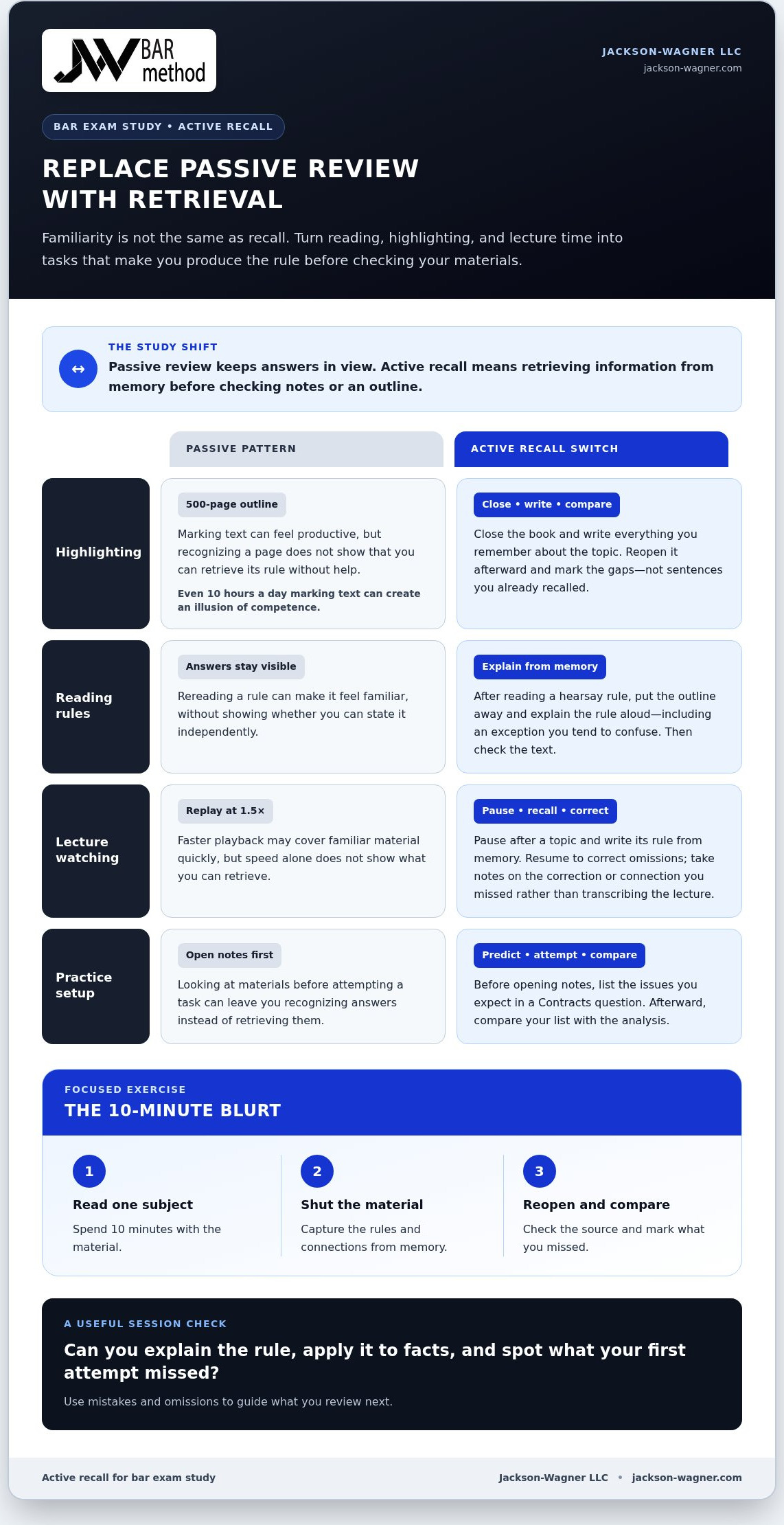
Passive studying makes information familiar, but familiarity alone doesn’t show you can remember it. Highlighting a rule in a 500-page outline may feel productive, yet spending 10 hours a day marking text can create an illusion of competence. You recognize the page when you see it; you haven’t necessarily retrieved the rule without help.
Change the technique after reading: close the book and write everything you remember about the topic. For a focused blurting exercise, read one subject for 10 minutes, shut the material, then capture the rules and connections from memory. Reopen the book only after writing. Compare your notes with the source and mark gaps, not sentences you already recalled.
Passive reading keeps the answers in view. Active recall requires you to produce them. After reading a hearsay rule, put your outline away and explain the rule aloud, including an exception you tend to confuse. Then check the text. This turns a familiar paragraph into a retrieval task and makes your review more targeted.
Lecture watching can also become passive. Replaying a lecture at 1.5x speed may cover familiar material quickly, but speed alone doesn’t show what you can retrieve. Pause after a topic, write its rule from memory, then resume to correct omissions. Take notes only on the correction or connection you missed, rather than transcribing the entire lecture.
Tie each study session to an observable task. Before opening your notes, list the issues you expect in a Contracts question; afterward, compare your list with the analysis. Use flashcards for rules that benefit from quick prompts, but don’t let making cards replace retrieval. Ask yourself: can you explain the rule, apply it to facts, and spot what your first attempt missed?
3. Breaking legal rules into smaller flashcards
Use flashcards to turn a long outline into focused retrieval prompts. To study black-letter law, divide each rule into elements, exceptions, and application cues; make a separate card for each useful piece. For example, one card can ask for a rule’s elements, while another prompts you to identify an exception. This requires actual recall instead of a quick glance at a dense paragraph.
Keep each prompt clear enough to answer without flipping through other cards. If a Contracts rule has several requirements, test one at a time, then add a card asking how the full rule works. Say the answer aloud before revealing it. Check its accuracy, correct any missing point, and rewrite prompts that allow a vague response.
How can bar exam students use active recall to study outlines and black-letter law? Read a short passage, cover it, and turn its rule into questions that require precise answers. Test yourself with those prompts, then reopen the outline to correct omissions and reinforce accurate recall.
Anki flashcards can support spaced repetition by bringing prompts back for review over time. A practical sequence is to review material on the study day, the following day, three days later, and again after a week. Use this as a structure for revisiting rules, not a reason to ignore errors: difficult cards need more attention than rules you can recall and explain accurately.
Make each review productive. Attempt the answer before revealing it, then sort the card by whether you recalled the rule fully, partly, or not at all. Use missed elements to guide your next review, and connect related cards only after learning their individual rules. Repetition supports retention when it requires retrieval; clicking through familiar answers without thinking doesn’t demonstrate mastery.
Flashcards work best as one part of your study. After recalling a rule, apply it to a short fact pattern or explain how a changed fact affects the result. This moves memorized language toward legal analysis, where bar exam questions require you to use the rule.
4. Tailoring study methods to learning preferences
Learning preferences can help you choose a study method, but let your performance guide adjustments. If you remember a rule after explaining it aloud, use spoken recall; if writing exposes gaps, close your outline and reconstruct the rule. For Evidence, compare both methods and keep the one that helps you retrieve and apply the rule accurately.
Match the task to the subject. A visual map may help organize Contracts concepts, while a timed practice question can reveal whether you can apply them. For Torts, outline an essay issue, state the rule from memory, and check your analysis afterward. The aim isn’t to label yourself a certain kind of learner; it’s to find the method that produces usable recall.
Use practice tests to identify frequently tested topics, then plan varied study sessions around your results. Interleave subjects instead of answering 50 Evidence questions in a row. For example, try 10 Evidence, 10 Torts, and 10 Contracts questions. This mix lets you practice recognizing which rules apply, not just repeating one subject’s patterns.
Build spaced repetition around recall and difficulty. Revisit each subject at least once a week, and review the hardest questions or concepts daily. Schedule a comprehensive review of all subjects monthly. If you can explain a rule and apply it to new facts, leave more time before reviewing it; if you miss it, revisit it sooner.
Test a study method for a week before changing it. Record the subjects you studied, how you practiced, and what you could recall or apply without notes. If highlighting leaves you unable to explain a rule, switch that session to a closed-book explanation or practice question. Keep methods that expose gaps, and adjust those that only make material feel familiar.
For a structured California exam-prep plan, explore JW Bar Method Prep - Full Exam California Bar.
Jackson-Wagner: JW Bar Method Prep - Full Exam California Bar
Jackson-Wagner LLC offers JW Bar Method Prep - Full Exam California Bar for candidates preparing for the full California Bar Examination. If you want a structured preparation course to bring your study plan and practice together, this offering is a natural next step after building active-recall habits.
Candidates preparing for the Attorney’s Exam can choose JW Bar Method Prep - Attorney’s Exam California Bar. Accelerated preparation tracks are also available for both the full exam and the Attorney’s Exam. Choose the course that matches the exam you plan to take and your preparation timeline.
Choose the Jackson-Wagner course that matches your California Bar exam track and sign up online.
Build a Study Plan You Can Sustain
Make your next step practical: choose a weekly routine that fits your exam track, then use your practice work to decide what deserves attention. Active recall for bar exam study is most useful as part of a consistent plan, not an occasional technique squeezed in after other tasks. Track the rules you can explain and apply, along with those that still need focused work.
For structured California Bar preparation, Jackson-Wagner LLC offers JW Bar Method Prep - Full Exam California Bar, JW Bar Method Prep - Attorney’s Exam California Bar, and JW Bar Method Accelerated Prep - Full California Bar Exam. The right course depends on which exam you’re preparing for and your study timeline.
Contact Jackson-Wagner LLC today to explore a preparation path that fits your next step. Keep practicing with purpose, and move forward with confidence.
Frequently Asked Questions
What is Active Recall?
Active recall means retrieving information from memory without first looking at the answer. For example, take a blank page, write the elements of a rule you studied, then compare your response with your outline. This shows whether you remembered the rule accurately or only recognized its wording. Use any gaps to guide your next review.
Need Study Materials That Actually Work?
Jackson-Wagner LLC’s JW Bar Method courses offer structured California Bar preparation with curated materials, interactive quizzes, and assignments with instant feedback. The JW Bar Method Prep - Full Exam California Bar is for candidates preparing for the full exam. The curriculum’s quizzes and assignments give you opportunities to engage with the material, rather than relying only on rereading. Choose the exam track that fits your preparation.
What are effective active recall techniques for MBE multiple-choice questions?
Before reviewing the answer choices, identify the legal issue and predict the applicable rule. After choosing an answer, explain why it fits the facts and why each tempting alternative fails. Record whether an error came from forgetting a rule, misreading a fact, or applying the wrong rule. That distinction helps target your next review instead of simply doing more questions.
How should active recall be used to practice essays and performance tests?
Start an essay by identifying issues in the facts before consulting an outline or sample answer. For each issue, retrieve the governing rule and connect it to a specific fact in your analysis. For a performance test, first recall the requested deliverable and organize your work around it. Afterward, compare your response with the instructions and identify one improvement for your next attempt.
How often should bar exam topics be reviewed using spaced repetition?
A practical spaced-repetition sequence is to review material on the study day, the following day, three days later, and again after a week. Then revisit each subject at least once weekly. Use your recall results to adjust: revisit difficult rules sooner, and leave more time before reviewing material you can explain and apply accurately.
How can students track weak subjects and adjust active recall practice?
Keep a simple error log with columns for subject, rule, error type, and next action. After a practice set, label each miss as a rule gap, an application problem, or a fact-reading mistake. Review the log weekly and schedule extra retrieval practice for recurring gaps. If errors cluster around one subject, add targeted questions and explanations for that subject to upcoming sessions.


