

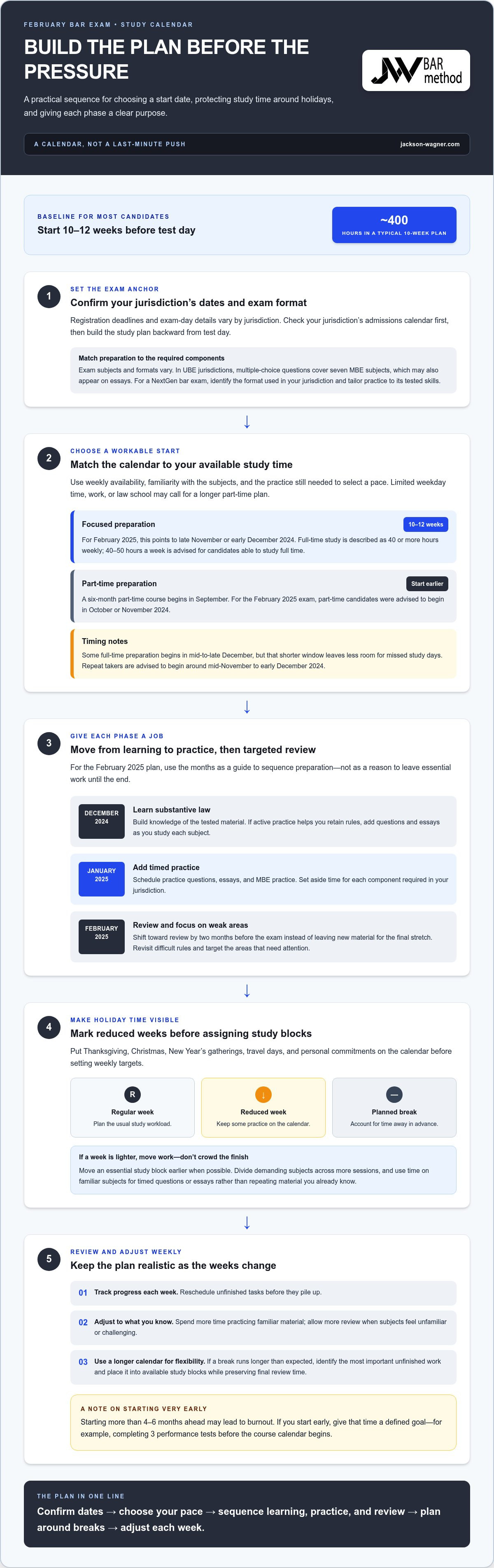
A February bar plan needs a calendar, not a last-minute push. For most candidates, the answer to when to start studying for the February bar exam is 10 to 12 weeks before test day. A typical 10-week schedule involves roughly 400 hours of study, so start earlier if holiday breaks or a part-time pace will interrupt consistent preparation.
It’s understandable to balance bar prep with work, family commitments, and the holidays. The key is to choose a start date that leaves enough time to build your knowledge and practice steadily, rather than relying on a last-minute cram.
Here’s how to set a realistic start date, plan around holiday breaks, and decide whether a longer, part-time schedule fits your life. You’ll also learn how to use the weeks before the exam effectively, so your study calendar has a clear purpose from the outset.
Key Takeaways
- Choose a study start date based on your available weekly study time, familiarity with the subjects, and the practice you still need to build.
- Plan holiday breaks into your calendar early, then adjust your study blocks so missed days don’t leave key preparation until the final stretch.
- Use a clear progression from learning substantive law to timed practice and targeted review to make each phase of preparation purposeful.
- Build exam-day and registration deadlines into your plan, since administrative dates and study milestones both shape a workable schedule.
1. When Should You Start Studying for the February 2025 Bar Exam?
For most candidates, when to start studying for the February bar exam depends on weekly availability and familiarity with the tested material. A focused, full-time plan commonly spans 10 to 12 weeks; for the February 2025 exam, that points to late November or early December 2024. A typical 10-week plan involves roughly 400 study hours.
Full-time preparation generally begins in mid-to-late December, while a six-month part-time course begins in September. For February 2025, part-time candidates were advised to begin in October or November 2024. Full-time study is described as 40 or more hours weekly, with 40 to 50 hours a week advised for candidates able to study full time.
Your jurisdiction’s rules shape your schedule because exam subjects and formats vary. First, identify the components required in your state, then set aside practice time for each. In UBE jurisdictions, the exam includes multiple-choice questions covering seven MBE subjects, which may also appear on essays.
Work backward from exam day: reserve the early weeks for learning substantive law, then schedule timed questions, essays, and review. If you work full time or attend law school, consider a longer, part-time schedule and start earlier to accommodate limited weekday study time. If you know the subjects well, devote more time to practice; if they’re unfamiliar or challenging, allow more time for review.
For a NextGen bar exam, identify the format used in your jurisdiction and tailor your practice to the skills it tests. Don’t assume a schedule designed for a different exam format will work unchanged.
Adapt the plan to how you learn. If active practice helps you retain rules, add questions and essays as you study each subject. If you benefit from repeated review, schedule regular sessions instead of leaving revision until the end.
2. Longer study schedules to accommodate holidays
Holiday plans can interrupt a February study calendar, so build those breaks in before choosing your start date. Candidates are advised to begin earlier than 10 weeks before the exam when possible, creating room for time away without squeezing essential review into the final weeks.
Start by marking holidays and personal commitments that will reduce your study time. Note Thanksgiving, Christmas, and New Year’s gatherings, along with any travel days. Then label each week as a regular study week, a reduced week, or a planned break. This gives you a realistic picture of the workload instead of assuming every week is equally available.
Next, schedule the essential tasks: substantive law, essay writing, multiple-choice practice, and review. If you expect to study less during Christmas week, move a block earlier rather than trying to make up every missed session afterward. Keep some practice on the calendar during reduced weeks so your preparation doesn’t become entirely passive.
A longer calendar should give you flexibility, not stretch studying indefinitely. Use the extra weeks to divide demanding subjects across more sessions and revisit difficult rules. If you already know a subject, spend that time on timed questions or essays rather than repeating familiar material. Track your progress each week and reschedule unfinished tasks before they pile up.
For a February 2025 exam, the holiday period falls within the preparation window, making advance planning especially useful. Set a realistic weekly target around work, family, and travel commitments. If a break runs longer than expected, revise the calendar promptly: identify the most important unfinished tasks, place them into available study blocks, and preserve time for final review. An earlier start gives you options; a detailed calendar helps you use them.
3. Recommended start date for the February bar exam
For a February 2025 exam, set your start date by counting backward from test day and matching the plan to your available study time. Most candidates are advised to prepare for 10 to 12 weeks. That points to late November or early December 2024, while a typical schedule begins in early December.
Full-time candidates may begin in mid-to-late December, but that shorter window leaves less room for missed study days. If you’re working or attending law school, use a part-time calendar that starts earlier. A six-month part-time plan begins in September; students planning part-time study for February 2025 were advised to start in October or November 2024.
Choose between those dates by assessing three factors: weekly availability, subject familiarity, and practice needs. A candidate with a demanding work schedule may need the earlier part-time start. Someone who knows the core material but needs timed essay practice can focus more of the available weeks on writing and review. Repeat takers are advised to begin around mid-November to early December 2024.
Then give each phase a clear job. For February 2025, December 2024 is the suggested first month for learning substantive law. January 2025 is the time to add practice questions, essays, and MBE practice. February 2025 is the final month for review and weak areas. By two months before the exam, shift toward review instead of leaving new material for the final stretch.
Starting more than 4 to 6 months ahead may lead to burnout, so an earlier date should serve a specific purpose. Set a measurable early goal, such as completing 3 performance tests before the course calendar begins. This gives early preparation a defined endpoint rather than turning it into an open-ended study routine.
4. When is the February bar exam date and registration deadline?
The February bar exam date and registration deadline depend on your jurisdiction. There’s no single nationwide registration calendar for every state. Use your jurisdiction’s admissions calendar to confirm deadlines and exam-day details, then add those dates to your study plan first.
Add the application deadline to your calendar, followed by any filing or documentation milestones listed for your jurisdiction. Set reminders well ahead of each deadline so administrative tasks don’t compete with study time. Keep confirmation records, such as application receipts and scheduling notices, together for easy reference.
Once you know the exam date, count backward to set study milestones. Mark when you’ll begin preparing, start timed practice, and move into final review. If the registration deadline comes before your planned study start, complete the application first. That way, an administrative task is less likely to disrupt your preparation.
Include travel and testing logistics in the same calendar. February weather can affect travel to testing sites, and some jurisdictions may offer fewer locations in February than in July. Record your assigned location and plan how to get there. Don’t leave these decisions until the final study week.
For a February 2025 candidate, the calendar should distinguish the exam date from the registration cutoff. They are separate planning milestones, and each affects a different task: the exam date sets the study countdown, while the filing deadline governs application timing. Use the exact dates published for your jurisdiction rather than assuming another state’s schedule applies.
After recording the official dates, review the calendar. Make sure study blocks, application tasks, and travel plans don’t conflict. If a deadline falls during a holiday or work commitment, complete the administrative task earlier. A clear timeline protects study time and keeps exam logistics visible alongside your academic preparation.
Jackson-Wagner: JW Bar Method Prep - Full Exam California Bar
JW Bar Method Prep - Full Exam California Bar gives California candidates a focused option for preparing for the full exam. Jackson-Wagner offers this course through its JW Bar Method, alongside accelerated preparation for candidates whose timelines call for that track. Choose the standard or accelerated course based on your available study time and preparation schedule.
If you’re taking the California Attorney’s Exam, Jackson-Wagner also offers standard and accelerated preparation programs for that exam. Choose the course that matches your exam path and the study schedule you can follow.
Explore Jackson-Wagner’s California Bar prep courses and choose the program that fits your exam path and study schedule.
Put Your February Bar Plan Into Motion
Turn your exam goal into a preparation path that fits your exam type and available study time. Deciding when to start studying for the February bar exam is only part of the plan; consistent, focused preparation gives that start date purpose. Choose a course that matches the exam you’ll take and the schedule you can sustain.
Jackson-Wagner offers JW Bar Method Prep - Full Exam California Bar, JW Bar Method Prep - Attorney’s Exam California Bar, and JW Bar Method Accelerated Prep - Full California Bar Exam. These fully online programs support different California exam paths and study schedules.
Take the next step by reviewing your preparation options and reaching out to discuss your path. Contact Jackson-Wagner to get started. With a clear plan and steady effort, you can move forward with purpose.
Frequently Asked Questions
When Should You Start Studying for the February 2025 Bar Exam?
For most candidates, begin 10 to 12 weeks before the exam, which means late November or early December 2024 for February 2025. If you’re studying part time, start earlier to fit preparation around work or school. First, put your available study days on a calendar; then select a start date that leaves room for missed sessions and final review.
Should I Consider Early Bar Prep?
Yes, if an earlier start gives you a defined, useful task rather than months of unstructured study. For example, set a goal to complete 3 performance tests before your main course calendar begins. Starting more than 4 to 6 months ahead may lead to burnout, so use early preparation selectively and keep the later schedule focused on practice and review.
What if You’re a Repeat Taker?
Repeat takers preparing for February 2025 are advised to begin around mid-November to early December 2024. Before restarting, review your prior preparation and identify where your process fell short, such as essay organization, timing, or missed study sessions. Use that diagnosis to shape practice priorities, while still reserving time to refresh substantive law and work through the exam’s required components.
How many weeks should you study for the February bar exam?
Plan for 10 to 12 weeks of focused, full-time preparation. A typical 10-week schedule involves roughly 400 hours, so divide the workload into steady study blocks rather than leaving large tasks for the final weeks. If you can’t study full time, choose a longer part-time schedule and set weekly milestones for learning, practice, and review.
How does the February bar exam study timeline differ for first-time and repeat takers?
First-time candidates often need to build a foundation across substantive subjects before moving into intensive practice. Repeat takers can use prior exam experience to target weaker areas, while retaining time for broad review. For February 2025, repeat takers were advised to begin around mid-November to early December 2024; the right emphasis depends on which skills need the most rebuilding.
What are the risks of starting February bar exam prep too late?
Starting late can leave too little time to learn substantive law, complete timed practice, and review. It also means less flexibility for holidays, work demands, or difficult topics that need another pass. Protect the most important tasks first: schedule regular practice, track unfinished work, and don’t rely on a final burst of studying to cover everything.


