

Creating your own bar exam outlines can help, but you don’t need to build one for every subject. Focus on the areas you find difficult, and use practice results to decide what needs revision. A condensed outline is typically 15 to 20 pages.
It’s understandable to want complete notes before you feel ready to practice. But outlining takes time, and copying material into a new document is not the same as learning to apply it.
This article explains when creating your own bar exam outlines is worth the effort, what to include, and how to use them for active review. You’ll learn how to test an outline with practice questions, spot gaps, and revise it so your study time focuses on the rules and subjects that need attention.
Key Takeaways
- Create an outline when building it helps you process the rules, not just recopy them. Distill material into a format you can use under exam conditions.
- Prioritize subjects and rule areas you find difficult, and keep each subject’s outline separate.
- Make outlining active: explain rules in your own words and use examples to connect them to their application.
- Use practice-question results to spot gaps, revise the relevant sections, and guide your next round of review.
1. Should I Make My Own Bar Exam Outlines?
Yes, if outlining helps you process rules rather than copy them. Creating your own bar exam outlines takes time to reorganize course notes and combine reliable materials, so start with subjects where building a structure will help. Use your course outline as a skeleton, then add rules, exceptions, and examples from your bar preparation materials. A first draft can reach 50 to 100 pages before you condense it.
Build accurate outlines from your bar preparation course materials, class notes, and assigned legal sources. Compare materials when a rule or exception differs, and record the version your course teaches. Don’t copy an existing outline without checking it against those materials. A copied rule may omit a qualification, such as an exception that changes how the rule applies.
Use NCBE bar exam subject outlines as a topic map for planning coverage. Match each listed subject area to a heading in your outline, then add the governing rules and examples from your course materials. The NCBE outline can help organize your review, but it doesn’t replace learning the rules or checking state-specific differences.
Keep a separate outline for each subject, with headings that follow its major topics and subtopics. A condensed outline is typically 15 to 20 pages; an attack outline or one-sheet goes further by highlighting the rules you need to recall quickly. Use keywords, short rule statements, acronyms, or a flowchart to show steps. For example, place a multi-part test in sequence, then note its exceptions nearby.
To tailor your work to a state, compare general subject rules with state-specific bar preparation materials. Mark distinctions clearly rather than blending them into a single rule. For example, label a state variation under the relevant doctrine so it stands out during review.
Outlining time depends on how much material you must reorganize, your familiarity with each subject, and how often you revise. Set a stopping point for drafting, then reserve study time for practice questions. Common risks include copying without understanding, making every topic equally detailed, and omitting exceptions. A 15-to-20-page condensed outline is useful only if it helps you recall and apply rules.
2. Focusing self-made outlines on difficult subjects
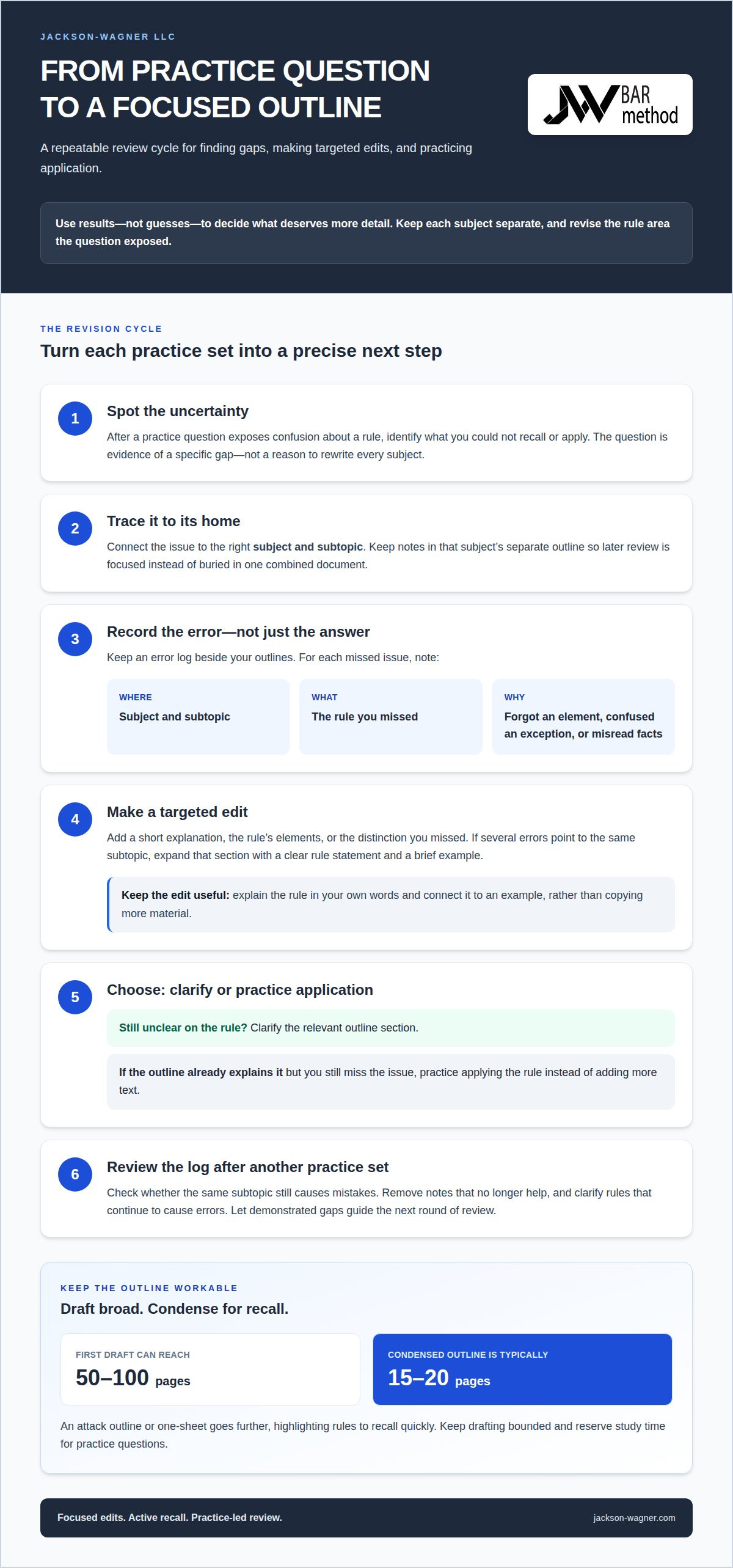
Use your study results to decide where a self-made outline will help. If a practice question exposes confusion about a rule, trace the issue to its subject and subtopic. Then add a short explanation, the rule’s elements, and the distinction you missed. This targeted approach gives difficult material more attention without turning every subject into a rewriting project.
A U.S. bar exam outline should cover the subjects and subtopics assigned to the exam you’re taking. Use your bar preparation course’s subject structure as a map, then include the rules, exceptions, and distinctions taught for each area. Coverage depends on the exam, so don’t assume a general outline includes every jurisdiction-specific topic.
Keep a separate outline for each subject. Mixing subjects can obscure where one doctrine ends and another begins, especially when similar terms appear in different contexts. If a question reveals a weak point in applying a rule, record the issue under the relevant subject and subtopic. That makes later review precise instead of forcing you to search one combined document.
Prioritize with an error log beside your outlines. After each practice set, record the subject, the rule you missed, and the reason: forgotten element, confused exception, or misread facts. Use that record to choose the next revision. If several errors involve the same subtopic, expand that section with a clear rule statement and a brief example. If an outline already explains the rule but you still miss the issue, practice applying it instead of adding more text.
Give difficult areas more detail, but keep familiar topics concise. A useful subject outline helps you find the controlling rule quickly and distinguish it from nearby doctrines. Review your error log after another practice set. Remove notes that no longer help and clarify rules that still cause mistakes. This cycle keeps each outline focused on demonstrated gaps, not assumptions about what you might forget.
3. Active learning and retention
Make each outline session a recall exercise, not a copying task. Read a short rule section, hide it, then explain the rule aloud in your own words. Reopen the outline and compare your explanation with the original. Add a note only if you missed an element, exception, or important distinction. This makes review an active part of building your outline.
Use a hypothetical to connect a rule to facts. After reviewing a negligence rule, for example, write a brief scenario involving a driver who fails to stop. Identify the relevant facts, state the rule, and explain how the facts could support each side. Keep the example short enough to revisit without turning your outline into a casebook.
Case facts can serve the same purpose. Instead of recording only a case name, add a one-line reminder of the facts that illustrate the rule and the court’s reasoning. Then cover the explanation and try to recall why those facts mattered. If you remember the conclusion but can’t explain the connection, rewrite the note more clearly.
- Recall: Hide a rule and state its elements from memory before checking your notes.
- Apply: Use a short hypothetical to connect facts with the relevant rule.
- Explain: Summarize why a case illustrates a rule, rather than memorizing its name alone.
Build these checks into each study session. After drafting a section, close the document and write its main rule structure on a blank page. Compare your version with the outline and mark missing steps or exceptions. Then answer a related practice question without consulting your notes. Return to the outline afterward and add only a clarification that would help with a similar issue. This ties each edit to recall or application, rather than adding detail for its own sake.
4. Revising outlines based on practice results
A practice question can show whether your outline supports recall and application. After answering, compare your reasoning with the explanation and identify exactly where it went off track. Did you forget an element, overlook an exception, confuse two doctrines, or misread a key fact? Each error calls for a different revision, so record the cause before editing.
Keep a brief error log beside the relevant subject outline. Note the topic, the missed rule or analytical step, and the change that would help next time. If a contracts question exposes confusion about an exception, for example, clarify the exception beneath its rule. If you knew the rule but missed how a fact affected it, add a short hypothetical to show the connection.
Revise selectively. A wrong answer doesn’t always mean your outline needs more text. First ask whether the rule is missing or unclear. If it is, add a concise statement and check it against bar preparation materials. If the rule is already clear, practice applying it instead of expanding the outline. A professor or other appropriate source can help resolve a point that remains unclear after review.
- Missing rule: Add the rule and its key elements.
- Forgotten exception: Place the exception beside the rule it limits.
- Application error: Add a short fact pattern or practice applying the rule.
- Repeated confusion: Clarify the distinction between the doctrines involved.
Then test the revision with another relevant practice question. Check whether you can locate the rule, explain it, and apply it to the facts without relying on a long paragraph. If the same gap persists, seek clarification and refine the explanation. If the revision helps, keep it concise. This cycle turns practice results into a focused editing plan rather than a reason to rewrite every subject. For structured support with California bar preparation, explore California bar exam prep.
Jackson-Wagner: JW Bar Method Prep - Full Exam California Bar
Jackson-Wagner LLC offers JW Bar Method Prep - Full Exam California Bar for candidates preparing for the full California Bar Examination. If you’re spending more time building outlines than learning and applying rules, a structured preparation course can provide a broader study framework alongside your targeted notes. Your outline can still support review, especially when practice answers reveal specific rules or subjects that need attention.
Candidates taking the Attorney’s Exam can choose JW Bar Method Prep - Attorney’s Exam California Bar. Accelerated programs are also available for the full exam and Attorney’s Exam. Choose the offering that matches the California exam you’re preparing for, then use your practice results to guide focused review within your study plan.
Visit Jackson-Wagner LLC online to explore the California bar preparation options.
Build a Study Plan You Can Act On
Turn your outline into a working study tool. Choose a subject, identify the rule or application issue that needs attention, and decide how you’ll test your understanding. Keep your plan flexible enough to respond to new practice results. That way, creating your own bar exam outlines supports deliberate study instead of becoming a competing project.
For a structured California bar preparation option alongside your own review, Jackson-Wagner LLC offers programs for the Full Exam and the Attorney’s Exam, including accelerated programs. Consider which exam you’re preparing for and whether a course fits your study approach.
Contact Jackson-Wagner LLC to discuss your case and explore your next step. Keep moving forward with a focused plan and purposeful practice.
Frequently Asked Questions
Should I Make My Own Bar Exam Outlines?
Make your own outline when the process helps you turn class or course material into decisions you can use on exam questions. If you can state a rule but struggle to spot which facts trigger it, for example, create a short section linking those facts to the rule. If reorganizing notes consumes study time without improving your analysis, use existing materials and customize only the parts causing difficulty.
How do you create your own bar exam outlines step by step?
Start with a subject’s topic headings, then gather the corresponding material from your course and notes. Draft each rule in plain language, adding its elements, exceptions, and a brief illustration. Check uncertain points against your course materials before treating them as settled. Then test the relevant section with a practice question. Revise the part that failed to help instead of rebuilding the entire document.
How do you organize rules, exceptions, elements, and examples in a bar exam outline?
Place each rule under its subject and doctrine, then show its elements in a clear sequence. Put exceptions immediately beneath the rule they limit, keeping them connected during review. Add a compact example after the rule structure. A hypothetical, for instance, can show which facts satisfy an element and which raise an exception. Use formatting consistently to distinguish rules, exceptions, and illustrations.
Is making your own bar exam outlines more effective than using commercial outlines?
Neither format is automatically more effective. What matters is whether it helps you understand and apply the tested material. A commercial outline can provide an organized reference, while creating your own bar exam outlines can help you work through topics that remain unclear. You can combine the two: use a prepared outline for broad coverage, then make targeted notes for recurring errors and test them with new questions.
How long does it take to make bar exam outlines while studying?
The time needed varies with how much material you need to reorganize, your familiarity with each subject, and how often you revise. Set a stopping point for drafting and reserve time for practice questions.


