

The California Performance Test is not a test of speed-reading; it is a high-stakes exercise in triage and executive execution. Most applicants fail because they treat the 90-minute session as a passive academic exercise rather than a tactical mission. If you have ever felt your heart race as you got lost in a dense Library of cases or realized you were over-outlining with only twenty minutes left to draft, you know the pressure. You don't need more time. You need a superior system to master how to manage time on the performance test before the July 2026 exam dates arrive.
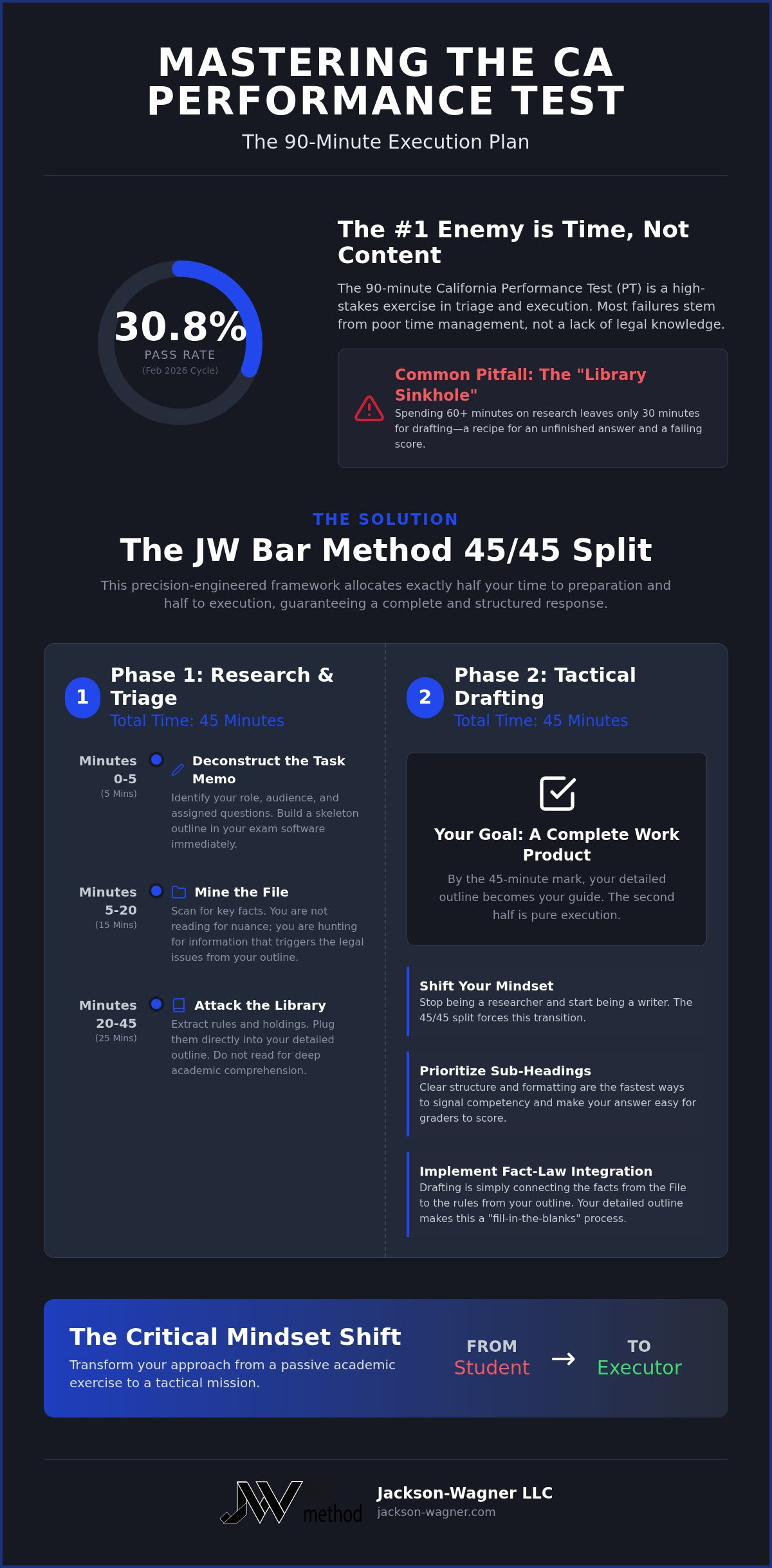
We understand the anxiety surrounding the 30.8% pass rate from the February 2026 cycle and the intense demand for professional precision. This guide replaces that stress with a precision-engineered framework designed to turn complex legal documents into passing scores. You will learn a repeatable 90-minute execution plan that eliminates the "Library Sinkhole" and ensures you never leave a conclusion unfinished again. We are going to break down the exact timing for every phase of the PT, from the initial File review to the final period on your draft.
Key Takeaways
- Understand why the 90-minute California Performance Test is a test of executive triage rather than speed-reading, and how to avoid the common pitfalls that lead to unfinished conclusions.
- Master the signature 45/45 split from the JW Bar Method to learn exactly how to manage time on the performance test by balancing intensive research with disciplined drafting.
- Stop reading for academic comprehension and start scanning for rules by identifying holdings and statutes within the Library in record time.
- Implement the "Fact-Law Integration" rule and learn why prioritizing sub-headings is the most efficient way to signal competency to a bar grader.
- Shift your preparation from passive lectures to high-stakes drills that are specifically engineered for the rigors of the 2026 California Bar Exam.
The 90-Minute Reality: Why Time is the #1 Enemy on the PT
The California Performance Test (PT) is the ultimate simulation of a first-year associate's life under fire. It isn't a test of how much law you've memorized; it's a test of how you use it. For the 2026 exam, you're handed a closed universe of facts and law, then given exactly 90 minutes to produce a professional work product. This constraint is the single biggest reason why otherwise brilliant students fail. While the MBE tests recognition and Essays test recall, the PT tests your ability to triage. If you don't master how to manage time on the performance test, you'll likely find yourself staring at a half-finished conclusion when the proctor calls time.
The psychological trap of the PT is the illusion of safety within the documents. Students often feel that because the "answers" are right there in the File and Library, they just need to find them. This leads to the "Library Sinkhole," where you spend sixty minutes researching and only thirty minutes drafting. That math is a recipe for disaster. Success requires a shift in mindset: you aren't there to learn the law, you're there to extract it and apply it immediately. You must treat the 90-minute clock as a hard boundary that dictates your every move.
Anatomy of the California PT in 2026
The PT consists of three distinct components: the Task Memo, the File, and the Library. The Task Memo is your instruction manual. It tells you exactly what to write and for whom. The File contains the "facts" of your case, often including transcripts or letters, while the Library provides the "law" via cases or statutes. For a foundational Performance Test overview, it's helpful to remember that the State Bar transitioned from a three-hour format to this 90-minute sprint to better measure "minimum competence" in a high-pressure environment. This shift means you can no longer afford the luxury of reading every word twice. You must be surgical in your approach.
Common Time-Management Pitfalls
Most applicants fall into the "Deep Dive" error. They spend 50 minutes reading and re-reading the Library, trying to understand every nuance of the case law. By the time they start writing, they have 40 minutes left for a task that requires 60. This leads to the "Blank Page" syndrome; panic sets in because the cursor is blinking and the clock is ticking. Another fatal error is ignoring the Task Memo's specific formatting instructions. If the memo asks for a persuasive brief and you write an objective memo, you've already lost significant points regardless of your legal analysis. Learning how to manage time on the performance test requires you to stop being a student and start being a lawyer who bills by the minute.
The 45/45 Split: A Precision Time Management Framework
The JW Bar Method rejects the outdated advice of reading for sixty minutes. If you spend an hour researching, you've already lost the battle against the clock. We mandate the 45/45 Split. This rigid framework is the most effective way to master how to manage time on the performance test. By allocating exactly half your time to preparation and half to execution, you ensure that you actually finish the task. According to the official California Bar Examination instructions, time management is essential for success. Our split turns that vague warning into a precision-engineered schedule that guarantees a complete work product.
Execution is everything. You can have the most brilliant legal mind in the room, but if your answer ends mid-sentence, you won't pass. The 45/45 Split creates a forced transition. It compels you to stop being a researcher and start being a writer. This ensures that even if your analysis isn't perfect, it's comprehensive and follows the specific instructions of the Task Memo.
Phase 1: Research and Triage (Minutes 0–45)
The first 45 minutes are about building your skeletal structure. From minute 0 to 5, you must deconstruct the Task Memo. Identify your role, your audience, and the specific legal questions you're assigned. Use these five minutes to build a skeleton outline in your exam software. From minute 5 to 20, mine the File. You aren't reading for nuance; you're looking for facts that trigger the legal issues you just outlined. Finally, from minute 20 to 45, attack the Library. Extract the rules and holdings, then plug them directly into your outline. By the 45-minute mark, your outline should be so detailed that drafting becomes a simple matter of connecting the dots.
Phase 2: Execution and Drafting (Minutes 45–90)
At exactly 45 minutes, you must stop researching. Even if you feel you haven't mastered every sentence in the Library, you start typing. Between minutes 45 and 80, engage in high-speed drafting. Follow the IRAC or CRAC structure religiously. Use the rules you've already plugged into your outline and integrate the facts you mined from the File. This is where knowing how to manage time on the performance test pays off. From minute 80 to 85, finalize your conclusion. Graders hate unfinished work. Spend the final five minutes polishing headings and ensuring your tone matches the Task Memo's requirements. This disciplined approach is a core feature of the JW Bar Method Prep - Full Exam California Bar, ensuring you deliver a professional work product every time.
Combatting the Library Sinkhole: Strategic Reading
Most applicants treat the PT Library like a law school textbook. They read for deep comprehension, highlighting every interesting sentence. This is a fatal error. Strategic reading means reading with a singular purpose: finding the specific rules that apply to your client's facts. The State Bar of California performance test instructions emphasize that the test measures your ability to handle a legal problem, not your ability to summarize every case in the packet. Mastering how to manage time on the performance test requires you to pivot from a student mindset to a practitioner mindset. You don't have time to be a scholar; you only have time to be an advocate.
The 'File First' vs. 'Library First' Debate
Legacy prep courses often suggest reading the Library first. The JW Bar Method rejects this. We mandate starting with the Task Memo, then moving immediately to the File. Why? Because knowing the facts makes the Library cases relevant. If you don't know your client's specific problem, you'll waste twenty minutes researching legal theories that don't apply. You can't afford to research law you don't have the facts to support. The JW Bar Method Accelerated Prep - Full California Bar Exam teaches this specific sequence to maximize efficiency. This targeted approach is a cornerstone of how to master the California Bar examination in 2026. By knowing the "what" before the "how," you filter the Library through a lens of utility.
Annotation and Outlining Techniques
Stop highlighting for "flavor." You need to distinguish between dispositive facts, those that change the legal outcome, and flavor facts that just provide background context. When you hit the Library, scan case law for the "Holding" and the "Rule" immediately. Don't linger on the procedural history or the judge's musings. In the 2026 digital exam environment, use your highlighting tools to mark only the essential rule statements. Transfer these statements directly into your answer template as you find them. Active Outlining is the process of building the final answer while reading. By the time you finish the Library, your IRAC rule sections should already be drafted. This eliminates the panic of staring at a blank screen at the 45-minute mark and is a vital component of how to manage time on the performance test. It turns your reading time into active production time.
Tactical Drafting for the 2026 California Bar Exam
Drafting is where your research is transformed into points. Graders don't award marks for beautiful prose; they award them for structural competence and the surgical application of law to fact. When you transition into the execution phase, your first priority is signaling. By using bold headings and sub-headings, you immediately tell the grader that you have identified the core issues. This structural clarity is a fundamental component of how to manage time on the performance test. If a grader can't find your argument in a five-second scan, you've already lost them. Structure your answer so the points are impossible to miss.
The "Fact-Law Integration" rule is your most powerful tool during these final 45 minutes. Never state a legal rule without immediately tethering it to a specific fact from the File. A common mistake is "dumping" rules from the Library and then "dumping" facts in a separate paragraph. This is inefficient and confusing. Instead, weave them together. "Because the defendant did X, the rule from Case Y applies, leading to result Z." This keeps your drafting lean and ensures you hit every analytical mark without wasting precious minutes on fluff.
Managing the conclusion is non-negotiable. An unfinished conclusion is a massive red flag that screams "I ran out of time." Even if you are under extreme pressure, you must force yourself to write a one-sentence conclusion for every major issue. It provides a sense of professional completion that graders respect. For those navigating the specific California Attorney's Exam Requirements, this ability to produce a polished work product under a 90-minute crunch is often the deciding factor in licensure.
Formatting as a Time-Saver
Your Task Memo is more than an instruction sheet; it's a table of contents. If the memo asks for a persuasive brief with three specific arguments, those three arguments should be your primary headings. Don't reinvent the wheel. Use point headings to structure your argument before you even write the body text. This ensures you address every requirement of the Task Memo while maintaining a professional tone. If you're struggling with these transitions, the JW Bar Method Accelerated Prep - Attorney’s Exam California Bar provides the specific templates you need to automate your formatting.
Dealing with Missing Information
Panic is the enemy of how to manage time on the performance test. If you realize you've missed a secondary issue and have only five minutes left, use the Triage Rule. Secure the points for the major, high-value issues first. If you must address a minor point, use a placeholder sentence. "While the issue of X remains, the primary analysis of Y dictates the outcome." This maintains the flow of your legal argument without dragging you into a time-consuming rabbit hole. You're aiming for a passing score, not a perfect law review article.
The JW Bar Method: Precision Preparation for the PT
Legacy bar prep is a relic of the past. Watching hundred-hour video lectures doesn't prepare you for the surgical precision required in 2026. The JW Bar Method is a disruptive alternative designed for the modern learner who needs results, not just a completion certificate. We replace passive consumption with high-stakes drills that simulate the exact pressure of the 90-minute clock. This is the definitive way to navigate the State Bar of California with total confidence. By focusing on execution over mere exposure, we ensure you are ready for the specific rigors of the performance test.
Our approach is specifically engineered for busy professionals. Whether you are a first-time taker or an out-of-state attorney, our accelerated tracks focus on the mechanics of execution. You will learn how to manage time on the performance test by internalizing a system that works every time. We don't just teach you the law; we teach you how to win. Our methodology moves you from the excitement of a guarantee to a steady, structured progression that culminates in licensure.
Why Precision Beats Volume
There is a common fallacy that taking fifty practice tests will somehow lead to success. It won't. Volume without a framework only reinforces bad habits. The JW Bar Method teaches you to spot the "Grader's Checklist" hidden within the Task Memo. We show you how to identify exactly what the graders are looking for so you can deliver it in under 90 minutes. Our program includes direct feedback from California licensure specialists who understand the nuances of 2026 grading standards. You learn to stop guessing and start performing. This targeted feedback loop is what distinguishes our students from those using legacy industry standards.
The Jackson-Wagner Guarantee
We are so certain of our pedagogical approach that we assume the risk of your performance. This isn't just a course; it's a partnership. Our structured programs are built to replace the high-stakes anxiety of the exam with a sense of "bold reliability." You will enter the testing center knowing that your time management is precision-engineered. Don't settle for legacy models that leave your success to chance. It's time to Pass the 2026 California Bar Exam with the JW Bar Method. Our JW Bar Method Accelerated Prep - Full California Bar Exam provides the modern tools you need to master how to manage time on the performance test and secure your future in the legal profession.
Secure Your California Licensure in 2026
Success on the California Bar Exam requires more than legal knowledge; it demands tactical superiority. You've now seen how the 90-minute clock can be transformed from a threat into a structured roadmap for success. By implementing the 45/45 split and prioritizing "Fact-Law Integration," you ensure that every minute spent on the exam contributes directly to a passing score. Mastering how to manage time on the performance test is the final hurdle between your current study routine and your professional future.
The proprietary JW Bar Method was built to replace the high-stakes anxiety of legacy prep with a results-oriented system that works. Whether you are a first-time taker or a busy professional utilizing our accelerated prep tracks, our pedagogical approach builds the "bold reliability" needed for the 2026 exam cycle. Don't leave your results to chance with outdated educational models that prioritize volume over precision. It's time to take control of your performance and join the ranks of California's elite legal community.
Master the California Bar with the JW Bar Method and approach your exam with the absolute confidence of a practitioner who has already won.
Frequently Asked Questions
How many minutes should I spend reading the Performance Test library?
You should allocate approximately 20 to 25 minutes to mining the Library for rules and holdings. This window is a subset of your first 45-minute research and triage block. Spending more than 25 minutes on the Library cases risks the "Library Sinkhole," where you sacrifice essential drafting time for academic depth that doesn't translate into extra points.
Is it better to start with the File or the Library on the CA Bar PT?
Always start with the Task Memo to identify your role, then move immediately to the File. Knowing the client's facts first makes the Library cases much more relevant. If you attack the Library first, you'll likely waste ten to fifteen minutes researching legal theories that don't actually apply to the specific facts of your case.
What happens if I don't finish the drafting phase of the PT?
Failing to finish the drafting phase is a major red flag for graders and often leads to a failing score. It signals a lack of "minimum competence" in managing professional deadlines. If you realize you're running out of time, use placeholder sentences to provide a sense of completion for every major issue rather than leaving a section entirely blank.
Can I use the same time management strategy for the Attorney's Exam PT?
Yes, the 90-minute Performance Test is identical for both the General Bar Exam and the Attorney's Exam in California. The 45/45 split remains the definitive framework for how to manage time on the performance test regardless of which license you are seeking. Efficiency is even more critical for practicing attorneys who may be out of the habit of high-pressure timed testing.
How has the 90-minute PT changed the way I should outline?
The 90-minute constraint has replaced traditional outlining with "Active Outlining," where you build your final answer template while you read. You no longer have the luxury of a separate, mid-exam outlining phase. Rule statements and holdings should be typed directly into your IRAC structure the moment you find them in the Library documents.
Is the California Performance Test harder than the MPT used in other states?
Many applicants find the California PT more challenging due to the sheer density of the File and Library compared to the Multistate Performance Test (MPT). While both tests often utilize a 90-minute window, California's "closed universe" tends to include more "flavor facts" and red herrings. This makes mastering how to manage time on the performance test even more vital for California applicants.
What are the most common formatting errors on the Performance Test?
The most frequent error is failing to follow the specific formatting instructions provided in the Task Memo. If the instructions ask for a persuasive brief and you deliver an objective memo, you will lose significant points for tone and structural incompetence. Always use the Task Memo as your primary guide for creating your headings and sub-headings.
Should I use IRAC or CRAC for the California Bar PT?
Use CRAC (Conclusion, Rule, Application, Conclusion) for persuasive tasks like briefs to lead with your strongest argument immediately. For objective tasks like internal memos, a standard IRAC (Issue, Rule, Application, Conclusion) is usually preferred by graders. Both structures are effective as long as you maintain a strict "Fact-Law Integration" throughout every paragraph of your answer.


