

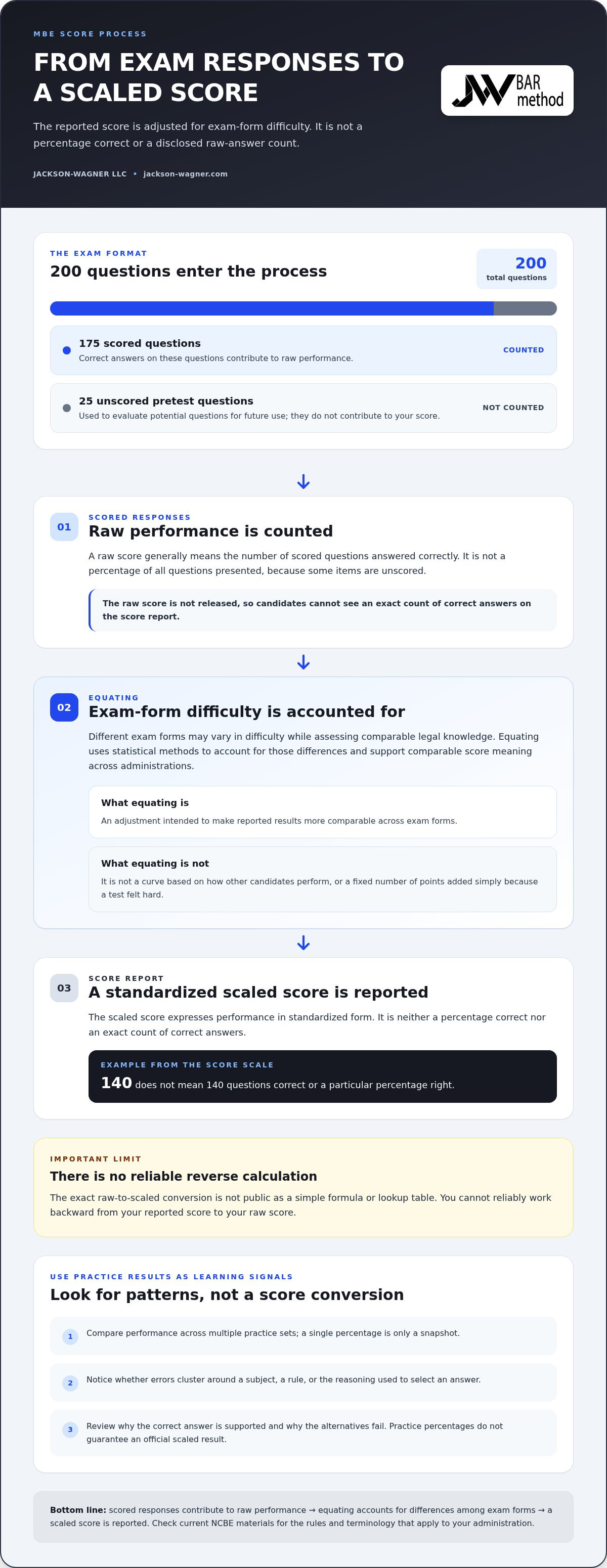
What if the MBE score on your report can’t tell you how many questions you answered correctly? If you’ve searched “how are MBE scores scaled,” the key point is that a scaled score is neither a percentage correct nor a disclosed raw-answer count. The MBE has 200 questions, but only 175 are scored; the raw score is not released.
It’s easy to see a number on a score report and assume it maps directly to a certain number of correct answers. It doesn’t. The National Conference of Bar Examiners uses equating, a statistical process that accounts for differences in exam difficulty so scaled scores can represent comparable performance across administrations. Because the exact conversion isn’t public, you can’t reliably work backward from your result to your raw score.
This guide explains the difference between raw and scaled scores, what equating does, and what your score can and can’t tell you. It also covers how jurisdiction-specific exam structures and passing standards affect interpretation, and how to use performance information to focus your study. For California candidates, reading score data carefully can help turn results into priorities for a structured preparation plan.
Key Takeaways
- Understand how are MBE scores scaled and why the reported score isn’t a percentage correct.
- Learn how equating accounts for differences in exam-form difficulty, including the role of unscored pretest questions.
- Interpret your MBE result separately from your overall bar-exam score and your jurisdiction’s passing standard.
- Use available subject-level results and missed-question patterns to choose focused study priorities.
- See how score insights can support structured California Bar Exam preparation through the JW Bar Method.
How Are MBE Scores Scaled? Start with Raw and Scaled Scores
An MBE scaled score adjusts raw performance for differences in exam-form difficulty, allowing results from different administrations to be compared more consistently. The distinction matters: one figure describes correct answers on scored questions, while the other is the adjusted result shown on a score report. Treating them as interchangeable can lead you to draw conclusions your report doesn’t support.
What is the difference between an MBE raw score and scaled score?
A raw score generally means the number of scored questions answered correctly, based on the exam specifications for that administration. It isn’t the percentage of all questions presented, because some items may not count toward the score. A scaled score is the result after statistical adjustment. Candidates shouldn’t expect to work backward from that reported score to an exact number of correct answers.
For example, a scaled score of 140 doesn’t mean you answered 140 questions correctly or got a particular percentage right. The scale expresses performance in a standardized form. Use current National Conference of Bar Examiners (NCBE) guidance for reporting-scale and score-range details rather than relying on a general online conversion chart.
Why does the MBE use a scaled score?
Different exam forms may vary in difficulty even when they’re designed to assess comparable legal knowledge. Without adjustment, a raw total could reflect both a candidate’s performance and the particular form they received. Equating accounts for these form differences and supports fairer comparisons across administrations.
Equating is not a curve based on how other candidates perform. Your score doesn’t rise or fall because someone else did better or worse. Instead, the adjustment is intended to give a reported score comparable meaning across forms. The technical details are not a simple public formula, so don’t treat practice-test raw totals as a guaranteed prediction of an official scaled result. Consult NCBE materials for current terminology and policies. The Multistate Bar Examination (MBE) on Wikipedia also offers a general overview of the exam and its scoring concepts.
So, how are MBE scores scaled in practical terms? Responses to scored items contribute to raw performance, and equating adjusts for differences among forms before the reported score is produced. That process gives you a standardized result, not a hidden answer key. Use your score as one piece of performance information, then read it alongside the rest of your score report and your jurisdiction’s rules. The next step is understanding what the score can and can’t tell you.
How MBE Equating Turns Exam Performance into a Reported Score
The scoring process is best understood as a sequence, not a public arithmetic formula. Responses to scored questions are evaluated, exam-form difficulty is accounted for through equating, and a scaled result is reported. Since the exact method and raw-to-scaled conversion aren’t available as a simple lookup table, you can’t use an official score report to reconstruct an exact number of correct answers.
Under the current MBE format, the exam has 200 questions: 175 scored questions and 25 unscored pretest questions, according to current NCBE information. Pretest questions are included to evaluate potential questions for future use and don’t contribute to an examinee’s score. Exam specifications and policies can change, so use the NCBE’s current MBE materials for the rules that apply to your administration.
What role does exam-form difficulty play in scaling?
Exam forms can differ in difficulty while testing comparable legal knowledge. Equating is designed to account for those differences so a reported score can have comparable meaning across administrations. It isn’t simply a fixed number of points added because an exam felt harder, nor is it a curve based on how other candidates performed. Don’t assume every examinee receives the same adjustment.
Perceived difficulty isn’t a reliable measurement tool. A question set can feel unusually challenging to you without proving that the form was statistically more difficult overall. Equating uses statistical methods across forms rather than an informal judgment about how tough a particular test seemed. NCBE materials are the appropriate reference for current terminology and details; general descriptions don’t provide an individual candidate conversion chart.
Can candidates calculate an MBE scaled score from practice results?
No reliable calculation turns a commercial practice percentage into an official MBE scaled score. Practice sets may use different question mixes, formats, difficulty levels, and scoring rules. Even a set of realistic questions doesn’t reproduce the equating process or all the conditions used to produce an official result. Treat practice scores as learning signals, not a promise of a particular exam-day score.
Use practice results to identify patterns. Compare performance over multiple sets and note whether errors cluster around a subject, a rule, or the reasoning used to choose an answer. Then revisit the questions and explain why the right answer is supported and why the alternatives fail. A single percentage is a snapshot; recurring patterns can point to a more useful study priority.
In short, how are MBE scores scaled? Scored responses are processed, exam-form differences are equated, and a scaled result is reported, but the conversion itself isn’t a public formula. Keep that in mind when setting goals. If you’re preparing for California licensure, Jackson-Wagner’s structured JW Bar Method preparation can help you turn performance insights into a focused study process.
What an MBE Scaled Score Means, and What It Cannot Tell You
An MBE scaled score gives you a standardized way to interpret exam performance, but it isn’t an answer count. A scaled MBE score can help compare performance across exam forms, but it cannot be reverse-engineered into the exact number of questions you answered correctly. Your score is useful information, not a hidden raw-score key.
Think of the result as one measure of MBE performance, not a complete diagnosis of your legal knowledge or your readiness across every part of a bar exam. It can help you understand your overall multiple-choice performance, but it won’t show which exact questions you got right or wrong unless your jurisdiction provides additional detail. Score-report formats and available breakdowns can differ, so interpret your report using the instructions for that administration.
Is an MBE scaled score the same as a percentage?
No. A scaled score doesn’t represent the percentage of questions answered correctly. For example, a hypothetical scaled score of 140 doesn’t mean 140 correct answers or 70% correct. Those figures may look mathematically related, but the score scale and the raw number correct are different kinds of information. Don’t convert a scaled result into a percentage unless an authoritative source provides a conversion that applies to your exam and administration.
Two candidates with the same scaled score shouldn’t assume they answered exactly the same number of questions correctly. The score communicates performance on the reporting scale; it doesn’t disclose the raw count. Use it as reported, and avoid online charts that promise an exact raw-to-scaled conversion without clear, applicable authority.
How should candidates read score reports across jurisdictions?
Start by separating the MBE result from the overall bar-exam result. In jurisdictions where the MBE is combined with written components, the total exam result reflects more than the MBE alone. The applicable passing standard belongs to the jurisdiction and exam, not to a universal MBE threshold. A passing score in one place shouldn’t be treated as a benchmark that applies everywhere.
Check your score report’s terminology, the administration it covers, and the relevant jurisdiction’s current rules. Reports may present different components or breakdowns, and a number’s meaning depends on that context. If your report includes subject-level information, use it to identify possible areas to review, not to infer which particular items you missed. For broader California exam context, the California Bar Exam strategic guide explains how exam planning fits into preparation.
So, how are MBE scores scaled relevant to your next step? The score supports interpretation and comparison, but it doesn’t determine your full exam outcome on its own. Read it alongside the rest of your report and your jurisdiction’s passing standard. This keeps the number in perspective and helps you make practical study decisions.
How to Use MBE Results to Set Your Next Study Priorities
A score is most useful when it changes what you do next. Treat your MBE result as a starting point for diagnosis, then pair it with any subject or subtopic breakdown your jurisdiction provides and your practice records. Look for recurring patterns, not a single number that predicts whether you’ll pass.
- Review the report. Note the administration, score components, and any available subject-level details. Use your jurisdiction’s reporting guidance to understand what each category represents.
- Identify repeated weak areas. Look for subjects or subtopics that appear challenging across official feedback and more than one practice session. Don’t overhaul your plan because of one unusually difficult set.
- Classify the errors. For missed questions, decide whether the cause was rule recall, applying a rule to the facts, reading the call carefully, or managing time. The right fix depends on the error.
- Choose a focused objective and reassess. Set a specific goal for the next study block, such as reviewing a rule set and applying it to fresh timed questions. Revisit your performance and adjust based on the pattern.
How can MBE practice data reveal a useful study target?
Compare results across subjects and question types over multiple sessions, and review explanations for incorrect answers and correct guesses. A correct guess may still signal a rule or reasoning gap. Ask whether you recalled the governing rule, applied it accurately, and answered the question the call actually asked. Timed practice can also reveal whether pacing is interfering with your analysis.
Keep the diagnosis precise. If you knew the rule but misread a key fact, more memorization may not help. If you understood the call but couldn’t recall the rule, targeted review may be a better use of study time. A short error log can connect each missed question to its cause and next action.
What should repeat takers do differently with score information?
Compare prior reports cautiously. Different administrations, report formats, or exam conditions can limit direct comparisons, so focus on recurring weaknesses rather than treating small changes as definitive. Turn each pattern into a specific study objective, then test it with fresh questions and review your reasoning. One practice result is feedback, not a forecast.
Knowing how are MBE scores scaled helps keep official results in perspective, while careful practice review can show where your next effort belongs. For California candidates, the California Bar Exam strategic guide provides broader planning context. To turn performance insights into a structured California-focused study plan, explore JW Bar Method preparation.
How Structured California Bar Preparation Uses Score Insights
Score feedback can help you decide what to study next, but it can’t guarantee a passing result. Its practical value is that it gives you clues about where review may be needed and helps you build a deliberate plan instead of responding to one score with unfocused extra work. The question “how are MBE scores scaled” concerns how the official result is produced; using score insights concerns what you do with the information afterward.
Turning score feedback into structured California Bar preparation
Start with areas your report or practice history identifies as challenging. Define the problem before choosing a response. A rule-recall gap may call for focused review; repeated difficulty applying rules to facts may call for more practice explaining your reasoning. If timing or careful reading is the issue, make that a separate study target rather than assuming you need to relearn the subject.
A structured review cycle can keep those priorities manageable:
- Choose a specific weakness. Use available score details and repeated practice patterns, not one isolated result.
- Set a clear task. Decide what rule, question type, or reasoning skill to work on.
- Practice and review. Use fresh questions to apply the material, then examine why each answer choice succeeds or fails.
- Reassess. Check whether the same error pattern continues and adjust your next study priority accordingly.
Jackson-Wagner’s JW Bar Method provides structured preparation focused on California licensure, including preparation for the full California Bar Exam and the California Attorney’s Exam. Score insights can help inform study priorities within a preparation process, but they don’t change official scoring, control exam questions, or determine the final result.
Choosing a preparation pace that fits your situation
Preparation is available in standard and accelerated tracks. Consider the time you have before the exam alongside the learning needs you’ve identified. A candidate working through several recurring subject gaps may need to organize review differently from someone focused on a narrower set of priorities. Choose a pace that fits your circumstances, and anchor the plan to specific learning needs rather than a predicted score.
A clear process turns feedback into action: identify a priority, work on it deliberately, and reassess with new practice. Explore California Bar preparation through the JW Bar Method for structured and accelerated options for your California exam preparation.
Turn Your Score Insights Into a Clear Next Step
Understanding the question “how are MBE scores scaled” can settle one uncertainty, but your next move is to decide how to use the information in front of you. Treat your results as a starting point for deliberate planning, not a verdict on your ability. Choose one study priority, define what progress would look like, and build a routine that gives you a chance to address it consistently.
Preparation is personal. Your available time, prior experience, and areas for growth all shape what a workable plan looks like. A structured approach can turn those priorities into purposeful California Bar Exam preparation while keeping the focus on learning rather than trying to predict an outcome from a single score.
Jackson-Wagner offers structured preparation for the full California Bar Exam, with standard and accelerated tracks. Explore the option that fits your preparation needs through the JW Bar Method. Take the next step by exploring a structured California Bar Exam preparation program and building a clear study plan.
Frequently Asked Questions
How are MBE scores scaled?
MBE scores are scaled by processing performance on scored questions and statistically accounting for differences between exam forms. The result supports comparison across administrations, not disclosure of the exact answers you got right. If you’re asking how are MBE scores scaled to plan your next study cycle, focus on what your report and practice history show about your performance rather than trying to reconstruct an undisclosed raw score.
Is an MBE scaled score the same as a percentage correct?
No. A scaled score isn’t the share of questions you answered correctly. For instance, a hypothetical scaled score of 135 doesn’t mean you got 67.5% of the questions right. Avoid simple division to turn the reported score into a percentage. If you need a percentage for a specific purpose, rely only on an authoritative conversion that applies to that exam administration.
Can I calculate my raw MBE score from my scaled score?
Usually, no. The reported score generally doesn’t give you enough information to identify the exact number of scored questions you answered correctly. Rather than searching for a conversion chart, use the details your official report actually provides. For a more actionable picture, compare your performance across fresh practice sets and record the rules or reasoning steps that repeatedly cause difficulty. That won’t recreate your raw score, but it can guide your review.
Does a harder MBE exam receive a higher curve?
Not in the simple sense of giving every candidate extra points because a form felt difficult. Equating uses statistical methods to account for form differences, and it isn’t a curve based on how other examinees perform. A tough-feeling exam alone doesn’t tell you how the adjustment worked. Don’t estimate a personal score boost; use current NCBE materials for an explanation of the process.
What is a good MBE score for passing the bar?
There isn’t one MBE score that guarantees a pass in every jurisdiction. The relevant threshold and how the MBE contributes to the final result depend on the exam and jurisdiction. Before setting a target, identify the exact exam you’re taking and consult its current passing rules and score-report guidance. A general benchmark online may refer to a different jurisdiction or scoring structure, so it may not be useful for your plan.
Do MBE practice question percentages predict my scaled score?
No. A practice percentage can help you spot patterns, but it doesn’t directly predict an official scaled result. Review whether your accuracy changes under timed conditions, across subjects, or when you explain why each answer choice is right or wrong. Track results across comparable sets instead of reacting to one score. Use that record to choose a review task, then test your understanding with new questions.
Does California use an MBE score in its Bar Exam?
Yes, California’s current legacy Bar Exam includes the MBE. California is set to adopt the NextGen Bar Exam for the July 2028 administration, so candidates should check the State Bar’s current exam materials for the format and scoring rules that apply to their test date. Don’t assume historical component weights or score-report details will apply to a future administration under a different exam format.


