

What if your practice score isn’t the most useful part of a practice exam? The real value comes from examining the answers behind it. If a total score leaves you unsure whether to review legal rules, improve timing, or change your approach, you’re not alone. Analyzing practice exam scores means looking beyond the number to find patterns that point to your next move.
For the California Bar Exam, a practice percentage isn’t a direct prediction of your final result because actual exam scores are scaled. A total can also conceal important differences, such as knowing a rule but applying it incorrectly, running out of time, or leaving an answer incomplete. Reviewing those details gives you a clearer basis for deciding what to study.
This guide shows you how to identify recurring errors, distinguish knowledge gaps from timing and execution problems, and prioritize focused study actions. You’ll also learn how to use your next practice attempt to see whether those adjustments are working. The goal is a deliberate review cycle: spot what went wrong, decide why, and turn each finding into a targeted next step.
Key Takeaways
- Treat practice results as diagnostic evidence, not a guarantee of your official exam outcome.
- Build an error log that records the task, the issue, its likely cause, and one specific follow-up action.
- When analyzing practice exam scores, compare similar tasks under similar conditions and track error patterns alongside totals.
- Use a repeatable review cycle to select a small number of recurring issues for your next study block, then reassess with new practice.
- Consistent milestones and feedback can help organize review and follow-up practice in a structured California Bar preparation routine.
What a California Bar practice exam score can, and cannot, tell you
A practice score is a diagnostic snapshot, not a verdict. It records how you performed on a particular set of questions or tasks under particular conditions. It can help reveal what to review, but it can’t guarantee an official result or, by itself, establish that you’re ready to pass. Jackson-Wagner’s stated promise is “Pass the California Bar or your money back.” That money-back guarantee is separate from what any single practice score can predict.
A practice result and an official California Bar Exam score aren’t automatically comparable. Official scores are scaled, while practice materials may use raw points, percentages, or a provider’s own rubric. The California Bar Examination overview describes the exam’s structure; use your practice set’s scoring guidance to understand what its numbers measure. Don’t apply an unsupported cutoff to decide you’re ready or unready.
Why one total score is not the whole story
A combined score can hide contrasting strengths and weaknesses. For example, a solid overall result might include accurate multiple-choice answers but an essay that misses key issues, or a well-organized essay alongside incomplete timed work. The total records the outcome, but it doesn’t explain the reasoning behind it.
Break the result down by task before deciding what it means. Note where you earned or lost credit, whether you finished, and what the scoring guide rewards. If the practice provider gives separate task scores or written feedback, review those details rather than relying on the headline number. Interpret each score using that set’s scoring instructions.
Match score interpretation to the task
Different tasks test different skills, so don’t treat their results as interchangeable. For MBE practice, review the question, the answer choices, your selection, and your reasoning. A correct answer reached by guessing may point to a different study need than a wrong answer caused by overlooking a key fact. Check why the best answer fits and why your chosen option does not.
For essays and Performance Test work, use the applicable rubric, sample answer, or model guidance. Look for missed issues, rule statements, factual application, organization, and whether you completed the task within the allotted time. A multiple-choice percentage can’t show those writing skills, just as an essay score can’t measure MBE reasoning.
Keep measured performance separate from broader conclusions. One result can raise a question, such as whether timing affected your work, but it can’t establish a lasting pattern on its own. Consider the task, conditions, and scoring method before drawing conclusions. When analyzing practice exam scores, ask what the evidence shows, what it leaves uncertain, and what review would clarify the gap. That approach turns a number into a useful starting point, not a label about your ability.
How to diagnose missed questions, essays, and Performance Test work
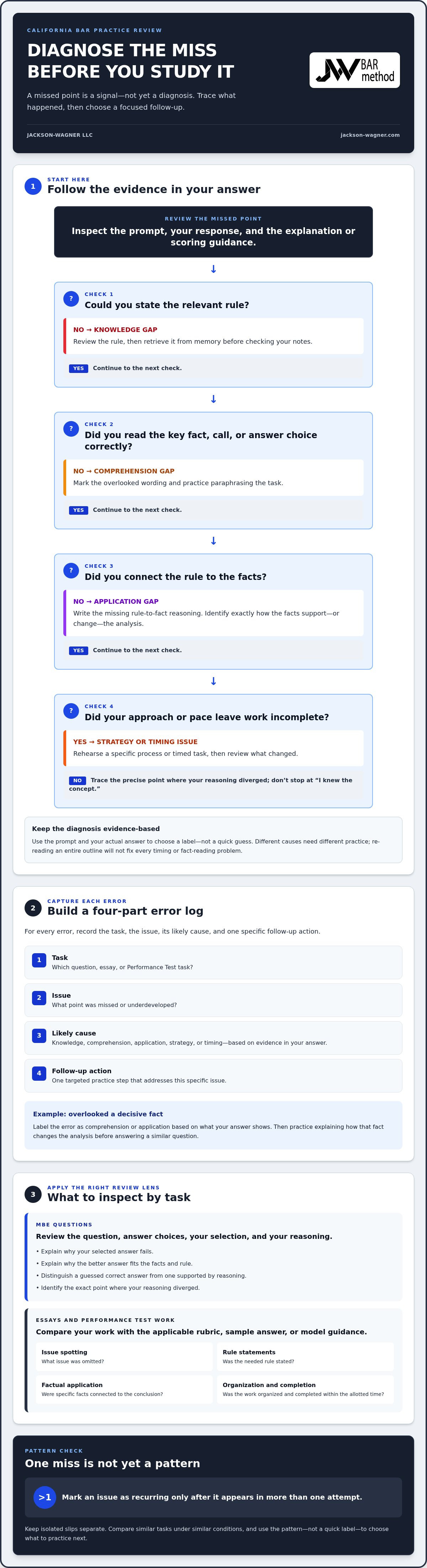
A missed point is a signal, not yet a diagnosis. Before adding a subject to your review list, inspect the prompt, your response, and the explanation or scoring guidance. Identify the mechanism behind the miss, then choose a practice action that targets it. Re-reading an entire outline won’t fix a timing problem or a habit of overlooking decisive facts.
Classify the cause before choosing a remedy
Use consistent labels so the same type of mistake is easy to spot across assignments. A useful starting set is knowledge, comprehension, application, strategy, and timing. Base each label on evidence in the question and your answer, not on a quick guess. Mark a pattern as recurring only after it appears in more than one attempt, and keep isolated slips separate.
For each error, capture four things: the task, the issue, the likely cause, and one follow-up action. For example, if you missed an MBE question because you overlooked a fact that changed the rule’s application, label it comprehension or application based on what your answer shows. Then write a targeted action, such as explaining how that fact changes the analysis before answering a similar question.
- Knowledge: You couldn’t state the relevant rule. Review it, then retrieve it from memory before checking your notes.
- Comprehension: You misread a fact, call, or answer choice. Mark the overlooked wording and practice paraphrasing the task.
- Application: You knew the rule but didn’t connect it to the facts. Write the missing rule-to-fact reasoning.
- Strategy or timing: Your approach or pace left work incomplete. Rehearse a specific process or timed task, then review what changed.
For every missed MBE item, record why your selected answer fails and why the better answer fits the facts and rule. Don’t stop at “I knew the concept.” Identify the precise point where your reasoning diverged. A distractor that tempts you through a familiar but irrelevant rule calls for a different response than a rule you couldn’t recall.
Review written work against clear criteria
Compare an essay or Performance Test response with its applicable rubric or model guidance. Check issue spotting, rule statements, factual application, organization, and completion. For each omitted or underdeveloped point, note what the response needed and where it belonged. If you named an issue but didn’t explain how specific facts supported a conclusion, record an application gap rather than simply “weak essay.”
Different error categories call for different practice actions, so diagnose the cause before choosing the fix. A missing rule may need focused recall; thin application needs fact-based analysis; unfinished work calls for timed execution. When analyzing practice exam scores, this distinction helps keep your next study step precise. Jackson-Wagner’s California Bar preparation courses include quizzes and assignments with automated feedback, which can support a consistent review routine.
How to compare practice exam results without chasing misleading trends
A change in score matters only if you understand what changed around it. A timed essay compared with an untimed essay, or one provider’s raw percentage compared with another’s rubric score, isn’t a clean measure of progress. Keep the comparison narrow: match task type, time limits, testing conditions, and scoring method as closely as possible. When those conditions differ, record the difference as context rather than treating the result as proof that your performance improved or declined.
Track more than totals. A score may move while a recurring reasoning error persists, or remain similar even as you finish more of the task. Those details help clarify whether a study adjustment is taking hold and give you useful evidence to guide the next practice block.
What to track across attempts
For each attempt, record the date, task, conditions, and scoring method. Add the recurring issue, whether you completed the work, and whether you applied the action chosen after your last review. This makes your log a record of both performance and follow-through, not just a collection of scores.
- Attempt: Date and practice source.
- Task and conditions: MBE set, essay, or Performance Test, plus timing and any relevant format details.
- Recurring issue: The error pattern or completion problem observed.
- Next action: The specific adjustment to test on a comparable task.
A sample entry might read: “Timed essay, provider rubric; application is thin in the same issue area; used fact-to-rule analysis from prior review; next action: check whether application is more complete on the next timed essay.” Keep unfinished work visible as its own signal rather than folding it into a score or an error label.
When score movement needs context
Before calling a result a trend, check whether both attempts used comparable tasks and scoring guidance. Different question sets, rubrics, or time limits can change the raw result, so don’t assume a higher number means broader improvement. Instead, compare the work itself: did the same error recur, did you complete more of the task, and did the previous review action show up in your reasoning?
If several comparable attempts show the same change, that pattern gives you a stronger basis for adjusting your plan, though it still isn’t a promise about the official exam result. Keep practice measures separate from official score reports, which follow their own reporting process. For analyzing practice exam scores, the useful trend is evidence that a targeted action is changing the work, not simply a rising total.
Turn practice exam analysis into a focused study plan
A useful study plan starts with evidence, not an attempt to fix everything at once. After reviewing a practice task, carry its clearest findings into a short cycle: review the work, classify the errors, prioritize recurring issues, practice a targeted adjustment, and reassess with another task. That sequence keeps each study block purposeful and makes it easier to see whether a change is helping.
Choose a limited number of priorities for the next block. Start with recurring issues that affect more than one task, such as trouble applying rules to facts across essays and MBE questions. Then decide what kind of practice fits the cause. A rule you can’t recall calls for focused review and retrieval. A rule you know but don’t apply calls for deliberate fact-to-rule analysis. Work left unfinished points toward timed execution, not another round of passive reading.
Prioritize the next study actions
Make each action specific enough to check later. “Review contracts” is broad; “recall the rule, then explain how each decisive fact affects its application in a practice question” gives you observable work. Avoid loading one study block with every weakness in your log. Focused practice makes it clearer whether you addressed the selected issue before adding another priority.
Sample error-log entry: Task: timed essay. Issue: conclusion stated, but key facts weren’t applied. Cause: application gap. Next action: revise one answer by connecting each relevant fact to the rule, then check the revision against the rubric.
This kind of entry links a diagnosis to a practical response without assuming a score or promising an outcome. As you’re analyzing practice exam scores, rank potential actions by recurrence and reach: a pattern that appears in multiple task types may deserve attention before a one-off slip. Keep the list manageable, and write down what evidence would show that the action worked.
Use the next attempt as a feedback loop
When you want to test a particular adjustment, choose a comparable task and conditions. If your goal is stronger essay application, another essay gives more relevant evidence than an MBE set. If timing is the focus, practice under a time limit and record whether you completed the work. Reuse the same error categories afterward, so you can compare the new response with the earlier one consistently.
Reassess the targeted behavior, not just the total result. Did you make the rule-to-fact links? Did you finish? Did the same reasoning error appear? If the intended change is absent, refine the action or do more focused practice before moving on. Use the task-based review guidance in this article as a companion to your practice cycle.
Structured California Bar preparation can help organize that cycle through planned milestones, quizzes, assignments, and automated feedback. Explore structured California Bar preparation to see how those elements can support deliberate practice and review.
Build a structured California Bar practice-and-review routine
Turn your score review into a routine you can repeat. Set a milestone for completing a practice task, reviewing the work, and applying one or two targeted corrections before the next attempt. A consistent structure makes it easier to see whether you followed through and what still needs attention. It also prevents practice from becoming a string of test attempts with no deliberate review between them.
Jackson-Wagner LLC’s California Bar preparation courses are fully online, with immediate digital access after registration and payment. No physical books are required. Courses include quizzes, assignments, and automated feedback, and completing each module awards a mastery certificate. These features can give your study routine clear checkpoints: complete the work, review the feedback, record any recurring issue, and use a later task to test your adjustment.
Choose the California program that matches the exam
Match the course content to the exam you’re preparing to take. The 4-Week Accelerated Program: July 2026 California Bar Exam covers MBE, California essays, and the Performance Test. The 3-Week Accelerated Program: July 2026 California Attorneys’ Exam covers essays and the Performance Test only, with no MBE. The formats address different exam components, so choose based on which exam applies to you.
Keep your review routine aligned with that scope. If your practice log shows MBE reasoning concerns, focus on MBE-specific work within the full California Bar preparation track. For essay or Performance Test patterns, use written practice and feedback to guide your next steps. Jackson-Wagner’s study options include part-time commitments of 4-6 hours per day and full-time commitments of 50+ hours per week. In either case, milestones can help you connect practice, review, and follow-up instead of treating them as separate activities.
Take a clear next step
Continue using your error log to decide what to work on next, and build a routine that gives each practice attempt a purpose. For broader preparation context, consult a California Bar exam strategic guide alongside your score analysis. It can help you consider how targeted review fits into a structured plan.
Jackson-Wagner LLC states: Pass the California Bar or your money back. The money-back guarantee accompanies the program’s results promise; it doesn’t turn any individual practice score into a prediction. Keep measuring your progress through the work itself: whether you recognize recurring issues, apply feedback, and address those issues in subsequent practice.
Make your next practice attempt count
Your next step doesn’t need to be a dramatic overhaul. Choose one recurring issue, decide how you’ll practice it, and use your next attempt to check whether that adjustment shows up in your work. That’s how analyzing practice exam scores becomes a steady process of learning and refinement, rather than a reason to second-guess every result.
If you want a structured framework for that work, explore Jackson-Wagner LLC’s fully online California Bar preparation programs. After registration and payment, you receive immediate digital access to quizzes, assignments, and automated feedback; each completed module awards a mastery certificate. These checkpoints can help you organize practice and review with a clearer sense of what comes next.
Jackson-Wagner LLC’s promise is direct: Pass the California Bar or your money back. Explore Jackson-Wagner LLC’s California Bar preparation programs and choose a focused next step for your preparation. Keep learning from each attempt by applying evidence-led adjustments to your work.
Frequently Asked Questions
Should I retake the same practice exam after reviewing my answers?
Yes, but use a repeat attempt to check your reasoning, not to measure performance as if the questions were new. Remembering an answer can make it seem easier than it is. Before revisiting the set, explain the rule or decision process behind each previously missed item without looking at the explanation. Then try fresh questions that test the same skill to see whether you can apply it independently.
How soon after a practice exam should I review it?
Review it while you can still recall your approach, including where you hesitated, changed an answer, or felt rushed. If you need a break, jot down those reactions and the testing conditions first. During the detailed review, compare those notes with the questions and your written responses. This can help distinguish what you remember thinking from what the answer or rubric shows, making your review more useful than relying on memory later.
Can a practice exam score predict whether I will pass the California Bar Exam?
No single practice result can guarantee or reliably determine your official outcome. Practice materials, scoring methods, and testing conditions vary, so a raw percentage shouldn’t be treated as an official scaled score. Use analyzing practice exam scores to identify what your work suggests you should address next, not to set an unsupported pass-or-fail cutoff. Jackson-Wagner’s money-back guarantee is a program promise, not a prediction based on an individual practice result. For official scoring information, consult current California Bar guidance rather than extrapolating from one practice attempt.
Should I compare scores from different practice-test providers?
Only cautiously. Providers may differ in question style, task format, and scoring instructions, so their numbers may not measure the same thing. Before comparing, check whether the tasks, time limits, and scoring methods are similar. If they aren’t, keep each result separate and look for evidence within the work itself, such as a repeated reasoning error or a response that remains incomplete. That comparison is more informative than combining unlike scores.
What should I do if my practice score drops?
Pause before changing your whole study plan. First check whether the task was different, conditions changed, or time pressure affected how much you completed. Then review the answers or written work to see which issues appeared and whether they were new or familiar. Choose one or two concrete adjustments and test them in a suitable later task. A lower total alone doesn’t explain the cause or establish a lasting decline.
Should I review questions I answered correctly?
Yes, if you guessed, felt unsure, or spent unusually long reaching the answer. A correct choice can conceal shaky recall or reasoning that won’t hold up when the facts change. Briefly state why the answer is correct, then compare your reasoning with the explanation. If you can clearly support the choice and dismiss the alternatives, move on; reserve deeper review for uncertain answers and missed questions.
How should I analyze a practice essay if I do not have a score?
You can still review the essay without assigning it a number. Use the available rubric, model answer, or feedback to identify missed issues, inaccurate rules, unsupported conclusions, weak factual analysis, organizational problems, and unfinished discussion. Mark a specific passage for each concern and write one revision or practice action. If no dependable scoring method is provided, don’t invent a score; use the written evidence to guide what you practice next.


