

The February 2026 general pass rate of 30.8% proves that working hard isn't enough; you have to work with surgical precision. Most candidates fail because they rely on generic, legacy calendars that ignore the unique complexity of California's specific subjects. You need a strategy that respects your time and the high stakes of the July 28-29, 2026, exam. By creating a realistic bar study schedule, you replace the anxiety of an endless "to-do" list with a high-precision timeline built for results.
We know the weight of this process. It's natural to feel overwhelmed by the sheer volume of material, especially when you're balancing professional obligations with the fear of a repeat attempt. This guide will show you how to master the art of a structured, modern study plan that prioritizes high-yield topics over mindless busy work. You'll gain a clear, day-by-day roadmap that ensures every hour is used efficiently, giving you the confidence to achieve successful licensure in California.
Key Takeaways
- Identify the "Volume Trap" and why 2026 candidates must prioritize California-specific rigor over generic national study plans.
- Differentiate between the Full Exam and Attorney’s Exam timelines to ensure your roadmap aligns with your specific licensure path.
- Master the art of creating a realistic bar study schedule by implementing the "Split-Shift" model designed for the modern working professional.
- Shift your daily routine from a checklist of tasks to outcome-based study blocks that maximize retention through high-stakes morning diagnostics.
- Learn how the JW Bar Method integrates a binary performance guarantee to provide the security and focus needed for successful California licensure.
The Volume Trap: Why Generic Bar Study Schedules Fail in California
The biggest obstacle to your success isn't a lack of effort; it's the "Volume Trap." This is the common but fatal mistake of equating total hours spent at a desk with actual exam readiness. Many candidates believe that if they just put in enough time, they'll pass. But for the 2026 California Bar Exam, volume alone is a liability. While the Bar examination in the United States typically follows a standardized format, California remains an outlier with its own unique grading rigor and subject matter requirements.
High-achievers often fall into this trap because they are used to succeeding through sheer force of will. They fail not because they didn't work hard, but because they lacked strategic prioritization. They spent as much time on minor UBE concepts as they did on high-stakes California-specific essay topics. Creating a realistic bar study schedule requires you to reject the "hours-first" mentality. Unlike legacy providers that bury you in thousands of pages of generic outlines, the JW Bar Method focuses on surgical precision, ensuring you master what actually appears on the exam.
The California Difficulty Curve
The State Bar of California is notorious for its grading rigor and its refusal to adopt the Uniform Bar Exam (UBE). This means your schedule must account for subjects like Community Property, California Wills and Trusts, and the specific nuances of the California Evidence and Civil Procedure codes. These subjects require significantly more schedule real estate than their national counterparts. The California Distinction is the reality that the State Bar’s grading rubric demands a level of analytical depth and state-specific mastery that generic national outlines simply cannot reach.
The Myth of the 600-Hour Study Rule
Many law libraries suggest a generic 400 to 600 hour total study time. This arbitrary number is a myth that leads to burnout and diminishing returns. Counting hours encourages passive reading, where your eyes move across the page but your brain doesn't retain the rule of law. Instead, you should focus on "Active Recall Blocks." These are intensive intervals where you practice retrieving information and applying it to complex fact patterns. By adopting the precision-based approach found in the JW Bar Method, you can cut through the noise and build a timeline that actually works. Creating a realistic bar study schedule is about the quality of your output, not the quantity of your clock-ins.
The 2026 California Timeline: Full Exam vs. Attorney’s Exam
The 2026 California exam isn't a "one size fits all" event. Your calendar must reflect the specific version of the test you are taking. Whether you are a fresh law graduate or a seasoned practitioner, creating a realistic bar study schedule begins with identifying your track. According to the official California Bar Examination Information, the July 2026 exam is set for July 28-29. This means your preparation window is fixed; your methodology is the only variable.
Before diving into substantive law, handle the administrative burden. You should integrate the California bar exam moral character application into your first week of planning. This process is notoriously slow. Getting it out of the way early prevents a background check from delaying your licensure after you've already passed the exam.
The Full California Bar Exam Track (10 Weeks)
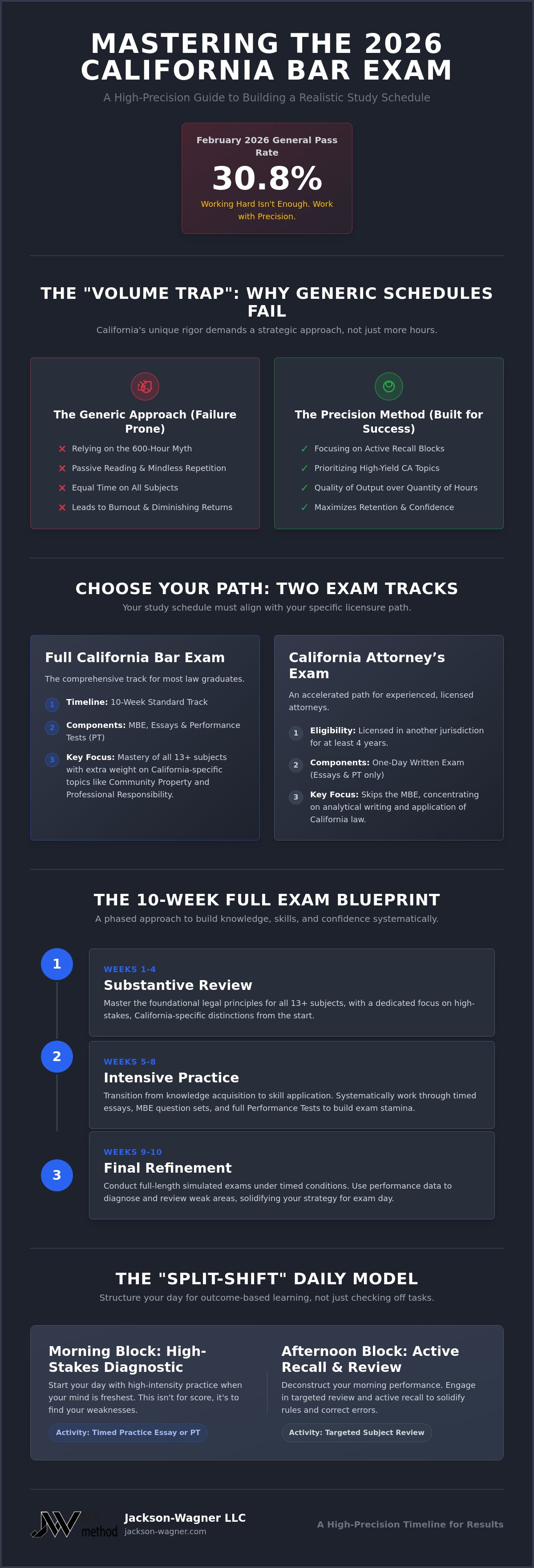
For most graduates, a 10-week standard track is the baseline for success. We break this down into three distinct phases: four weeks of substantive review, four weeks of intensive practice, and two weeks of final refinement. You can't just study the MBE subjects. You must rotate through all 13+ subjects, giving extra weight to California-specific areas like Community Property and Professional Responsibility. Scheduling the Performance Test (PT) components is equally vital. The JW Bar Method Prep - Full Exam California Bar ensures you spend time on the high-stakes written portions that national UBE schedules often treat as afterthoughts.
The California Attorney’s Exam Track (Accelerated)
Practicing attorneys licensed in other jurisdictions for at least four years can opt for the one-day written exam. This requires a completely different cognitive approach. You don't need to waste weeks on multiple-choice drills. Instead, your schedule should focus on essay-writing precision and the 90-minute Performance Test. The JW Bar Method Accelerated Prep - Attorney’s Exam California Bar is designed for this 5-week sprint. It respects your professional reality by cutting out the fluff and focusing on the specific grading standards of the California Bar. If you are balancing a full caseload, the JW Bar Method Accelerated Prep provides the structure needed to pass without sacrificing your practice. This precision is why our students feel more prepared in half the time compared to those using legacy programs.
Balancing the Bar: Realistic Schedules for Working Professionals
Your weekends then become your laboratory for high-intensity practice. Use Saturday for a full-length simulated MBE or essay block, and Sunday for meticulous review and feedback. This structure aligns with the State Bar of California Examinations Overview, which highlights the broad range of testing requirements you must satisfy beyond just the general bar exam. If you find yourself constantly falling behind, the JW Bar Method Accelerated Prep is specifically engineered for time-poor candidates who need to prioritize precision over sheer volume. It replaces the "survival" mentality with a structured, professional framework.
The 20-Hour Study Week Framework
When time is your most scarce resource, you must prioritize high-yield topics. Don't waste your lunch break scrolling; use "Micro-Study" sessions to drill flashcards or review rule statements. These 15-minute bursts keep the law at the front of your mind without requiring a full library setup. You also need a non-negotiable "Study Sanctuary." This is a physical space where professional and personal distractions are banned, allowing you to reach a state of deep work instantly. For those studying at home, ensuring your environment is free from disruptions—such as a restless pet that might benefit from the behavior consulting at I Wuff You Dog Training—is essential for maintaining focus. If you aren't in your sanctuary, you aren't studying.
Managing Professional and Personal Boundaries
Success requires radical transparency with your employer and family. You must communicate your schedule clearly and set expectations about your availability. It's also vital to schedule "Buffer Days" every two weeks. These days allow you to catch up on missed targets or simply rest, preventing the total burnout that derails so many candidates. Traditional best bar review courses often fail working professionals because they demand a volume of work that is physically impossible to complete alongside a 40-hour work week. Precision isn't just a preference; it's your only path to the finish line.
The Daily Grind: Structuring Your Study Blocks for Maximum Retention
Most candidates fail because they treat their calendar like a grocery list. They check off "read 50 pages" or "watch three hours of video" without measuring what they actually learned. This is task-based scheduling; it's the fastest way to fall into the bottom 70% of test-takers. Creating a realistic bar study schedule requires a shift to outcome-based scheduling. You don't study for four hours; you study until you can perfectly recite the elements of Homicide or successfully navigate a Community Property crossover essay. Your schedule is a tool for mastery, not a log of your attendance.
Your day should follow a rigid four-step structure designed for maximum cognitive load. First, you perform a morning diagnostic to identify your knowledge gaps. Second, you conduct targeted substantive review based on those gaps. Third, you move to the afternoon application phase where you write full-length California essays to build stamina. Finally, you end with an evening review. This final step involves a meticulous analysis of every missed point. If you don't know exactly why you missed a sub-issue, you haven't finished your day.
The Power of the Diagnostic Start
Starting your day by reading an outline is a strategic mistake. It gives you a false sense of security known as the "fluency illusion." You must use practice questions to prime your brain for learning before you ever open a textbook. Retrieval practice is the cognitive science of forcing your brain to recover information from memory, which creates significantly stronger neural pathways than passive reading. By starting with a diagnostic, you tell your brain exactly what information it needs to hunt for during your review session. This makes your study time active rather than observational.
Mastering the California Essay Block
California essays are distinct from the UBE. They require a specific depth of analysis and a rigid adherence to the "California Style" of IRAC. You must schedule both "Timed" and "Untimed" sessions in your daily blocks. Untimed sessions allow you to perfect your rule statements and structure, while timed sessions build the pressure needed for the actual exam. Understanding the State of California State Bar licensing requirements is the first step, but mastering the essay block is what ultimately secures your license. If you want a schedule that automates this precision, explore our JW Bar Method Prep - Full Exam California Bar to ensure your daily blocks lead directly to a passing score.
Beyond the Calendar: Executing the JW Bar Method in 2026
Creating a realistic bar study schedule is the blueprint, but the JW Bar Method is the engine that drives you to the finish line. A calendar alone cannot account for the psychological pressure of the 2026 California exam. Our methodology transforms your timeline from a static list of dates into a results-driven machine. We replace the anxiety of "doing enough" with the certainty of having mastered the specific metrics required for licensure. Precision-focused prep is the only realistic way to handle the California Bar because it acknowledges that your brain has a finite capacity for information. We don't just give you a schedule; we give you a system for execution.
As you enter the final 14 days, your focus must shift from the "Study Phase" to the "Exam Phase." This transition is critical. You stop learning new law and start refining your performance. This period is about simulated environments, timed pressure, and mental conditioning. By this stage, the JW Bar Method has already ensured you have the substantive knowledge required. Now, you must prove you can deploy it under the exact conditions you'll face on July 28-29, 2026.
The JW Bar Method Advantage
Our approach is built on "bold reliability." We are so confident in our precision-based curriculum that we offer a binary performance guarantee. This serves as a powerful anchor for our candidates, removing the financial risk and allowing you to focus entirely on your performance. Whether you are using the JW Bar Method Prep - Full Exam California Bar or an accelerated track, our curriculum adapts to your specific professional reality. We position ourselves as the modern mentor for agile learners who are tired of legacy providers and their volume-first failures. We don't just help you study; we partner with you to ensure you pass.
Final Steps to Licensure
Even the best-laid plans encounter obstacles. If your schedule falls behind, you must implement the "Reset Protocol." Don't try to cram three days of missed work into one; instead, re-prioritize your remaining high-yield blocks and move forward. Mental conditioning in the final week is just as important as your substantive review. You've done the work, followed the roadmap, and mastered the precision required. Now, it's time to execute. Enroll in the JW Bar Method today to secure your 2026 success.
Secure Your California Licensure in 2026
Success on the 2026 California exam isn't about the number of hours you log; it's about the precision of your preparation. By creating a realistic bar study schedule that prioritizes state-specific subjects and outcome-based blocks, you move beyond the exhaustion of generic prep. You now have the tools to bypass the "Volume Trap" and structure your day for maximum cognitive retention. Whether you're a recent graduate or a veteran practitioner, your roadmap must be as rigorous as the exam itself.
We provide the specialized California-only curriculum and accelerated tracks designed to fit your professional reality. Our binary performance guarantee ensures that we're just as invested in your results as you are. Don't leave your future to legacy providers that rely on outdated, high-volume models. Master the California Bar with the JW Bar Method; Guaranteed.
The path to becoming a California attorney is demanding, but with a structured and reliable plan, it's entirely within your reach. Take control of your timeline today and walk into the exam room with absolute confidence.
Frequently Asked Questions
How many hours a day should I study for the California Bar Exam?
You should prioritize 4 to 6 hours of high-intensity, active study over long days of passive reading. Quality of engagement matters more than the total number of hours spent at your desk. By focusing on Active Recall Blocks and diagnostic drills, you ensure that every minute contributes to your mastery of the material rather than just filling a calendar with empty time.
Can I create a realistic bar study schedule while working full-time?
Yes, creating a realistic bar study schedule is entirely possible for full-time professionals using the Split-Shift model. This framework involves two hours of study before work and two hours in the evening, totaling 20 hours of focused prep by Friday. This approach, combined with high-intensity weekend sessions, provides a professional structure that prevents burnout while maintaining a full caseload.
What is the difference between a Full Bar and an Attorney’s Exam schedule?
The Full Bar schedule requires a 10-week track to cover both the MBE and the written portions, including all 13+ tested subjects. In contrast, the Attorney’s Exam schedule is a 5-week accelerated sprint focused exclusively on the written components. Because attorneys don't take the multiple-choice section, their timeline prioritizes essay-writing precision and the 90-minute Performance Test over broad substantive review.
When is the best time to start my California Bar study schedule?
For the July 28-29, 2026 exam, law school graduates should begin their 10-week standard track in mid-May. Practicing attorneys using an accelerated track should start their 5-week prep in late June. Regardless of your track, you should initiate your moral character application months in advance to ensure administrative delays don't prevent your licensure after you pass the exam.
How do I adjust my study schedule if I fail a practice exam?
You should implement a "Reset Protocol" rather than increasing your study hours in a panic. Analyze your diagnostic results to identify the specific sub-issues or rules you missed, then re-allocate your next study block to address those exact gaps. This outcome-based adjustment ensures you are fixing the root cause of the failure instead of just repeating the same ineffective habits.
Is 8 weeks enough time to study for the California Bar?
Eight weeks is a tight window for the Full Exam and requires extreme precision to be successful. While legacy programs often demand 10 to 12 weeks of high-volume work, creating a realistic bar study schedule with a focus on high-yield topics can make an 8-week timeline viable. However, most candidates benefit from the extra two weeks to handle the unique grading rigor of the California Bar.
Should I include rest days in my bar study schedule?
Rest days, or "Buffer Days," are a non-negotiable part of a professional study framework. Scheduling one full day of rest every two weeks prevents the cognitive fatigue that leads to diminishing returns and burnout. These days also serve as a safety valve, allowing you to catch up on missed targets without derailing your entire timeline for the final weeks of prep.
How do I handle California-specific subjects in my study timeline?
You must give California-specific subjects like Community Property and Professional Responsibility dedicated real estate in your schedule. Don't treat them as secondary to UBE subjects; they often appear as high-stakes crossover essays that can make or break your score. Your timeline should rotate through these subjects early and often to ensure state-specific nuances are deeply internalized before the exam dates.


