
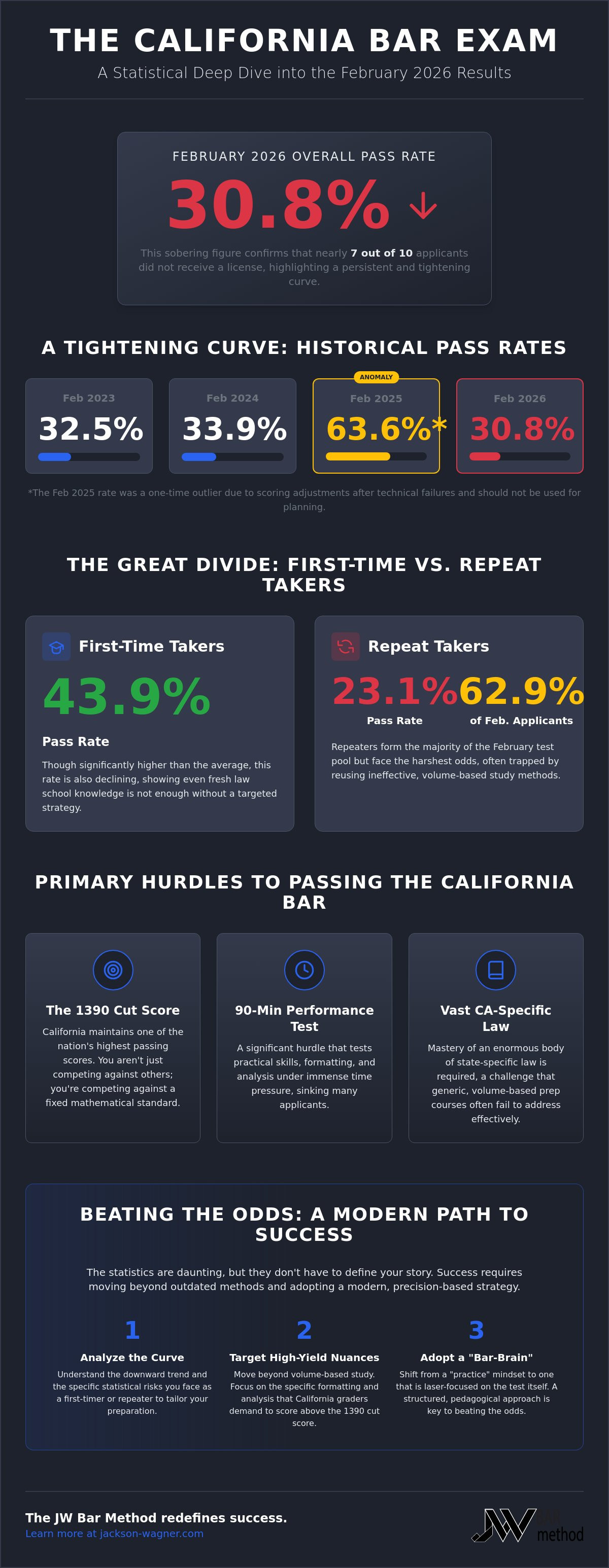
The February 2026 california bar exam pass rate plummeted to a sobering 30.8%, confirming that nearly seven out of ten applicants walked away without a license. It's a brutal reality that transforms years of law school dedication into high-stakes anxiety, especially when you're facing a mountain of California-specific law and a historically low 23.1% success rate for repeaters. You aren't just fighting a test; you're fighting a curve designed to filter people out based on legacy testing standards that often fail the modern student.
We understand that the fear of failure is real, but it doesn't have to be your story. This article provides a strategic breakdown of the 2026 statistics and a precision-based roadmap to ensure you land securely on the passing side of the 1390 cut score. We will analyze the specific trends from the February 2026 and July 2025 results, identify the pitfalls that sink most applicants, and reveal the structured study methodology you need to beat the odds with absolute confidence. By replacing overwhelm with a modern pedagogical approach, you can stop worrying about the statistics and start preparing for your swearing-in ceremony.
Key Takeaways
- Analyze the downward trend of the california bar exam pass rate since 2023 to understand how the curve is tightening for upcoming test cycles.
- Identify the specific statistical risks facing repeat takers and the strategic shifts required to break the cycle of failure.
- Pinpoint why the 90-minute Performance Test and the massive breadth of California-specific law serve as the primary hurdles for most applicants.
- Understand the deceptive nature of the Attorney’s Exam pass rates and how to pivot from a "practice-brain" mindset to a "bar-brain" approach.
- Discover a structured, precision-based study roadmap that utilizes modern pedagogy to guarantee you fall on the passing side of the curve.
California Bar Exam Pass Rate 2026: The Brutal Reality of the Numbers
The February 2026 california bar exam pass rate plummeted to 30.8%, a figure that should command the attention of every prospective attorney in the state. This result represents a significant decline from the 33.9% seen in 2024 and the 32.5% recorded in 2023. These figures demonstrate a persistent, tightening curve that leaves very little room for error. The numbers don't lie. Some students might look at the 63.6% pass rate from February 2025 and feel a false sense of security; however, that number was a one-time anomaly resulting from scoring adjustments after technical failures. Relying on that outlier for your 2026 planning is a dangerous mistake. If you're worried about the california bar exam pass rate, you need a plan that targets the 1390 score directly.
Historical Trends and the 1390 Cut Score
California remains the most challenging jurisdiction for legal licensure in the nation. This is largely due to the State Bar of California and its commitment to the 1390 cut score. While many other states have recently lowered their passing thresholds to increase the number of practicing attorneys, California has held firm. The cut score is the specific, non-negotiable scaled score that serves as the primary hurdle for every 2026 candidate. Achieving this score requires more than just knowing the law; it requires a mastery of the specific formatting and analysis that the graders demand. You aren't just competing against other students; you're competing against a fixed mathematical standard that has historically sidelined thousands of qualified graduates.
February vs. July: Why the Timing Matters
There is a recurring statistical gap between the February and July administrations. February pass rates are consistently lower, primarily because the candidate pool contains a much higher percentage of repeat takers. In the February 2026 cycle, repeaters represented 62.9% of all applicants. These individuals are often battling the psychological weight of a previous failure and may be using the same ineffective study methods that failed them before. To beat the odds in 2026, you must recognize that the timing of your exam dictates the level of precision required. A February sitting demands a more aggressive, structured approach to ensure you don't fall into the statistical trap that catches so many repeaters. Use these trends as motivation to adopt a prep method that is proven to work under the most difficult testing conditions.
First-Time vs. Repeat Taker Statistics: Where You Stand
Your status as a first-time or repeat applicant is the single greatest predictor of your outcome. According to the official California Bar Examination statistics, first-time takers in February 2026 achieved a 43.9% pass rate. While this is significantly higher than the overall average, it marks a decline from previous years, signaling that even those with fresh law school knowledge are struggling against the current curve. Meanwhile, repeat test takers dominated the February 2026 applicant pool, making up 62.9% of the total candidates. This concentration of repeaters creates a unique statistical pressure that defines the February cycle.
The First-Timer Advantage and How to Keep It
First-time applicants often possess a momentum that repeaters lack, yet many squander this advantage by falling into the trap of volume-based study. Legacy prep programs focus on sheer quantity, pushing thousands of multiple choice questions and dozens of essays without teaching the precision required for California graders. To avoid becoming a statistic, you must prioritize passing the California bar exam in 2026 on your very first attempt. This requires moving beyond generic outlines and focusing on the high-yield nuances that actually move the needle on your scaled score. If you're a first-timer, don't let the california bar exam pass rate intimidate you; instead, use it as a signal to adopt a more sophisticated approach like the JW Bar Method Prep - Full Exam California Bar.
Breaking the Cycle for Repeat Takers
For those who didn't succeed on the first try, the path to licensure feels increasingly narrow. The Repeater Trap is real. It happens when students reuse the same generic prep materials, hoping that a second pass will magically yield different results. This rarely works because the issue isn't a lack of effort; it's a fundamental flaw in the study methodology. The psychological toll of facing a low california bar exam pass rate can be paralyzing. To break this cycle, you must abandon the legacy models that failed you and embrace a modern, results-driven framework. Success as a repeater requires a fundamental shift in pedagogical approach that targets your specific weaknesses rather than repeating general content. You need a system that assumes the risk of your performance, turning your previous failure into a one-time setback rather than a permanent barrier.
Why the California Bar Pass Rate is Historically Low
The historically low california bar exam pass rate isn't a reflection of applicant intelligence; it's a testament to a testing system designed for endurance and surgical precision. While many other jurisdictions have transitioned to the Uniform Bar Exam (UBE), California maintains its own rigorous standards, requiring mastery of 13 separate legal subjects. The most significant hurdle for many high-achievers is the 90-minute Performance Test (PT). This section simulates real-world practice by forcing you to synthesize a complex "file" and "library" into a coherent legal document under brutal time constraints. Students who treat the PT as a secondary concern often find themselves falling just short of the 1390 cut score.
Grading subjectivity remains a primary enemy of the modern applicant. Legacy prep programs often provide "model answers" that are impossible to replicate under exam conditions, leading to frustration and wasted effort. You don't need a perfect legal treatise; you need a structured framework that aligns with the specific benchmarks the graders use. Our JW Bar Method Prep - Full Exam California Bar is built around this objective reality, focusing on the high-yield rule statements and formatting that actually move the needle. By replacing generic volume with precision pedagogy, you ensure your output meets the Examiners' standards regardless of which grader reviews your booklet.
The Limitations of Legacy Bar Prep
Most traditional prep courses rely on an outdated model that prioritizes sheer volume over strategic mastery. They drown you in thousands of multiple-choice questions and hours of passive video lectures, hoping that repetition will magically lead to success. This passive approach is a dangerous gamble in an environment where the california bar exam pass rate is so low. For a detailed comparison of why precision beats volume, explore our analysis of the best bar exam preparation service 2026.
The Complexity of California-Specific Law
The distinction between the Multistate Bar Examination (MBE) and California-specific essays is where many candidates lose their footing. Common pitfalls often arise in subjects like Professional Responsibility and Community Property, where California's rules differ sharply from majority standards. The Examiners use these nuances to validate their high standards, ensuring only those who can demonstrate absolute precision gain entry to the profession. You don't need more information; you need a way to filter the noise and focus on the specific rules that appear on the exam year after year.
The California Attorney’s Exam: A Different Statistical Story
The February 2026 Attorney’s Exam pass rate of 57.0% presents a statistical paradox. While this number is significantly higher than the general california bar exam pass rate of 30.8%, it's arguably more deceptive. Seasoned lawyers often approach this one-day exam with a dangerous level of overconfidence. They assume their years of successful practice in other jurisdictions will naturally translate into a passing score in California. This assumption is a mistake. The Examiners aren't testing your ability to practice law; they're testing your ability to apply California-specific rules within a rigid, academic rubric. You must master the California attorney’s exam requirements before you even open a casebook.
The one-day format creates a high-pressure environment where there is zero margin for error. Unlike the General Bar Exam, which allows for some recovery across multiple days of testing, the Attorney’s Exam is a concentrated sprint. Out-of-state practitioners often struggle with "practice-brain," where they attempt to answer essays based on real-world experience rather than the specific legal theories the graders demand. To succeed, you must intentionally pivot back to a "bar-brain" mindset. This means prioritizing the Examiners' preferred formatting and rule statements over the nuanced legal arguments you use in your daily practice. If you want to avoid becoming part of the 43% who fail, you need a strategy that respects the unique difficulty of this jurisdiction.
The Accelerated Path for Practicing Lawyers
Busy professionals don't have the luxury of a ten-week study sabbatical. You need an efficient, high-impact study track that leverages your existing knowledge without letting it hinder your performance. Our JW Bar Method Prep - Attorney’s Exam California Bar is designed specifically for this demographic. It strips away the fluff of legacy prep courses and focuses on the high-yield precision pedagogy required to hit the 1390 cut score. This accelerated approach ensures you spend your limited study hours on the specific California nuances that actually determine your result. Efficiency isn't just a preference; it's a necessity for any lawyer looking to expand their practice into the California market.
Why Attorneys Fail: The Top 3 Mistakes
Failure on the Attorney's Exam usually stems from three specific areas. First, many underestimating the rigid formatting required for California essays. Second, seasoned lawyers often fail to practice under timed conditions, forgetting that a 60-minute essay sprint is vastly different from a day at the office. Finally, and most importantly, the failure to adapt to the Bar Examiners’ perspective is a fatal flaw for many practitioners. You aren't writing for a judge or a client; you're writing for a grader who has a specific checklist. If you are ready to secure your licensure without the risk of a public failure, the JW Bar Method Accelerated Prep - Attorney’s Exam California Bar provides the structured path you need.
Beating the Odds: How the JW Bar Method Redefines Success
The 30.8% california bar exam pass rate from February 2026 serves as a harsh reminder that generic preparation is no longer enough. You don't have to be another data point in a downward trend. We've designed a system that moves you from being a statistic to a licensed attorney through precision pedagogy. This isn't about memorizing every footnote in a 1,000-page outline. It's about mastering the specific mechanics of the California Bar Exam. The Jackson-Wagner LLC performance guarantee is our way of putting skin in the game. We assume the financial risk of your performance because we're certain our methodology works.
The JW Bar Method represents the modern evolution of legal education. We've stripped away the ineffective, passive learning models used by legacy providers for decades. Instead of watching hours of lectures, you'll engage with a results-oriented curriculum that prioritizes active output. We've replaced the anxiety of the unknown with a structured, reliable path to success. Your 2026 study plan should be measured by results, not by the number of hours you've spent sitting at a desk—leaving you more time for restorative interests, such as supporting the community at We LOVE Arabian Horses.
The JW Bar Method: Precision Over Volume
Our structured study programs are built to bypass the fluff that bloats traditional prep courses. We focus on the high-yield topics and formatting nuances that actually determine your score. You'll learn to navigate the state of california state bar requirements with surgical accuracy, ensuring every essay you write hits the graders' specific benchmarks. High-stakes drills are a core component of our 2026 curriculum, forcing you to apply law under the exact same pressure you'll face on exam day. This level of intensity ensures that the california bar exam pass rate doesn't dictate your future.
Your 2026 Success Plan
Your next step is choosing the path that fits your current career stage. If you're a first-time taker or a repeater looking to break the cycle, the JW Bar Method Prep - Full Exam California Bar is your comprehensive solution. For those who need a more condensed timeline, our JW Bar Method Accelerated Prep - Full California Bar Exam provides a streamlined version of our core pedagogy without sacrificing quality. Don't settle for the legacy models that have contributed to historically low success rates. Enroll in the JW Bar Method Prep - Full Exam California Bar and secure your future as a California attorney.
Secure Your California Licensure in 2026
The data from the February 2026 cycle makes one thing clear: the path to becoming a California attorney is narrowing. With a california bar exam pass rate of just 30.8%, relying on legacy prep methods is a statistical gamble you can't afford to take. You've seen how the 1390 cut score acts as a filter, especially for repeaters and out-of-state attorneys who struggle to adapt to the Bar Examiners' specific demands. Success requires a shift away from passive volume and toward surgical precision.
The JW Bar Method is the only program exclusively focused on California licensure success. By utilizing our proprietary precision pedagogy, you replace overwhelm with a structured, high-yield roadmap. We're so confident in our results that we offer a financial performance guarantee. We assume the risk because we know our system works. It's time to stop fearing the curve and start mastering it. Master the 2026 California Bar Exam with the JW Bar Method and take the final step in your professional journey. You have the potential. We have the method to unlock it.
Frequently Asked Questions
What was the overall California bar exam pass rate for February 2026?
The overall california bar exam pass rate for the February 2026 administration was 30.8%. This figure represents a continued decline from the 33.9% seen in 2024 and the 32.5% recorded in 2023. These numbers highlight the increasing difficulty of the exam and the urgent need for a precision-based study approach. Legacy prep methods are no longer sufficient to clear this tightening curve, making a structured, modern strategy essential for success.
Is the California bar exam really the hardest in the US?
California is objectively one of the most difficult jurisdictions in the United States for legal licensure. While difficulty can be subjective, California maintains a high 1390 cut score and tests over 13 separate legal subjects. Many other states have lowered their passing thresholds recently, but California’s refusal to do so ensures its exam remains a formidable barrier. Success here requires mastering both multistate law and unique California-specific rules with absolute surgical precision.
How does the California Attorney’s Exam pass rate compare to the General Bar Exam?
The February 2026 Attorney's Examination pass rate was 57.0%, which is significantly higher than the 30.8% seen for the General Bar Exam. This gap exists because the Attorney's Exam is a condensed, one-day test for those already licensed in other states. However, the higher rate is deceptive. Many seasoned lawyers fail because they rely on real-world practice experience rather than the academic precision and specific formatting the California Examiners demand.
Why are California bar exam pass rates so low compared to other states?
The california bar exam pass rate remains low due to a combination of a high 1390 cut score and the sheer breadth of tested material. Unlike states with lower passing thresholds, California requires a higher level of performance across both the MBE and essay sections. The 90-minute Performance Test also acts as a significant hurdle, as it forces applicants to demonstrate complex practical skills under extreme time pressure and rigid grading rubrics.
Can I pass the California bar exam while working full-time in 2026?
Passing while working full-time is entirely possible if you abandon the volume-based study habits of legacy prep courses. You don't need 600 hours of passive video lectures; you need an accelerated, results-oriented track that focuses on high-yield content. By using a structured methodology like the JW Bar Method Accelerated Prep - Full California Bar Exam, you can maximize your limited study windows and achieve the precision necessary to pass on your first attempt.
What is a passing score for the California Bar Exam in 2026?
The passing score for the California Bar Exam in 2026 is 1390 out of a possible 2000 points. This score is a scaled average of your performance on the Multistate Bar Exam and the written portions, which include five essays and one Performance Test. Because the cut score is non-negotiable, your study plan must be mathematically focused on hitting this specific target. You need consistent, high-quality output that aligns with the graders' checklists.
How many times can you take the California bar exam?
California does not currently place a limit on the number of times an applicant can sit for the bar exam. However, the statistical likelihood of passing decreases significantly for repeaters, who saw only a 23.1% pass rate in February 2026. Breaking the cycle of failure requires more than just persistence. It requires a fundamental change in how you prepare and a shift toward a modern, pedagogical approach that targets your specific analytical weaknesses.
What is the pass rate for first-time vs. repeat takers in California?
There is a persistent gap between first-time and repeat takers in California. In the February 2026 exam, first-timers passed at a rate of 43.9%, while repeaters struggled at 23.1%. In the July 2025 administration, the disparity was even more pronounced, with first-time takers reaching 69.7% compared to a low 12.4% for repeaters. These statistics underscore the critical importance of passing on your first attempt with a reliable, results-driven study method.


