

The biggest mistake you can make seven days out is treating your final week like a standard study block. Most candidates believe they need to cram new rules or master complex sub-topics in a desperate sprint to the finish line. In reality, the most effective strategy for what to do the week before the bar exam is to stop learning and start performing. At this stage, your focus must shift from information acquisition to tactical refinement and psychological stabilization—principles that are also central to the high-pressure readiness training at Performance Krav Maga.
It is natural to feel the weight of the California-specific essay format or the looming two-day gauntlet in July 2026. You've worked too hard to let brain fog or logistical confusion derail your results now. This guide provides a professional roadmap to replace that pre-exam panic with precision. We will outline a clear daily schedule for your final seven days, a foolproof logistics plan for the 2026 exam cycle, and the mental strategies needed to walk into the testing center with absolute clarity. These final adjustments are what separate a passing score from a repeat attempt, ensuring your preparation culminates in peak performance on exam day.
Key Takeaways
- Stop the cycle of information acquisition and shift your focus to tactical refinement to avoid the common "panic trap" of the final seven days.
- Master exactly what to do the week before the bar exam by prioritizing high-yield California subjects and replacing full-length essays with efficient issue-spotting drills.
- Finalize your physical and technical readiness by syncing your sleep schedule to the exam's rhythm and completing all mandatory 2026 ExamSoft mock trials.
- Implement a structured day-by-day countdown that transitions from intensive weak-subject review to a low-impact maintenance mode for maximum mental clarity.
- Leverage the JW Bar Method’s results-driven approach and binary performance guarantee to walk into the testing center with professional confidence.
Navigating the Final Week: Avoiding the Prep Panic Trap
The final week of bar preparation is a psychological battlefield where many candidates lose their edge through sheer exhaustion. Success at this stage requires a fundamental shift in your methodology. You must move away from volume-based study and toward precision-based execution. Many students fall into the trap of panic-looping, which involves frantically scanning outlines without actually retaining information. When considering what to do the week before the bar exam, the answer is rarely to learn more law. Instead, it's about stabilizing the knowledge you already possess and refining your ability to deploy it under pressure.
Cramming new subjects in these final seven days is a mathematical mistake. The cognitive load required to synthesize complex legal principles from scratch is too high when your brain is already taxed by months of preparation. According to a Bar Examination Overview, the test is designed to measure minimum competence across a vast range of topics, not deep academic mastery of a single niche you just discovered on a forum. To preserve your cognitive resources, set a hard shutdown time for each day. If you are still at your desk at 9:00 PM, you aren't being productive; you're just getting tired. This discipline is a core component of what to do the week before the bar exam to ensure you arrive at the testing center with a sharp, responsive mind.
The Psychology of the Home Stretch
It's common for high-achievers to experience the "I forgot everything" phenomenon. This isn't a loss of memory; it's a symptom of information saturation. You haven't lost the law; you've just temporarily lost the ease of access to it. To combat this, begin visualizing the 2026 testing environment. Picture the check-in process, the sound of keyboards in the room, and the specific rhythm of the California sessions. Reframe this exam as a professional hurdle you are qualified to clear, rather than a final judgment on your worth as a person.
Identifying Productive vs. Unproductive Anxiety
Anxiety isn't always your enemy. Moderate stress can actually serve as a catalyst for focus during timed drills. The key is distinguishing this productive edge from the unproductive spiral of the inner critic. If your thoughts are focused on the mechanics of the test, that's productive. If they are focused on the consequences of failure, that's a panic loop. Silence the critic by establishing a confidence anchor. Look back at your completed JW Bar Method milestones. These represent objective evidence of your readiness. Trust the data of your own performance over the temporary fluctuations of your mood.
Strategic Review: Transitioning from Learning to Execution
Precision is your primary objective during this phase. While generic advice often suggests reviewing everything, a strategic approach to what to do the week before the bar exam involves zeroing in on high-probability subjects like Professional Responsibility and Community Property. You should no longer be reading textbooks. Instead, focus your energy on "Attack Outlines" that condense complex rules into punchy, two-sentence statements. This ensures that when a familiar issue appears on Tuesday, your response is automatic and authoritative.
Efficiency dictates that you stop writing full essays. At this stage, your time is better spent on "issue-spotting" drills. Take a past California essay, set a timer for ten minutes, and outline every issue and sub-issue you find. This allows you to cover five times the material in the same window it would take to write a single practice response. Integrating the best bar exam preparation service methods into these drills will help you internalize the essay templates that graders expect. The final countdown of bar exam prep is about refining these mechanical skills so your legal knowledge translates directly into points.
Mastering the High-Yield California Topics
California testing patterns are predictable if you know where to look. Focus on refining rule statements for Evidence and Torts specifically within the California framework, as these frequently cross-over with other subjects. The "Three-Minute Issue Spot" is an essential drill; look at a fact pattern and identify the primary conflict before your coffee gets cold. Professional Responsibility is a non-negotiable daily review item. Because it is virtually guaranteed to appear, your mastery of it must be absolute. If you are using the JW Bar Method Prep - Full Exam California Bar, lean heavily on the provided high-yield checklists during these final hours to ensure no points are left on the table.
Refining the Performance Test (PT) Strategy
The 90-minute California PT is often the difference between a pass and a fail. Success here is about time management, not legal knowledge. Practice navigating the "File" and "Library" with surgical speed. You must learn to ignore irrelevant facts that are designed to waste your time. Ensure your formatting for memos and briefs is second nature; you should be able to set up your headers and structure in under five minutes. By mastering the JW Bar Method time-management breakdown, you ensure that the second half of your Tuesday is a victory lap rather than a frantic scramble.
California Bar Logistics: Physical Readiness for the Two-Day Gauntlet
The California Bar Exam is a physical marathon as much as a mental one. While your legal knowledge is the engine, your physical state is the fuel that keeps it running through two days of intense testing. A critical part of what to do the week before the bar exam involves handling technical and biological logistics with professional precision. For the July 2026 cycle, you must confirm your laptop software certification through ExamSoft by the July 24 deadline. Failing to upload your mandatory mock exam is a preventable error that can lead to unnecessary friction on Tuesday morning. Eliminate these technical variables now—and ensure your transport is as reliable as your hardware; even if you aren't currently seeking auto repair Boynton Beach, a pre-exam vehicle inspection is a vital part of logistical readiness so your focus remains entirely on the law.
Your nutrition plan should also shift toward long-term endurance. Avoid high-sugar "quick fixes" that lead to mid-session crashes. Instead, prioritize high-protein, slow-burn energy sources like complex carbohydrates and healthy fats. This dietary discipline ensures your cognitive stamina remains consistent through the final hour of the Performance Test. For a deeper dive into venue-specific details and local travel arrangements, consult our strategic guide on passing the California Bar Exam in 2026. Managing these granular details is what separates the prepared professional from the overwhelmed student.
The 2026 California Bar Exam Packing List
Security protocols at California testing centers are notoriously rigid. Your packing list must be compliant with the latest State Bar policies to avoid having items confiscated at the door. Ensure you have an analog watch, as digital displays are strictly prohibited. Pack silent snacks that don't crinkle, and double-check that your government-issued ID is current and matches your registration exactly. Large testing halls are famous for unpredictable temperature fluctuations; dress in layers so you can adjust without losing focus on your essay prompts.
Optimizing Your Circadian Rhythm for Test Day
You cannot expect your brain to perform at 8:30 AM if you have been studying until 2:00 AM for the last month. Shifting your circadian rhythm is a core component of what to do the week before the bar exam. Start your 6:00 AM wake-up call today. This allows your biological clock to reset, ensuring you are fully alert when the first proctor's instructions begin. Many candidates worry about "exam-somnia" on the night before the test, but the Friday night sleep is actually more vital for long-term cognitive function. Eliminate blue light and high-stimulant study sessions after 7:00 PM to signal to your body that the workday is over. If you struggle to sleep, rely on proven relaxation techniques rather than experimenting with new medications in the final 72 hours.
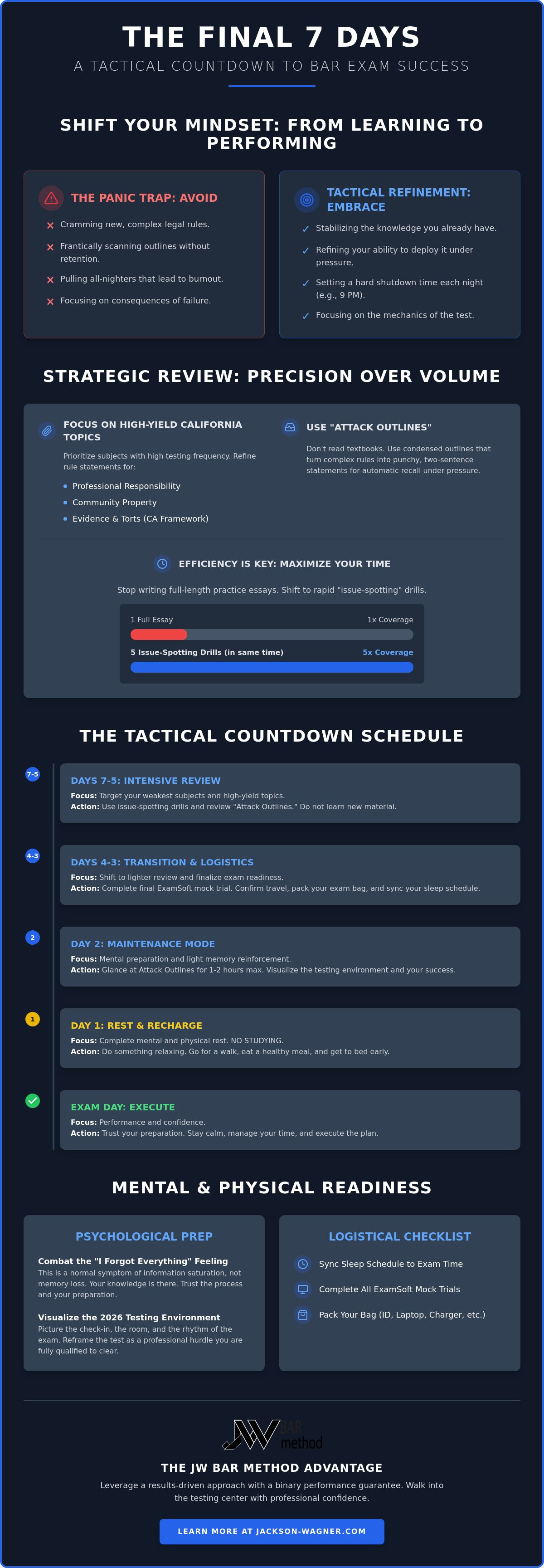
The Tactical Countdown: A Day-by-Day Schedule for Peak Performance
Success on the California Bar Exam requires more than just knowledge; it requires a disciplined tapering of your effort. Just as an athlete doesn't run a marathon the day before the Olympics, you shouldn't be grinding through 12-hour study blocks in the final 72 hours. Your objective for what to do the week before the bar exam is to transition from heavy lifting to mental agility. This schedule is designed to ensure you hit your peak on Tuesday morning rather than burning out on Sunday afternoon. By following a structured countdown, you replace the chaos of last-minute cramming with the professional precision of a veteran litigator.
Days 7 through 5 are your final opportunities for deep dives. This is the window to confront your weakest high-yield subjects, whether that is the nuances of California Evidence or the complexities of Real Property. Use these days to complete one final 50-question MBE set. This isn't about learning new law; it's about maintaining your timing and rhythm so that the 200 questions on Wednesday feel like a routine exercise. If you haven't yet mastered your timing, consider the JW Bar Method Accelerated Prep - Full California Bar Exam to streamline your final approach.
Days 7 to 4: The Final Polish
During this period, focus on finalizing your "mental maps" for Constitutional Law and other heavy hitters. You should be able to close your eyes and see the branching logic of a First Amendment analysis or a hearsay exception. For practicing lawyers from other jurisdictions, this is also the time to ensure you have fully internalized the California Attorney's Exam requirements. The distinction between the full exam and the attorney's variant is subtle but critical, particularly regarding which sections you are exempt from and how that affects your overall scoring strategy. Spend these days polishing rule statements until they are punchy and impossible to misstate.
The Final 48 Hours: Tapering for Peak Performance
When you reach the 48-hour mark, you must stop taking full-length practice exams. The risk of a low score damaging your confidence far outweighs any marginal gain in knowledge. Transition to the "Half-Day" rule on Day 2. Review only your most critical "Must-Know" rule statements and your Personal Error Log. This log is your secret weapon; it contains the specific traps you've fallen into over the last ten weeks. Reviewing it ensures you don't repeat those mistakes when they matter most. On Day 1, the only thing on your schedule should be total cognitive rest. Stage your "Go-Bag," confirm your travel to the 2026 testing center, and then shut down your brain. You've done the work.
On Tuesday morning, your focus shifts to the execution mindset. Use the JW Bar Method "First Page" routine. When you open that first essay booklet, don't just start typing. Take two minutes to breathe, read the call of the question, and outline your headers. This small act of discipline prevents the "blank page" syndrome and signals to your brain that you are in control. You aren't there to learn law; you're there to demonstrate mastery. Walk into the room with the quiet confidence of someone who has already won.
The JW Bar Method Advantage: Precision Over Volume in 2026
The final seven days are where months of preparation meet the reality of the testing center. While legacy programs often bury students under a mountain of generic outlines, the JW Bar Method prioritizes surgical precision. Understanding exactly what to do the week before the bar exam is the cornerstone of our pedagogical approach. We don't believe in the "more is better" philosophy that frequently leads to late-stage burnout. Instead, we focus on the specific levers that move your score from the danger zone to the passing column. Our curriculum is built for the modern learner who demands efficiency and a clear, reliable path to licensure.
Our Binary Performance Guarantee serves as a testament to our efficacy. We are so certain of our methodology that we assume the financial risk of your performance. This isn't just a study tool; it's a professional partnership. By utilizing our accelerated tracks, you ensure that every hour of your final week is spent on high-yield execution rather than aimless review. When you follow our roadmap for what to do the week before the bar exam, you aren't just studying; you're executing a proven tactical plan designed for the 2026 California cycle. This results-driven mindset is why our candidates consistently outperform those using conventional, volume-heavy formats.
The JW Method Advantage for California Licensure
Precision pedagogy is essential when facing the State Bar of California's unique scoring metrics. Generic "big box" prep courses often waste your final week on subjects that have a low probability of appearing or on formats that don't match the 2026 requirements. We move beyond these outdated standards by providing expert-level feedback that helps you secure those final, crucial points. Our JW Bar Method Prep - Full Exam California Bar focuses on the specific sub-topics that graders use to distinguish between minimum competence and professional mastery. This targeted focus allows you to walk into the exam room with a level of confidence that volume-heavy study simply cannot provide.
Securing Your Professional Future
The transition from a bar candidate to a Counselor-at-Law requires a structured, reliable path to success. High-stakes exams demand more than just hard work; they demand a sophisticated strategy that accounts for cognitive limits and physical endurance. The JW Bar Method empowers you with the flexibility to manage your final days with professional precision. You have done the heavy lifting, and now it's time to trust the system that has been refined for this exact moment. Stop guessing and start performing. Join the next cohort of successful California Attorneys with the JW Bar Method and secure the future you have worked so hard to build.
Secure Your Professional Future in 2026
Your final seven days shouldn't be defined by panic; they should be defined by professional execution. By shifting your focus from learning new law to refining high-yield California subjects and stabilizing your logistics, you ensure that your months of hard work translate into a passing score. Mastering exactly what to do the week before the bar exam allows you to walk into the testing center with the mental clarity required to dismantle complex fact patterns with surgical precision. This transition from a student's mindset to a practitioner's mindset is the ultimate key to clearing the two-day gauntlet.
We provide a modern alternative to legacy prep through the proprietary JW Bar Method. Our approach offers specialized tracks, including the JW Bar Method Accelerated Prep - Attorney’s Exam California Bar, and a bold performance-based financial guarantee that distinguishes us from cautious competitors. We assume the risk of your outcome because we are certain of our precision pedagogy and its ability to produce results. Stop the cycle of information overload and choose a structured path that respects your time and your professional goals. Pass the California Bar Exam with the JW Bar Method and take the final step toward your legal career with total confidence. You've prepared for this moment; now it's time to claim your results.
Frequently Asked Questions
Should I take a full practice exam the week before the bar exam?
You should avoid taking full-length practice exams during the final seven days. The cognitive fatigue and potential for a late-stage confidence hit far outweigh any marginal gains in stamina. Instead, focus on shorter, timed sets of 30 to 50 MBE questions and issue-spotting drills for essays. This approach maintains your rhythm without the risk of burnout that comes from a full day of testing.
How many hours should I study daily during the final week?
Your study hours should taper as the week progresses. Begin the week with six to eight hours of focused, high-yield review, but reduce this to four or five hours by the weekend. The goal of what to do the week before the bar exam is to maintain mental sharpness, not to engage in deep learning. Quality of review is now more valuable than the quantity of hours spent at your desk.
When is the best time to stop studying before the California Bar Exam?
You should stop all intensive studying at least 24 hours before the exam begins. For the July 2026 cycle, this means closing your books by Monday morning. Use this final day for logistical staging and total cognitive rest. Pushing through to Monday night often leads to diminished returns and increased anxiety, which can negatively impact your performance during the Tuesday morning essay sessions.
What should I do if I feel like I have forgotten all the law I learned?
Recognize that this feeling is a common psychological response to information saturation. You haven't actually lost the knowledge; your brain is simply prioritizing storage over retrieval under high stress. Review your "Attack Outlines" or JW Bar Method milestones to prove your competence to yourself. Trust that the structure of the exam prompts will trigger the recall you've spent months building through disciplined practice.
How do I handle the Performance Test (PT) review in the final days?
Focus your PT review on formatting and time-management templates rather than practicing full 90-minute simulations. Ensure you can set up the headers for memos, briefs, and letters in under five minutes. Reviewing "File" and "Library" navigation strategies is the most efficient use of your time. This ensures you can handle the unique 90-minute California PT structure without getting bogged down by factual distractors in the moment.
What are the specific California Bar security and laptop rules for 2026?
For the July 2026 exam, you must use Examplify software and complete your mandatory mock exam by July 24. Security remains strict; you are permitted an analog watch but no digital devices. Ensure your government-issued ID is current and that you've paid the $153 laptop fee. Check the State Bar's latest bulletins for specific rules on quiet snacks and the required clear plastic bags for personal items allowed in the hall.
How can I adjust my sleep schedule if I am a night owl?
Shift your wake-up time incrementally by 30 minutes each day starting a week before the exam. Aim for a 6:00 AM wake-up call to align with the 2026 testing center check-in requirements. Eliminate blue light from screens after 7:00 PM and avoid high-stimulant study sessions late at night. This gradual adjustment ensures your peak cognitive alertness coincides with the morning essay sessions rather than occurring late in the evening when the test is over.
What is the most common reason high-achievers fail in the final week?
The most common reason for failure is the attempt to master new, complex subjects during the final countdown. This leads to information overload and "panic-looping," where candidates scan outlines without meaningful retention. High-achievers often struggle with letting go of the need for total mastery. Success requires trusting your existing foundation and focusing on what to do the week before the bar exam to preserve your energy for the two-day gauntlet.


