

Why do seasoned litigators with decades of experience often struggle to pass the one-day california attorney's exam? It isn't a lack of legal acumen; it is a failure to realize that the State Bar demands a specific, academic performance that often contradicts your daily practice. You are likely balancing a demanding caseload and a 40-plus hour work week. The fear of failing a high-stakes exam after years of professional success is a heavy burden to carry.
We agree that your time is far too valuable to waste on legacy study methods that don't respect your expertise. This guide ensures you master the unique requirements and high-stakes strategy needed to pass the California Attorney’s Exam while maintaining your professional practice. We'll provide a clear understanding of California-specific essay nuances and a streamlined study plan designed for first-time results. You will learn exactly how to transition from the courtroom to the exam room without missing a beat in your career, ensuring you avoid the biennial exam cycle entirely.
Key Takeaways
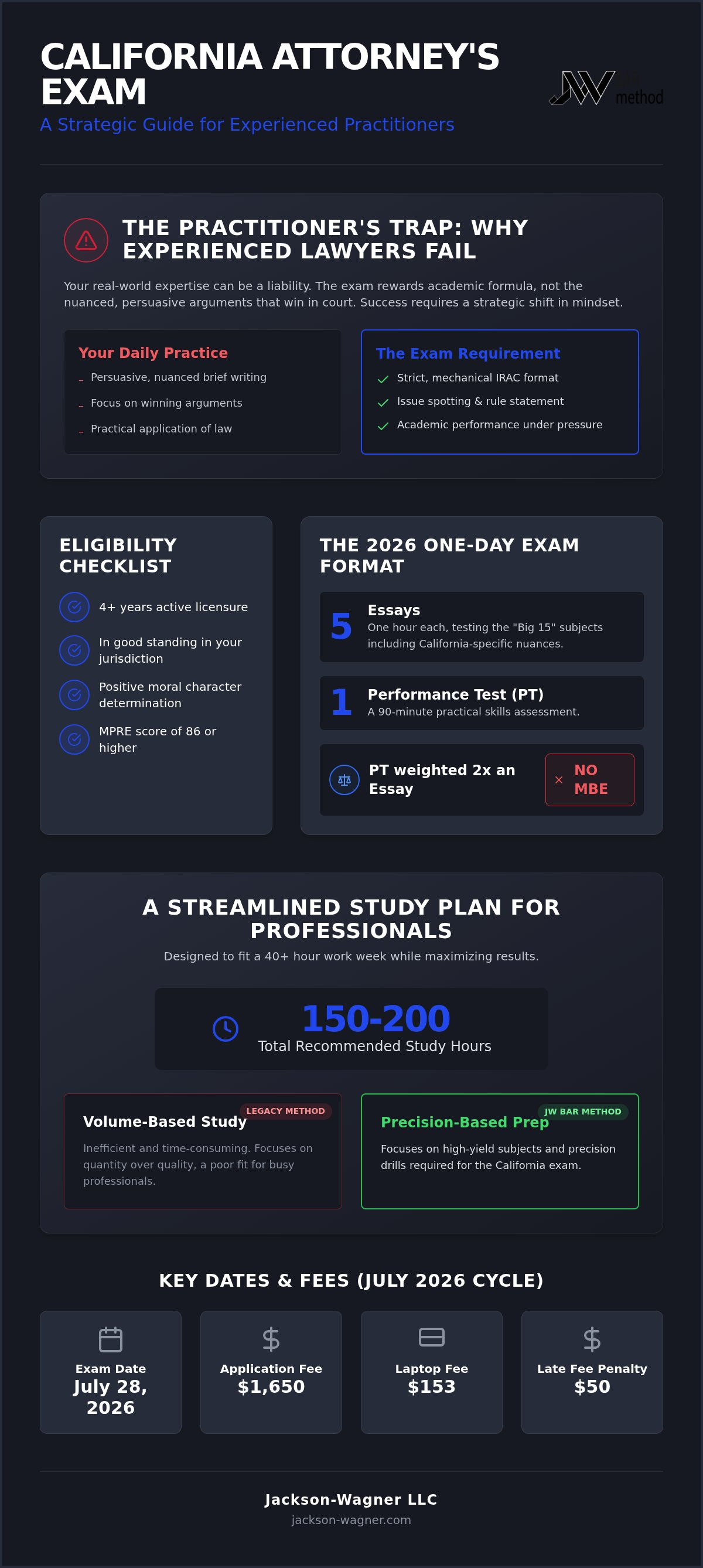
- Confirm your eligibility by verifying the four-year active licensure and good standing requirements necessary to qualify for the abbreviated one-day format.
- Master the high-stakes 2026 schedule, which replaces the Multistate Bar Examination with five intense essays and a single 90-minute Performance Test.
- Identify the "practitioner’s trap" where your professional experience might conflict with the specific academic grading criteria of the california attorney's exam.
- Develop a streamlined 150 to 200 hour study plan that prioritizes high-yield subjects and fits into a demanding 40-plus hour work week.
- Utilize the modern JW Bar Method to move beyond legacy, volume-based study habits and focus on the precision drills required for California licensure.
Understanding the California Attorney’s Examination Requirements
The california attorney's exam is a specialized, one-day path designed exclusively for experienced out-of-state practitioners. Unlike many other states, California rejects the concept of reciprocity or admission on motion. If you want to practice here, you must prove your competence through examination. The State Bar of California administers this rigorous assessment to ensure that every licensed attorney meets the state's high standards, regardless of their success in other jurisdictions. This one-day format is a privilege earned through years of practice, not a right, and it demands total compliance with strict eligibility protocols.
Eligibility and the 4-Year Rule
To qualify for the one-day format, you must have been actively licensed and in good standing in another U.S. jurisdiction for at least four years immediately preceding your application. This isn't just a cumulative total. Calculating this four-year window requires precision. If you spent two years on inactive status or took a sabbatical, those months don't count toward your requirement. The State Bar is meticulous in its verification, requiring proof that you've been a practicing professional without significant gaps.
If your record includes disciplinary action, your eligibility isn't automatically voided, but it will trigger a much more intensive review process. You must be active and in good standing at the precise moment you apply and sit for the exam. Any lapse in your home state’s dues or compliance during the application window can disqualify you from the abbreviated attorney's track, forcing you into the full two-day general bar exam. We recommend verifying your status with your home bar at least six months before the California filing deadline.
The Registration and Application Timeline
Planning for 2026 requires strict adherence to administrative deadlines. For the July 2026 cycle, the initial filing deadline is April 1, with the exam taking place on Tuesday, July 28. If you're targeting the February 2027 cycle, mark February 23 on your calendar. Beyond the $1,650 application fee, you'll need to provide a Certificate of Good Standing from every jurisdiction where you've been admitted. Late applications incur a $50 penalty, and using a laptop requires an additional $153 fee.
A critical component of your admission is the Multistate Professional Responsibility Examination (MPRE). You must achieve a scaled score of 86 or higher to satisfy the requirement. Additionally, the State Bar requires a positive moral character determination, a process that can take six months or longer to complete. We recommend starting this immediately. For a deep dive into this complex requirement, consult our California Bar Exam Moral Character Application Guide to ensure your background check doesn't stall your licensure.
The One-Day Format: Essays and the Performance Test
The 2026 california attorney's exam is a 6.5-hour endurance test that leaves no room for error. On Tuesday, July 28, you'll face five one-hour essays in the morning followed by a single 90-minute Performance Test (PT) in the afternoon. This condensed format removes the Multistate Bar Examination (MBE) entirely. While many attorneys celebrate the lack of multiple-choice questions, it creates a high-stakes environment where your entire grade depends on written performance. The State Bar provides official context for these California bar admission examinations, confirming that the PT is weighted at twice the value of a single essay. You must reach a minimum scaled score of 1390 to pass, which requires the physical and mental stamina to maintain precision through six and a half hours of intense drafting.
Mastering the Five California Essay Questions
The State Bar frequently tests a rotating selection of the "Big 15" subjects, including California-specific nuances in Evidence, Civil Procedure, and Professional Responsibility. You can't rely on general common law or your experience in other jurisdictions. Success requires strict adherence to the IRAC (Issue, Rule, Analysis, Conclusion) format. This often feels regressive to experienced litigators who are used to persuasive, nuanced brief writing. Graders are looking for mechanical application rather than creative lawyering. You must also prepare for "crossover" questions, where a single prompt might blend Community Property with Wills and Trusts or Torts with Remedies.
The 90-Minute Performance Test (PT) Strategy
The PT is often the "make or break" section for out-of-state lawyers. It simulates a real-world legal task, such as drafting a memo or a closing argument, using only a provided "File" and "Library." The challenge isn't the law; it's the 90-minute clock. You must extract relevant facts and rules with surgical efficiency. Many practitioners fail here because they over-analyze the facts or attempt to bring in outside legal knowledge that isn't in the provided Library. Mastering the PT requires a disciplined approach to outlining that ensures you finish the work product with time to spare. To help you refine this specific skill set, we recommend the JW Bar Method Prep - Attorney’s Exam California Bar, which treats the PT as a precision drill rather than a creative writing exercise.
Why Experienced Lawyers Fail: Avoiding the Practitioner’s Trap
Experienced attorneys often approach the california attorney's exam with a dangerous level of overconfidence. You've spent years winning cases, managing clients, and drafting airtight contracts. However, the State Bar's grading rubric doesn't reward professional expertise; it rewards compliance. The "Practitioner’s Trap" occurs when your real-world experience conflicts with "Bar World" rules. In your office, you have the luxury of research. In the exam room, you must carry the entire cognitive load of California's specific codes in your head. This transition from "looking it up" to "knowing it cold" is where many successful lawyers stumble.
Practitioners frequently fail sections like Evidence and Civil Procedure because they rely on local court customs rather than black-letter law. You might know how a specific judge interprets a rule, but the California Bar Examination format requires you to apply the law exactly as written. If you argue equitable principles or "common sense" where a clear statute exists, you will lose points. The graders aren't looking for a sophisticated legal mind; they're looking for a candidate who can follow a rigid logic tree under extreme pressure.
Unlearning Practice Habits for Exam Success
In your daily practice, the answer to most legal questions is "it depends." On the California Bar, that phrase is a recipe for failure. You must commit to a definitive rule and apply it. Graders want to see a mechanical application of IRAC that prioritizes black-letter law over creative arguments. You aren't writing for a judge who understands the nuances of your case. You're writing for a grader who has a checklist of issues they need you to spot. If you focus on equity instead of the specific elements of a tort or contract, you won't meet the passing threshold.
Managing the "Expert Bias"
Your previous decade of practice in another jurisdiction can actually be a liability. Whether it's New York's hearsay exceptions or Texas's service of process rules, your brain is wired for a different system. You must compartmentalize that knowledge to pass the california attorney's exam. This is especially true for the Performance Test. You must use only the provided "Library" and "File." Bringing in outside legal knowledge is an automatic score killer. We've proven that precision beats volume in bar prep, and for the experienced attorney, that means stripping away the habits of a practitioner to become a world-class test-taker for one day.
Strategic Preparation: Balancing a Full-Time Practice with Study
Our 8-week timeline is designed to integrate into your existing professional life. During weeks one through four, you will focus on substantive review and building your rule outlines. Don't get bogged down in obscure common law history; stick to the black-letter rules that graders actually look for. From weeks five to seven, you must transition to high-intensity output. This involves drafting essays and performing PT drills under strictly timed conditions to build the mental muscle memory required for a 6.5-hour testing day. Your final week is reserved for simulations and "memorization sprints" to lock in the exact phrasing needed for the exam room.
High-Yield Topic Prioritization
Not all subjects are created equal in the eyes of the State Bar. Professional Responsibility is a guaranteed testable subject on every california attorney's exam, making it your highest priority. You must master the specific distinctions between the ABA Model Rules and the California Rules of Professional Conduct. Beyond that, focus your energy on the "Big Three" of California law: Community Property, Wills and Trusts, and Business Associations. These subjects appear with high historical frequency and offer the greatest return on your study investment. For a more granular breakdown of testing trends, consult The Definitive Strategic Guide to the CA Bar.
Maximize your "dead time" by utilizing auditory learning during your commute or reviewing digital flashcards between client meetings. This strategy allows you to maintain your practice while building the necessary knowledge base in the background. If you are ready to secure your California license without sacrificing your professional standing, the JW Bar Method Accelerated Prep - Attorney’s Exam California Bar is the only choice for the modern practitioner.
The JW Bar Method: Precision Prep for the Attorney’s Exam
The JW Bar Method represents a fundamental shift away from legacy educational models that prioritize volume over precision. Jackson-Wagner LLC recognizes that as a practicing attorney, your primary obstacles are time and the practitioner's trap discussed in previous sections. Our approach is built on structured learning environments that replace the stress of high-pressure certification with a reliable path to success. We don't treat the california attorney's exam as a minor hurdle; we treat it as a surgical operation that requires a specialized toolset. While standard courses overwhelm you with thousands of multiple-choice questions you'll never see, our method focuses exclusively on the written mastery required for the one-day format.
JW Bar Method Prep - Attorney’s Exam California Bar
Our specialized track for out-of-state lawyers is a comprehensive deep-dive into California-specific essay subjects. We don't just provide generic outlines; we provide interactive workshops focused on mastering the 90-minute Performance Test. These sessions are designed to turn your professional drafting skills into a precision instrument that satisfies the State Bar's rigid grading rubric. You'll receive personalized feedback from California bar experts who understand the unique needs of a practitioner. They won't just tell you what the law is. They'll show you exactly how to present it so a grader can check every box on their list in seconds. This level of mentorship ensures you are never studying in a vacuum, providing the structured, modern, and reliable path you require.
The Accelerated Prep Advantage
The Accelerated Prep track is the gold standard for working attorneys with limited bandwidth and high stakes. We leverage your existing legal knowledge to shorten the learning curve, focusing your energy on Attack Outlines and high-yield rule statements. These tools are designed for rapid recall during the grueling 6.5-hour testing day. Our methodology is built on efficiency, ensuring you get the maximum ROI on every hour you spend studying. Jackson-Wagner LLC is so confident in this structured, modern approach that we assume the financial risk of your performance outcome through our signature guarantee. This is a partnership built on bold reliability. If you are ready to secure your licensure with a partner that values your time as much as you do, it's time to choose a results-oriented path. Secure your spot in the 2026 JW Bar Method Prep Program and ensure you pass the california attorney's exam on your first attempt. Replacing the stress of high-pressure certification with empowerment is our primary mission.
Secure Your California Licensure in 2026
Success on the california attorney's exam requires more than just years of professional practice; it demands a surgical transition from practitioner to elite test-taker. You must navigate the rigid one-day format by mastering specific IRAC requirements and the high-stakes 90-minute Performance Test. By focusing on high-yield subjects and a "minimum effective dose" of study, you can protect your existing practice while achieving a first-time passing result. Jackson-Wagner LLC provides the only proprietary JW Bar Method designed exclusively for the modern, busy professional. Our accelerated 2026 tracks ensure you aren't wasting time on legacy, volume-based models that don't respect your expertise. We are exclusively focused on your California licensure success and offer the structured, reliable path you need to move forward. Master the Attorney’s Exam with the JW Bar Method. You've already built a successful career; now it's time to take the final step toward your California practice with absolute confidence.
Frequently Asked Questions
Is the California Attorney’s Exam easier than the General Bar Exam?
No, the california attorney's exam isn't necessarily easier; it is just more condensed. While you skip the two hundred multiple choice questions of the general bar, the entire weight of your grade rests on the written portion. This format creates a high stakes environment where a single weak essay can prevent you from passing. You don't have the luxury of using the MBE to offset a difficult essay prompt.
How many years of practice do I need to qualify for the one-day exam?
You must have been actively licensed and in good standing in another United States jurisdiction for at least four years immediately preceding your application. This requirement is strictly enforced by the State Bar. Periods of inactive status or suspension don't count toward your four year total. You should verify your continuous active status with your home bar before applying to ensure you qualify for this specialized one day track.
Can I take the Attorney’s Exam if I am licensed in another country?
No, the one day format is reserved exclusively for attorneys licensed in a United States jurisdiction. If you're licensed only in a foreign country, you must sit for the full two day General Bar Examination. This rule applies regardless of your years of experience or professional standing abroad. Foreign applicants are required to complete both the written components and the multiple choice Multistate Bar Examination to achieve licensure.
What is the passing score (scaled score) for the California Attorney’s Exam in 2026?
The minimum passing scaled score for the california attorney's exam in 2026 is 1390. This score is calculated based on your performance on the five essays and the Performance Test. Since there is no MBE component to buffer your results, every point on the written portion is essential. Reaching this threshold requires a mechanical application of law that prioritizes clarity and issue spotting over the creative arguments used in daily practice.
Do I need to take the MPRE again if I am already licensed out-of-state?
Yes, you must provide a scaled score of 86 or higher on the Multistate Professional Responsibility Examination (MPRE). California doesn't waive this requirement for experienced practitioners. If you haven't taken the MPRE or if your previous score doesn't meet the 86 point threshold, you'll need to sit for it again. This requirement is separate from the attorney's exam but essential for your final admission to the bar.
What happens if I fail the Attorney’s Exam? Can I take it again?
If you don't achieve a passing score, you're permitted to retake the exam during any future administration. California offers the test twice a year in February and July. However, failing requires you to repeat the entire application process and pay the fees again. Our accelerated programs are designed to help you avoid this biennial cycle by focusing on the precision drills needed for a first time passing result.
How much study time is realistically required for a practicing lawyer?
A focused professional can realistically prepare in 150 to 200 hours using an accelerated methodology. While legacy bar prep companies suggest 40 hours a week, that isn't feasible for a senior associate or partner. By stripping away the academic fluff and focusing on high yield California subjects, you can master the necessary rule statements in about eight weeks. Efficiency is the key to balancing your study with a demanding 40 plus hour work week.
Does the California State Bar offer reciprocity for any states?
No, the California State Bar doesn't offer reciprocity or admission on motion for any other jurisdiction. Every out of state lawyer seeking a license must pass an examination. While the attorney's exam provides a shorter path for those with four years of active experience, it's still a rigorous test of competence. You must prove your knowledge of California law regardless of your professional success in other states.


