

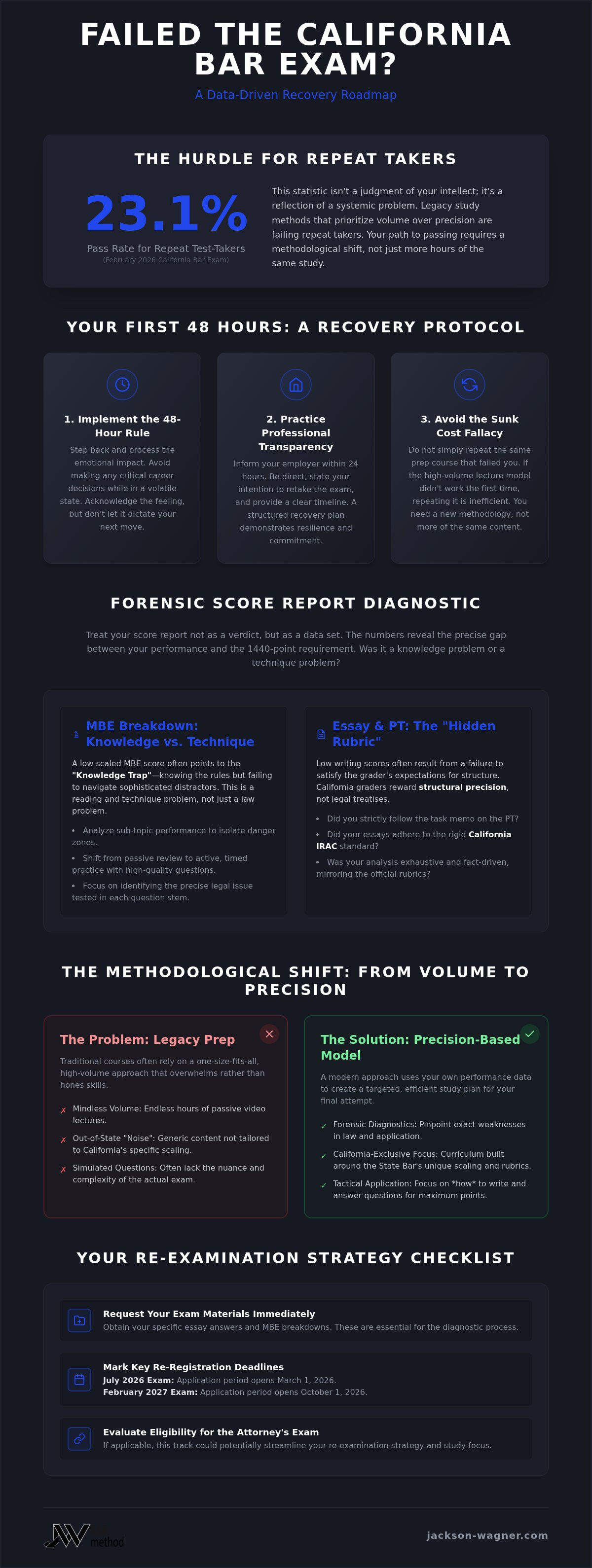
Only 23.1% of repeat test-takers passed the February 2026 California Bar Exam. If you're staring at a "fail" notice, that statistic isn't just a number; it's a reflection of the professional embarrassment and financial anxiety you're feeling right now. You've likely exhausted yourself following legacy study methods that prioritize mindless volume over actual mastery, leaving you wondering if your career is stalled before it truly began. It isn't. The problem isn't your intellect; it's a pedagogical framework designed for a testing environment that has moved on without the big-box providers.
This recovery plan provides a structured, diagnostic roadmap for what to do if you fail the california bar exam so you can transform this setback into a license. We're replacing the stress of high-pressure certification with a modern, reliable path to success. You'll learn how to conduct a forensic audit of your score report, develop a study schedule that fits the reality of a working professional, and adopt a precision-based approach that makes your next attempt your last. We'll move from the immediate shock of the results to a steady, logical explanation of how the JW Bar Method secures your professional future.
Key Takeaways
- Implement the "48-hour rule" to process the emotional impact before you make any critical career decisions.
- Perform a forensic score report diagnostic to determine if your gap lies in black-letter law or tactical application.
- Discover what to do if you fail the california bar exam by shifting from high-volume "legacy" lectures to a precision-based study model.
- Evaluate your eligibility for the Attorney’s Exam track to potentially streamline your 2026 re-examination strategy.
- Leverage a California-exclusive curriculum that eliminates out-of-state "noise" and focuses on the specific scaling of the State Bar.
Navigating the Immediate Aftermath of California Bar Results
The first 48 hours after receiving a negative result are the most volatile. It's critical to step back and allow the emotional impact to settle before making any career-altering decisions. Many high-achieving law graduates struggle to reconcile their academic success with a failing score, often because they don't understand the unique scaling mechanics used by the State Bar of California. A score of 1430 might feel like a near-miss, but in the context of California's rigorous weighting, it indicates a specific tactical deficiency rather than a lack of intelligence.
When you're deciding what to do if you fail the california bar exam, transparency with your employer is your strongest professional asset. Reach out to your firm or organization within 24 hours of the results release. Be direct. State your intention to retake the exam and provide a clear timeline for the next administration. Most partners value a resilient, structured recovery plan over a vague promise to "try harder."
Avoid the "Sunk Cost Fallacy" during this transition. Many repeaters believe that because they've already invested thousands in a legacy prep course, they should simply repeat that same curriculum. This is a mistake. If the 10-week, high-volume video lecture model didn't work the first time, doing it again is unlikely to yield a passing 1440. You need a different methodology, not just a second helping of the same content.
The Psychology of Professional Recovery
Immediate Logistics and Deadlines
The window for re-registration is narrow. For the July 2026 exam, the application period opens on March 1, 2026. If you're targeting the February 2027 administration, mark October 1, 2026, on your calendar. You must also request your specific essay answers and MBE breakdowns immediately. These documents are the only way to identify whether your scores were dragged down by a single weak subject or a general lack of performance test speed. Understanding the "Lapse in Application" rules is also vital to avoid unnecessary late fees.
Diagnosing the Failure: Analyzing Your Score Report with Precision
A score report diagnostic is the clinical process of identifying whether your failure was due to "Black Letter" ignorance or "Application" deficiency. Most candidates treat their results as a final verdict. For the modern professional, these numbers are actually a roadmap. They tell you exactly what to do if you fail the california bar exam by highlighting where your methodology collapsed. The data doesn't lie; it reveals the specific gaps between your current performance and the 1440-point requirement.
MBE Breakdown: Knowledge vs. Technique
Your scaled MBE score is the ultimate barometer of foundational speed and accuracy. Many examinees fall into a "knowledge trap." They know the rules but cannot navigate the sophisticated distractors in Property or Evidence questions. This is usually a reading problem disguised as a law problem. Legacy prep courses often rely on simulated questions that lack the nuanced complexity of the current standards. According to the February 2026 Bar Exam Results, repeaters struggle significantly more than first-time takers, often because they fail to pivot their MBE technique. You must analyze your sub-topic performance to isolate specific danger zones.
Essay and Performance Test (PT) Evaluation
The disconnect between legal knowledge and essay scores usually stems from a failure to satisfy the "Hidden Rubric." California graders don't want a treatise. They want structural precision. If your Performance Test (PT) score was low, analyze whether you ran out of time or ignored the task memo. The California IRAC standard is the core of essay success, requiring a rigid adherence to clear rule statements and exhaustive, fact-driven analysis that mirrors the State Bar’s specific grading rubrics. To bridge this gap, consider an accelerated preparation track that focuses on these writing mechanics rather than passive video consumption.
Hitting a 1390 or 1400 is a specific kind of frustration. It suggests you have the law down but lack the "scaling" margin. You don't need another 500 hours of video lectures. You need a precision-based intervention. Understanding what to do if you fail the california bar exam involves moving past the "volume trap" and into a data-driven diagnostic phase. This requires a forensic audit of your previous study schedule to identify where your time was wasted on low-yield activities.
Why Legacy Prep Courses Often Fail Repeat Takers
Legacy prep providers rely on a "one-size-fits-all" model that prioritizes mindless volume over tactical execution. This "Volume Trap" forces you to sit through 100 hours of video lectures, a low-yield activity for someone who has already seen the material. For repeat takers, the challenge isn't a lack of information; it's a failure of retrieval and application under pressure. Checking boxes on a generic syllabus creates a false sense of security while leaving your specific technical gaps unaddressed. Knowing what to do if you fail the california bar exam starts with identifying that you don't need a broad survey of the law; you need a sharp, diagnostic intervention.
National courses often suffer from excessive generalization. Because they cater to a broad audience, they frequently miss the specific "scaling" nuances and grading quirks unique to the State Bar of California. When you are determining what to do if you fail the california bar exam, you must recognize that "more material" is rarely the answer. The JW Bar Method replaces passive consumption with active production. It forces you to engage in high-stakes drills that mimic the intensity of the actual 2026 exam environment, ensuring you are prepared for the specific way California tests its candidates.
The Efficiency Gap in 2026 Bar Prep
Standard 10-week courses are designed for 3L students who have no professional obligations. Repeaters and working attorneys require a different pedagogical arc that respects their time and focuses on surgical interventions. This is where Why Precision Beats Volume becomes a critical concept. Accelerated programs allow you to bypass the foundational fluff and move straight into the high-yield topics that determine your score. The transition from your initial interest to the actual study process should be fast, efficient, and results-oriented.
The Myth of 'More Material'
A 2,000-page outline is often the enemy of a passing score. It creates cognitive overload, making it impossible to master the highly tested areas with the required precision. Success in 2026 requires a focus on "Precision Pedagogy," where you master the most frequent subjects with absolute certainty. By utilizing high-stakes drills rather than passive reading, you build the mental stamina needed for the two-day California marathon. This shift from "knowing" to "doing" is what separates a 1390 from a 1440. You need a curriculum that assumes competence and targets mastery through active, high-yield engagement.
Developing Your 2026 Re-Examination Strategy
Your 2026 recovery requires a clinical pivot from passive learning to strategic execution. The core of what to do if you fail the california bar exam is developing a schedule that respects your professional reality rather than forcing you into a 40-hour-per-week "legacy" grind. You don't need more hours; you need higher efficiency within the hours you have. This strategy isn't about hope. It's about data-driven adjustments that ensure your next attempt is your final one.
- Step 1: Conduct a 'Post-Mortem'. Identify exactly where your previous schedule leaked time. Were you spending hours on low-yield video lectures instead of active essay drafting?
- Step 2: Select Your Track. Decide between the Full Bar Exam and the Attorney's Exam if you meet the practice requirements. This choice dictates your entire pedagogical focus.
- Step 3: Define Your Window. Map out a 30, 60, or 90-day accelerated study window. A shorter, higher-intensity burst is often more effective for repeaters than a long, drawn-out cycle that leads to burnout.
- Step 4: Prioritize Active Tools. Secure study tools that emphasize immediate essay feedback and high-stakes MBE drills over passive reading.
- Step 5: Adopt a 'Binary Success' Mindset. The State Bar doesn't award extra points for perfection. Focus exclusively on hitting the 1440 threshold with the least amount of wasted effort.
Special Considerations for Practicing Attorneys
If you're already licensed in another jurisdiction and have practiced for at least four of the last six years, you might be eligible to bypass the MBE entirely. Review the California Attorney's Exam Requirements to see if you can focus your energy solely on the essay and performance test portions. Balancing a full-time practice while studying is a significant challenge. Our JW Bar Method Accelerated Prep is specifically designed for this demographic, replacing the 10-week student model with a streamlined, results-oriented framework that fits into a lawyer's billable day.
The 2026 Testing Environment
The July 2026 California Bar Exam will take place on Tuesday, July 28, and Wednesday, July 29. You must be prepared for the logistical realities of the in-person testing sites, including the specific laptop software requirements for ExamSoft. Understanding the nuances of the two-day format is essential for pacing. For a deeper look at the specific tactics required for this cycle, consult our guide on Passing the California Bar Exam in 2026. Success in this environment requires more than law; it requires a mastery of the testing interface and the mental stamina to perform over two high-pressure days.
If you're ready to stop the cycle of "volume-based" failure and start a precision-based recovery, enroll in a JW Bar Method prep track today and secure your licensure.
Shifting to the JW Bar Method for Your Final Attempt
The JW Bar Method isn't just another study plan; it's a proprietary pedagogical framework designed specifically for the high-stakes environment of the State Bar of California. While legacy courses attempt to cover every jurisdiction, our curriculum is exclusively California-focused. This eliminates the "noise" of out-of-state law and allows for a surgical focus on the specific scaling and grading rubrics that determine your success. When you're deciding what to do if you fail the california bar exam, the most effective choice is to move away from generalist providers and toward a specialist who assumes the financial risk of your outcome.
Our method utilizes "Precision Pedagogy" to identify and repair the technical deficiencies revealed in your previous score report. We don't ask you to re-watch 100 hours of basic lectures. Instead, we provide an accelerated path that respects your existing knowledge while demanding active production in your weakest areas. This results-oriented approach replaces the anxiety of high-pressure certification with a structured, modern, and reliable path to licensure. We lead with a bold financial assurance because we believe in the efficacy of our structured learning environment.
Customizing Your Recovery Plan
Repeat candidates don't need a foundation; they need a refinement. Our diagnostic tools allow you to skip the concepts you've already mastered, focusing your energy on the "danger zones" that dragged your score below 1440. This is why our Accelerated Prep tracks are considered the gold standard for working professionals. We integrate structured essay grading that mirrors the State Bar's specific grading rubrics, ensuring your writing reflects the precision graders expect. By shifting from passive consumption to active, high-stakes drills, you build the specific mental stamina required for the 2026 administrations.
Taking the Next Step Confidently
The transition from a student's initial interest to their actual study process should be seamless and empowering. When you enroll in our programs, you aren't just buying a syllabus; you're entering a mentor relationship with a team that understands the logistical and administrative nuances of the California system. We act as a partner so certain of our own efficacy that we offer a binary performance guarantee. This bold reliability ensures you feel both motivated and legally protected throughout your final attempt.
Now is the time to stop the cycle of exhaustion from legacy methods that didn't work. The path forward is clear, logical, and transparent. You have the intellect; now you need the methodology. Pass the California Bar with the JW Bar Method and secure the career you've worked so hard to build. Knowing exactly what to do if you fail the california bar exam means choosing a partner who values your time and shares your commitment to a final, successful result.
Secure Your California Licensure in 2026
Failing the bar isn't a reflection of your potential; it's a clear signal that your previous methodology didn't match the State Bar’s unique scaling mechanics. You've learned how to perform a forensic audit of your score report and why legacy, volume-based courses often fail repeaters by prioritizing passive consumption over active mastery. Deciding what to do if you fail the california bar exam requires a strategic pivot toward precision. By focusing on California-exclusive pedagogy and high-stakes drills, you can close the gap between your previous score and the 1440 threshold.
We provide accelerated tracks specifically for working professionals who require flexibility without sacrificing academic rigor. Our binary performance guarantee for all 2026 enrollees ensures that we assume the financial risk of your outcome. You don't need a larger outline or more video lectures; you need a structured, modern framework that targets your specific technical deficiencies with surgical accuracy.
Stop guessing and start passing with the JW Bar Method. Your professional future is waiting. Let's work together to ensure your next attempt is the final one.
Frequently Asked Questions
How many times can you fail the California bar exam?
There is currently no limit on the number of times an applicant can sit for the California Bar Exam. However, each attempt requires a full re-application fee and significant preparation costs. Repeated failures often indicate a fundamental flaw in study methodology rather than a lack of legal knowledge. Instead of repeating the same high-volume legacy courses, candidates should pivot to a precision-based model to ensure their next attempt is the final one.
What is the passing score for the California Bar Exam in 2026?
The minimum passing score for the California Bar Exam remains 1440 out of a possible 2000 scaled points. This score is a combined average of your performance on the Multistate Bar Examination (MBE) and the written portion, which includes five essays and one Performance Test. Achieving this threshold requires a balanced performance across both days. Candidates often miss this mark by narrow margins due to scaling nuances rather than a lack of subject mastery.
Should I quit my job to study for the bar exam a second time?
Quitting your job isn't always the optimal solution for repeat takers. Many working professionals successfully pass by utilizing accelerated preparation tracks that focus on high-yield topics rather than the 10-week "legacy" grind. A structured, 90-day window allows for consistent, high-intensity study without the financial pressure of total job loss. The key is shifting to an active production model that maximizes the efficiency of your available evening and weekend hours.
How do I analyze my California Bar Exam score report?
When determining what to do if you fail the california bar exam, you must perform a forensic audit of your score report. Compare your scaled MBE score against the national average and examine individual essay scores to identify specific "danger zones." A low Performance Test score usually indicates a timing or structural issue, while inconsistent essay scores suggest a failure to adhere to the California IRAC standard. Treat these numbers as data points for a clinical intervention.
What is the difference between the Full Bar and the Attorney's Exam?
The Full Bar Exam consists of the MBE, five essays, and one Performance Test over two days. In contrast, the Attorney's Exam is limited to the written portion only, bypassing the MBE entirely. Eligibility for the Attorney's Exam generally requires being an active member in good standing of another U.S. jurisdiction for at least four years. This track allows experienced lawyers to focus exclusively on California's specific writing rubrics and structural requirements.
Can I pass the California Bar in 30 days if I failed before?
Passing in a 30-day window is achievable for repeaters who already possess a strong foundational understanding of black-letter law. This "accelerated" approach requires a total shift from passive video consumption to high-stakes active drills and essay drafting. By utilizing diagnostic tools to skip mastered topics, you can focus your remaining time on fixing the tactical errors that caused your previous failure. It's about surgical precision during a high-intensity study burst.
Why is the JW Bar Method more effective for repeaters than conventional courses?
Conventional courses are designed for 3L students who need a broad, foundational survey of the law. Repeaters already have that foundation; they fail because of application errors. The JW Bar Method, provided by Jackson-Wagner LLC, focuses on Precision Pedagogy, replacing passive video hours with active production and high-stakes drills. By targeting the specific technical gaps revealed in your previous attempt, we ensure you spend your time on high-yield activities that directly impact your score.
What happens if I fail the bar exam and have a job offer?
If you fail while holding a job offer, immediate and transparent communication with your employer is essential. Many firms have established policies for "second-chance" candidates, though some offers may be contingent on passing the first time. Presenting a structured recovery plan, such as enrollment in an accelerated prep program, demonstrates professional resilience. It shows your employer that you've identified what to do if you fail the california bar exam and are taking decisive steps to correct it.


