

What if your practice sessions are preparing you for a calmer, shorter exam than the one you’ll actually face? Learning how to simulate exam day conditions means practising more than timed questions. It means reproducing the California Bar Exam’s sequence and sustained workload so timing, focus, and stamina issues show up before test day.
Practice can feel less demanding than the real thing, especially when sessions are interrupted or loosely timed. A full simulation can also be difficult to fit around work and other responsibilities. A repeatable plan helps you practise consistently without treating every study day as exam day.
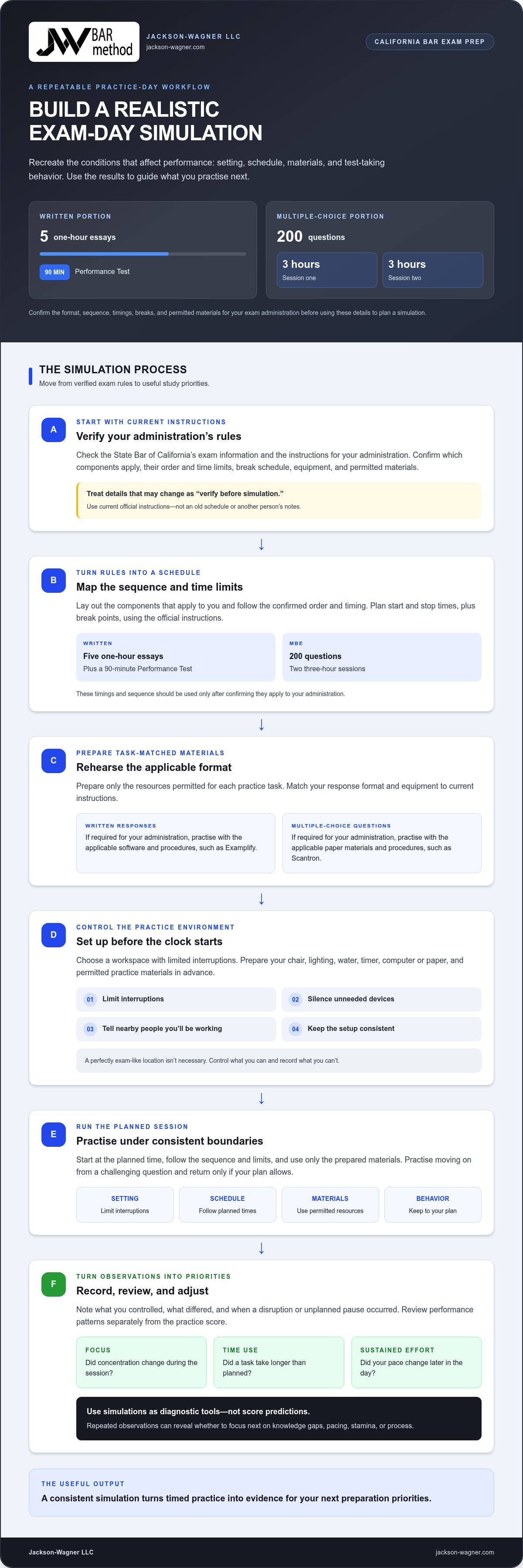
This guide explains which conditions to mirror, how to build a full or split simulation, and what to track. The California Bar Exam’s written day includes five one-hour essays and a 90-minute Performance Test. The MBE is divided into two three-hour sessions. Use your results to target the next stage of preparation, turning practice into a focused plan rather than just another score.
Key Takeaways
- Learn how to simulate exam day conditions by matching verified timing, sequence, materials, and test-taking routines.
- Use a planned simulation to make practice more consistent, even when a full exam day is difficult to fit into your schedule.
- Track conditions and review answers separately to distinguish knowledge gaps from pacing, stamina, or process issues.
- Turn simulation observations into specific priorities for your remaining California Bar Exam preparation.
- Explore how JW Bar Method Prep - Full Exam California Bar can provide a structured preparation path for full-exam candidates.
What It Means to Simulate California Bar Exam Day Conditions
A simulation is planned practice that reproduces conditions affecting your performance: the setting, schedule, materials, and test-taking behavior. It’s more than completing a set of questions. Decide in advance when to begin, what resources to use, how to handle breaks, and what to do when a question feels difficult. That structure makes it easier to compare sessions and spot patterns instead of relying on a single impression.
A useful simulation controls four things: setting, schedule, materials, and behavior. You may not be able to recreate every detail of the official testing environment, but you can make those controllable elements consistent. For background on the exam’s administering body, see the State Bar of California. Before planning a simulation, verify current exam instructions and use the applicable format.
A controlled session differs from an ordinary study block. In a regular session, you might pause the clock to look up a rule, check notes, or take an unscheduled break. Those choices can support learning, but they change the conditions and make it harder to judge whether your timing and focus would hold under exam-like limits. A simulation sets boundaries in advance and records when you depart from them.
- Setting: Choose a workspace where interruptions are limited.
- Schedule: Set a start time and follow the planned sequence and time limits.
- Materials: Prepare only the resources permitted for that practice task.
- Behavior: Practise moving on from a challenging question and returning only if your plan allows.
The goal isn’t to manufacture a score prediction. It’s to build familiarity with sustained, timed work and collect useful evidence about what to practise next. That’s the practical aim of learning how to simulate exam day conditions.
Why realistic practice can reveal more than an untimed study session
Timed retrieval asks you to bring information to mind and use it without stopping to consult notes. It can expose a gap between recognizing a rule during review and recalling it quickly enough to apply it. It also makes pacing visible. You may discover that one answer takes too long, leaving less time for later tasks.
Informal sessions can blur those signals. A phone interruption or an unrecorded pause may affect concentration, while open notes can make recall seem stronger than it is. Log deviations rather than treating a disrupted practice score as directly comparable to a controlled one.
What a simulation can and cannot tell you
Review a session for patterns in focus, time use, and sustained effort. Did your pace change later in the day? Did a particular task take longer than planned? A single result isn’t a reliable forecast of your official exam performance. Practice questions, conditions, and testing environments can differ.
Use simulations as diagnostic tools, not guarantees. You control your preparation setup and process, but you can’t reproduce every feature of an official test site. Record what you controlled, note what differed, and use repeated observations to set more precise study priorities.
Match Practice to Current California Bar Exam Conditions
Before setting a timer or choosing practice materials, verify the instructions for your exam administration. The California Bar Exam’s format, schedule, breaks, and permitted materials determine what a useful simulation should reproduce. Official instructions, not another exam’s routine, should set your simulation rules.
Build the simulation around official exam instructions
Start with The State Bar of California Examinations page and the administration-specific instructions it directs applicants to review. Check which components apply to you, their order and time limits, the break schedule, and the rules for equipment and materials. Mark details that could change between administrations as “verify before simulation” rather than treating an old schedule or someone else’s notes as current guidance.
The format described in State Bar information includes five one-hour essays and a 90-minute Performance Test in the written portion. The MBE consists of 200 questions in two three-hour sessions. Use these timings and sequence only after confirming they apply to your administration. Take break timing and permitted-item rules from current official instructions, not assumptions based on a prior exam.
Match your practice method to each component. If your administration uses a computer for written responses and paper materials for multiple-choice questions, practise those formats separately. If the current instructions require software such as Examplify for written responses or Scantron for the MBE, practise with the applicable equipment and procedures. For each session, note the response format, allowed resources, start and stop times, and permitted break points.
Choose a realistic setting and remove avoidable interruptions
Choose a quiet workspace and prepare it before the clock starts. Set up your chair, lighting, water, timer, computer or paper, and permitted practice materials in advance. This reduces last-minute decisions and helps you focus on the tasks you’re measuring. Silence and put away devices you don’t need, and let people nearby know you’ll be working without interruptions.
A perfectly exam-like location isn’t necessary. A consistent desk at home can still produce useful observations if you control what you can and record what you can’t. If household noise interrupts you, log when it happened and whether you paused. Don’t quietly extend the timer or add an unplanned break. That changes the conditions and makes results harder to compare with later sessions.
- Before practice: Recheck official timing, sequence, breaks, and material rules.
- At setup: Prepare the workspace and resources allowed for that task.
- During practice: Follow the verified schedule and record disruptions or deviations.
- Afterward: Mark any details that need rechecking before the next simulation.
This is a practical starting point for how to simulate exam day conditions without importing rules from a different test. If you want your practice observations to feed into a more structured study plan, explore structured California Bar Exam preparation.
How to Run a California Bar Exam Practice-Day Simulation
A useful practice day starts before the first question. Choose a representative practice exam that matches your preparation and the applicable California Bar Exam format. Then build a routine around the verified schedule, including the order of tasks, time limits, and planned breaks. For a full-day run, keep the sequence intact. If you’re short on time, simulate one complete component rather than compressing several sessions into an unrealistic block.
Prepare the workspace, materials, and schedule in advance
Set up the night before or well ahead of your start time. Lay out only the resources permitted by the verified rules and practice format. Check your computer or paper materials, timer, and any other tools you’ll use. Plan meals, water, and personal needs around the schedule, and tell household members when you’ll be working so they can help prevent avoidable interruptions.
- Step 1: Choose the practice set. Select questions that reflect the topics and response formats you’re currently studying. Avoid reviewing questions or answers in advance, since familiarity can distort their diagnostic value.
- Step 2: Write down the schedule. List each task in order, its verified time limit, and the breaks included in your plan. Make clear whether this is a full simulation or a focused component run.
- Step 3: Prepare the environment. Put permitted materials within reach, silence unrelated devices, and open only the tools needed for the session. Keep notes and answer explanations out of sight.
- Step 4: Start on schedule. Begin at the planned time and use a visible clock or timing method suitable for the practice. Follow each task’s time limit without pausing to check answers or look up rules.
Follow the plan and record what happens
During timed work, take only the breaks included in your verified simulation schedule. Don’t stop the clock to answer a message, research a rule, or recover extra time. If you hit a difficult question, use the approach you intend to practise under exam conditions, such as moving on and returning only if time remains.
Capture observations without turning them into interruptions. Keep a brief condition log nearby and make a quick mark at a natural transition, or write details immediately after a timed block ends. Record when fatigue appeared, whether attention drifted, which tasks ran long, and any distraction or technical issue. If an interruption forces you to pause, note its start and end and whether you stopped the timer. Don’t treat the altered session as uninterrupted.
Afterward, label deviations clearly. A session affected by a device failure or an unscheduled break can still offer useful information, but it shouldn’t be compared as if it followed the plan perfectly. Make how to simulate exam day conditions a repeatable process: prepare deliberately, follow the schedule, record what changed, and preserve an honest account of the conditions for review.
How to Review Simulation Results and Fix Practice-Day Problems
A simulation becomes useful when it changes what you do next. Don’t judge the session by its score alone, and don’t let one difficult practice day trigger a complete overhaul of your study plan. Review the answers and conditions log separately. One shows what happened in your work; the other helps explain the circumstances around it. Together, they can point to a manageable next step.
Turn observations into a focused adjustment
First, review the practice work by component. Note missed issues, incomplete answers, or questions that took longer than planned. Then compare those findings with your log. Did your pace slow near the end? Was recall difficult across several tasks, or did a distraction interrupt one block? Look for patterns across sessions before treating a single problem as a trend.
Use the pattern to choose a targeted follow-up:
- Knowledge gap: Revisit the rule or topic, then test recall with a short, closed-note drill.
- Pacing issue: Practise outlining or answering a representative task within its time limit.
- Stamina concern: Build sustained effort with timed blocks and planned breaks.
- Environmental disruption: Adjust the workspace or reduce a preventable source of interruption.
- Process deviation: Rehearse the routine, such as moving on when a task is taking too long.
Choose one or two adjustments for the next simulation, not all of them at once. That makes it easier to see whether a change helped. A score can provide context, but it isn’t a reliable prediction of an official result. Your own records are more useful for identifying what to practise next.
Adapt when a full-length simulation is difficult to schedule
A full practice day can be demanding, especially alongside work or other responsibilities. If you can’t fit one in, use a shorter, complete timed block that targets a particular component or skill. Keep its timing, materials, and interruption rules consistent, and label it clearly as a partial simulation. Don’t compare its score directly with a full-day session.
Schedule a fuller simulation when practical, but there’s no single frequency that fits every candidate or preparation stage. Use shorter sessions to maintain focused practice and address specific patterns. Use a longer run when you need to observe how your focus and pacing hold across extended work. If fatigue makes a session difficult, record when it arose and what changed rather than dismissing the whole result.
The process behind how to simulate exam day conditions is repeatable: separate performance from conditions, identify a recurring issue, and test a focused adjustment. Structured California Bar preparation can help turn those observations into study priorities. Explore California Bar Exam preparation options to connect practice findings with a purposeful plan.
How Structured California Bar Prep Makes Simulations More Useful
A simulation gives you evidence. A preparation structure helps you decide what to do with it. Instead of repeating practice tests and collecting scores, connect each recurring observation to a study priority, then check whether the next round of practice shows a change. This creates a purposeful cycle: practise, review, target a need, and practise again.
Connect simulation findings to a California-focused study plan
Translate observations into specific actions. If you repeatedly struggle to recall a rule, schedule focused review followed by closed-note practice applying it. If one component consistently takes longer than planned, use a timed drill for that task and review where the extra time went. When fatigue affects later work, plan practice that builds sustained effort rather than changing unrelated subject priorities.
Keep a simple record of the issue, the study task you chose, and what you’ll look for in your next practice session. A consistent structure makes it easier to distinguish a recurring need from an off day and monitor whether your response is addressing the right problem. For broader strategy, see this California Bar Exam strategic guide.
JW Bar Method Prep - Full Exam California Bar is a structured option for candidates preparing for the full California Bar Exam. The program uses the JW Bar Method to prepare candidates for California licensure requirements. Simulation notes can help you identify which priorities to bring into your preparation, without treating one practice result as a promise about a future score.
Choose a preparation path that fits your timeline
Candidates can choose between standard and accelerated preparation tracks. Consider your available study time, current preparation, and the priorities revealed by practice when deciding which structure fits your needs. Choose a path you can follow consistently while giving focused attention to the areas your simulations identify. For wider context on evaluating preparation approaches, review this bar exam preparation service guide.
Keep the next step manageable. Turn a simulation observation into a study task, complete it, and then use a later practice session to see what has changed. That way, learning how to simulate exam day conditions supports a preparation plan instead of becoming an isolated exercise. Structured California Bar preparation can give your findings a clearer place in your ongoing study. Explore California Bar Exam preparation to consider a structured path for your full-exam preparation.
Make Your Next Practice Session Count
Your next simulation doesn’t need to be perfect to be useful. Treat it as a checkpoint: choose one skill or condition to work on, follow a clear plan, then decide what the evidence suggests you should practise next. That steady cycle can make preparation more manageable and help you use your remaining study time with purpose.
Knowing how to simulate exam day conditions is one part of a broader preparation plan. For candidates who want added structure, JW Bar Method programs focus on California licensure exams, with standard and accelerated tracks for full-exam preparation. Use your practice observations to identify the kind of structure that fits your needs and timeline.
Explore structured California Bar Exam preparation and take a clear next step toward a more focused plan. Keep building, one purposeful session at a time.
Frequently Asked Questions
How many full practice simulations should I do before the California Bar Exam?
There’s no single number that suits every candidate. Choose a number you can complete and review without crowding out focused study or recovery. For example, if a full simulation reveals that essay timing is the main concern, targeted essay practice may be more useful next than immediately repeating the entire exam. Consider your preparation stage, available time, and what prior simulations show when deciding whether another full run will add value.
Should I take a practice exam at the same time of day as the actual exam?
Yes, if your schedule allows. Starting practice near the official start time can help you notice how alertness, meals, and your usual morning routine affect concentration. It also gives you a chance to test practical choices, such as when to eat beforehand. Treat this as a way to learn about your habits, not a requirement for every study session. Check the official schedule for your administration before setting the practice start time.
Can I simulate exam day conditions if I cannot study for a full day?
Yes. Use a shorter, complete block focused on one exam component or skill, and keep its time limit and resource rules consistent with current official guidance. For example, a candidate with a limited evening could complete one timed essay, then review it separately later. Mark the session as partial so you don’t mistake it for evidence about full-day stamina. Fit a longer simulation into your plan when practical.
What should I do if I run out of time during a practice simulation?
Stop when the allotted time ends, then note which task you were completing and what remains unfinished. Don’t extend the session to make the work look complete. That hides the pacing information you need. During review, check whether time went to outlining, analysis, or getting stuck on one issue. Choose a targeted drill to practise the specific step that consumed too much time, then compare your approach in a later session.
Should I use the same materials in a practice exam as on test day?
Use practice resources that match the permitted materials and response format for your exam administration. Confirm the current rules in official State Bar instructions before each simulation, since equipment and permitted-item details can change. You can use separate resources during untimed learning, but keep them out of a closed-resource practice session if they wouldn’t be allowed for that task. This distinction helps you assess unaided recall without giving up broader study tools.
Can a practice exam score predict whether I will pass the California Bar Exam?
No single practice score can reliably predict your official result. Practice materials, scoring methods, preparation stage, and testing conditions can differ, so treat a score as one piece of information rather than a verdict. Look at the underlying work: which issues you spotted, whether your analysis was complete, and how you used time. Those details can guide what to study next more clearly than focusing on the score alone.
How soon before the exam should I complete my final full-length simulation?
There isn’t a universal best date. Plan the final full-length run early enough to review it and make focused adjustments, while leaving room to rest and consolidate your preparation before test day. Avoid scheduling it so late that fatigue from the simulation interferes with your final review or sleep. Use your workload and recovery needs to choose a date, then reserve the remaining time for specific follow-up rather than another rushed full run.


