

The State Bar of California functions as your regulator, not your mentor, and treating the licensure process as a mere administrative checklist is a recipe for professional delay. We understand that the maze of california bar exam requirements feels designed to overwhelm even the most disciplined legal minds. Between the $900 Moral Character application fee and the intimidating 1390 minimum passing score, the pressure to execute perfectly is immense. You're likely feeling the weight of the upcoming July 28 and 29, 2026, exam dates and the administrative bureaucracy that precedes them.
This guide replaces that high-stakes anxiety with a structured, modern roadmap to success. You'll learn how to master every administrative and academic requirement the State Bar demands, ensuring you move from candidate to counselor without the typical friction of legacy systems. We'll break down the critical filing windows, the specifics of the Attorneys' Examination for out-of-state practitioners, and the strategic timing needed for your Moral Character determination.
Key Takeaways
- Understand the State Bar’s dual mission as a regulatory agency to navigate the licensure process with professional precision rather than simple compliance.
- Identify the specific california bar exam requirements for 2026, including the critical distinctions between the Full Bar and the specialized Attorney’s Examination.
- Master the unique architecture of the 90-minute California Performance Test to secure a competitive advantage on the written portion of the exam.
- Treat the Moral Character application as a strategic priority by initiating the process early to bypass common Applicant Portal delays.
- Adopt a modern, results-driven pedagogical approach through JW Bar Method Prep to replace traditional study fatigue with efficient, accelerated mastery.
Understanding the Role of the State Bar of California in 2026
The State Bar of California acts as the administrative arm of the California Supreme Court. It isn't a private trade association; it's a state agency within the judicial branch. For the 2026 candidate, this means your application isn't just paperwork. It's a formal petition to join a regulated monopoly. The Bar’s dual mission focuses on public protection and rigorous attorney regulation, ensuring that every licensee meets high academic and moral standards. This authority extends from the moment you register as a law student to your eventual professional discipline.
Understanding the Bar's internal mechanics is essential for mastering the california bar exam requirements. The 2026 Digital Annual Report signals a shift toward data-driven licensure standards. This report outlines how the Bar uses performance metrics to adjust exam difficulty and moral character scrutiny. It provides a transparent look at how the Bar evaluates the fitness of new lawyers. You aren't just fighting a test; you're navigating an evolving regulatory framework that prioritizes risk mitigation and consumer safety.
Regulation vs. Licensure: What Candidates Must Know
Candidates often confuse the Bar’s administrative functions with its judicial ones. While the Admissions Department handles your california bar exam requirements, the State Bar Court adjudicates professional misconduct. The Office of Chief Trial Counsel (OCTC) sets the tone for these standards. It acts as the prosecutor in disciplinary cases and influences the baseline for what the Bar considers "good moral character." When you understand that the Bar views every candidate through a lens of potential public risk, you can approach your ethics exam and background disclosures with the necessary gravity. This isn't about being perfect. It's about proving you are governable within the state’s legal ecosystem.
The 2026 Regulatory Landscape for New Attorneys
The Bar has fully embraced digital-first interactions within its infrastructure. In 2026, the Applicant Portal is no longer just a document dump; it's a sophisticated tracking system. The Bar’s risk-benefit analysis now influences how exams are structured, focusing on practical skills that protect the public from novice errors. This means your preparation must shift from rote memorization to high-level application. For 2026 California applicants, the regulatory shift moves away from passive oversight toward a model of active, technology-integrated professional monitoring.
Core California Bar Exam Requirements for 2026 Licensure
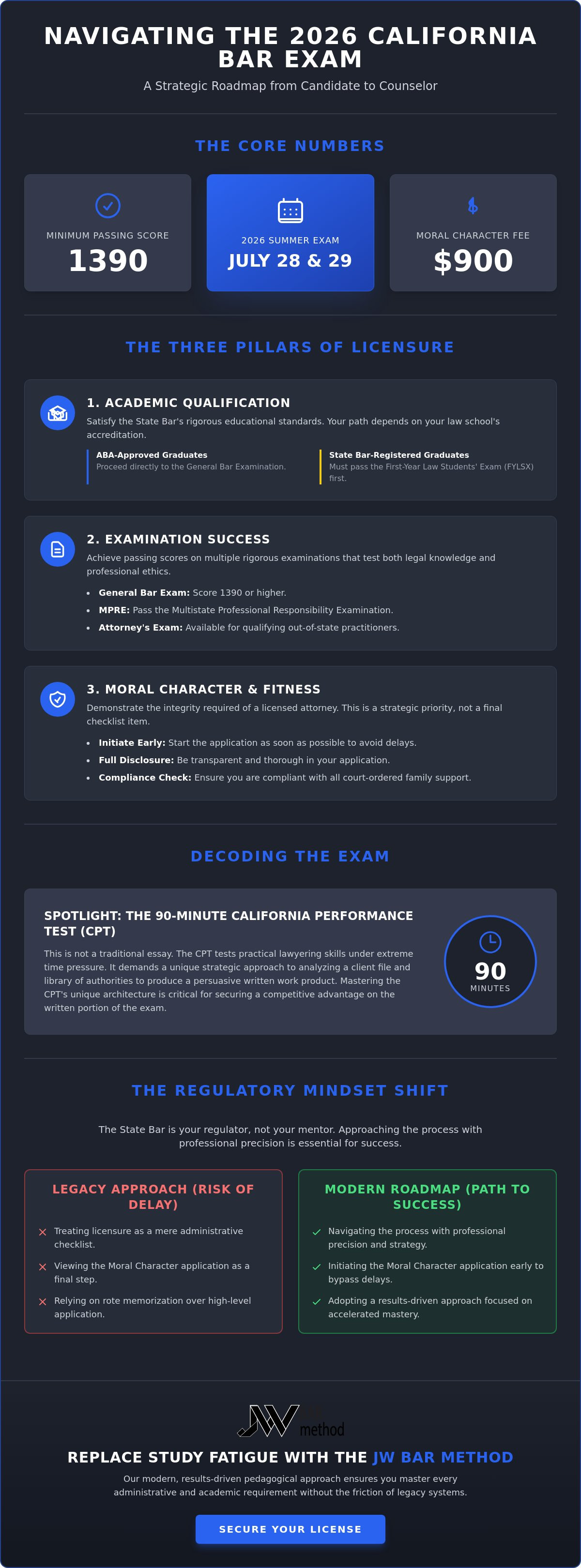
Securing your license in California is a multi-step verification process that demands more than just academic proficiency. It's a rigorous alignment of your educational background, professional ethics, and personal history. To meet the baseline california bar exam requirements, you must satisfy several distinct criteria. These include completing a qualifying legal education, achieving a passing score of 1390 on the examination, and obtaining a positive moral character determination. Precision is the baseline. If you miss a single administrative deadline or fail to disclose a required detail, the State Bar will pause your progression indefinitely.
The Bar also enforces non-academic standards that many candidates overlook until the final stages. For instance, you must be in compliance with all court-ordered child or family support obligations. The State Bar coordinates with other government agencies to verify this status before issuing a license. You can find the exhaustive list of California Bar Admission Requirements on the official site, but navigating the strategy behind these rules is what separates successful applicants from those stuck in administrative limbo. We recommend viewing these hurdles as a series of professional gates rather than a single wall.
Educational Standards and Accreditation
California provides multiple paths to licensure, but each has specific 2026 standards. Graduates from ABA-approved law schools typically move directly to the General Bar Examination. However, if you attend a school registered with the State Bar but not ABA-accredited, you must first pass the First-Year Law Students’ Exam (FYLSX). For the 2026 cycle, you must ensure your degree is conferred and your final transcripts are uploaded to the Applicant Portal well before the July 28 and 29 exam dates. Any delay in transcript verification can result in the forfeiture of your exam seat and fees.
The MPRE and Professional Responsibility
Professional responsibility is the bedrock of your future practice. The State Bar of California requires a scaled score of 86 or higher on the Multistate Professional Responsibility Examination (MPRE). Don't treat this as a secondary task. We suggest clearing this hurdle during your second year of law school or at least six months before your primary bar exam sitting. This proactive approach allows you to focus your mental energy entirely on the substantive california bar exam requirements during your final months of prep. Our curriculum at Jackson-Wagner LLC integrates these ethical standards into your broader study plan, ensuring you don't just pass the test, but master the professional mindset required for 2026 licensure.
Decoding Exam Standards: Full Bar vs. The Attorney’s Examination
The 2026 California Bar Exam is a two-day assessment of mental endurance and tactical application. To succeed, you must understand the weight of each component. The standard General Applicant format consists of five one-hour essay questions and one 90-minute California Performance Test (PT) on the first day, followed by the 200-question Multistate Bar Examination (MBE) on the second day. The State Bar maintains a strict scaled passing score of 1390. This "cut score" is one of the highest in the nation, making it clear that the California Bar Exam Requirements are designed to filter for only the most competent practitioners.
The 90-minute PT is the most significant hurdle for many 2026 candidates. It requires you to process a "File" and a "Library" to produce a specific legal work product under intense time pressure. It isn't a test of what you know, but of how you work. For a deeper look at the tactics required to beat this clock, consult Passing the California Bar Exam in 2026: The Definitive Strategic Guide.
The Attorney’s Examination: A Test of Precision
If you've been an active member in good standing of another U.S. jurisdiction for at least four years, you may qualify for the Attorney’s Examination. This is a one-day written test that bypasses the MBE entirely. While this sounds like a shortcut, it's actually a test of extreme precision. Without the multiple-choice section to buffer your score, your essay and PT performance must be flawless. You can find more details on eligibility in our California Attorney’s Exam Requirements: The 2026 Guide to Licensure for Out-of-State Lawyers.
Analyzing Recent Results and Performance Trends
Recent data from the State Bar shows a consistent trend: volume-based study is the primary reason high-achieving candidates fail. Many applicants believe that doing 3,000 MBE questions is the path to success. It's not. Success in 2026 requires a structured, pedagogical approach that focuses on the mechanics of the test. You must analyze why an answer is correct rather than just checking a box. The correlation between structured prep and success has never been higher. If you rely on legacy study methods that prioritize quantity over quality, you're essentially gambling with your career. We track these results to refine our curriculum, ensuring you aren't just studying hard, but studying with the specific precision the Bar demands.
Strategic Management of Administrative Hurdles and the Portal
The State Bar’s administrative machinery moves with a deliberate, often frustrating, slowness. You can't afford to treat the Moral Character application as a post-exam afterthought. For 2026 candidates, timing is a strategic asset. Processing times for these background checks frequently exceed six months. If you wait until after the July 28 and 29, 2026, exam dates to submit your application, you're effectively delaying your licensure and your professional earning potential by half a year. We recommend initiating this process, which carries a $900 fee for general applicants, at least eight months before your intended swearing-in date. For a comprehensive breakdown of this phase, consult our guide on Decoding the California Bar Exam Moral Character Application: A 2026 Strategic Guide.
Beyond the background check, you must manage the final transition into the profession with precision. Once you've satisfied all california bar exam requirements, the State Bar will issue your licensure invitation. This leads to the Oath of Office. You can't practice law until this oath is administered and your signed card is processed. Many candidates lose weeks of practice time because they don't have a notary or judicial officer lined up. Treat this final registration step as the final sprint of a marathon. Efficiency here ensures you transition from a "candidate" to an "attorney" without unnecessary administrative friction.
The Moral Character Determination Process
The Bar demands total transparency. Disclosure is your only viable path. Whether it's a past academic sanction, a credit issue, or a prior legal encounter, honesty is non-negotiable. The Bar's investigators look for patterns of behavior that suggest a lack of integrity or financial responsibility. If your background is complex, be proactive. Gather court records and explanatory statements now. Your determination is typically valid for 36 months. If you don't secure your license within that window, you'll be required to pay the $900 fee again and undergo a fresh investigation. Don't let your hard-earned exam results expire because of a lapsed background check.
Mastering the Applicant Portal
The Applicant Portal is the digital gatekeeper for all your interactions with the Bar. It's where you'll track your law school certifications and transcript uploads. For the July 2026 cycle, the timely filing window opens March 1 and closes April 1. Missing this window triggers late fees of $50 or $250, plus the 2.5% credit card processing fee. The portal is the central hub for satisfying the administrative california bar exam requirements for transcript verification. Our resource on How to Navigate the State Bar of California: A 2026 Guide to Licensure Success provides the technical roadmap you need to avoid these portal-induced delays. To ensure your study plan stays on track while you handle these logistics, explore the accelerated prep options at Jackson-Wagner LLC today.
Securing Your License with the JW Bar Method Prep
Administrative compliance is merely the entry fee for professional licensure. Once you've navigated the portal and cleared your background check, the focus shifts entirely to performance. The State Bar doesn't award licenses for effort; it awards them for results. This is where legacy bar prep programs often fail. They bury candidates under a mountain of generic video lectures and thousands of low-utility practice questions, leading to cognitive fatigue rather than mastery. The JW Bar Method Prep is the modern, disruptive alternative designed specifically for the high-stakes reality of the 2026 cycle. We replace the stress of high-pressure certification with a structured, reliable path to success.
We're so certain of our methodology that we assume the financial risk of your performance. Our binary performance guarantee for 2026 serves as a powerful brand anchor, providing you with a sense of absolute security. While other providers offer cautious advice, we act as a partner invested in your outcome. This bold reliability allows you to stop worrying about the "what ifs" and start focusing on the execution required to meet the california bar exam requirements. You aren't just a student in our ecosystem; you're a future colleague preparing to dominate a rigorous professional assessment.
Precision vs. Volume: The JW Pedagogical Advantage
Our curriculum is built on precision, not volume. We use the State Bar’s own grading standards and past performance data to build a predictive syllabus that targets the specific challenges of the California licensure track. Instead of passive memorization, our candidates engage in active, high-level application. This pedagogical shift ensures you feel empowered rather than overwhelmed. By focusing on the mechanics of how the 1390 cut score is actually achieved, we help you transition from "studying" to "executing" under the intense conditions of the July 28 and 29, 2026, exam dates. We don't just teach the law; we teach the test.
Your 2026 Success Roadmap
Success requires a strategy tailored to your specific professional needs. Whether you're a first-time applicant or an out-of-state practitioner, we offer specialized programs to match your timeline. You can choose between our comprehensive JW Bar Method Prep - Full Exam California Bar or the JW Bar Method Prep - Attorney’s Exam California Bar. For those on a tighter schedule, our accelerated options provide a high-impact, condensed curriculum that doesn't sacrifice depth. Your next step is to audit your current readiness and secure your enrollment before the 2026 windows close. Don't leave your career to chance when you can rely on a proven, results-driven partner. Discover the JW Bar Method and Secure Your California Licensure today.
Take Command of Your Legal Career in 2026
The path to becoming a California attorney is defined by rigorous standards and uncompromising deadlines. You've seen that mastering the california bar exam requirements involves more than just hitting the books; it requires a strategic alignment of your Moral Character application timing, your administrative portal management, and your technical exam execution. Success in 2026 demands a shift from the outdated, high-volume study habits of the past to a modern, pedagogical approach that prioritizes precision and predictive analysis.
We built the JW Bar Method to be the definitive alternative to legacy prep models. Our proprietary performance-driven methodology is focused exclusively on California licensure success, ensuring you don't waste energy on irrelevant material. We're so confident in our results that we assume the financial risk ourselves through our binary performance guarantee. It's time to replace the anxiety of the unknown with a structured roadmap to your license.
Master the California Bar with the JW Bar Method and step into your future with absolute confidence. Your professional journey starts now.
Frequently Asked Questions
How do I check my status with the State Bar of California?
You can check your application status through the official State Bar of California Applicant Portal. This digital platform provides real-time updates on your Moral Character determination, transcript verification, and exam registration. It's essential to monitor this dashboard weekly to ensure you haven't missed any administrative flags. The Bar uses this portal as the primary communication channel for all licensure candidates throughout the 2026 cycle.
What is the passing score for the California Bar Exam in 2026?
The minimum passing score for the California Bar Exam is a scaled 1390 out of a possible 2000 points. This "cut score" applies to both the February and July 2026 administrations. To reach this benchmark, you must demonstrate consistent proficiency across the Multistate Bar Examination (MBE), five essay questions, and the 90-minute Performance Test. Precision in your written responses is critical for hitting this high standard.
Can I take the California Attorney’s Exam if I am licensed in another state?
You're eligible for the one-day Attorney’s Examination if you've been an active member in good standing of another U.S. jurisdiction for at least four years. This format allows you to bypass the MBE portion of the test. However, you must still meet all other california bar exam requirements, including the Moral Character determination and the MPRE score. It's a test of high-level legal writing and analysis.
How long does the Moral Character application process take?
The Moral Character application process typically takes a minimum of six months to complete. Because the State Bar conducts an exhaustive background check, processing times can vary based on the complexity of your history. We recommend submitting your application at least eight months before your intended licensure date. This proactive approach prevents administrative delays from holding up your professional career once you've passed the exam.
What happens if I fail the California Bar Exam twice?
There's no limit on the number of times you can sit for the exam, but you must submit a new application and pay the full fees for each attempt. Failing twice often indicates a need to pivot from legacy study methods to a more pedagogical, results-oriented approach. If you find yourself in this position, auditing your previous scores is essential. Our accelerated programs are specifically designed to break these cycles of performance plateaus.
Are there specific 2026 updates for the State Bar of California Applicant Portal?
The 2026 Applicant Portal features enhanced digital tracking for transcript verification and law school certifications. You must adhere to the timely filing window, which for the July 2026 exam runs from March 1 to April 1. Missing these deadlines results in late fees of $50 or $250. The Bar has streamlined the interface to make administrative compliance more transparent and manageable for modern candidates.
Is the JW Bar Method compatible with a full-time work schedule?
Our methodology is specifically engineered for the modern professional who requires flexibility. We offer accelerated programs that prioritize high-impact mastery over the generic, volume-based study found in legacy courses. By focusing on the mechanics of the california bar exam requirements, we help you maximize your limited study hours. You don't need to quit your job to succeed if you use a structured, efficient roadmap.
What is the difference between an active and inactive member of the State Bar?
Active members are licensed to practice law in California and must pay an annual fee of $598 as of 2026. In contrast, inactive members cannot practice law but maintain their status for a lower annual fee of $205. This distinction is important for attorneys who are taking a career break or working in roles that don't require a law license. You can switch between these statuses through the Member Portal.


