

The relative difficulty of the Uniform Bar Exam and a state bar exam can depend on the exam format and the test taker. Whether one bar exam administration is easier than the other depends on the jurisdiction’s format, tested subjects, timing, and scoring rules. The UBE takes two days, while state exams may add jurisdiction-specific content or use different formats. A shorter schedule doesn’t necessarily mean an easier test.
Comparing administrations by length or pass rates can be misleading. What matters is how an exam’s demands match your strengths and the law you need to know for the jurisdiction where you plan to practice.
This comparison explains how exam formats, duration, scheduling, scoring, and jurisdiction affect difficulty, using California as a key example. You’ll see what distinguishes the UBE from state exams and how to use those differences to make an informed preparation decision.
Key Takeaways
- Start with the jurisdiction where you plan to seek admission, since its exam format determines what you need to prepare for.
- Compare the tested components and subject coverage, not just the number of exam days.
- Read scoring rules in context: passing thresholds and score scales vary, so pass rates alone don’t show which exam will suit you best.
- For California, match your preparation to the full exam or Attorney’s Exam and choose a standard or accelerated track that fits your timeline.
Exam duration and scheduling
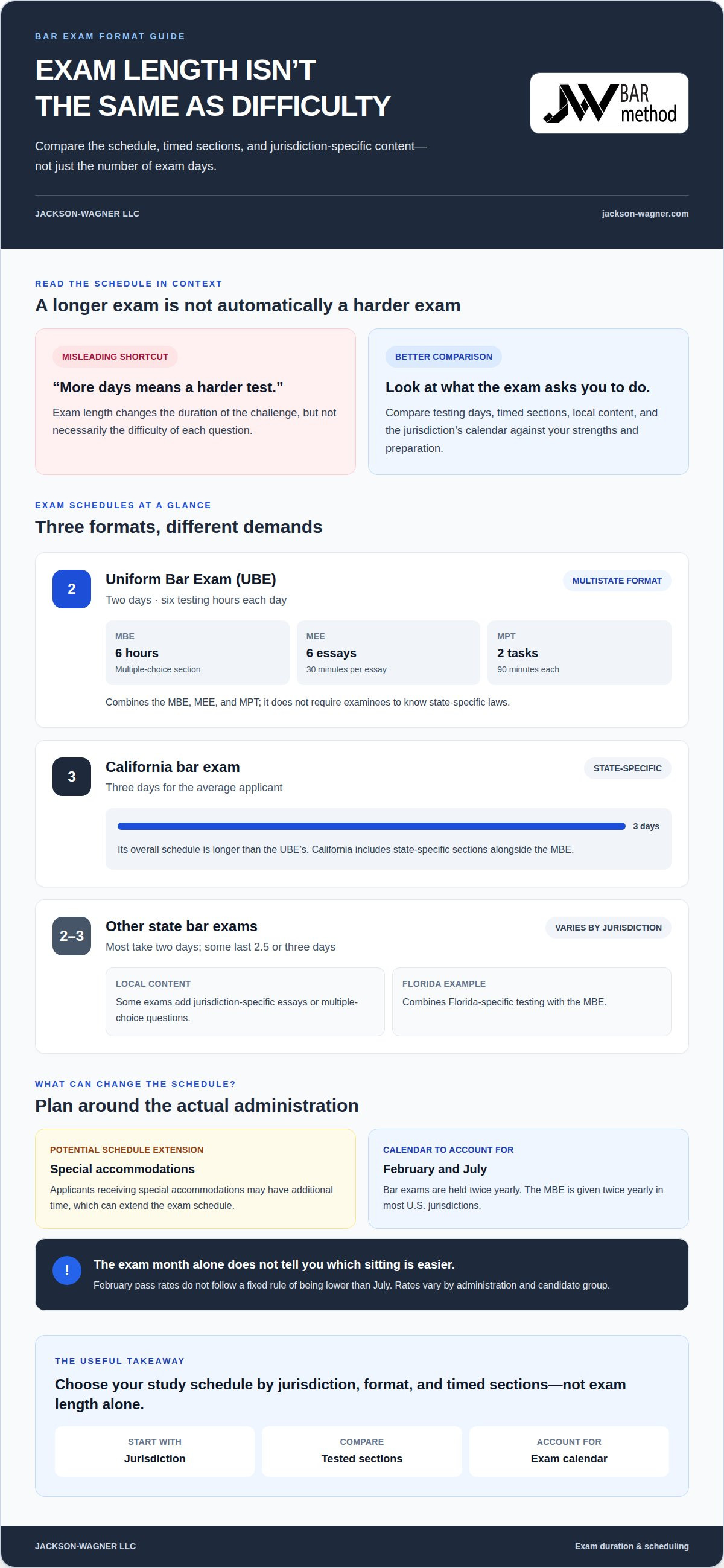
Exam length affects the demands of each administration, but a longer schedule doesn’t automatically mean harder questions. Compare the testing days, timed sections, and the jurisdiction’s calendar.
Exam Length
The UBE takes two days, with six hours of testing each day. Its MBE section also has six hours of testing, while each of the six MEE essays receives thirty minutes. California’s average applicant exam takes three days, making its overall schedule longer than the UBE’s.
Most state bar exams take two days, while some last 2.5 or three days. Applicants receiving special accommodations may have additional time, which can extend the exam schedule. These differences affect the length of the challenge, not necessarily the difficulty of each question.
Testing Sections and Scheduling
The UBE combines the MBE, MEE, and multistate performance test. Its MPT includes two 90-minute tasks, which test practical legal analysis under timed conditions. State exams can add local essays or multiple-choice questions. Florida, for example, combines Florida-specific testing with the MBE.
Bar exams are held twice yearly, in February and July. The MBE is given twice a year in most U.S. jurisdictions. Build your preparation schedule around the exam date and the specific sections your jurisdiction uses.
Does the February bar exam have a lower pass rate than the July exam? No fixed rule makes February’s pass rate lower. Rates vary by administration and candidate group, so the month alone doesn’t show which sitting is easier.
| Option | Typical duration | Scheduling and sections |
|---|---|---|
| UBE | Two days, six testing hours each day | MBE, MEE, and two MPT tasks |
| California bar exam | Three days for the average applicant | State-specific sections alongside the MBE |
| Other state bar exams | Most take two days; some last 2.5 or three days | Format and local content vary by jurisdiction |
Choose your study schedule based on the jurisdiction’s format and timed sections, not exam length alone.
Is the Uniform Bar Exam easier than a State Bar Exam?
No format is automatically easier. Difficulty depends on the jurisdiction’s tested material, question types, and how those demands match your strengths.
Uniform and State-Specific Exams
The UBE combines the MBE, MEE, and MPT, and it doesn’t require examinees to know state-specific laws. It tests 14 subjects total. A state bar exam may add local law or use jurisdiction-specific questions, changing what candidates must learn and how they demonstrate their knowledge.
Are the UBE and NextGen bar exam administrations equally difficult? They can’t be assumed to be equally difficult. Their components and formats differ, and this comparison doesn’t establish that either is easier. Start by assessing the exam requirements against your strengths.
State Difficulty and Requirements
Difficulty and pass rates vary between states, but pass-rate comparisons don’t isolate exam difficulty. Candidate preparation, education, and the examinee group also affect results. New York and California are often considered harder than some other jurisdictions, but each candidate’s challenge depends on the specific exam requirements.
Before choosing a preparation plan, identify the jurisdiction and its required components. New York applicants, for example, must complete a New York Law Course and a New York Law Exam, adding state-specific steps beyond the bar exam itself.
Subjects and Exam Formats
State-specific subjects affect what candidates must learn, while question formats determine how that knowledge is tested. Florida’s exam has two parts: Part A covers Florida-specific multiple-choice questions and essays, while Part B is the MBE.
How do MBE, MEE, and MPT difficulty vary across exam administrations? The MBE uses multiple-choice questions, the MEE tests written analysis, and the MPT assesses practical legal work. Their relative difficulty depends on your strengths and the jurisdiction’s additional requirements.
Administration Difficulty and Scaling
Can a bar exam administration be equated or scaled to account for differences in difficulty? Pass rates alone can’t establish that one administration was easier. The National Conference of Bar Examiners oversees a process intended to support fair testing, but comparisons still need to account for jurisdiction, format, and candidate groups.
To assess whether one bar exam administration is easier than another, compare tested content and scoring rules rather than treating one pass rate as an adjustment for difficulty. The answer depends on how the jurisdiction’s demands align with your preparation and strengths.
Scoring and passing thresholds
Score scales and passing thresholds differ by jurisdiction, so raw results aren’t directly interchangeable. Before interpreting pass rates, compare each exam’s scoring weights and required score.
Pass Rates by Date and Jurisdiction
Pass rates vary across jurisdictions and administrations, but a rate alone doesn’t measure exam difficulty. In 2023, first-time pass rates were 78% in New York, 78.1% in Florida, and 70% in Georgia. These figures describe different candidate groups and state exams, so they don’t establish that one February or July administration is easier.
How do bar exam pass rates vary by exam date and jurisdiction? Rates can differ by jurisdiction, administration, and the candidates sitting for each exam. Compare like with like, especially candidate status and jurisdiction, rather than treating a single rate as a forecast of your own result.
Questions and Scoring Standards
Different questions can test the same exam components, while scoring weights and passing thresholds determine how results contribute to passing. For the UBE, the MBE is 50% of the score, the MEE is 30%, and the MPT is 20%. A UBE passing threshold varies by jurisdiction, ranging from 260 to 280 points.
Do bar exam questions or scoring standards change between administrations? Question sets may differ between administrations, but that alone doesn’t show that the scoring standard has changed. Focus on the jurisdiction’s scoring structure and threshold, which determine how each component affects the final result.
California uses a different scale: the passing score is 1390 out of 2000. That number can’t be compared directly with a UBE threshold because the scoring scales differ. A law school course may teach the tested material, but candidates still need preparation aligned with the relevant jurisdiction’s format and passing standard.
Use a straightforward comparison: identify the jurisdiction, note its score scale, then learn each component’s weight. This separates exam difficulty from scoring mechanics and makes pass-rate comparisons more meaningful.
Bar exam administration by jurisdiction
The useful comparison isn’t simply UBE versus state exam. The jurisdiction determines which topics appear, how they’re tested, and where an exam result can support your career plans.
The UBE combines multistate components and can be used to seek admission in about three dozen states, plus the District of Columbia and the U.S. Virgin Islands. That reach can make its format relevant if you’re considering several jurisdictions. It doesn’t make every state’s admission requirements identical, so compare the destination jurisdiction’s rules as well as the exam.
California illustrates how a state-specific administration can differ. The full California bar exam described here includes 200 multiple-choice questions, six essays, and two performance tests, covering 14 subjects. California also offers a two-day Attorney’s Exam as an alternative to the full exam. The distinction changes the exam pathway, so a comparison must account for candidate eligibility and which administration applies.
States build different local components into their exams. Georgia’s administration comprises four essays, two performance tests, and the MBE. New York applicants must complete a New York Law Course and a New York Law Exam. These examples show why “state bar exam” doesn’t describe a uniform set of subjects or requirements.
- For a multistate path: Compare the UBE format with the jurisdictions where you may seek admission.
- For California: Distinguish the full exam from the Attorney’s Exam before planning your preparation.
- For another state: Identify its local subjects, exam components, and additional requirements.
Compare exams in light of your intended jurisdiction and career direction, then prepare for that administration’s actual subject mix. Exam length or a familiar multistate component alone can’t tell you which option is easier. The key is how well your preparation matches the required format and local topics.
Jackson-Wagner: JW Bar Method Prep - Full Exam California Bar
JW Bar Method Prep - Full Exam California Bar prepares candidates for California’s full exam. Choosing preparation that matches your route matters: the full exam and Attorney’s Exam are distinct, so select the course designed for the exam you plan to take.
Jackson-Wagner LLC also offers JW Bar Method Prep - Attorney’s Exam California Bar, plus accelerated preparation for both routes: JW Bar Method Accelerated Prep - Full California Bar Exam and JW Bar Method Accelerated Prep - Attorney’s Exam California Bar. Choose the standard or accelerated track that fits your study timeline, and the full-exam or attorney-exam course that matches your California bar exam path.
Explore Jackson-Wagner LLC’s California-focused JW Bar Method courses and choose the preparation track that fits your exam route.
Choose the Preparation Path That Fits Your Exam
Turn the format comparison into a focused study plan. Identify the jurisdiction where you intend to qualify, then align your preparation with its exam route, subject coverage, and testing style. Rather than asking whether one bar exam administration is easier than another, focus on preparing for the specific exam you’ll take.
For California candidates, Jackson-Wagner offers preparation for both the full exam and the Attorney’s Exam, with standard and accelerated tracks. Select the path that matches your exam and timeline, then build a plan around the skills that format requires. Contact Jackson-Wagner to discuss California bar exam preparation. Take the next step with a clear target and a plan built for your route.
Frequently Asked Questions
Are some U.S. bar exam administrations statistically easier to pass than others?
Pass rates vary by jurisdiction, administration, and the candidates who sit for each exam, but those differences don’t prove that one sitting is inherently easier. For a useful comparison, distinguish first-time takers from repeat takers and compare candidates with similar backgrounds. A rate describes a group’s results; it can’t predict an individual outcome or isolate exam difficulty on its own.
Which states use different bar exams or scoring rules that affect difficulty?
California uses a state-specific exam and a scaled passing score, while UBE jurisdictions set their own passing thresholds within the 260-to-280-point range. As a result, a UBE score may meet one jurisdiction’s threshold but fall short of another’s. The practical comparison is the jurisdiction’s exam components and passing rule, not the exam’s label alone.
What do bar examiners say about comparing the difficulty of different administrations?
The National Conference of Bar Examiners oversees a process intended to support fair testing, but that doesn’t create a simple ranking of administrations from easiest to hardest. Distinguish examiners’ scoring and fairness processes from pass-rate comparisons. For a sound personal assessment, consider the tested content, score requirements, and your strengths across the relevant question formats.


