

Speed on bar exam essays comes from making better decisions, not just typing faster. Learning how to write faster on bar exam essays starts with practicing under the MEE’s 30-minute limit for each essay, so you can spot issues, organize rules, and apply facts without letting one point consume your time.
If you’re worried that a slow answer means you need to type faster or memorize every rule, a more focused approach can help. The goal is to develop a repeatable writing process that leaves time for the issues that matter most.
This article explains how to structure MEE practice, divide time across multiple issues, and make essay writing more efficient. You’ll also learn how to prioritize frequently tested rules and turn timed practice into a clear plan for improving your answers.
Key Takeaways
- Build timed MEE practice into your study routine to make essay pacing more familiar.
- Separate issues into clear IRAC analyses and allocate writing time according to each issue’s importance.
- Improve efficiency with a repeatable plan for organizing and applying rules, rather than focusing only on typing speed.
- Prioritize frequently tested rules so your study time supports faster, more focused essay answers.
1. Method-specific practice for the MEE
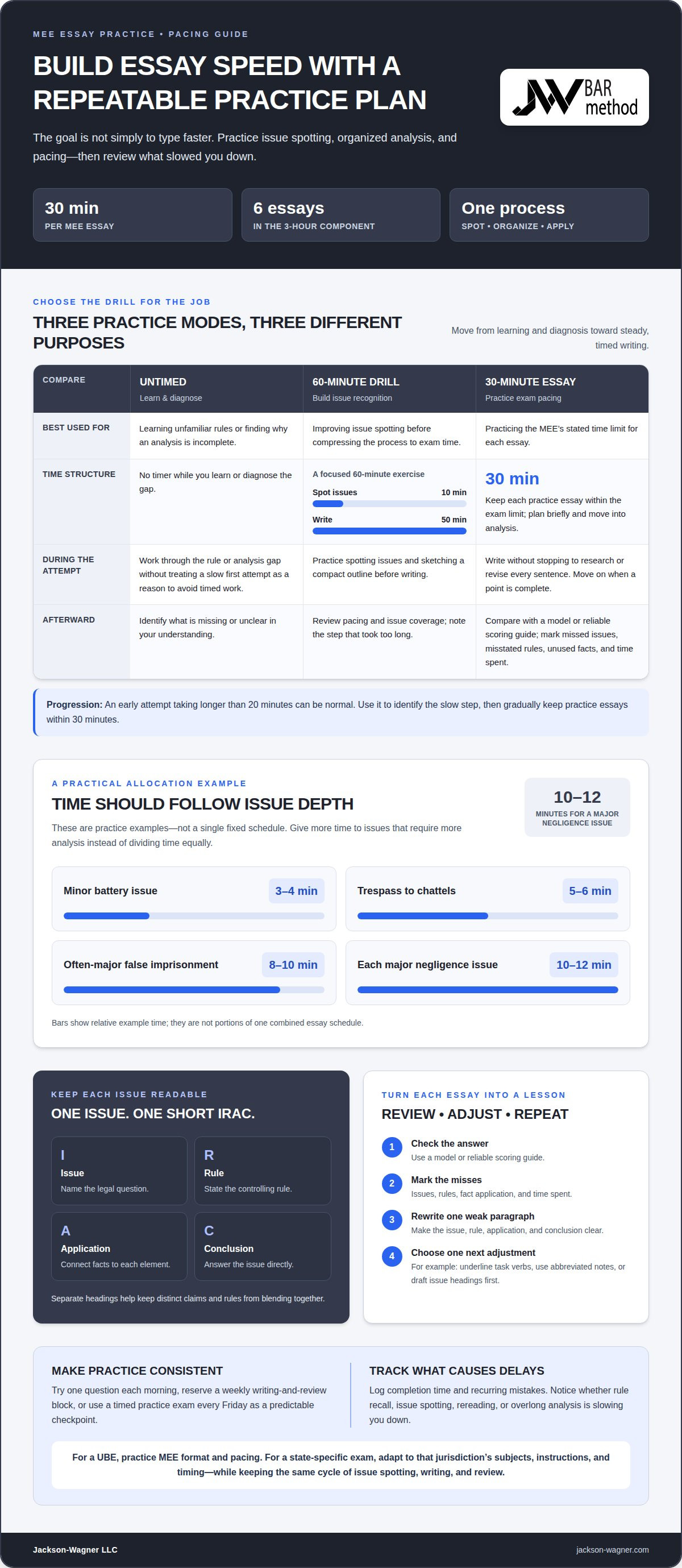
The MEE gives you 30 minutes per essay, so practice should build both analysis and pacing. Its format includes six essay questions in a three-hour component. Start with a focused 60-minute exercise: spend 10 minutes spotting issues, then use the remaining 50 minutes to write. This longer drill lets students improve issue recognition before compressing the process to the exam’s 30-minute limit.
Timed and untimed practice serve different purposes. Use untimed essays when learning unfamiliar rules or diagnosing why an analysis is incomplete. Then add a timer and write without stopping to research or revise every sentence. Early in preparation, taking longer than 20 minutes on an essay can be normal; use that attempt to identify the slow step, not to avoid timed work. Gradually keep each practice essay within 30 minutes.
After each attempt, grade your answer against a model or reliable scoring guide. Mark missed issues, misstated rules, facts you didn’t apply, and time spent on each part. Rewrite one weak paragraph using a clear issue, rule, application, and conclusion. Targeted review turns each essay into a lesson, rather than simply another timed attempt.
Schedule essay work consistently. Try answering one question each morning, or reserve a weekly block for writing and review; a timed practice exam every Friday can add a predictable checkpoint. Track completion time and recurring mistakes in a simple log. Notice whether rule recall, issue spotting, or overlong analysis causes delays. Consistent practice also helps you recognize what three to five minutes feels like, making it easier to move on when an issue deserves no more time.
For the UBE, practice the MEE format and its 30-minute essay pacing. For a state-specific bar exam, adapt your practice to that jurisdiction’s essay subjects, instructions, and timing; keep the same disciplined cycle of issue spotting, writing, and review.
2. Use separate IRAC analyses for multiple issues
Give each distinct legal issue its own short IRAC analysis: issue, rule, application, and conclusion. If a fact pattern raises negligence and false imprisonment, use separate headings and analyze each claim independently. This keeps rules from blending together and gives graders a clear path through your answer.
An attack outline helps you spot issues without drafting a long preliminary essay. Organize it by subject, then list key elements, defenses, and fact cues. During a practice essay, spend the suggested 10 minutes spotting issues and sketching a compact outline. For example, a reference to unwanted contact may cue battery; interference with personal property may raise trespass to chattels.
Match writing time to issue importance. A practice allocation might give a minor battery issue 3-4 minutes, trespass to chattels 5-6 minutes, and often-major false imprisonment 8-10 minutes. Each major negligence issue may need 10-12 minutes. These examples help you resist spending equal time on issues with different depth.
An efficient IRAC is direct: name the issue, state the controlling rule, connect specific facts to each rule element, then conclude. CREAC can work too, but avoid repeating the same analysis in a separate conclusion and rule discussion. Concise answers can earn credit by addressing relevant issues, stating accurate rules, and applying facts. Extra length alone does not make analysis stronger.
For a 60-minute practice exercise, use 10 minutes to read actively, spot issues, and outline; reserve the remaining 50 minutes for writing. In an actual 30-minute MEE essay, keep planning brief and move promptly into analysis. Repeatedly rereading facts, writing long rule explanations, and polishing sentences mid-answer all consume time without advancing issue coverage.
A structured California bar essay course can support practice with issue organization and timed writing.
3. Improve efficiency rather than simply typing faster
Faster answers come from reducing wasted decisions, not racing through every sentence. To learn how to write faster on bar exam essays, use a repeatable sequence: read the question, identify the task, mark facts tied to legal elements, and draft under clear issue headings. If a fact describes someone entering another person’s land, connect it to the relevant issue instead of copying the story. This focused process preserves time for analysis.
Read the fact pattern actively. First, identify what the question asks you to decide, such as liability or a defense. Then scan for conduct, intent, harm, timing, and relationships between the parties. Make brief notes beside facts that support or weaken an element. This keeps details visible and avoids repeated rereading. If one fact relates to two issues, note both connections without restating it.
Typing speed still matters, but accuracy and organization matter more. Bar takers typically bring three years of laptop typing experience from law school, internships, and work. Use that familiarity to practice clean formatting and direct sentences, not to chase an unsupported words-per-minute target. To learn how to write faster on bar exam essays, type a short rule statement, apply each relevant fact, and move forward when the point is complete. Editing every sentence immediately interrupts analysis.
After practice, identify what slowed you down. Did you lose time rereading the question, searching for a rule, or rewriting your opening paragraph? Choose one adjustment for your next attempt: underline task verbs, use abbreviated planning notes, or draft issue headings before writing full paragraphs. If repeated edits slowed you, finish the analysis first and save a brief final pass for clarity. Track whether the change helps you finish more steadily.
4. Prioritizing highly tested essay rules
Study rules by exam relevance, rather than giving every doctrine equal time. Use course materials and reviewed practice essays to identify rules that recur across subjects or appear in different fact patterns. Build a short priority list and spend more review time on those rules than on isolated details. This keeps outlines from becoming an unfiltered memorization task.
Make each priority rule usable in an essay. Write a compact rule statement, list its elements, and add a fact cue for each one. For negligence, for example, organize your notes around duty, breach, causation, and damages. Then try recalling the rule without looking. If you can’t state an element clearly, mark it for review before attempting a full essay.
Start memorizing law early in your study period with brief, repeated recall sessions, rather than relying only on rereading. Cover the rule in your notes, state it from memory, then compare your version with the source. Correct missing elements right away. Keep separate records of rules you recalled accurately and rules you confused, such as mixing a defense with an element of a claim.
Use practice questions to check whether a rule is ready for timed writing. After each essay, record the issues tested, rules you missed, and any rule you knew but couldn’t express precisely. Move a rule higher on your study list when it appears in several reviewed answers. If an obscure detail takes time but rarely appears in your practice materials, learn its basic framework before polishing exceptions.
Prioritization still requires coverage: a frequently tested rule deserves depth, but an unfamiliar issue in a fact pattern deserves attention too. In each answer, state the relevant rule, apply the facts, and avoid adding unrelated doctrine. For structured study of California bar essays, explore California bar exam preparation.
Jackson-Wagner LLC
Jackson-Wagner LLC offers structured bar exam preparation to help candidates strengthen essay practice, issue organization, and rule recall. A preparation course can provide a guided study path alongside your independent timed writing and review.
Choose a program that matches your exam and preparation timeline: options include comprehensive full exam preparation as well as accelerated tracks for attorney applicants. These programs focus on bar candidates nationwide and can complement consistent practice as part of a broader study plan.
Explore Jackson-Wagner LLC’s preparation options to choose a course that fits your specific exam track.
Make your next practice session count
Make essay preparation a repeatable routine: choose a question, work through your analysis, then review how you used your time and attention. The next step in learning how to write faster on bar exam essays is to apply that routine consistently and adjust your study plan based on the issues you miss or struggle to explain.
For California Bar candidates, Jackson-Wagner offers JW Bar Method Prep - Full Exam California Bar, JW Bar Method Prep - Attorney’s Exam California Bar, and JW Bar Method Accelerated Prep - Full California Bar Exam. These programs provide structured preparation alongside independent practice.
Contact Jackson-Wagner today to explore your preparation options. Keep building your skills one focused essay at a time, and approach your next practice session with a clear plan.
Frequently Asked Questions
What is the best way to structure a bar exam essay quickly?
Use a compact IRAC sequence for each issue: identify the legal question, state the rule, apply relevant facts, then conclude. A practical way to learn how to write faster on bar exam essays is to prepare descriptive issue headings before drafting. For example, label a contract defense separately from formation so each analysis stays focused and the grader can follow your reasoning.
How can I spot and prioritize legal issues faster on bar exam essays?
Create a quick fact-to-doctrine map as you read. A broken promise, for instance, may raise formation or a defense, depending on the surrounding facts. Start with the question’s task, then flag facts that support or weaken an element. Give fuller analysis to issues with several relevant facts, and briefly address plausible secondary issues rather than overlooking them.
How much should I write for each issue on a timed bar exam essay?
Write enough to show the governing rule, its application, and a reasoned conclusion. A minor issue with one disputed element may need a focused paragraph; a major issue involving several elements or conflicting facts needs more explanation. Explain how each key fact affects a contested element, then stop when the analysis is complete instead of repeating the rule.
How can I improve bar exam essay typing speed and accuracy?
Write complete legal sentences rather than isolated words, and use transitions such as “because” and “therefore.” When working on how to write faster on bar exam essays, focus on a steady drafting rhythm and fewer corrections mid-analysis. Keep formatting consistent, then check for recurring errors such as dropped words, misspelled party names, or missing punctuation. Target one error pattern in your next practice passage.
What timed essay practice drills help increase writing speed?
Rotate short drills to train different skills. Read a prompt and list possible issues without drafting, recall a rule without notes, or write an application paragraph from a fact set. Then complete a timed answer and compare it with a model. Record where you paused, lost structure, or repeated analysis, and use that observation to choose the focus of your next drill.


