

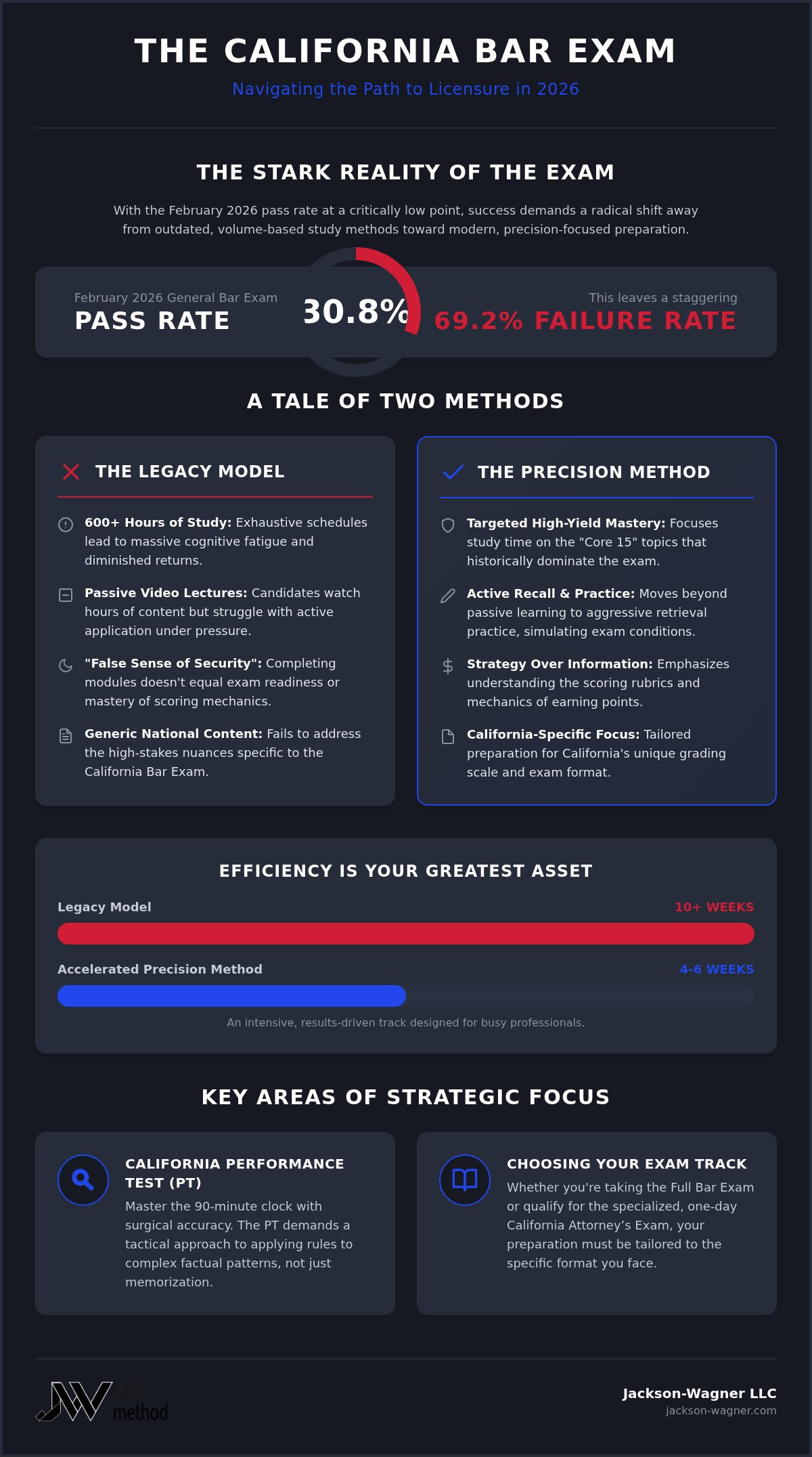
With the February 2026 California General Bar Exam pass rate sitting at a staggering 30.8%, the margin for error has never been thinner. You're likely feeling the pressure of these odds, especially when faced with "big box" california bar prep programs that bury you under 600 hours of generic, low-yield lectures. It's difficult to balance your professional obligations when your study materials feel like a relic of the past rather than a modern path to licensure. You deserve a method that respects your time and targets the specific mechanics of the California examiners.
We agree that the traditional approach to the bar is broken. You don't need more information; you need better strategy. This article promises to show you how to evaluate prep programs based on precision, high-yield methodology, and results-driven strategies specifically tailored for the 2026 cycle. We'll preview a structured path to passing on your first attempt, focusing on mastering California-specific performance tests and creating an efficient schedule that respects your time. By moving away from legacy models and toward surgical preparation, you can approach the July 28, 2026, exam with absolute certainty.
Key Takeaways
- Identify why legacy "big box" study models are failing modern candidates and how a shift toward precision prep can secure your licensure.
- Learn to evaluate california bar prep programs by prioritizing high-yield content and active mastery over hundreds of hours of passive lectures.
- Discover advanced strategies for the California Performance Test (PT) to help you dominate the 90-minute clock with surgical accuracy.
- Determine whether you qualify for the California Attorney’s Exam and why this one-day format demands a specialized, professional approach.
- Explore how the JW Bar Method compresses traditional 10-week schedules into an intensive, results-driven accelerated track for busy professionals.
Evaluating California Bar Prep Programs in 2026: The Shift Toward Precision
The February 2026 General Bar Exam pass rate of 30.8% serves as a stark warning for anyone entering the current cycle. Traditional study methods are yielding diminishing returns because they prioritize volume over validity. Candidates are frequently drowning in information while starving for actual strategy. To succeed in 2026, you've got to pivot toward "Precision Prep." This approach moves beyond passive video watching and focuses on active mastery of the specific mechanics required by the State Bar of California. You aren't just studying for a test; you're preparing for a professional performance.
California's unique grading scale and its refusal to adopt the Uniform Bar Exam (UBE) demand a specialized approach. The examiners aren't looking for a walking encyclopedia. They're looking for a practitioner who can apply specific rules to complex, often messy, factual patterns. This requires a psychological shift. You must treat the bar exam as a high-stakes performance where every minute on the clock is a tactical decision. Choosing between various california bar prep programs requires looking for a partner that understands this shift from academic memorization to professional execution.
The Problem with "Big Box" Bar Review
Legacy california bar prep programs often rely on exhaustive 600-hour schedules that are designed for students with no other obligations. These schedules lead to massive cognitive fatigue and a significant drop in retention by the halfway point. The danger lies in generic national materials that fail to capture the subtle, high-stakes nuances of California-specific law. For the modern, busy professional, a one-size-fits-all model isn't just inefficient; it's a liability. You don't have the luxury of wasting hours on "maybe" topics that haven't appeared on an essay in a decade.
High-Yield Mastery: The 2026 Standard
Efficiency is your most valuable asset during the prep cycle. You need to identify the "Core 15" topics that historically dominate the California Bar Exam to ensure you're studying the right material. High-yield mastery is the strategic allocation of study time to the most frequently tested rules. By focusing your energy here, you maximize your point-earning potential without the burnout associated with legacy courses. Modern preparation must leverage active recall and spaced repetition to ensure long-term retention. These pedagogical tools transform your study sessions from passive reading into aggressive retrieval practice, which is exactly what you'll need when the clock starts on July 28, 2026.
Traditional Bar Review vs. Modern Accelerated Methods
Retaking the bar exam is a professional setback you can't afford. Beyond the immediate $878 application fee for non-attorneys, the true cost lies in months of stalled career progression and thousands in lost income. Most california bar prep programs still cling to a pedagogical foundation built decades ago. This legacy model demands a grueling 10-week schedule of passive consumption and exhaustive memorization. In contrast, the JW Bar Method utilizes 4-6 weeks of intensive precision. We focus on the mechanics of the score rather than the sheer volume of the material. This disruptive shift is why accelerated tracks are now the preferred choice for practicing attorneys who don't have time for fluff.
Volume-Based Learning: The Legacy Model
Traditional courses rely on massive question banks and 4-hour lectures to justify their existence. These programs are built for the traditional law student who can dedicate 50 hours a week to "the grind." However, the "False Sense of Security" trap is a common pitfall. Watching a progress bar hit 100% doesn't mean you're ready to pass. It simply means you've sat through the content. Most traditional california bar prep programs miss the high-stakes nuances found in the Official California Bar Examination Information. You end up over-prepared for the easy topics and under-equipped for the complex ones that actually determine your pass/fail status.
Precision-Based Learning: The Modern Evolution
The JW Bar Method represents a radical evolution in legal licensure. Instead of broad surveys, our approach targets the specific scoring rubrics used by California graders. We ensure your study time is spent only on what actually earns points on exam day. Personalized feedback from specialized mentors replaces the vague, automated grading systems used by big-box providers. This level of granular detail is critical for passing on your first attempt. You can explore why Precision Beats Volume in our comprehensive guide. If you're balancing a high-pressure career while preparing for the 2026 cycle, choosing a precision-based method provides the structured, high-yield path you need to succeed without the typical 10-week burnout.
Essential Features of High-Performance California Bar Prep
Success on the California Bar is a performance, not just a test of knowledge. While many california bar prep programs focus on rote memorization, high-performance prep requires a tactical approach to the three distinct phases of the exam. You must navigate the Multistate Bar Exam (MBE) with surgical precision, identifying "distractor" answers that are designed to look correct but lack legal sufficiency. Beyond the MBE, your ability to handle real-world exam simulations under high-pressure conditions determines whether you'll pass or join the majority who fail each cycle. It's about building the stamina to maintain accuracy over two grueling days of testing.
Cracking the California Essay Code
Moving beyond the basic "IRAC" structure is mandatory for a passing score in California. Graders expect a sophisticated analysis that demonstrates an understanding of how laws interact in complex scenarios. We utilize the "Rule Block" method to ensure rapid, accurate drafting that leaves room for deep analysis. This method helps you spot "hidden" issues that big-box courses often gloss over in their rush to cover generic volume. In the California Bar Exam, the five essay questions and one performance test collectively account for 50% of the total scaled score. This weight makes essay mastery the cornerstone of your licensure strategy.
The Performance Test: 90 Minutes to Success
The Performance Test (PT) is often where well-prepared candidates lose their footing. It's a 90-minute race against the clock that requires you to act as a first-year associate under a tight deadline. You must master strategic reading, digesting the provided file and library in under 45 minutes to leave adequate time for drafting. High-performance california bar prep programs teach you to focus on tone, audience, and formatting, as these professional elements are critical for maximum points. Graders don't just want the right law; they want a professional work product that solves the client's problem.
Drafting a memo or brief that sounds like a lawyer, rather than a student, is what separates a passing PT from a failing one. You can find more on these tactical shifts in our guide to Passing the California Bar Exam in 2026: The Definitive Strategic Guide. By treating the PT as a deliverable for a senior partner, you align your output with exactly what the graders are looking for. This mental shift, combined with rigorous timing drills, ensures you don't just finish the race, but win it with confidence.
Choosing Your Track: Full Bar Exam vs. The California Attorney’s Exam
The decision between the Full Bar and the Attorney’s Exam isn't just about how many days you'll spend in the testing center. It's about aligning your preparation with your specific professional background. Many california bar prep programs treat these tracks as interchangeable, but that’s a dangerous assumption. While the Attorney’s Exam is shorter, its July 2025 pass rate of 43.4% proves it’s no "easy way out." You've got to choose a path that recognizes your experience while stripping away the bad habits that come with years of practice.
Strategic Prep for the One-Day Attorney’s Exam
If you've been actively practicing law in another jurisdiction for at least four years, you're likely eligible for the one-day written exam. This track eliminates the MBE but places extreme pressure on your essay and PT performance. The primary hurdle for seasoned practitioners is "Practice Bias." You might know how the law works in your home state, but the examiners only care about California’s specific distinctions. Being a great lawyer isn't enough to pass if you can't translate your skills into the specific format required.
Successful preparation for this track requires:
- Exclusively focusing on the five essays and the 90-minute Performance Test.
- Unlearning "short-hand" legal writing used in real practice to favor formal analysis.
- Mastering the exact scoring rubrics the examiners use to grade written work.
You can find more on eligibility and structure in our California Attorney’s Exam Requirements: The 2026 Guide to Licensure for Out-of-State Lawyers.
The Full California Bar: A Two-Day Marathon
The Full Bar Exam is a 48-hour test of mental and physical stamina. On Day 1, you face the written portion, followed by the 200-question MBE on Day 2. This track requires a more diverse pedagogical toolkit because you're balancing two very different skill sets simultaneously. You aren't just memorizing rules; you're building the endurance to maintain peak cognitive function through the final hour of the second day.
Success here requires a schedule that alternates between deep analytical drafting and rapid-fire multiple-choice drills. Many california bar prep programs fail because they don't simulate the exhaustion of Day 2. We believe your prep must include full-length, high-pressure simulations to ensure your brain doesn't quit when the MBE distractor answers get toughest. If you're ready for a method that treats your time with respect, our JW Bar Method Prep - Full Exam California Bar provides the precision you need to finish strong.
The JW Bar Method: A Results-Oriented Approach to Licensure
The JW Bar Method is built on a single, uncompromising principle: efficiency is the only path to licensure for the modern professional. While traditional california bar prep programs prioritize the exhaustive accumulation of knowledge, we focus on the strategic mastery of exam mechanics. You don't need to know every obscure legal footnote to pass; you need to know how to score points on the specific issues the examiners prioritize. We’ve stripped away the fluff and replaced it with a surgical approach that targets the scoring rubrics directly. This results-oriented mindset is what allows our students to walk into the testing center with absolute confidence.
Accelerated Prep for Busy Professionals
For the practitioner balancing a full-time caseload or the graduate who needs a more agile study track, our 30-day intensive track is a game-changer. We’ve successfully condensed over 1,000 pages of dense legal theory into high-yield execution guides that focus on application rather than just memorization. This isn't a watered-down version of a standard course; it's a concentrated, high-performance program designed for rapid retrieval. You’ll have direct access to California bar experts who provide granular feedback on your work, ensuring you aren't just practicing, but practicing correctly. Whether you're enrolled in the JW Bar Method Accelerated Prep - Full California Bar Exam or the Attorney’s Exam track, the focus remains on high-impact results in a fraction of the time.
Securing Your California License
As you look toward the July 28, 2026, administration or the February 2027 cycle, your choice of preparation will be the deciding factor in your success. The psychological advantage of knowing you're using a proven, disruptive method cannot be overstated. We're so certain of our methodology that we share the risk with you through a binary performance guarantee. This focus on a specific, measurable outcome is a unique marker that distinguishes our california bar prep programs from cautious, legacy providers who offer volume without accountability.
Before the April 1, 2026, timely filing deadline, take the final steps to secure your professional future:
- Review our high-yield execution guides to identify your core knowledge gaps.
- Commit to a 30-day or 45-day precision track that aligns with your professional obligations.
- Engage with specialized mentors for personalized scoring analysis that moves the needle.
The path to licensure in 2026 requires a departure from outdated models. It’s time to move beyond the "big box" mentality and embrace a strategy built for the modern era. You can Explore JW Bar Method Prep Programs today to secure your spot for the upcoming cycle and begin your journey toward the California Bar with a partner that assumes the risk of your success.
Secure Your Professional Future in California
Success on the 2026 exam requires a departure from legacy study models that favor volume over validity. By prioritizing high-yield mastery and surgical precision, you can navigate the complexities of the California-specific format without the typical 600-hour burnout. Choosing between various california bar prep programs is the most critical decision of your licensure journey, and it's one that demands a partner committed to your specific outcome. You've already invested years into your legal education; don't let an outdated study method stall your career progression.
The JW Bar Method provides a structured, modern alternative through our specialized Accelerated Prep tracks for practicing attorneys and full exam candidates. We assume the financial risk of your performance with a bold, performance-based financial assurance, ensuring our goals are perfectly aligned with yours. It’s time to replace the anxiety of low pass rates with the confidence of a proprietary, proven methodology. You don't have to face this challenge alone when a faster, more reliable path to success is within reach.
Master the California Bar with the JW Bar Method
Take the final step toward your California license with absolute certainty. You've done the hard work to get here; now it's time to finish the race with the precision you deserve.
Frequently Asked Questions
What is the pass rate for the California Bar Exam in 2026?
The February 2026 General Bar Exam pass rate was 30.8%, with first-time takers succeeding at a rate of 43.9% and repeaters at 23.1%. These figures reflect the exam's rigorous standards and the high level of difficulty compared to other jurisdictions. Historically, July administrations see higher pass rates, such as the 54.8% recorded in July 2025. This volatility underscores the necessity of choosing specialized california bar prep programs that prioritize precision over volume.
How much time do I realistically need to study for the California Bar?
Traditional legacy models typically demand a 10-week commitment involving approximately 500 to 600 hours of study. However, modern accelerated methods focus on high-yield mastery and can be completed in 4 to 6 weeks. The realistic time frame depends on your existing legal knowledge and professional obligations. By focusing on the mechanics of the score rather than exhaustive memorization, you can achieve readiness in a significantly compressed window without sacrificing performance on exam day.
Can I take a California bar prep program while working full-time?
Yes, you can successfully prepare while working full-time if you utilize a program designed for efficiency. Legacy "big box" courses often fail working professionals because their rigid 10-week schedules cause cognitive fatigue. Modern california bar prep programs, like the JW Bar Method, offer accelerated tracks that condense study into high-impact sessions. This allows you to balance professional duties while mastering the specific rules and analysis required for the July 2026 administration.
What is the difference between the Full Bar Exam and the Attorney’s Exam?
The Full Bar Exam is a two-day marathon consisting of five essays, one Performance Test, and the 200-question Multistate Bar Exam (MBE). In contrast, the Attorney’s Exam is a one-day test limited to the written components. Eligibility for the Attorney’s Exam generally requires active practice in good standing in another jurisdiction for at least four years. While the one-day format is shorter, its 43.4% July 2025 pass rate highlights its deceptively high difficulty.
Why do high-achieving attorneys often fail the California Bar Exam?
High-achieving attorneys often fail due to "Practice Bias," where real-world experience conflicts with the specific academic rules tested by the examiners. Experienced lawyers may use short-hand analysis or home-state rules that don't align with California's rigorous grading rubrics. Success requires unlearning professional habits to favor the formal, sophisticated analysis required by the State Bar. Failure often stems from treating the exam as a test of general lawyering rather than a specific performance of California law.
Does the JW Bar Method offer a performance guarantee?
Yes, the JW Bar Method is anchored by a binary performance guarantee that distinguishes us from more cautious competitors. We assume the financial risk of your outcome because we are entirely confident in our proprietary methodology. This guarantee ensures that our goals are perfectly aligned with your success. By focusing on high-yield mastery and results-driven strategies, we act as a partner deeply invested in your ability to secure licensure on your first attempt.
What are the key dates for the 2026 California Bar Examination?
The July 2026 Bar Exam will be held on July 28 and 29, 2026. To avoid late fees, you must submit your application by the timely filing deadline on April 1, 2026. The final filing deadline is June 1, 2026. For those looking ahead, the February 2027 exam is scheduled for February 23 and 24, 2027, with a timely filing deadline of November 2, 2026. Missing these dates results in substantial financial penalties.
How do California bar prep programs handle the Performance Test (PT)?
Most programs provide generic checklists, but high-performance courses focus on the PT as a 90-minute race against the clock. You must learn to digest the file and library in under 45 minutes to leave sufficient time for drafting. Effective preparation emphasizes professional tone, specific audience requirements, and strict formatting. Graders look for a work product that mirrors the output of a first-year associate, making tactical reading and rapid, accurate drafting the essential keys to success.


