
The Attorney's Exam isn't the easier path. For many experienced California attorneys, it's actually the harder one. When you strip away the multiple-choice buffer of the full exam and leave nothing but written analysis, there's nowhere to hide. That's the real difference at the center of the California Bar exam vs. Attorney's Exam debate, and it's the one most candidates discover far too late.
If you've been practicing law and you're weighing your licensure options for 2026, you already know the stakes. California's bar passage rates are punishing, your schedule has zero margin for a poorly structured study plan, and the eligibility rules around the "good standing" requirement add a layer of confusion that most prep resources don't bother to clarify. You're not looking for a general overview. You're looking for a decision.
This article gives you exactly that. You'll get a clear, data-informed breakdown of how these two paths differ structurally and strategically, who genuinely qualifies for each, and how to build a prep approach that fits the reality of a working attorney's life, not a full-time student's.
Key Takeaways
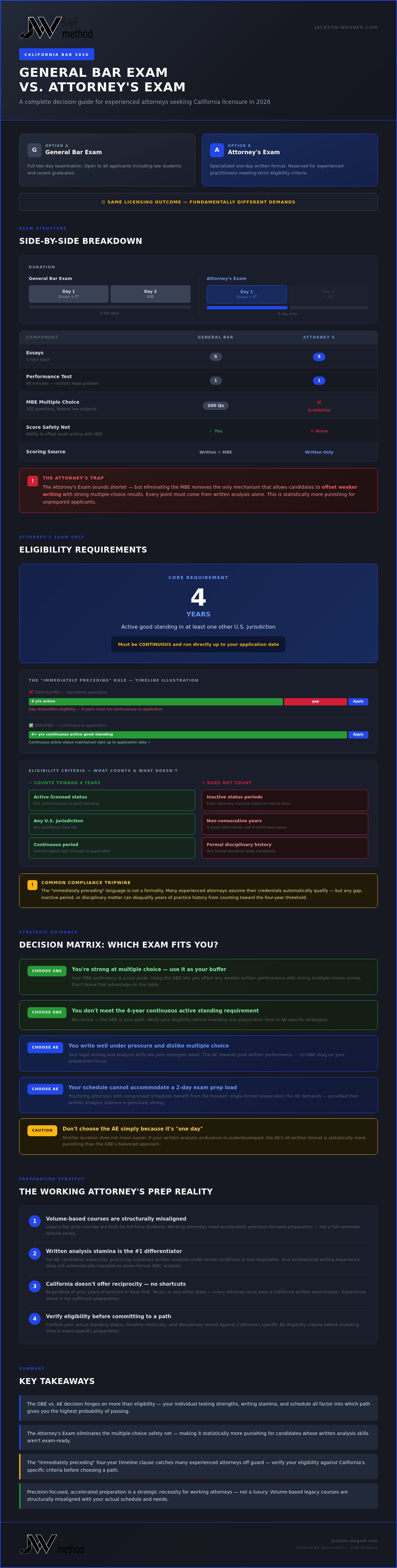
- The california bar exam vs attorney's exam decision hinges on more than eligibility — your individual testing strengths, writing stamina, and schedule will determine which path gives you the highest probability of passing in 2026.
- The Attorney's Examination is a one-day, all-written format that eliminates the multiple-choice safety net many GBE candidates rely on, making it statistically more punishing for unprepared applicants despite its shorter duration.
- Qualifying for the Attorney's Exam requires four years of active good standing in another U.S. jurisdiction — and the "immediately preceding" timeline clause catches many experienced attorneys off guard during the application process.
- Legacy, volume-based bar prep courses are structurally misaligned with the demands of working attorneys — accelerated, precision-focused preparation is a strategic necessity, not a luxury.
- A clear decision matrix exists for choosing between the two paths, and understanding where your MBE proficiency and written analysis endurance fall on that matrix is the most actionable step you can take before registering.
General Bar Exam vs. Attorney's Exam: The Fundamental Choice
California doesn't offer reciprocity. Full stop. No matter how long you've practiced in New York, Texas, or any other U.S. jurisdiction, there's no shortcut that bypasses California's licensure process entirely. Every attorney seeking admission to the California Bar must pass one of two written examinations, and the path you choose will define your entire preparation strategy for 2026.
That choice, at its core, is the california bar exam vs attorney's exam decision: a two-day comprehensive examination built for the full spectrum of applicants, or a specialized one-day written format reserved for experienced practitioners who meet a specific eligibility threshold. Same licensing outcome. Fundamentally different demands.
The General Bar Exam (GBE) Structure
The GBE runs across two full days and tests candidates across two distinct formats. Day one consists of five one-hour essay questions followed by a single 90-minute Performance Test, which requires candidates to analyze a realistic legal problem using a provided case file. Day two shifts entirely to the Multistate Bar Examination: 200 multiple-choice questions covering core federal law subjects. That MBE component is both a buffer and a burden. It gives candidates a second opportunity to compensate for weaker written performance, but it also demands a separate and substantial study investment. Law students, recent graduates, and attorneys with fewer than four years of qualifying experience are required to take the GBE.
The California Attorney's Exam (AE) Structure
The Attorney's Examination compresses the written half of the GBE into a single day: five essays and one Performance Test, administered back-to-back with no MBE component. That might sound like a lighter lift. It isn't. The MBE's elimination removes the one mechanism that allows candidates to offset a weaker writing performance with strong multiple-choice results. Every point earned on the Attorney's Exam comes from written analysis alone, which raises the performance ceiling on each individual question considerably.
Eligibility for the AE requires four continuous years of active good standing in at least one other U.S. jurisdiction, and that standing must be maintained in the period immediately preceding the application. The "immediately preceding" language is not a formality; it's a compliance tripwire that has derailed more than a few experienced attorneys who assumed their credentials would automatically qualify.
Understanding the structural differences between these two paths is the starting point. But structure alone doesn't tell you which exam you're more likely to pass. That analysis requires a harder look at your individual strengths, your available preparation time, and where your written analysis skills actually stand right now.
Eligibility Requirements for the 2026 California Attorney's Exam
Qualifying for the Attorney's Examination sounds straightforward on paper. Four years of practice in another U.S. jurisdiction, and you're in. The reality is more precise, and the gaps between assumption and actual compliance have cost experienced attorneys their eligibility window. Before you commit to this path in the california bar exam vs attorney's exam decision, you need to understand exactly what California's State Bar is looking for, and what it will reject.
For the 2026 cycle, the foundational requirement is this: you must have been actively licensed and in good standing in at least one other U.S. jurisdiction for a minimum of four years in the period immediately preceding your application. Not four years total across your career. Not four years at any point in the past. The four years must be continuous and must run directly up to the date you apply.
Defining 'Active and Good Standing'
This is where eligibility claims fall apart. "Active" is not interchangeable with "licensed." If you've been on inactive status in your home jurisdiction, whether voluntarily to reduce dues or because your practice shifted, that period does not count toward your four-year threshold. Inactive status disqualifies those years entirely. Disciplinary history adds another layer of complexity; any formal discipline on your record in another jurisdiction will be scrutinized by California's State Bar and may affect both your eligibility determination and your moral character application. If your standing has any blemishes, engage with this process early and with full transparency.
The Moral Character Application
Every applicant, regardless of which exam path they choose in the california bar exam vs attorney's exam decision, must complete California's Moral Character Application. For out-of-state attorneys, this process carries additional weight. California will request records from every jurisdiction where you've been licensed, and any gaps, disclosures, or inconsistencies between your application and those records will trigger follow-up. The review timeline is not guaranteed, and delays can push your eligibility determination past critical registration deadlines.
Start this process months before your target exam date. Not weeks. The State Bar's review queue does not accommodate late applicants, and an incomplete moral character determination means you cannot sit for the exam, full stop. For a detailed breakdown of what the application requires and how to navigate common disclosure issues, the California Bar Exam Moral Character Application guide is a practical starting point.
Common pitfalls for out-of-state attorneys include failing to disclose past bar complaints that were dismissed, underreporting jurisdictions where they held a license, and submitting Certificates of Good Standing that have expired by the time the State Bar reviews them. Certificates must be current, and "current" means recent, not from six months ago when you first started assembling your application.
The MPRE requirement applies to both exam paths. A scaled score of 86 or higher is required for California admission. If you haven't yet satisfied this requirement, factor it into your 2026 timeline now rather than treating it as an afterthought.
If you're mapping out your eligibility and timeline and want to understand how preparation fits into that window, exploring the JW Bar Method's Attorney's Exam track is a practical next step for working attorneys who can't afford to lose months to a misaligned prep approach.
The Attorney's Trap: Why the One-Day Exam is Often Harder
Here's the assumption that derails experienced attorneys every cycle: a shorter exam must be an easier exam. It isn't. In multiple recent testing cycles, the Attorney's Examination has posted lower pass rates than the General Bar Exam, a fact that most bar prep resources bury or ignore entirely. The california bar exam vs attorney's exam debate almost always underweights this reality, and candidates pay for that omission with a failed attempt.
The reason isn't complexity of subject matter. It's structural. When you remove the MBE from the equation, you remove the only mechanism that allows a candidate to compensate for weaker written performance. GBE candidates who struggle with essay analysis can recover meaningful points across 200 multiple-choice questions. Attorney's Exam candidates have no such option. Every point comes from six pieces of writing, and six pieces only.
The Written-Only Scoring Model
Five essays and one Performance Test. That's your entire score. There's no partial credit from a strong MBE afternoon, no safety net if two essays land below the passing threshold. California's grading rubric demands more than accurate legal knowledge; it rewards a specific analytical structure, precise issue identification, and California-specific rule statements that differ meaningfully from the law you apply in daily practice. Knowing the law and writing it in the format California graders reward are two different skills, and most experienced attorneys have spent years developing only one of them.
The Performance Test compounds this problem. The PT is consistently the most failed section among practicing lawyers, and the reason is professional ego. Attorneys who've drafted motions, briefs, and contracts for years assume the PT plays to their strengths. It doesn't. The PT tests your ability to work exclusively within a closed universe of provided materials, ignoring everything you actually know about the law. That discipline runs directly counter to how experienced practitioners think, and without deliberate preparation, it shows in the score.
Common Reasons Attorney Candidates Fail
- Conflating practice experience with bar exam law. The rules you apply in a real courtroom often diverge from the majority rules California tests. Jurisdiction-specific nuances don't transfer automatically.
- Time collapse during back-to-back sessions. Six written responses in a single day requires a pacing discipline that feels unnatural until you've trained for it specifically. Most candidates hit the fourth essay already running behind.
- Unstructured preparation. Volume-based study approaches that work for full-time students don't map to the precision California's written format demands. The JW Bar Method's Attorney's Exam track is built around this specific problem, training candidates on the exact analytical structure California graders reward rather than general legal review.
The attorneys who pass the AE on their first attempt don't just know more law. They've trained for this format as a distinct skill set, separate from everything their career has taught them. That distinction is the whole game.
Strategic Decision Matrix: Which Exam Should You Take?
You've absorbed the structural differences. You understand the eligibility rules. Now comes the decision that actually determines your 2026 outcome in the california bar exam vs attorney's exam comparison: which path gives you the highest probability of passing, given who you are as a test-taker right now?
This isn't a question of which exam looks better on paper. It's a question of honest self-assessment across three variables: your multiple-choice proficiency, your written analysis stamina, and your available study time. Get these three right, and the decision makes itself.
When to Choose the General Bar Exam (Even if Eligible for the AE)
Eligibility doesn't obligate you. Plenty of qualified attorneys are better served by the GBE, and choosing the AE out of convenience rather than strategic fit is one of the most common mistakes in this decision.
Choose the GBE if any of these conditions apply to you:
- Your MBE practice scores consistently land above 150. If multiple-choice testing is a genuine strength, the GBE's 200-question MBE component becomes a scoring asset. That's not a safety net; it's a competitive advantage you'd be abandoning by defaulting to the AE.
- High-pressure writing volume drains you. Six written responses in a single day is a specific kind of endurance test. If your practice tests show quality degrading significantly after the third or fourth essay, the GBE's two-day structure gives you a natural reset point that the AE simply doesn't offer.
- You need the two-day scoring curve. A strong MBE performance can pull a borderline written score across the passing threshold. If your essay analysis is still developing, that buffer is real, and it's worth the additional study investment.
When the Attorney's Exam is the Correct Move
For the right candidate, the AE isn't just viable; it's the smarter path. The question is whether you fit the profile honestly, not aspirationally.
- Your study time is genuinely compressed. A full-time caseload doesn't accommodate the dual-track preparation the GBE demands. Eliminating the MBE study load from your schedule isn't cutting corners; it's strategic resource allocation.
- You're a precision writer who can adapt quickly. If you can internalize California's specific analytical structure and apply it consistently under time pressure, the AE rewards that skill set directly. Candidates who absorb the JW Bar Method's written framework efficiently tend to outperform their own expectations on this format.
- Standardized multiple-choice testing works against you. Some attorneys are simply not strong MBE performers, and no amount of drilling 200-question sets will change that within a compressed timeline. If that's your reality, removing the MBE entirely isn't a weakness; it's a tactical decision.
Before you register, review the full California Attorney's Exam requirements guide to confirm your eligibility and map your timeline precisely. Then explore the JW Bar Method's exam-specific tracks to match your preparation approach to the path you've chosen.
The JW Bar Method: Precision Prep for Modern Attorneys
Legacy bar prep was built for law students with three months of uninterrupted study time and no competing professional obligations. That's not you. The volume-based model that dominates the industry, hundreds of hours of lecture content, sprawling outlines covering every conceivable topic, practice sets designed to fill a full-time schedule, is structurally incompatible with a working attorney's life. Applying it to your 2026 preparation doesn't just waste time. It actively works against you by burying the high-yield material under content you don't need and can't realistically absorb.
The JW Bar Method is built around a different premise entirely: that precision beats volume, and that a disciplined, accelerated curriculum calibrated to California's specific grading standards outperforms any generic national course. Whether you're navigating the california bar exam vs attorney's exam decision or have already committed to a path, the preparation framework you choose determines your outcome more than any other variable at this stage.
That confidence isn't rhetorical. Jackson-Wagner LLC assumes the financial risk of your performance through a binary performance guarantee. If the method doesn't work, you don't bear the loss alone. That's not a standard industry offer. It's a structural commitment that no legacy provider makes, because their model doesn't require them to.
Accelerated Prep for the Attorney's Exam
The Attorney's Exam track strips away everything that doesn't serve a single-day, all-written format. The curriculum concentrates on high-yield essay subjects, the California-specific rule statements that graders actually reward, and deliberate Performance Test mastery built around the closed-universe discipline that experienced practitioners consistently underestimate. The entire track is designed to fit a 30-to-60 day professional window, training you on the analytical structure California expects rather than recycling the general legal review that fills generic courses. There's no MBE content consuming your preparation bandwidth. Every hour maps directly to what you'll face on exam day.
The Full Exam Track: Mastering the MBE and Written
For candidates taking the General Bar Exam, the JW Bar Method integrates written analysis training across all 13-plus tested subjects with strategic MBE drilling designed to build the specific stamina a two-day examination demands. The curriculum doesn't treat the written and multiple-choice components as separate study tracks bolted together. It trains them as a unified scoring strategy, because that's how the GBE actually works.
For a broader look at how precision-focused preparation compares to the legacy alternatives, the Best Bar Exam Preparation Service 2026 guide breaks down exactly why volume-based models underperform for the modern professional. When you're ready to match your preparation to the path you've chosen, enroll in the JW Bar Method today and start with a curriculum built for the california bar exam vs attorney's exam reality, not a hypothetical student's schedule.
Your 2026 California Licensure Path Starts Now
The california bar exam vs attorney's exam decision isn't one-size-fits-all, and the right answer depends entirely on your individual testing profile. If your MBE scores are a genuine asset, the GBE's two-day structure works in your favor. If your schedule is compressed and your writing is precise, the Attorney's Exam rewards exactly that skill set. What neither path rewards is generic preparation built for someone else's timeline.
Three things determine your outcome: choosing the right exam, starting your moral character application early, and training with a curriculum calibrated specifically to California's grading standards, not a national framework that treats California as an afterthought.
The JW Bar Method is built exclusively around California licensure, with accelerated tracks designed for working professionals and a performance-based financial guarantee that no legacy provider offers. The risk isn't yours alone to carry.
Secure your California licensure with the JW Bar Method and start your preparation with a framework that's built for the exam you're actually taking.
Frequently Asked Questions
Can I switch from the Attorney's Exam to the General Bar Exam after I register?
Switching exam paths after registration is possible but not guaranteed, and it depends entirely on where you are in the application cycle when you request the change. California's State Bar sets firm administrative deadlines, and a registration switch may require resubmitting documentation and paying additional fees. Don't treat this as a fallback option. Make the right decision before you register, because the process of reversing it isn't frictionless.
Does California offer any reciprocity for attorneys licensed in New York or Florida?
California offers no reciprocity with any U.S. jurisdiction, including New York and Florida. Every attorney seeking California admission must pass either the General Bar Exam or the Attorney's Exam, regardless of how long they've practiced elsewhere or how many other states have admitted them. The california bar exam vs attorney's exam decision is the only choice available; there's no third path that bypasses a written examination entirely.
How much study time is actually required for the one-day Attorney's Exam?
A realistic preparation window for the Attorney's Exam is 30 to 60 days of structured, focused study for a working attorney who can commit consistent daily hours. That estimate assumes you're using a curriculum calibrated specifically to California's written format, not a generic national course. Volume-based approaches that stretch preparation across three or four months don't serve a compressed professional schedule; precision-focused preparation that targets high-yield essay subjects and Performance Test discipline does.
What happens if I fail the Attorney's Exam? Can I take the General Bar Exam next time?
Yes. Failing the Attorney's Exam doesn't lock you into that format permanently. You can apply to take the General Bar Exam in a subsequent cycle, provided you still meet all applicable requirements. Some attorneys who fail the AE find the GBE's two-day structure and MBE component better suited to their testing profile on reflection. A failed attempt is worth treating as diagnostic data, not just a setback, because it tells you exactly where your written analysis broke down under real exam conditions.
Are the essay questions on the Attorney's Exam different from the General Bar Exam?
The essay questions on the Attorney's Exam are drawn from the same subject pool and tested to the same analytical standard as the GBE essays. Both exams use California-specific rule statements and reward the same structured analytical format that graders are trained to score. The difference isn't the questions themselves; it's the context. On the Attorney's Exam, those five essays and one Performance Test represent your entire score, which raises the consequence of each individual response considerably compared to the GBE's blended scoring model.
Is the MPRE required for the Attorney's Exam?
Yes. The Multistate Professional Responsibility Examination is required for both the Attorney's Exam and the General Bar Exam. California requires a scaled score of 86 or higher, and that score must be on file before you can be admitted to the bar. If you haven't satisfied the MPRE requirement yet, build it into your 2026 timeline now. It's a separate registration and testing process with its own deadlines, and treating it as an afterthought has delayed admission for candidates who cleared everything else.


