
Failing the California Bar Exam often starts months before you ever sit for the first essay. The administrative process isn't just paperwork; it's a test of professional precision that many applicants underestimate. You've likely felt the anxiety of juggling law school or a full-time practice while trying to decode the complex california bar exam requirements. It's natural to worry that a missed deadline or an incomplete Moral Character application could delay your career by another six months.
We're here to replace that uncertainty with absolute clarity and a structured path to eligibility. This guide ensures you master every educational and administrative mandate for the 2026 cycle. We will provide a comprehensive checklist of fees and deadlines, clarify the timing for your Moral Character determination, and distinguish between the law student and attorney applicant tracks. You'll gain the confidence to meet every standard while focusing entirely on your preparation for the February or July exam dates.
Key Takeaways
- Differentiate between Law Student and Attorney Applicant tracks to secure your registration within the critical 90-day window.
- File your Moral Character application at least eight months early to ensure your background check doesn't delay your licensure.
- Learn how the 1390 scale score is calculated across the MBE and written portions to focus your study efforts effectively.
- Verify your specific california bar exam requirements if you are attending a non-accredited school or participating in the Law Office Study Program.
- Adopt a modern, high-efficiency prep method that prioritizes strategic mastery over the inefficient volume of legacy bar review courses.
Eligibility and Registration: The Foundation of Your 2026 Application
Administrative compliance is the gatekeeper of your legal career. Before you master the substantive law, you must master the portal. The State Bar of California requires every applicant to register as either a law student or an attorney before they can even apply for the exam itself. This registration isn't just a formality; it's a prerequisite that establishes your eligibility file and starts the clock on your path to licensure.
Attorney vs. Student Applicant Tracks
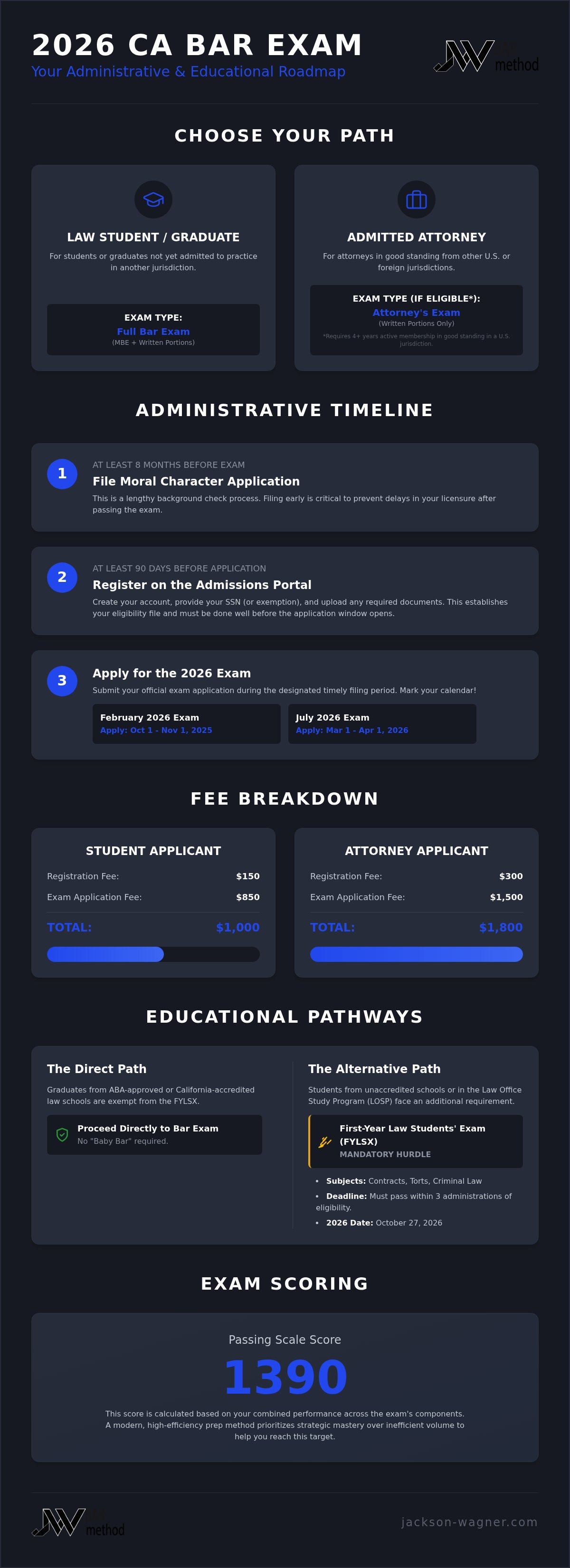
The path you choose depends entirely on your current professional status. If you're a law student or a graduate who hasn't been admitted to practice elsewhere, you fall into the Student Applicant track. However, attorneys in good standing from other U.S. jurisdictions or foreign countries follow a different set of california bar exam requirements. If you've been an active member in good standing for at least four years in a U.S. jurisdiction, you may qualify for the shorter Attorney's Exam. This version omits the Multistate Bar Examination (MBE) entirely, focusing only on the written portions. Knowing your track is vital because it dictates your study strategy. We've designed the JW Bar Method Prep - Attorney’s Exam California Bar specifically for those skipping the MBE, while students should focus on the JW Bar Method Prep - Full Exam California Bar to cover all components.
The Registration Logistics Checklist
Success starts with an organized digital file. You must create an account on the Admissions portal and provide a Social Security Number. If you're an international applicant without an SSN, you'll need to submit a specific exemption request form. Don't let this technicality stall your progress. You also need to upload mandatory documentation for any name changes or prior bar history in other states. For the 2026 cycles, keep these deadlines in your calendar:
- February 2026 Cycle: Timely application filing opens October 1, 2025, and closes November 1, 2025.
- July 2026 Cycle: Timely filing begins March 1, 2026, and closes April 1, 2026.
- The 90-Day Window: It's best practice to ensure your general registration is active at least 90 days before your intended exam cycle to avoid portal locks during the high-traffic application period.
Monitoring your "Status Screen" is your primary administrative duty. This dashboard tracks your fees, Moral Character status, and MPRE scores. Initial registration fees are $150 for students and $300 for attorneys. These are separate from the actual exam application fees, which are $850 and $1,500 respectively. Precision here clears your mental runway, allowing you to focus on the rigorous pedagogical demands of the JW Bar Method.
Educational Standards: ABA, California-Accredited, and Law Office Study
California offers several distinct paths to licensure, but each route has strict california bar exam requirements that you must navigate with precision. Most candidates hold a Juris Doctor (JD) from a school approved by the American Bar Association (ABA). However, California is one of the few jurisdictions that also recognizes degrees from state-accredited and even unaccredited institutions. Your educational background determines your administrative burden and the specific hurdles you'll face before you're permitted to sit for the general exam. International practitioners aren't left out, but they must undergo a detailed credential evaluation to see if their foreign legal education meets the California Bar Admission Requirements or if additional LLM credits are necessary.
Navigating the First-Year Law Students’ Examination (FYLSX)
Commonly known as the "Baby Bar", the FYLSX is a mandatory gatekeeper for students at unaccredited law schools or those participating in the Law Office Study Program. You're exempt from this test if you've completed your first year at an ABA or California-accredited school and were promoted to the second year. For everyone else, the exam focuses exclusively on Contracts, Torts, and Criminal Law. The timing is critical; you must pass within three administrations of first becoming eligible to receive credit for all your law school work. The October 2026 FYLSX is scheduled for October 27, 2026. Missing this window can be devastating, as the State Bar will only grant credit for one year of study regardless of your actual progress.
The Law Office Study Program (LOSP) Path
The LOSP is a storied but demanding alternative to traditional law school that allows you to "read law" under the supervision of a judge or an attorney. To qualify, you must engage in 18 hours of study per week for four years, with at least five of those hours under direct supervision. Meeting the california bar exam requirements for the LOSP track involves submitting mandatory semi-annual reports and passing the FYLSX. Because LOSP candidates lack the structured environment and pedagogical support of a traditional law school, they often struggle with the sheer volume of the bar's curriculum. This is where a results-oriented approach like the JW Bar Method Prep - Full Exam California Bar becomes an essential partner. It provides the disciplined, structured framework necessary to bridge the gap between practical apprenticeship and the rigorous academic standards of the 2026 exam.
Exam Components and the MPRE: Testing Requirements for 2026
Mastering the 2026 California Bar Exam requires more than just legal knowledge; it demands an understanding of the exam's mechanical structure. The State Bar continues to use a two-day format for the General Bar Exam, consisting of five one-hour essay questions, one 90-minute Performance Test, and the 200-question Multistate Bar Examination (MBE). To pass, you must achieve a total scaled score of 1390. This threshold is non-negotiable and requires a balanced performance across both the written and multiple-choice sections. While the industry anticipates a transition to the NextGen Bar Exam in July 2028, your 2026 attempt will follow the traditional format, emphasizing the need for a preparation strategy that targets these specific California Bar Admission Requirements with absolute precision.
The General Bar Exam vs. The Attorney's Exam
The distinction between the two tracks is significant in both duration and content. The General Bar Exam spans two full days. Day one focuses on the written components, including five essays and the Performance Test. Day two is dedicated entirely to the MBE. In contrast, the Attorney's Exam is a one-day event that omits the MBE, focusing solely on the written portions. Data from the February 2026 cycle indicates that first-time takers generally perform at a much higher success rate than repeaters, often nearly doubling the pass percentage. This disparity highlights the danger of using legacy, volume-based prep. Whether you are enrolled in the JW Bar Method Prep - Full Exam California Bar or the JW Bar Method Prep - Attorney’s Exam California Bar, our focus is on teaching you to recognize the patterns that examiners use to score essays and PTs.
The MPRE: The Ethics Prerequisite
You cannot be admitted to practice without passing the Multistate Professional Responsibility Examination (MPRE). For the 2026 cycle, California requires a minimum scaled score of 86.00. We recommend completing this requirement before you sit for the bar exam to clear your administrative runway. If you wait until after the bar, your admission will be delayed until your score is processed and reported. MPRE scores in California don't expire as long as you remain an active applicant, but you must ensure your score is officially sent to the State Bar through the NCBE portal. This ethics hurdle is often underestimated, but failing to secure the 86.00 score can stall an otherwise successful bar performance.
If you require testing accommodations for the 2026 exams, you must be proactive. The State Bar enforces strict deadlines for these requests, usually coinciding with your initial application. Documentation must be comprehensive and current. Delayed or incomplete accommodation files are a common cause for administrative rejection, which can force you to postpone your career goals by six months. We empower our students to handle these logistics early, ensuring that by the time February 24 or July 28, 2026, arrives, their only focus is execution.
Moral Character and Administrative Compliance
Clearing the 1390 scaled score is a massive hurdle, but it's only half of the journey. A positive moral character determination is a prerequisite for admission that many applicants treat as an afterthought. This is a mistake. The State Bar evaluates your candor and integrity through a lens of "Complete and Candid" disclosure. Omissions are often treated more harshly than the underlying conduct itself. If you've ever had a disciplinary issue, a criminal record, or even significant financial instability, you must disclose it fully. This administrative "test" ensures that you meet the ethical california bar exam requirements before you're entrusted with the public's legal affairs.
The Moral Character Application Process
The background check process takes a minimum of six to eight months. We advocate for a "Strategic Early Filing" method: submit your application at least eight months before your intended admission date. For most students, this means filing at the start of their 3L year. You'll need to navigate fingerprinting via Live Scan and provide a comprehensive history of every job you've held and every residence you've occupied. Precision is your best defense against delays. For an exhaustive breakdown of how to handle specific red flags, read our article on Decoding the California Bar Exam Moral Character Application: A 2026 Strategic Guide.
Statutory Requirements: Family Support and SSN
Licensure is also tied to your status as a responsible citizen. California law mandates that the State Bar coordinate with other agencies to ensure statutory compliance. This includes family support and tax obligations. If you have outstanding child support arrears, your license will be withheld until you're in compliance. Additionally, providing a valid Social Security Number is mandatory for tax enforcement. These requirements are non-negotiable. Once these boxes are checked and your Moral Character is cleared, the Board of Trustees will approve your file. Your final act will be taking the Oath of Allegiance and paying your initial licensing fees.
Don't let administrative hurdles derail your career. While you handle the paperwork, we'll handle the pedagogical heavy lifting. Experience the efficiency of the JW Bar Method Prep - Full Exam California Bar and ensure you're ready for the 2026 exam cycle.
Executing Your Strategy: Prep for the 2026 California Bar
Meeting the california bar exam requirements is merely the administrative baseline. It grants you the right to sit in the room; it doesn't grant you the license. To cross the finish line, you need a preparation strategy that moves beyond the passive consumption of lectures. Most students fail because they drown in the sheer volume of traditional study materials. They should focus instead on the specific scoring rubrics used by California examiners to reach that mandatory 1390 scaled score. Precision is the only way to clear this hurdle without succumbing to cognitive fatigue.
Precision Over Volume: The JW Bar Method Advantage
Legacy industry models often fail modern learners by prioritizing quantity over cognitive efficiency. They provide thousands of questions but fail to teach the underlying patterns of the 2026 California rubric. We've disrupted this model to offer a more surgical approach. The JW Bar Method Prep - Full Exam California Bar is designed for first-time takers who must master the MBE and written portions simultaneously. It avoids the burnout associated with conventional prep by focusing on high-impact pedagogical features that connect law to application. This ensures your study time is spent on the highest-yield topics. You won't just memorize rules; you'll learn how to win points through structured analysis.
The Professional’s Path: Accelerated Preparation
For practicing attorneys, the challenge isn't just the law. It's the clock. Balancing a full-time practice with the rigorous demands of exam mastery requires a specialized approach that respects your professional schedule. The JW Bar Method Accelerated Prep - Attorney’s Exam California Bar is built for this specific demographic. It strips away the multiple-choice noise to focus exclusively on the Essay and Performance Test components. This streamlined track allows you to maintain your professional obligations while securing your California licensure. For a deeper dive into the tactical execution of your study plan, consult our guide on Passing the California Bar Exam in 2026: The Definitive Strategic Guide.
We're so certain of our methodology that Jackson-Wagner LLC assumes the financial risk of your performance. Our binary performance guarantee is a powerful brand anchor. It distinguishes us from cautious competitors who offer no accountability for their results. We act as your partner in success, providing a structured, modern, and reliable path to clearing the california bar exam requirements. This focus on a measurable outcome is what makes us a cutting-edge education provider. When you choose our method, you aren't just buying a course; you're securing a results-oriented mentor dedicated to your professional empowerment.
Master Your Path to California Licensure
Navigating the complex california bar exam requirements is the first true test of your professional precision. Success in the 2026 cycle requires more than just legal knowledge; it demands a tactical approach to registration deadlines, Moral Character disclosures, and the 1390 scaled score threshold. You've now got the comprehensive roadmap needed to clear every administrative hurdle and focus entirely on your pedagogical performance. Don't let legacy study methods or administrative delays stall your career by another six months.
We offer the only results-guaranteed prep method that's exclusively focused on California licensure. By utilizing our proprietary accelerated tracks for attorneys, you can balance the demands of a full-time practice with the rigorous mastery required for the 2026 exam. We replace the high-pressure anxiety of legacy volume-based courses with a structured, modern, and reliable path to your license. Secure Your 2026 Success with the JW Bar Method and take command of your legal future. Your career's waiting; let's ensure you're ready to claim it with absolute confidence.
Frequently Asked Questions
Can I take the California Bar Exam without a law degree in 2026?
Yes, you can sit for the exam without a traditional law degree through the Law Office Study Program (LOSP). This path requires four years of supervised study under a judge or attorney and passing the First-Year Law Students’ Examination (FYLSX). While this route fulfills the california bar exam requirements, it demands exceptional self-discipline. Most LOSP candidates find that a structured, results-oriented prep system is necessary to bridge the gap between practical apprenticeship and the rigorous academic standards of the general bar.
What is the passing score for the California Bar Exam in 2026?
The passing score for the 2026 California Bar Exam is a scaled score of 1390. This score is a composite of your performance on the Multistate Bar Examination (MBE) and the written portions, which include five essays and one Performance Test. Because the threshold is high, you must demonstrate proficiency across all components. Our programs focus on teaching you the specific patterns and rubrics used by examiners to ensure you reach this target score with precision.
How long is a California Bar Exam Moral Character determination valid?
A positive Moral Character determination is valid for 36 months from the date it's issued. If you aren't admitted to the State Bar within this three-year window, you must file a new application and undergo the background check process again. Because the initial investigation takes a minimum of six to eight months, we recommend filing early in your final year of law school to ensure your eligibility remains active throughout your testing cycle.
Can out-of-state attorneys skip the MBE in California?
Yes, out-of-state attorneys can qualify for the shorter Attorney’s Exam, which omits the MBE entirely. To be eligible, you must have been an active member in good standing of a U.S. jurisdiction for at least four years immediately preceding your application. If you meet these criteria, you only complete the written portions of the exam. We offer the JW Bar Method Prep - Attorney’s Exam California Bar specifically to help practitioners master this essay-heavy format efficiently.
What are the deadlines for the July 2026 California Bar Exam?
For the July 2026 cycle, the timely filing period opens on March 1, 2026, and closes on April 1, 2026. If you miss this initial window, you can still file until the final deadline in early June, but you'll incur significant late fees ranging from $50 to $250. Monitoring these dates is a critical part of meeting the california bar exam requirements. Missing a deadline can delay your legal career by a minimum of six months.
Is the California Bar Exam moving to the NextGen format in 2026?
No, the California Bar Exam won't use the NextGen format in 2026. The State Bar of California has scheduled the transition to the NextGen UBE for July 2028. This means the current exam structure, featuring the MBE, five essays, and one Performance Test, will remain in place for both the February and July 2026 administrations. You should focus your preparation on the existing testing rubrics and subjects rather than anticipating changes to the exam format.
How much does it cost to take the California Bar Exam in 2026?
The cost depends on your applicant track. For 2026, the general application fee for students is $850, while the attorney application fee is $1,500. You must also pay a one-time registration fee of $150 as a student or $300 as an attorney. Additional costs include the $725 Moral Character application fee and potential late filing fees. These administrative costs are separate from your preparation expenses and are mandatory for all candidates seeking licensure.
Can I take the California Bar Exam online in 2026?
No, the 2026 California Bar Exam is administered in person at designated testing centers. While you'll use your personal laptop and specific software like ExamSoft to complete the written essay and Performance Test portions, you must be physically present at the site. The multiple-choice MBE section remains a paper-based exam using Scantron sheets. There are currently no options for remote or fully online testing for the 2026 February or July exam cycles.


