
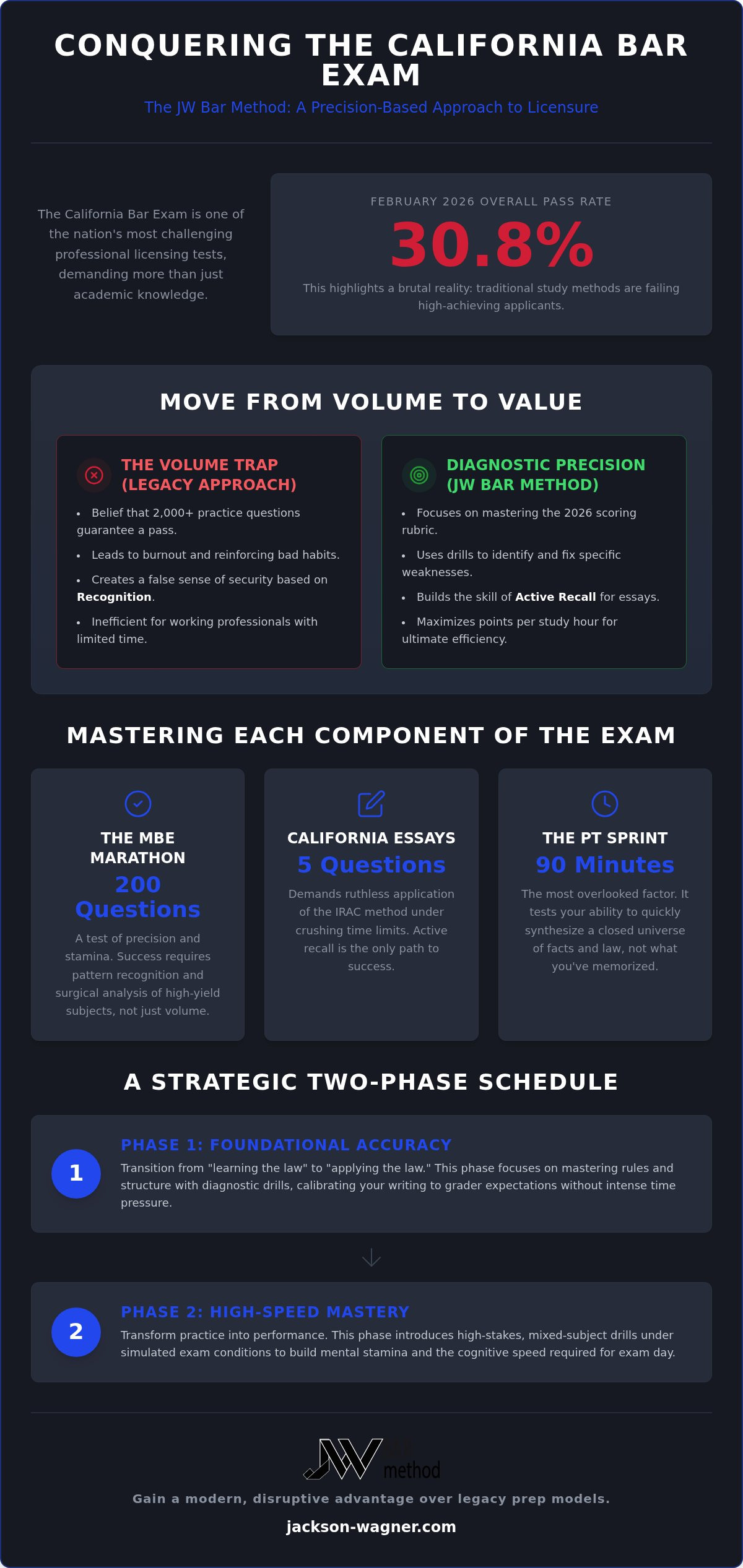
Did you know that the overall pass rate for the February 2026 California Bar Examination was a staggering 30.8%? This figure highlights a brutal reality. Even high-achieving students often find themselves buried under a mountain of study material while trying to maintain their professional lives. It's exhausting to balance a full-time career with the need for rigorous california bar exam practice, especially when the fear of failing a high-stakes exam looms despite your academic success. You deserve a path that respects your time and your intelligence.
Volume is a vanity metric; true success requires precision. We'll show you how to master the exact diagnostic drills and high-stakes strategies needed to conquer the exam with the authority of the JW Bar Method. By moving away from legacy industry standards, you'll gain the confidence to handle both the MBE and California-specific essays through our JW Bar Method Prep - Full Exam California Bar. This article previews our proprietary framework, detailing an efficient, results-oriented approach that allows you to maintain your career while preparing for the July 2026 administration. It's time to replace anxiety with a structured, modern, and reliable path to licensure.
Key Takeaways
- Identify why question volume is a vanity metric and how to pivot toward diagnostic drills that master the 2026 California scoring rubric.
- Execute high-stakes california bar exam practice by incorporating intense time pressure and limited resources to simulate real exam-day conditions.
- Refine your "IRAC" method for California-specific essays and develop the precision needed to conquer the 200-question MBE marathon.
- Organize your study efforts into a strategic two-phase schedule that transitions from foundational accuracy to high-speed, mixed-subject mastery.
- Leverage the JW Bar Method Prep - Full Exam California Bar to gain a modern, disruptive advantage over legacy prep models.
Beyond the Question Bank: Why Volume Alone Fails the California Bar Exam
Many applicants fall into the "Volume Trap," believing that grinding through 2,000 multiple-choice questions guarantees a passing score. It doesn't. This approach often leads to frustrating plateaus because it prioritizes sheer quantity over tactical methodology. If you're practicing without a diagnostic framework, you're merely reinforcing existing weaknesses and bad habits. The 2026 scoring rubric is notoriously unforgiving. With the February 2026 pass rate sitting at just 30.8%, it's clear that the State Bar of California demands more than just a passing familiarity with legal concepts. High-achieving attorneys often fail because they rely on law school habits like deep academic synthesis and exhaustive outlining. The bar exam isn't an academic exercise; it's a high-pressure performance. You must transition from "learning the law" to "executing the exam" through intentional, high-stakes california bar exam practice. Success depends on your ability to apply rules with surgical precision rather than broad, generalized knowledge.
The Difference Between Recognition and Recall
Multiple-choice questions often rely on simple recognition. You see a familiar rule in a prompt and pick the corresponding answer. This creates a dangerous false sense of security. California's complex essay prompts require active recall, the specific ability to pull nuanced rules from memory and apply them under extreme time constraints. Passive reading won't save you when the clock is ticking. Effective california bar exam practice involves high-stakes simulation where you're forced to produce analysis, not just recognize a correct statement. Shift your focus from "knowing" to "performing" to ensure you're ready for the cognitive load of test day.
Diagnostic Practice: Identifying Your Scoring Gaps
Stop treating study sessions as a daily chore. Practice should be a surgical tool. Every session must identify a specific gap in your knowledge or timing. While the "Selected Answers" provided by the state can be intimidating, they're your most valuable resource for understanding the exact expectations of graders. Use them to calibrate your own writing and issue spotting. The JW Bar Method focuses on this diagnostic approach, ensuring every hour translates into measurable points. This efficiency is why our accelerated tracks are designed for working professionals who cannot afford to waste time on low-impact study methods.
Essential Components of California Bar Exam Practice
Mastering the California Bar Exam structure requires a multi-dimensional approach to your daily routine. You aren't just memorizing rules; you're training for a high-stakes athletic event. The 2026 exam consists of the Multistate Bar Examination (MBE), five essay questions, and one Performance Test (PT). Each component requires a distinct mental gear. Effective california bar exam practice must treat these as separate disciplines that eventually merge into a cohesive, high-energy performance on test day.
The MBE is a 200-question marathon where precision is the only currency that matters. Essays demand a ruthless application of the IRAC method under crushing time limits. However, the 90-minute PT is often the most overlooked success factor for applicants. It isn't about what you know; it's about how quickly you can synthesize a closed universe of facts and law. To succeed in 2026, you must simulate these conditions exactly, using the same software and environment you'll face at the testing center. Mental stamina is built through high-stakes california bar exam practice, not just passive reading. If you're looking for a structured way to build this endurance, the JW Bar Method Prep - Full Exam California Bar provides the exact framework needed to bridge the gap between study and execution.
MBE Drills: Quality Over Quantity
Focus your energy on high-yield subjects like Torts, Evidence, and Constitutional Law. Don't just chase a high volume of questions to feel productive. Use a surgical approach for every wrong answer by analyzing exactly why the incorrect choices were deceptive and why the correct one was legally superior. This depth of analysis builds the speed and accuracy necessary for the 2026 administration. You need to reach a point where you recognize patterns instantly, allowing you to bank time for more complex questions.
The 90-Minute PT Sprint
The Performance Test requires a specialized "File and Library" extraction technique. You have 90 minutes to digest a dense packet of information and produce a professional legal document. You should write at least one full PT per week to master the timing. For practicing lawyers taking the Attorney's Exam, the PT is often the most critical hurdle. Practice extracting the relevant law from the Library and the key facts from the File until the process becomes reflexive. Mastery here often makes the difference between a passing score and a near-miss.
High-Stakes Drills: Transforming Practice into Performance
A drill is only "high-stakes" if it forces you to confront the same limitations you'll face on exam day. For your california bar exam practice to be effective, you must remove all safety nets. This means practicing with strict timers, no notes, and the exact software environment used by the State Bar. We don't believe in comfort during study; comfort is the enemy of performance. This focus on high-fidelity simulation and precision mirrors the approach taken in complex industrial engineering; for example, you can learn more about RWC Inc. to see how they utilize automated machine simulation to optimize robotic manufacturing systems. The JW Bar Method utilizes an iterative drafting process where you don't just write an essay once. Instead, you refine it through multiple timed cycles until the structure becomes reflexive. Early in the 2026 cycle, closed-book drills are essential to expose knowledge gaps that passive reading masks. By the final week, you must replicate the full two-day experience, sitting for six hours of testing each day to build the psychological calluses required for success.
The 30-Minute Essay Outline Drill
Issue spotting is the foundation of a passing essay. You don't need 60 minutes to know if you've found the points; you need 15. Our 30-minute drill forces you to identify every major and minor issue under a 15-minute timer, leaving the remaining time for skeleton outlining. You must develop these skeleton outlines for every major California subject to ensure you never face a blank screen on test day. The JW Bar Method's unique approach to essay precision prioritizes diagnostic issue-spotting and structured rule application, ensuring every word serves the singular purpose of securing points under extreme time pressure. This discipline prevents the "kitchen sink" approach that wastes time and confuses graders. Integrating these drills into your daily california bar exam practice ensures you're never surprised by the exam's intensity.
Self-Grading: The Path to Absolute Trust
Passive feedback is often useless for high-stakes preparation. You must become your own harshest critic using the "Red Pen" technique. This involves auditing your practice answers against model responses and literally marking where you missed an issue or misstated a rule. Identifying "fatal errors" in your analysis, such as missing a threshold standing issue or a statute of frauds defense, is critical before the examiners see your work. This level of self-awareness builds the absolute trust in your own skills required for California State Bar success. You'll stop guessing and start executing with the confidence of a licensed professional. When you can spot your own errors with surgical precision, you've mastered the mindset needed to win.
Building a Strategic Practice Schedule for 2026
A generic timeline is a recipe for mediocrity. Your california bar exam practice must be phased to build both competence and confidence. During Weeks 1-4, focus on foundation and untimed precision. This phase isn't about speed; it's about the surgical application of rules. In Weeks 5-8, pivot to speed building and mixed-subject drills. This forces your brain to switch between Constitutional Law and Community Property without hesitation. Finally, Weeks 9-12 are dedicated to high-stakes simulation. You aren't just studying anymore; you're rehearsing. For those on a tighter timeline, the JW Bar Method Accelerated Prep - Full California Bar Exam compresses these phases into a high-impact, results-driven track that respects your professional commitments.
Practicing While Working Full-Time
Most legacy prep courses assume you have 12 hours a day to study. We know you don't. Success while working full-time requires a tactical approach to your calendar. Start with an "Early Bird" MBE session. Knocking out 20 questions before your first meeting ensures that even if the workday derails, you've made progress. Use your lunch break for high-speed essay outlining. You don't need to write a full response; just spot the issues and map the rules. However, "Deep Work" on weekends is non-negotiable. This is when you sit for full-length PTs and mixed-subject essay blocks. This discipline turns small windows of time into a powerful engine for successful california bar exam practice.
Tapering for Peak Performance
Peak performance requires a deliberate taper. Approximately 10 days before the July 28, 2026 exam date, stop trying to learn new law. If you don't know a niche rule by then, your time is better spent drilling the high-yield topics you've already mastered. The final 72 hours should focus on mental conditioning and rest. Review your "Red Pen" audits and ensure your logistics are flawless. Knowing exactly where you'll park and what you'll eat reduces day-of anxiety, allowing your brain to focus entirely on execution. Trust the structured path you've built and enter the testing center with the authority of someone who's already won.
Mastering the JW Bar Method: From Practice to Licensure
Licensure isn't a reward for effort; it's a result of execution. The JW Bar Method Prep - Full Exam California Bar represents a total departure from legacy educational models by integrating rigorous california bar exam practice into every instructional module. We don't treat practice as a separate phase that happens after you've learned the law. Instead, we embed it within the curriculum. This ensures that every rule you memorize is immediately tested through high-stakes application. Our exclusive focus on California means our resources aren't diluted by national trends or irrelevant out-of-state nuances. You're training specifically for the 2026 California rubric, ensuring that your precision always beats the aimless volume of generic prep courses.
The JW Bar Method Advantage
Fragmented study aids often leave you guessing about your actual readiness. You need a structured learning environment that connects pedagogical features to measurable benefits. Our binary performance guarantee acts as the ultimate proof of our methodology. We assume the financial risk of your outcome because we're certain our system works. This "bold reliability" replaces the stress of high-pressure certification with a structured, modern path to success. You'll move from passive recognition to active, diagnostic mastery. Learn more about why we are the best bar exam preparation service for 2026 and how our focus on precision eliminates the "Volume Trap" discussed earlier in this guide.
Your Path to the California Bar
Choosing between the Full or Accelerated tracks depends on your current professional standing and timeline. Both options utilize the same high-stakes california bar exam practice framework to ensure you're prepared for the July 2026 administration. If you're an out-of-state lawyer, ensuring your California Attorney's Exam requirements are met is just the first step. You must then master the specific drills that allow you to bypass the MBE and focus entirely on the PT and essays. Targeted practice is the only way to bridge the gap between your existing legal expertise and the unique demands of the California examiners. Secure your future by adopting a methodology built for results, not just participation. Your path to the oath of office begins with the decision to practice with authority.
Secure Your California Licensure in 2026
The path to success on the 2026 California Bar Exam isn't paved with mindless multiple-choice questions. It's built through intentional, high-stakes california bar exam practice that prioritizes diagnostic precision over sheer volume. You've learned that mastering the IRAC method under pressure and treating the Performance Test as a tactical sprint are non-negotiable for those who want to avoid the "Volume Trap." By shifting your focus to active recall, you ensure test day is simply a rehearsal of the drills you've already mastered.
The JW Bar Method offers a disruptive alternative to legacy prep models. We provide a California-exclusive prep methodology and accelerated tracks for working professionals who need to balance study with career responsibilities. Our binary performance guarantee stands as proof of our commitment to your results. You don't have to face this high-stakes hurdle with uncertainty. It's time to adopt a structured, modern approach that turns your academic performance into professional licensure.
Master the California Bar with the JW Bar Method and take the first step toward your oath of office. You have the talent; now you have the method.
Frequently Asked Questions
How many practice questions should I do for the California Bar Exam?
Quality matters more than quantity when scheduling your california bar exam practice. While legacy courses suggest 2,000 questions, the JW Bar Method focuses on diagnostic mastery through targeted sets of 20 to 30. You should aim for a number that allows you to surgically analyze every mistake. Grinding through thousands of questions without a method leads to stagnation. Focus on high-yield subjects like Torts and Evidence to maximize your scoring potential before the 2026 administration.
Is the California Bar Exam harder than other states' exams?
Historically, California is considered one of the most difficult exams in the nation. The February 2026 pass rate was just 30.8%, significantly lower than most Uniform Bar Exam (UBE) jurisdictions. This difficulty stems from the unique scoring rubric and the inclusion of California-specific subjects. You need a prep system that addresses these localized challenges rather than a generic national program. Precision in rule application is the only way to overcome these rigorous standards.
When should I start doing full-length practice exams for the 2026 bar?
You should begin full-length simulations approximately four weeks before the July 28, 2026 exam date. This final phase of your california bar exam practice should replicate the two-day experience to build psychological stamina. Earlier weeks should focus on foundational accuracy and speed building through shorter drills. Starting full exams too early can lead to burnout, while starting too late leaves you unprepared for the cognitive load of a six-hour testing day.
Can I pass the California Bar Exam while working a full-time job?
Passing while working full-time is entirely possible with a structured, efficient schedule. You must utilize "Deep Work" on weekends and maximize small windows during the work week for essay outlining. The JW Bar Method Accelerated Prep - Full California Bar Exam is specifically designed for professionals who need results-oriented study without a 12-hour daily commitment. Focus on high-impact drills that prioritize execution over passive reading to ensure you remain competitive on test day.
What is the best way to practice for the California Performance Test (PT)?
The most effective way to prepare for the PT is through timed, 90-minute drills using the "File and Library" extraction technique. You aren't being tested on your knowledge of the law, but on your ability to synthesize a closed universe of facts. You should write at least one full PT every week during your prep cycle. Mastering the organization of the library and file ensures you can produce a professional legal document under extreme pressure.
How do I self-grade my practice essays for the California Bar?
Self-grading requires the "Red Pen" technique, where you audit your work against official model responses. Don't just read the model answer; mark exactly where your analysis deviated or where you missed a threshold issue. Identifying these fatal errors early prevents them from appearing on the actual exam. This diagnostic approach builds absolute trust in your skills. It turns every practice essay into a surgical tool for improvement rather than a passive writing exercise.
Are the past exams on the State Bar website enough for practice?
Past exams are an excellent raw resource, but they don't provide a methodology for success. The State Bar website gives you the test, not the solution for passing it. You need a structured framework to interpret those model answers and apply them to your own writing. Relying solely on past exams without a diagnostic system often leads to the "Volume Trap." A proprietary curriculum like the JW Bar Method turns those raw materials into actionable performance.
What is the JW Bar Method's approach to multiple-choice practice?
The JW Bar Method prioritizes diagnostic precision over sheer volume in multiple-choice sets. Instead of answering hundreds of questions daily, you'll analyze why every incorrect choice was deceptive and why the correct one was legally superior. This "Rule of Five" approach builds the speed and accuracy required for the 200-question MBE marathon. We focus on high-yield subjects to ensure your study time translates directly into the points needed for licensure in the 2026 cycle.


