

Bar stamina is built before exam day, not summoned at the last minute. A typical recommended preparation period for the California Bar Exam is two months. Building stamina for the California Bar Exam means using that time for regular practice, timed sessions, and deliberate recovery.
It’s natural to focus on how much material you still need to cover. But knowing the law is only part of the challenge: you also need to sustain concentration and make sound decisions throughout a demanding, two-day exam. Longer study hours alone won’t prepare you if your practice never reflects the effort test day requires.
This article explains how to build endurance through consistent essay and multiple-choice practice, manage fatigue during long sessions, and prepare for the rhythm of the exam. You’ll also learn how to adjust your study plan as exam day approaches, developing both legal knowledge and the focus to use it under pressure.
Key Takeaways
- Build speed and structure with regular essay writing and timed multiple-choice practice, then review mistakes to guide what you study next.
- Manage mental fatigue by using brief reset breaks during demanding sessions and protecting time for rest.
- Set a consistent study schedule that prioritizes challenging subjects and eases off rather than cramming as exam day approaches.
- Rehearse extended exam-style sessions to practice pacing, focus, and endurance across the day.
1. Building knowledge through regular practice questions
Build California Bar Exam knowledge by answering questions, then reviewing the reasoning behind each response. A course can introduce a rule, but active practice shows whether you can recognize and apply it. Prioritize question quality over volume: work through a focused set, explain why each answer is right or wrong, and note which rule needs more review. For example, if you miss a contracts question because you overlooked acceptance, record the issue and revisit it before trying similar questions again.
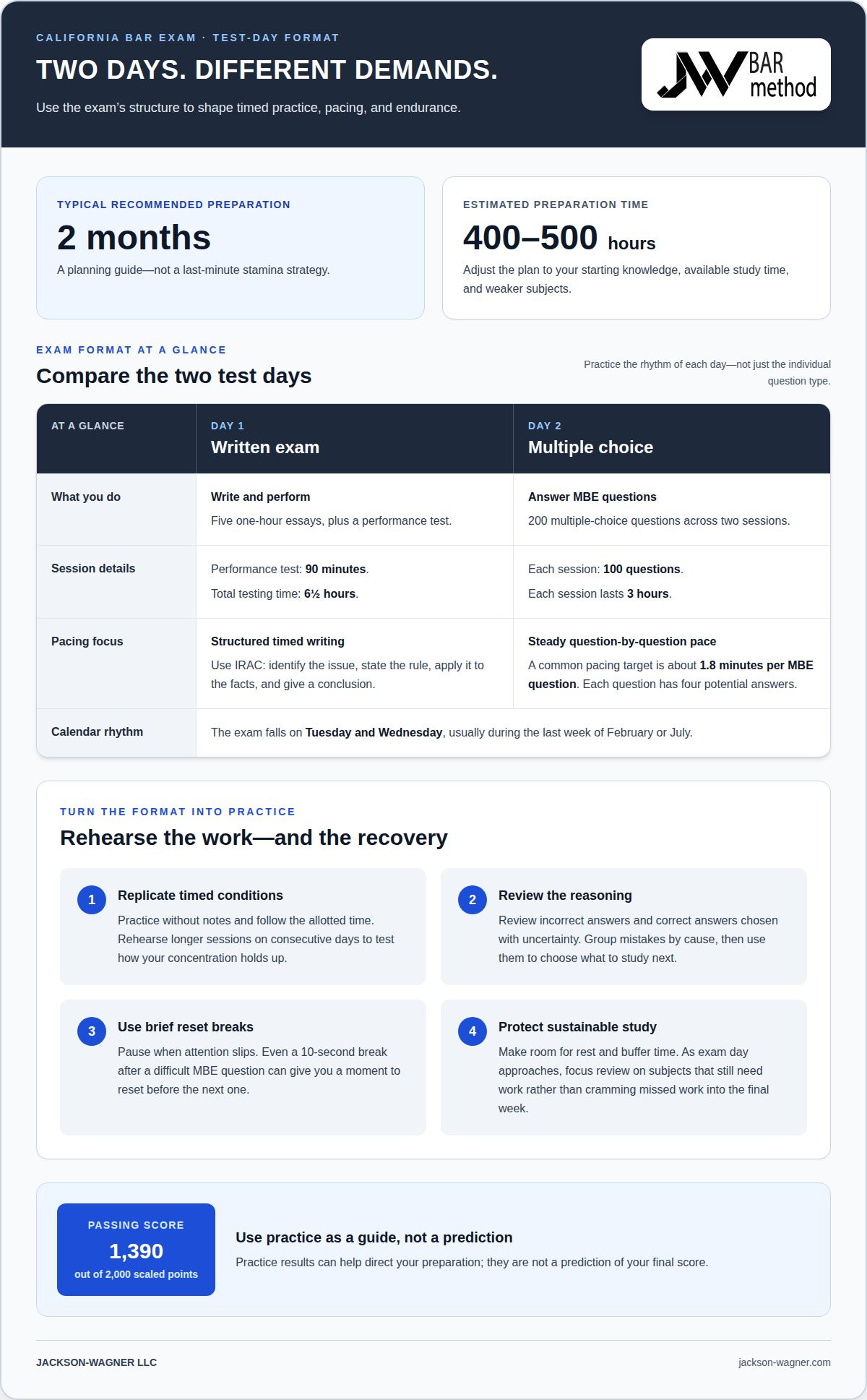
Use a timed practice set to build pace without sacrificing analysis. A common pacing target is about 1.8 minutes for each MBE question. Each question has four potential answers, so eliminate choices by applying the facts to the rule rather than guessing from familiar wording. Afterward, review both incorrect answers and correct answers reached through uncertain reasoning. That distinction helps separate reliable learning from lucky selections.
Practice essays with a timer and a repeatable IRAC structure: identify the issue, state the rule, apply it to the facts, and give a conclusion. For example, on a negligence problem, identify the alleged breach, state the relevant rule, connect specific facts to each element, then conclude. Timed writing shows whether you spend too long outlining or leave your application underdeveloped. Review one essay for rule accuracy and another for organization before writing more.
Simulate exam conditions during practice exams by working without notes and following the allotted time. Treat each session as a diagnostic, not just a score check. Mark questions where you misunderstood a rule, misread a fact, or ran short on time. Then group errors by cause and choose the next learning task accordingly, such as reviewing a weak subject or completing a timed essay. According to calbar.ca.gov, the passing score for the California bar exam is 1,390 out of 2,000 scaled points. Use practice results to guide preparation, not as a prediction of your final score.
2. Managing fatigue during long testing sessions
During a long bar prep block, work toward one clear task, such as reviewing a missed rule or outlining an essay. Put unrelated materials aside, and pause briefly when attention slips. Even a 10-second break after a difficult MBE question can create a moment to reset before the next problem. Mental fatigue can affect concentration, memory, processing speed, and decision-making, so notice when repeated rereading or rushed choices signal that you need a short pause.
To strengthen concentration and mental endurance, alternate focused study with brief breaks, then return to a specific task instead of extending a session without direction. Support steady preparation with regular sleep, physical activity, balanced meals, and water throughout the day. These habits help sustain learning, rather than relying on late-night cramming and extra caffeine.
Test-day anxiety can draw your attention to the clock or a difficult question. When stress rises, pause, take a slow breath, and identify the next concrete action, such as rereading the call of the question. If an answer isn’t coming, make the best reasoned choice you can, mark the issue mentally, and move on. Keep a short reminder of why you chose to pursue law nearby during study breaks; reconnecting with that motivation can help restore perspective.
Watch for signs of overtraining, including persistent difficulty concentrating, irritability, trouble recalling familiar rules, or losing interest in study tasks. Respond by shortening your next study block, taking a genuine break away from exam materials, and returning with a narrower goal. Keep a brief daily log of focus, energy, and completed work. If your concentration keeps worsening, adjust your schedule to make it more sustainable instead of simply adding hours. A planned rest day can protect consistency and help you resume bar prep with clearer priorities. Regular check-ins with an accountability partner can also turn discouragement into a practical discussion about what to change.
3. How Long Do You Need to Study for the California Bar Exam?
A typical recommended preparation period is two months, with California Bar Exam preparation estimated at 400-500 hours. Treat those figures as planning guides, not a daily quota: your schedule should reflect your starting knowledge, available study time, and the subjects needing the most attention. To build stamina over several months, keep a repeatable weekly routine, increase practice gradually, and reserve review time for difficult material.
Start with a weekly plan that gives each study block a clear purpose. For example, pair subject review with practice questions, then use another session to revisit missed rules. Adjust the balance as your results reveal stronger and weaker areas. Include buffer time for topics that take longer than expected, missed study sessions, or a full practice exam. In the final weeks, focus more review on subjects that still need work instead of trying to cover every topic equally.
Plan around the exam’s two-day format. The first day includes five one-hour essays and a 90-minute performance test, with six and a half hours of testing time overall. The second day includes 200 multiple-choice questions across two sessions; each session has 100 questions and lasts three hours. California Bar Exam dates fall on Tuesday and Wednesday, usually during the last week of February or July. Use that schedule to place longer practice sessions on consecutive days and test how your concentration holds up.
For medical or disability-related needs, accommodations can address barriers to accessing the exam, and your preparation should reflect the testing arrangements you’ll use. Build those arrangements into timed practice so your schedule and practice conditions align. Allow time for rest and adjustments rather than compressing missed work into the final week. A buffer helps you stay consistent and respond when studying takes longer than expected.
4. Building test-day stamina
Build test-day ability by rehearsing sustained work, not just isolated questions. Schedule a full exam-day practice, follow planned start and stop times, and use only permitted materials. This reveals whether your pacing strategies hold up under fatigue. For example, note when careful reading starts to slip, then decide how you’ll reset without losing focus on the remaining questions.
Make the rehearsal realistic. Complete essays and a performance test in sequence, then practice multiple-choice work in extended blocks. Keep breaks consistent with your planned routine. Avoid pausing the clock to check notes or messages. Afterward, review when your attention dipped, whether you rushed, and which tasks took longer than expected. Use those observations to adjust your next practice day.
Prepare a simple exam-day sequence before practice begins: read the instructions, settle your materials, and start the first assigned task. If a difficult question disrupts your rhythm, take a breath, identify what it asks, and choose your next step. Don’t spend the rest of the session replaying one answer. A calm reset protects your ability to work through later questions.
In the week leading up to the California Bar Exam, taper your study time instead of cramming. Keep review focused and make room for physical and mental rest. Use your final practice sessions to rehearse familiar strategies, not chase every possible topic. Sleep well, prepare your materials ahead of time, and avoid turning the last evening into another long study block. A rested, repeatable routine is more useful than arriving depleted.
Want a structured way to prepare for sustained exam practice? Explore California Bar Exam preparation options and choose a study track aligned with your exam and timeline.
Jackson-Wagner
Jackson-Wagner LLC helps California Bar Exam candidates prepare with structured study programs that support consistent learning and practice. Its offerings include preparation for the Full Exam and Attorney’s Exam, with standard and accelerated tracks to suit different study timelines and backgrounds. If you need a guided framework for organizing subject review, practice questions, and exam preparation, a program can help bring those tasks together in a focused plan. Choose the exam track that matches your path and the preparation pace that fits your timeline. For support choosing a suitable California Bar Exam preparation program, contact Jackson-Wagner LLC.
Make your next study step deliberate
Building stamina for the California Bar Exam takes consistent practice: choose a routine you can sustain, then use your progress to guide what comes next. Jackson-Wagner’s fully online courses offer structured preparation for the full California Bar Exam and the Attorneys’ Exam, with options for different study timelines.
Jackson-Wagner LLC offers JW Bar Method Prep - Full Exam California Bar, JW Bar Method Prep - Attorney’s Exam California Bar, and JW Bar Method Accelerated Prep - Full California Bar Exam. These options provide a focused next step when you want a course to support your preparation. Consider which exam you’re taking and whether a standard or accelerated track best fits your schedule.
Contact Jackson-Wagner LLC to discuss your preparation needs. Keep your next step clear and manageable, then build from there with steady purpose.
Frequently Asked Questions
How Long Do You Need to Study for the California Bar Exam?
A typical recommended preparation period is two months, with preparation estimated at 400-500 hours. Building stamina for the California Bar Exam takes a repeatable schedule that fits your starting knowledge, available study time, and practice results. If you’re repeating the exam, use your score report to prioritize subjects and question types needing attention. Adjust your plan as practice shows where additional review will help most.
How long is the California Bar Exam and what is the current exam-day schedule?
The California Bar Exam is administered over two days. Day one includes five one-hour essays and a 90-minute performance test, for six and a half hours of testing time. Day two has 200 multiple-choice questions in two three-hour sessions, with 100 questions per session. Plan your preparation around the sequence and sustained effort, rather than assuming one practice block represents the whole experience.
What stamina demands do the California Bar Exam essays, performance test, and multiple-choice sections place on test takers?
Essays require you to recall rules, organize analysis, and keep writing across several prompts. The performance test adds a different demand: processing provided materials and producing a focused work product within its allotted time. Multiple-choice sessions require sustained attention across 100 questions. Switching between these tasks challenges pacing and mental flexibility, so note whether fatigue affects reading accuracy, rule recall, or written analysis.
What is a sample weekly study schedule that gradually increases hours for California Bar Exam preparation?
A weekly plan for building stamina for the California Bar Exam should increase study time in manageable steps, not add a long block all at once. Begin with subject review and targeted questions early in the week; add a timed essay and deeper review midweek. Later, include a longer mixed-practice session, then reserve a lighter day for error review and planning. Track focused study time and energy before increasing your workload the following week.
How should I practice full-length timed California Bar Exam essays and performance tests?
Set up a quiet workspace, follow the official time limits, and complete each task without notes or interruptions. For a full practice day, place essays and the performance test in the same order as the exam, with realistic transitions between tasks. Afterward, review missed issues, incomplete rule application, organization, and time allocation. Choose one recurring weakness to address in your next practice session instead of rewriting everything.


