

A diagnosis alone doesn’t explain why you need a particular bar exam accommodation. To understand how to get accommodations for ADHD for the bar exam, your application should pair a current, comprehensive evaluation with evidence of how ADHD affects your functioning under timed testing conditions and why each requested adjustment addresses those limitations. For the California Bar Exam, the evaluation report should include a clinical interview, relevant test data, and a clear rationale connecting the diagnosis to the accommodation requested.
It’s understandable to focus on the diagnosis, especially if you have a history of ADHD. But ADA eligibility also depends on whether the impairment substantially limits one or more major life activities. Your accommodation request must explain how ADHD affects your exam performance in practical terms. This guide covers the documentation to gather, how timed conditions can expose functional barriers, who may need to apply, and how ADA eligibility fits into the review. It also explains why past records and specific evidence of current limitations can help make your request more complete.
Key Takeaways
- Build a documentation record that shows more than a diagnosis: its history, current impact, and supporting evaluation evidence all matter.
- Connect ADHD-related limitations to the demands of timed testing so each requested accommodation has a clear purpose.
- Determine whether you need an accommodation application by distinguishing disability-related adjustments from standard testing options.
- Understand how ADA eligibility relates to functional limitations, while recognizing that each bar jurisdiction reviews requests through its own process.
What Makes Documentation “Comprehensive”?
Comprehensive documentation connects an ADHD diagnosis to current functional limitations and explains why each requested accommodation addresses them. To learn how to get accommodations for ADHD for the bar exam, start by matching your application evidence to the instructions for your jurisdiction.
ADHD Diagnostic and Evaluation Records
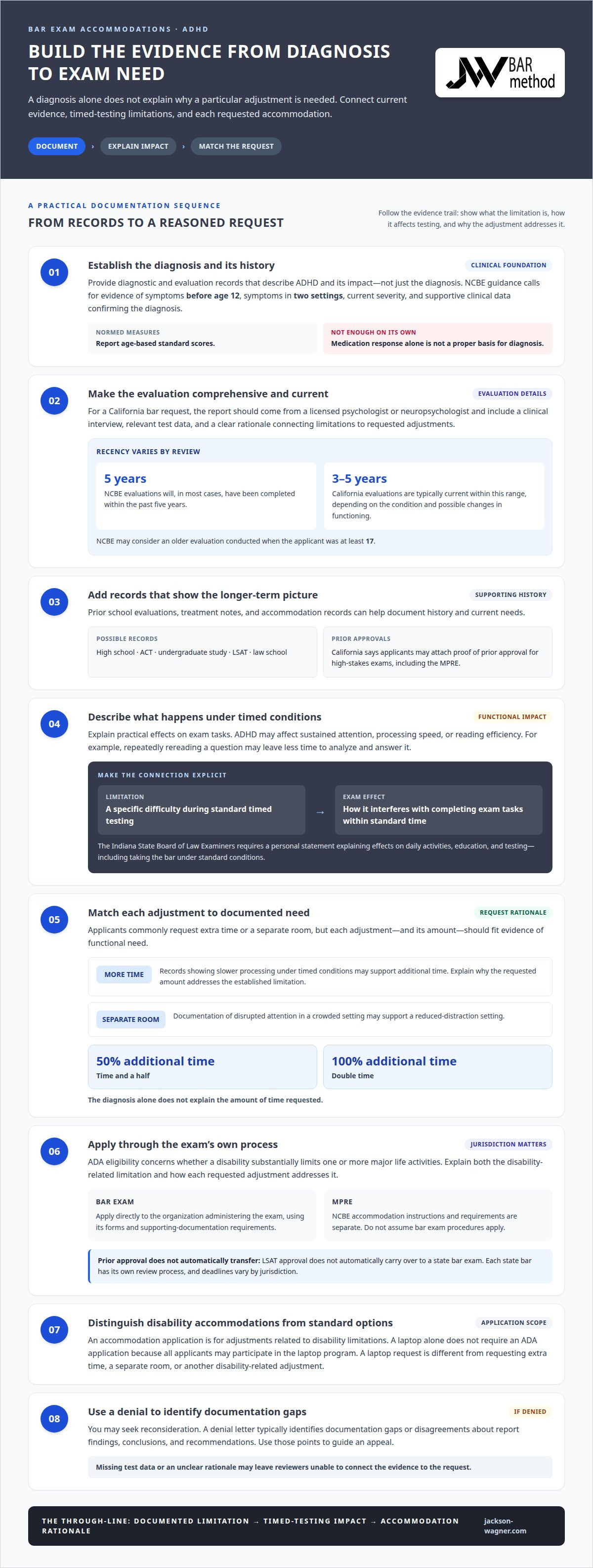
Diagnostic records are clinical evidence establishing ADHD and describing its impact on testing. For a California bar request, an evaluation from a licensed psychologist or neuropsychologist includes a clinical interview, relevant test data, and a rationale connecting limitations to requested adjustments. NCBE guidance calls for evidence of symptoms before age 12, symptoms in two settings, current severity, and supportive clinical data confirming the diagnosis. Normed measures should report age-based standard scores. Medication response alone isn’t a proper basis for diagnosis.
Evaluation Recency and Documentation Rejections
Evaluation recency describes how recently an assessment documents current functioning. NCBE says evaluations will in most cases have been completed within the past five years, though it may consider an older evaluation conducted when the applicant was at least 17. California evaluations are typically current within the past three to five years, depending on the condition and possible changes in functioning. Missing test data or an unclear rationale may leave reviewers unable to connect the evidence to the request.
If you’re figuring out how to get accommodations for ADHD for the bar exam, remember that deadlines vary by jurisdiction. The ABA directory outlines state processes, forms, deadlines, and related application information. The MPRE has separate NCBE accommodation instructions and requirements, so don’t assume that bar exam approval procedures apply.
Prior school evaluations, treatment notes, and records of accommodations from high school, the ACT, undergraduate study, the LSAT, or law school can help document your history. The State Bar of California says applicants may attach proof of prior approval for high-stakes exams, including the MPRE.
If your request is denied, you may seek reconsideration. A denial letter typically identifies documentation gaps or disagreements about report findings, conclusions, and recommendations. Use those points to guide an appeal.
ADHD-related functional impairment under timed testing conditions
Your accommodation request should show how ADHD affects your exam performance under standard conditions. Link each specific limitation to the adjustment you’re requesting.
Functional Impairment During Timed Testing
Functional impairment is a documented limitation affecting a major activity, such as reading or concentrating. During a timed bar exam, ADHD may affect sustained attention, processing speed, or reading efficiency. Explain the practical impact: for example, repeatedly rereading a question may leave less time to analyze and answer it. Your records should connect your history to these testing limitations rather than rely on a diagnosis alone.
The Indiana State Board of Law Examiners requires a personal statement explaining how the disability affects daily activities, education, and testing, including taking the bar under standard conditions. Describe specific effects and explain how they interfere with completing exam tasks within the standard time.
Extended Time and Reduced Distractions
Extended time provides additional testing minutes to address a documented limitation, while a reduced-distraction setting limits competing stimuli. Applicants with ADHD commonly request extra time or a separate room, but each request should match evidence of functional need. For example, records showing slower processing under timed conditions may support a request for additional time. Documentation of disrupted attention in a crowded setting may support a request for a separate room.
Some testing accommodations provide time and a half, meaning 50% additional time, or double time, meaning 100% additional time. The documentation should explain why the requested amount addresses established limitations; the diagnosis alone does not explain the amount.
ADA Eligibility and Testing Accommodations
ADA eligibility concerns whether a disability substantially limits one or more major life activities. The ADA provides a framework for reasonable testing accommodations, but applicants must establish both disability-related limitations and a connection to the requested adjustments. Prior approval for the LSAT does not automatically transfer to a state bar exam, because each state bar has its own review process.
Apply directly to the organization administering your bar exam, using its accommodation forms and supporting documentation. Identify each adjustment you’re requesting and explain how it addresses a specific limitation under standard testing conditions. This connection helps reviewers assess whether the request fits your documented exam-related needs.
Who Should NOT Complete an Application for Testing Accommodations?
A testing-accommodations application requests adjustments for disability-related limitations, not standard exam options. If you only need to use a laptop, you don’t need an ADA application because all applicants may participate in the laptop program. A laptop request alone is different from asking for extra time, a separate room, or another disability-related adjustment.
A neuropsychological evaluation is a structured assessment of cognitive functioning, learning, and related areas. For California bar accommodations, the evaluation report must come from a licensed psychologist or neuropsychologist and connect the diagnosis to the requested adjustment. A useful report combines clinical interview findings with relevant test data and a clear rationale.
Standardized testing provides objective measures that help describe your functioning, but scores need clinical context. The Indiana State Board of Law Examiners requires applicants with ADHD to provide a comprehensive psycho-educational or neuropsychological assessment. The Florida Board of Bar Examiners states that psychological testing and self-report checklists cannot be the sole indicator of an ADHD diagnosis, separate from history and interview. Test results should support, not replace, the diagnostic record.
An adult ADHD evaluation assesses whether current symptoms meet diagnostic criteria and affect functioning. It should address your history, current clinical presentation, and relevant learning or testing records. A prior school diagnosis or medication history can inform the assessment, but medication response alone is not a proper basis for diagnosing ADHD.
Before applying, distinguish the adjustment you need from options available to every examinee. If you need disability-related testing changes, follow your jurisdiction’s application process and provide an evaluation that supports your requests. If you only need laptop use, an ADA application is unnecessary. If ADHD-related limitations call for another adjustment, your supporting documentation must address that need.
ADA disability eligibility and bar exam accommodations
ADA disability eligibility means showing that an impairment substantially limits one or more major life activities. For applicants with ADHD, a diagnosis matters, but the diagnosis alone doesn’t establish eligibility. The central question is how the condition affects abilities such as concentrating, reading, learning, or thinking in the exam setting. Your evidence should make that connection clear.
The Americans with Disabilities Act Amendments Act was enacted in 2008. Under the ADAAA framework, eligibility focuses on the impairment’s effect on major life activities, rather than treating a diagnostic label as sufficient proof. An applicant’s evaluation and personal history can explain how ADHD affects examination tasks. For example, documented limits in sustained attention may affect the ability to work through timed questions.
Evidence from a qualified professional should support both your disability-related limitations and the accommodations you’re requesting. The report should connect these points: if attention or processing limitations interfere with completing exam tasks under standard conditions, explain how a specific adjustment addresses that effect. Without this link, reviewers may be unable to assess whether the accommodation fits your documented needs.
Request accommodations through the bar examination organization for your jurisdiction. The ADA provides a framework for reasonable testing accommodations, but each state bar has its own review process. Prior LSAT approval does not automatically carry over to a state bar exam. Your evidence must address the bar exam and your current functional limitations.
Title III of the ADA covers examinations and courses. That makes disability-related access relevant to professional testing, while the review still turns on documented impact and the requested adjustment. Mental health information should be distinguished from functional evidence: the diagnosis identifies the condition, while the evaluation explains its effect on exam participation. For structured California Bar study alongside this process, explore California Bar exam preparation.
Jackson-Wagner
Jackson-Wagner LLC supports bar candidates nationwide with structured preparation through the JW Bar Method, helping you focus on exam readiness alongside your accommodation application process. Its comprehensive courses cover multi-state exams, the Uniform Bar Exam, and state-specific pathways with standard and accelerated preparation tracks. Choose the track that fits your exam timeline, no matter your jurisdiction.
Bar exam preparation and an accommodation request serve different purposes. Your jurisdiction reviews your application and supporting evidence; focused study helps you prepare for the exam itself. If you are preparing for your upcoming licensing exam, explore Jackson-Wagner LLC’s online courses designed to guide you through every step of your study journey.
Keep Your Accommodation Plan Moving
A practical part of learning how to get accommodations for ADHD for the bar exam is keeping your application and exam preparation on separate tracks. The bar authority reviews accommodation requests, while a focused study plan helps you prepare for the exam. As you organize both, choose California Bar preparation that matches your exam pathway and timeline.
Jackson-Wagner offers JW Bar Method Prep - Full Exam California Bar, JW Bar Method Prep - Attorney’s Exam California Bar, and JW Bar Method Accelerated Prep - Full California Bar Exam. These fully online programs help candidates prepare for the California Bar while they manage their accommodation applications separately.
If you’re planning your California Bar studies alongside an accommodation request, contact Jackson-Wagner about California Bar preparation. Take the next step with a study plan that fits your exam path.
Frequently Asked Questions
How do I apply for ADHD testing accommodations on the bar exam?
Apply through the bar admission authority administering your exam, using its accommodation application and forms. Identify the correct jurisdiction, complete the required sections, and submit your supporting evaluation and records by the deadline. For a UBE administration, follow that jurisdiction’s process; don’t assume approval for another exam carries over. Keep copies of your application and supporting documents so you can refer to what you submitted if questions arise.
What ADHD accommodations are available on the UBE and state bar exams?
Depending on your documented limitations and the jurisdiction’s process, you may request additional testing time or a separate room. Some application forms offer different amounts of extra time, while others use distinct procedures. For a UBE or state exam, use the relevant authority’s forms to identify available request options. Explain how each adjustment addresses a specific barrier, such as difficulty sustaining attention in a shared testing environment.
What documentation is required for bar exam accommodations for ADHD?
Applications generally require a current evaluation with diagnostic findings, relevant objective test data, and an explanation of the requested accommodations. Supporting materials should come from a qualified professional and be typed in English, dated, signed, and on letterhead. School evaluations, treatment notes, and records of earlier academic or exam accommodations can add useful context. Submit these as supporting evidence, not as substitutes for a current evaluation.
Can I request extra time, breaks, a separate room, or medication accommodations for ADHD?
You can request adjustments such as extra time or a separate room from the examining authority, explaining the specific testing barrier each would address. Use the jurisdiction’s application to determine how to present requests for breaks or medication-related arrangements. Medication response alone isn’t a proper basis for an ADHD diagnosis. Explain each requested adjustment through documented exam-related limitations, rather than relying only on medication use.
What are common reasons bar exam accommodation requests for ADHD are denied?
Outdated evaluations, missing objective data, or reports that don’t explain how ADHD affects exam performance can weaken a request. Self-report alone or medication response alone may not establish a diagnosis. A request may also lack a clear link between documented limitations and each adjustment. If denied, review the decision letter for documentation gaps or disagreements that can guide a reconsideration request.
What deadlines apply for requesting bar exam accommodations in each state?
Deadlines vary by state. The article recommends applying 6-12 months before the exam; the ABA directory provides each state’s specific deadlines and application information.


