

California’s provisional licensure rules were shaped by a temporary supervised-practice program, not a general exemption from bar admission. Under California Rule of Court 9.49, eligible graduates could provide legal services under direct supervision; the rule took effect November 17, 2020.
The word “exception” can be misleading: eligibility depended on defined conditions, while an expanded pathway offered a limited route for additional candidates. To understand whether the program waived a requirement or whether its history affects bar admission, separate that temporary program from ordinary licensing requirements.
This article explains what provisional licensure meant in California, how supervised practice worked, which eligibility exceptions applied, and what restrictions governed licensees. It also covers the program’s background and clarifies how provisional practice relates to California Bar Exam preparation.
Key Takeaways
- Distinguish California’s temporary supervised-practice program from the state’s ordinary path to bar admission.
- Understand how the program’s history shaped its limited eligibility pathways and what “exceptions” meant in practice.
- Identify the supervision and conduct requirements that governed provisional legal work.
- Learn which consequences could follow violations and how California Bar Exam preparation fits into your next steps.
What Is a Provisional License in California?
California uses “provisional” for distinct licensing pathways, including teen driving and supervised legal practice. The rules depend on the type of license.
Provisional License Definition and Duration
A provisional license is a restricted or supervised license issued before a person qualifies for unrestricted status. For drivers under 18, California requires a permit held for at least six months before applying for a provisional driver license. Driving restrictions generally apply during the first 12 months after issuance.
The separate legal provisional licensure program allowed eligible graduates to provide legal services under supervision. It was temporary, with a scheduled conclusion of June 1, 2022, unless extended. These programs have different durations and purposes, so the permit’s six-month holding period does not define the legal program’s term.
Differences from Regular or Temporary Licenses
A provisional license differs from a regular license because it carries conditions that limit driving or legal practice. A temporary license describes a time-limited status; “provisional” identifies a particular restricted pathway in these California examples.
Drivers under 18 face provisional restrictions; drivers 18 and over don’t face those additional restrictions. In legal practice, provisional licensees could perform lawyer activities under a supervising lawyer’s guidance, subject to program restrictions. The applicable rules vary by licensing area: the DMV governs teen driving, while California’s court rules governed the legal program.
Eligibility and Application Requirements
Eligibility and application steps depend on the license type. A teen driver may apply from age 15½, after meeting permit requirements. The DMV application requires driver education or training forms, identified as DL 356 or OL 237 and OL 238, and a parent or guardian must sign the application.
The legal program had separate eligibility criteria and application procedures. Its expanded pathway included candidates who scored 1390 or higher on a California Bar Exam administered from July 2015 through February 2020, according to the State Bar of California. Applicants were charged an application fee of $75 or $50.
Permitted Work and Supervision Restrictions
A legal provisional licensee could perform lawyer activities under the guidance of a qualifying supervising lawyer, subject to restrictions. These activities included court appearances, drafting legal documents, negotiating settlements, and providing legal advice.
Supervisors had to meet program requirements, including four years of law practice and two years holding an active California law license. Provisional licensees also had to identify their status in filings and to clients and courts. For official rules, consult California Rules of Court 9.49 and 9.49.1; driver permit forms are DMV forms.
California provisional licensure program background
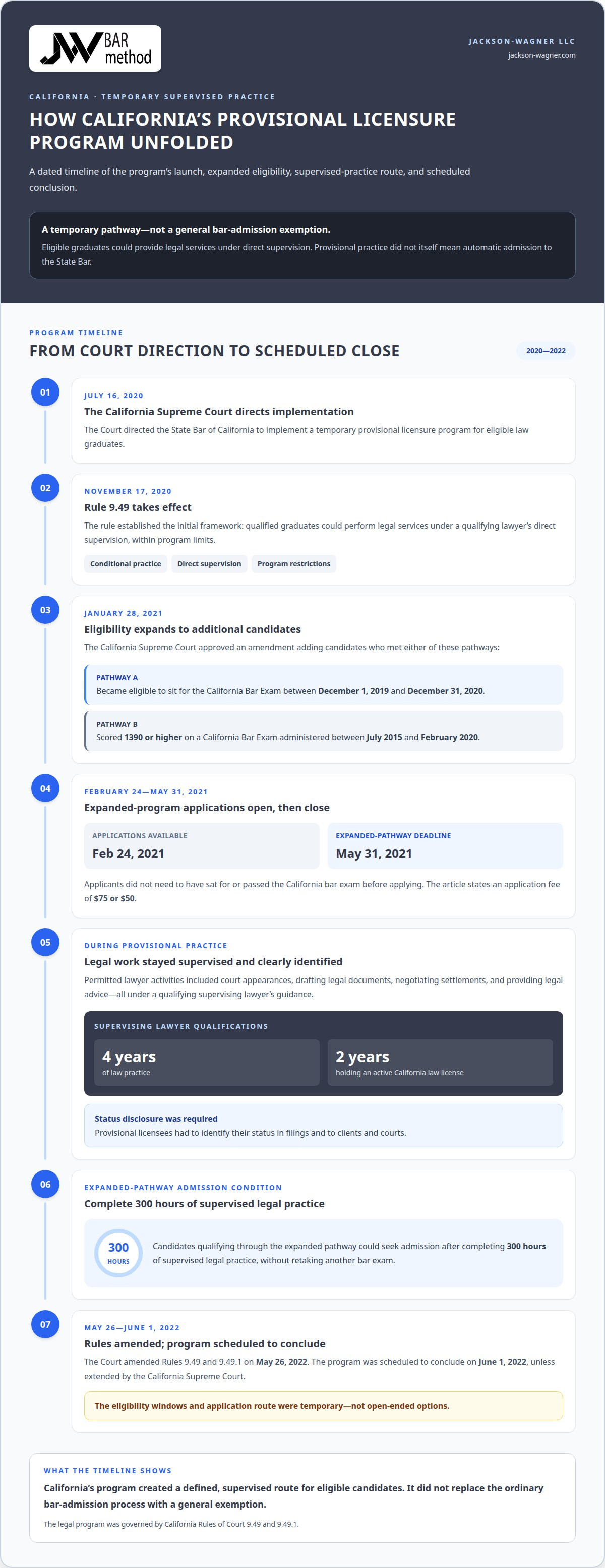
California’s provisional licensure program was a temporary pathway for eligible law graduates to provide legal services under a qualifying lawyer’s direct supervision. On July 16, 2020, the California Supreme Court directed the State Bar of California to implement the program. California Rule of Court 9.49 took effect on November 17, 2020, establishing the initial framework for supervised practice.
The program allowed conditional practice, not automatic admission to the State Bar. A provisional licensee could perform legal work under supervision, within boundaries set for both the work and the supervising lawyer’s role. This structure gave eligible candidates supervised legal-practice experience through a temporary licensing pathway.
The California Supreme Court approved an amendment expanding eligibility on January 28, 2021. The expanded program covered qualifying candidates who had become eligible to sit for the California bar exam from December 1, 2019, through December 31, 2020. It also included candidates who scored 1390 or higher on a California Bar Exam administered from July 2015 through February 2020, according to the State Bar of California.
Applications for newly qualifying candidates became available on February 24, 2021, and the expanded-program deadline was May 31, 2021. Applicants did not need to have sat for or passed the California bar exam before applying. Those qualifying through the expanded pathway could seek admission after completing 300 hours of supervised legal practice, without retaking another bar exam.
The program’s deadlines marked a defined, temporary opportunity rather than a permanent exception to California’s ordinary admission process. The program was scheduled to conclude on June 1, 2022, unless the California Supreme Court extended it. The Court amended Rules 9.49 and 9.49.1 on May 26, 2022. These dates explain why the program’s eligibility windows and application route should not be treated as open-ended options today.
Penalties for violating provisional license rules
Penalties depend on the type of provisional license. California’s rules for provisional drivers differ from consequences involving a residential care facility for the elderly, or RCFE. The temporary legal provisional licensure program was a separate pathway, so driver penalties should not be applied to provisional lawyers.
For a provisional driver, point violations can lead to license restrictions or suspension. Two or more point violations within 12 months may result in a 30-day license restriction. Three or more point violations within 12 months may result in a six-month suspension and one-year probation.
These thresholds matter because the consequences escalate with the number of point violations recorded during the same 12-month period. For example, two qualifying violations may trigger a restriction, while a third may place the driver within the higher threshold for suspension and probation. The stated outcomes are possible penalties, not an automatic result in every case.
RCFE provisional-license consequences focus on residents’ health, safety, and welfare. If licensing officials identify deficiencies during the provisional period that threaten these interests, the Department may pursue administrative action, civil proceedings, or referrals for criminal prosecution. The response depends on the deficiencies and the threat identified.
An RCFE provisional license also has defined operating limits. It may cover only the number of residents for whom an immediate need is established or the facility’s established capacity, whichever is lower. The license is not renewable and ends on its stated expiration date or when the application is denied, whichever comes first. Compliance and the end date are therefore central to lawful operation.
To understand a specific consequence, identify the license type first, then match the conduct to its governing rule. A California driver’s point history, an RCFE’s safety deficiencies, and a lawyer’s supervised-practice obligations fall under separate regulatory frameworks. The penalty details here concern driver and RCFE licensing; they do not establish a penalty schedule for provisional legal licensees.
What are California's provisional license eligibility requirements?
Eligibility depends on whether you mean a provisional driver license or the temporary legal-practice program. These pathways had different criteria, application steps, and supervision conditions.
For teen drivers, a provisional license is available to applicants under 18 who are at least 15½ years old. They must first hold an instruction permit for six months and document 50 hours of driving practice, including 10 hours at night. Applicants also needed required driver education or training forms, identified as DL 356 or OL 237 and OL 238.
The legal program had separate eligibility rules for law graduates. Under the rules on provisional licensure in California, applicants could apply without first sitting for or passing the California Bar Exam. They needed a work or volunteer placement with a firm that had a California office, or a conditional offer for such a placement. Candidates could apply before receiving a positive moral character determination if they had submitted a complete application and received no adverse determination.
For the expanded pathway, qualifying candidates had to score 1390 or higher on a California Bar Exam administered from July 2015 through February 2020. Eligibility also covered people who became eligible to sit for the state bar exam from December 1, 2019, through December 31, 2020. Applicants who had not passed the MPRE had to attest they would complete New Attorney Training’s legal ethics components within the first 30 days of provisional licensure.
Supervision was another eligibility condition. A supervisor needed at least four years of law practice and an active California law license held for at least two years. The supervisor also had to be an active State Bar licensee in good standing and meet the program’s requirements. These rules on provisional licensure in California applied to a temporary program, not an open application route today.
Candidates preparing for standard admission can build exam readiness with California Bar Exam preparation.
Jackson-Wagner
Jackson-Wagner helps California Bar Exam candidates prepare for the exam, a practical next step for those pursuing standard admission rather than relying on the temporary provisional program. Its JW Bar Method courses prepare candidates for both the full California Bar Exam and the Attorney’s Exam, with standard and accelerated options.
Choose a full-exam course if you’re preparing for the complete exam, or an Attorney’s Exam course if that is your examination path. Preparation supports exam readiness; it does not provide legal representation or determine licensure eligibility. To plan your next step toward California bar admission, explore Jackson-Wagner’s preparation courses.
Choose Your Next Step Toward California Bar Admission
Understanding the rules on provisional licensure in California is a starting point, not a study plan. Use what you’ve learned to identify your admission path and decide how to prepare for its requirements. These rules describe a distinct pathway, while bar exam preparation supports a separate goal: readiness for the exam.
Jackson-Wagner offers preparation options for candidates taking the full California Bar Exam or the Attorney’s Exam, including standard and accelerated tracks. Choose the course that matches your exam path and build a focused study routine around it.
For help considering your preparation options, contact Jackson-Wagner. Take your next step with a clear plan and keep moving forward with confidence.
Frequently Asked Questions
What does provisional licensure mean in California, and which professions offer it?
California uses provisional status in distinct contexts, including supervised legal practice, teen driving, and residential care facility licensing. It is not a single profession-wide license. The legal pathway applied to eligible law graduates, while an RCFE provisional license applies to a residential care facility, not an individual professional. Identify the license category and issuing authority first: driver, lawyer, and facility licensing follow different rules.
How long does a California provisional license last, and can it be renewed?
There’s no single duration across California’s provisional licenses. For teen drivers, additional restrictions apply during the first 12 months after issuance; that period describes restrictions, not the license’s full validity. An RCFE provisional license may last up to six months, or twelve months when qualifying circumstances beyond the applicant’s control delay compliance. It isn’t renewable. The legal program was scheduled to conclude June 1, 2022, unless extended by the California Supreme Court.
What are the risks and penalties for practicing outside provisional license rules in California?
A provisional legal licensee’s authority depended on supervised practice and clear identification of provisional status in filings and communications with clients and courts. Acting outside those boundaries risks violating the conditions of that status. Driver-license penalties are separate: point violations can lead to restrictions or suspension. For an RCFE, deficiencies that threaten residents’ health, safety, or welfare can prompt administrative action, civil proceedings, or referrals for criminal prosecution.


