
With a punishing 30.8% pass rate for the February 2026 session, the California Bar Exam remains the most formidable hurdle in the legal profession. You've likely felt the weight of that statistic while staring at a mountain of generic "big box" prep materials that feel more like a burden than a blueprint. It's exhausting to juggle a full-time legal career while wondering if your bar review classes are actually teaching you what California graders want or just burying you in national noise.
You don't need more content. You need more precision. This guide will show you how to cut through the information overload by identifying bar review classes that prioritize California-specific essay and PT requirements over useless volume. We'll preview how a streamlined, accelerated approach to the 2026 exam can replace high-pressure anxiety with a structured, reliable path to success. By the end, you'll have a clear ROI on your study time and the confidence to master the hardest exam in the country.
Key Takeaways
- Understand why legacy volume-heavy courses often fail in California and why precision is the new standard for the 2026 exam cycle.
- Learn how to evaluate bar review classes to ensure they offer a 100% California-focused curriculum rather than a repurposed national template.
- Discover how the JW Bar Method compresses traditional 10-week schedules into high-impact tracks designed for busy legal professionals.
- Identify the strategic differences in the Attorney’s Exam track that prevent seasoned lawyers from over-studying the wrong material.
- Shift your focus from standard "repeat" policies to a binary performance guarantee that prioritizes your actual success on exam day.
The Evolution of Bar Review Classes: Why Volume No Longer Guarantees Success
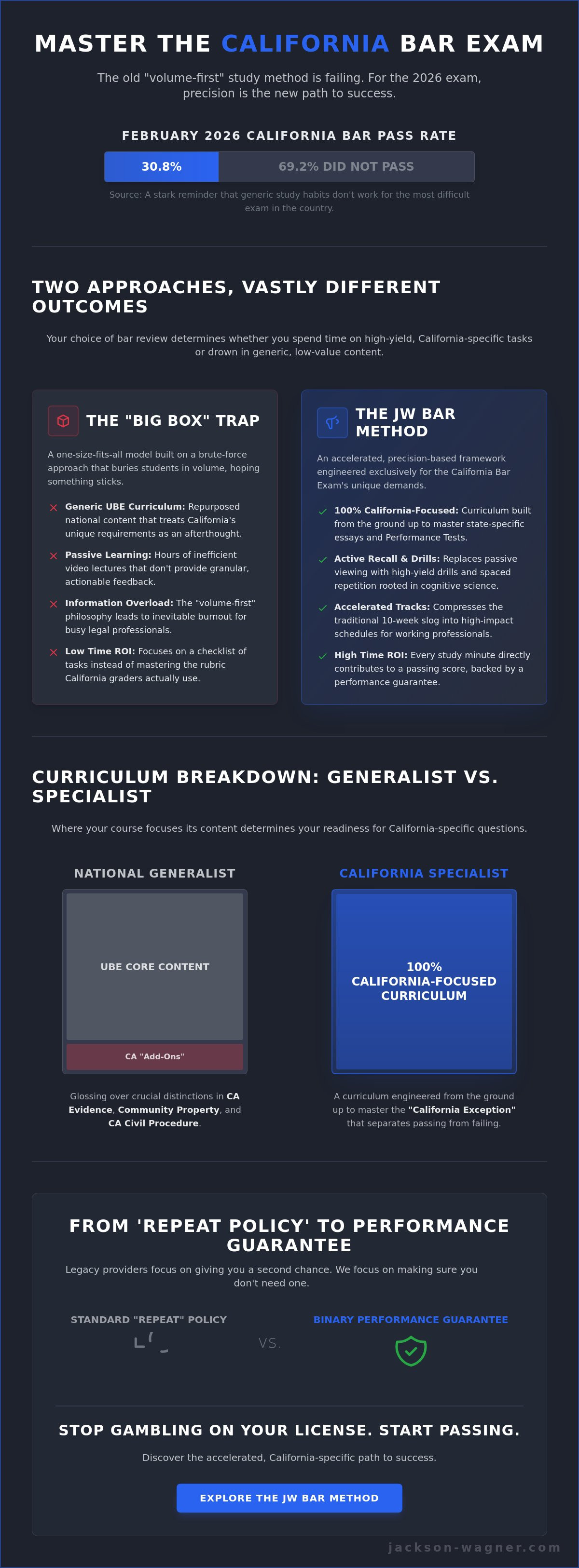
For decades, the standard bar examination prep model relied on a brute-force approach. Legacy providers assumed that if they buried students under enough outlines and lectures, some of that information would eventually stick. This "volume-first" philosophy is the primary reason many candidates fall into the pass rate trap. National providers often advertise success rates exceeding 90%, but these figures usually aggregate data from easier Uniform Bar Exam (UBE) jurisdictions. In California, the reality is much harsher. The February 2026 pass rate of 30.8% serves as a stark reminder that generic study habits don't work for the most difficult exam in the country.
Success in the 2026 landscape favors precision over rote memorization. You don't need to know everything about 15 different legal subjects; you need to know exactly how to apply the specific rules that California graders prioritize. Traditional bar review classes often ignore this, leading to massive information overload. This isn't just a logistical problem; it's a psychological one. When you're forced to balance a full-time legal career with a curriculum designed for someone with zero obligations, burnout is inevitable. You must transition from simply "learning the law" to mastering the California-specific rubric that determines your score.
The Problem with Big-Box Bar Prep
Most big-box providers offer a "one-size-fits-all" curriculum that's essentially a modified UBE course. This approach fails California candidates because it treats the state's unique essay and Performance Test (PT) requirements as an afterthought. Sitting through four-hour lectures is an inefficient use of time in a digital-first world. These passive learning models don't provide the granular feedback necessary to fix subtle writing weaknesses. Without California-specific precision, you're just practicing how to fail with more confidence.
The Shift Toward Pedagogical Precision
Modern professional licensure requires a sophisticated, pedagogical approach. Precision-based learning replaces passive video consumption with active recall and high-yield drills. It focuses on the subjects and sub-topics most likely to appear on the 2026 exam. A high-quality bar review course must include a curriculum built from the ground up for California, rather than a national template with a few local add-ons. It's about working smarter, not longer, to ensure a clear ROI on your limited study hours.
By moving away from legacy industry standards, you can find a more agile and results-driven path. The goal isn't to finish a checklist of 2,000 tasks. It's to ensure that every minute you spend studying directly contributes to a passing score on the 2026 California Bar Exam.
Introducing the JW Bar Method: A Disruptive Approach to Professional Licensure
Most bar review classes are built on legacy models that prioritize hours spent over points earned. They operate on the assumption that more is always better, leading to a curriculum that is bloated and inefficient. The JW Bar Method is an accelerated, result-oriented framework specifically engineered for California licensure. We don't believe in the traditional 10-week slog that burns out candidates before they even reach the testing center. Instead, we've developed a proprietary system designed exclusively for the unique demands of the California State Bar, ensuring that every minute of your study time translates into measurable performance gains.
Mastering the "California Exception" is what separates those who pass from those who fall into the repeat taker category. The official California Bar Examination requires a level of state-specific precision that national generalists simply don't provide. While other courses gloss over the nuances of California Evidence or Community Property to save time for their UBE students, we lean into them. This focus on precision allows us to compress the standard study schedule into a high-impact track that fits the lives of busy legal professionals.
The Science of the JW Method
Our methodology is rooted in cognitive science rather than tradition. We utilize spaced repetition specifically for high-weight subjects like California Civil Procedure and Evidence. This ensures that the most complex rules are moved from your short-term memory to long-term retention. We also implement "High-Stakes Drills" that simulate the pressure of exam day. These drills build the necessary muscle memory to execute perfect IRAC structures under strict time constraints. It's why our approach is the preferred choice for working professionals who can't afford to waste a single hour on passive learning.
Efficiency vs. Exhaustion
The secret to passing the hardest exam in the country isn't studying everything; it's studying the right things. We've analyzed decades of past exams to eliminate the 40% of material that is statistically unlikely to appear. This allows you to master the Performance Test (PT) without the time-consuming methods taught by big-box providers. By focusing on the high-yield rubrics that graders actually use, you can achieve a higher score with less total study time. If you're tired of the "volume-first" approach, you can see why we are considered the Best Bar Prep Service 2026. If you're ready to secure your future with a more tactical approach, consider how our California-specific prep tracks can streamline your path to success.
California Specialist vs. UBE Generalist: Why Your Choice of Provider Matters
The recent withdrawal of legacy national providers from the California-specific prep market signals a critical shift in how candidates must approach their 2026 studies. When major industry giants stop offering specialized instruction, it highlights the immense difficulty of maintaining a curriculum that meets the State Bar's exacting standards. Choosing bar review classes designed for a national audience is no longer just a risk; it's a strategic error. California requires approximately 30% more state-specific study than Uniform Bar Exam (UBE) jurisdictions. Relying on a generalist provider means you're effectively ignoring nearly a third of the required precision needed to pass.
Generic MBE tools often leave you vulnerable during the grueling essay portion of the exam. While national providers excel at broad multiple-choice drills, they often fail to capture the specific "flavor" of California's grading rubric. The danger is compounded when using "national" graders who lack deep expertise in local preferences. Graders who aren't immersed in the California Bar Examination Information and recent testing trends won't provide the surgical feedback required to turn a 60-score essay into a 75. You need a partner who understands the local landscape, not a generalist who treats California as just another jurisdiction.
The California Advantage
Expertise in California Community Property and Professional Responsibility isn't optional. National test-prep AI is typically trained on UBE data, creating a dangerous mismatch when applied to California's distinct legal landscape. Specialist providers adapt much faster to policy changes and scoring shifts within the State Bar of California. This agility ensures your materials are always aligned with the most current standards rather than being a year behind. We prioritize the nuances that national providers miss, ensuring your effort is never wasted on low-yield topics.
Navigating the 2026 Exam Requirements
The 2026 format demands a focused strategy that accounts for the state's unique scoring weights. If you're a seasoned lawyer, your review class must prioritize the "Attorney Exam" track to avoid wasting time on the MBE. You need to know How to Navigate the State Bar of California to ensure your path to licensure is as direct as possible. We provide the specialized support required for both first-time takers and experienced attorneys, replacing high-stakes anxiety with a structured, modern, and reliable path to success.
How to Evaluate Bar Review Classes for the 2026 Season
Selecting the right partner for your 2026 attempt requires looking past glossy brochures and celebrity lecturers. Most bar review classes are designed to maximize the provider's profit margins by reusing generic content across dozens of jurisdictions. To pass in California, you must verify that the curriculum was built from the ground up for this specific jurisdiction. A modified national course is often just a UBE program with a "California" sticker on the cover. You should also scrutinize the quality of feedback you'll receive. Ask if your essays will be graded by experts who understand the nuances of the State Bar or by law students following a generic key.
The "Guarantee" Check is perhaps the most revealing metric of a provider's efficacy. Most legacy providers offer a simple repeat guarantee. This is a low-stakes promise; if you fail, they simply give you the same ineffective materials for free. A binary performance guarantee is different. It signals that the provider is so confident in their methodology that they're willing to share the financial risk of your outcome. This level of accountability is what separates modern, results-driven programs from the outdated industry standard.
The 5-Point Selection Checklist
- California-Specific Precision: Ensure the course prioritizes state-specific rules over generic common law summaries that don't apply here.
- Accelerated Study Windows: Look for tracks that offer 30, 60, or 90-day options to accommodate your professional and personal schedule.
- Expert Feedback: Verify that essay grading is handled by specialists who understand exactly what California graders are looking for.
- Direct Instructor Access: Avoid "automated help desks" in favor of direct communication with the mentors who designed your curriculum.
- Active Learning Focus: Prioritize high-stakes drills and active recall over passive video consumption and long lectures.
Red Flags in Bar Prep Marketing
Beware of providers boasting "nationwide" pass rates. These figures often hide lower performance in California by averaging in scores from much easier states. Another major red flag is a focus on "hours watched" as a metric of success. Watching 100 hours of video doesn't earn points; writing passing essays does. Finally, don't let "free MPRE prep" sway your decision. It's often a marketing distraction designed to lock you into a sub-par Bar Exam course months before you're ready to commit. Focus on the core curriculum that will actually determine your future.
Your study time is a finite resource with a clear financial value. If you're ready to move beyond the lectures and start a precision-based program, explore how JW Bar Method Prep can transform your study experience into a reliable path to licensure.
Strategic Success: The JW Path for California Attorneys and Grads
Passing the California Bar shouldn't require you to pause your life or abandon your law practice. Many bar review classes are built for students who have 40 or 50 hours a week to spare, but that's not the reality for practicing attorneys or high-achieving graduates with professional commitments. The JW Bar Method Accelerated Prep is specifically engineered for efficiency. It allows you to maintain a full-time practice while preparing for the most rigorous exam in the country. We replace the standard, exhausting 10-week grind with a high-impact track that focuses on point acquisition rather than time spent watching videos.
Seasoned lawyers often fail the California Bar because they over-study the wrong things. They get bogged down in national MBE subjects that don't even appear on the one-day exam, wasting hundreds of hours on low-yield material. Our approach is different. We provide a surgical focus on the California-specific rubrics that graders actually use. By prioritizing the "Attorney’s Exam" track, you can bypass the noise and focus entirely on the essays and Performance Tests that will determine your licensure. It's about working with a partner who understands that your time has a clear financial value.
Tailored for the Attorney’s Exam
The one-day Attorney’s Exam requires a completely different pedagogical approach than the full two-day test. Without the "MBE crutch" to balance your score, your essay precision must be flawless from the first paragraph. We help you master the essay portion by focusing on the specific rules and exceptions that the State Bar of California prioritizes. JW Method students often achieve licensure in half the traditional study time because we've eliminated the 40% of material that's statistically unlikely to appear. This streamlined path ensures you're prepared for the 2026 requirements without the burnout associated with legacy providers.
Commitment to Your Results
We believe in a concept called "bold reliability." This is why we lead with a binary performance guarantee. We assume the financial risk of your outcome because we're certain our methodology works for the modern learner. Unlike competitors who offer a simple repeat of the same failed materials, we're invested in your actual success from day one. You can find more details on how to optimize your approach in our definitive strategic guide to passing the California Bar in 2026. We provide the structured, modern, and reliable path you need to replace high-stakes anxiety with professional empowerment.
Securing your spot in the 2026 JW Bar Method cohort is the first step toward a more tactical study experience. Whether you need the JW Bar Method Prep - Full Exam or the specialized JW Bar Method Prep - Attorney’s Exam track, we provide the tools to ensure you don't just study, but succeed. Don't settle for a legacy model that treats you like a generalist. Choose the specialist path that respects your time and guarantees your results. Explore our accelerated prep options today to secure your future in the California legal market.
Secure Your California Licensure with Precision
The 2026 California Bar Exam doesn't reward those who study the most; it rewards those who study with the most precision. As you evaluate your options, remember that generalist providers often sacrifice the state-specific depth required to conquer the hardest exam in the country. By choosing bar review classes that prioritize an exclusively California-focused pedagogy, you eliminate the noise and focus on the rubrics that actually result in a passing score.
We've built a system that respects your professional time through accelerated tracks designed for working attorneys and graduates. Our methodology is backed by a proprietary binary performance guarantee, ensuring that we share the financial risk of your success. This is "bold reliability" in action. You have the talent and the drive; now you just need the right framework to execute with total confidence. It's time to replace high-stakes anxiety with a structured, modern, and reliable path to success.
Master the California Bar with the JW Bar Method and take the final step toward your professional goals. Your future as a California attorney starts with a smarter strategy.
Frequently Asked Questions
Are bar review classes worth it for the California Bar?
Professional guidance is essential for navigating an exam where the majority of applicants fail each cycle. Attempting to self-study for the most difficult licensing exam in the country often leads to a lack of focus on state-specific rubrics and grading preferences. High-quality bar review classes provide the pedagogical structure and expert feedback necessary to master California's unique scoring requirements and complex essay formats.
How much do California bar review courses typically cost in 2026?
Market prices for 2026 bar prep fluctuate based on the provider's scope and specialized focus. Traditional legacy courses are often priced between $2,000 and $5,000, while specialized or digital-first tracks may offer different entry points. You should evaluate these costs against the potential loss of income associated with a six-month delay in licensure if you fail to pass on your first attempt.
Can I pass the California Bar Exam while working full-time?
You can pass while maintaining a full-time practice if you utilize a precision-based, high-yield study track. Traditional 10-week programs often demand a 40-hour weekly commitment, which is unsustainable for working professionals. Modern methodologies focus on point acquisition to compress the schedule without sacrificing the depth required for California-specific subjects like Community Property and Professional Responsibility.
What is the difference between a bar review course and a bar tutor?
A bar review course provides a comprehensive, structured curriculum and all necessary study materials, while a tutor typically offers individualized coaching on specific weaknesses. Many candidates find that specialized bar review classes that include expert essay grading offer the best of both worlds. This combination provides the pedagogical framework of a course with the surgical feedback usually associated with private tutoring.
Is the California Attorney’s Exam easier than the full Bar Exam?
The Attorney's Exam is shorter, but it isn't necessarily easier because it lacks the MBE "buffer." Without the multiple-choice section to balance your score, your performance on the five essays and the Performance Test must be exceptionally precise. Seasoned lawyers often struggle with this format because they underestimate the state-specific nuances required for a passing score on the one-day exam.
What happens if I fail the bar exam after taking a review class?
Most legacy providers offer a simple "free repeat" of their course, which essentially gives you the same materials that didn't work the first time. A more results-oriented approach involves a binary performance guarantee, where the provider assumes a level of financial risk for your outcome. This ensures the provider is incentivized to help you pass rather than just offering a recycled curriculum.
Do I need a separate course for the California Performance Test (PT)?
You don't need a separate course, but you must ensure your primary review class treats the PT as a priority rather than an afterthought. The PT accounts for a significant portion of your total score and requires specific time-management skills that differ from the essay section. A comprehensive California-focused program will integrate PT drills into the core curriculum from the start of your studies.
How early should I start my bar review classes for the July 2026 exam?
For the July 28 and 29, 2026 examination, most students begin their studies in mid-May. However, if you're using an accelerated track or have significant professional obligations, you can start as late as June if the program is sufficiently high-yield. The key is to secure your spot early to ensure you have all materials ready for the timely filing window which opens on March 1, 2026.


